
Virtual try-on (VTO) has been part of fashion’s digital vocabulary for more than a decade. It has promised fewer returns, greater confidence, and a more inclusive online shopping experience. And yet, despite several waves of investment and experimentation, it has never fully earned shoppers’ trust.
Throughout the 2010s, multiple large retailers and marketplaces launched virtual try-on pilots across e-commerce sites and social platforms. These initiatives often attracted significant attention during launch, but most remained limited pilots because accuracy, latency, and the cost of scaling the technology across thousands of SKUs proved difficult barriers to overcome – and because users simply didn’t buy in.
But that shopper hesitancy wasn’t, when you think about it, irrational. Early VTO tools often looked impressive in demos but struggled in real-world applications. They were expensive to deploy, slow to generate results, difficult to scale across full catalogues, and frequently produced visuals that felt artificial. This all undermined one of the central parts of the promise, introduced uncertainty into a process that was designed to instill confidence, and ran counter to the ROI expectations that the retailers themselves had.
Now, the industry is going back to the well, but with a different technology as the scaffolding: AI. For a further wave of brands and technology providers, this step change at the technology level seems as though it could address some or all of the concerns that prevented virtual try-on from achieving take-off.

But before we get into where that renewed drive is coming from, and before we can try to predict what variables are going to influence its success, fashion needs to make sure it understands why so many VTO pilots stalled in the past.
Why previous waves of VTO receded
The central tension in online apparel shopping is between convenience (value, variety, and shipping speed) and a predictable model for understanding size and fit, and managing and meeting expectations. For all the innovation that’s taken place in and around online checkout, and for all the channel expansion we’ve seen, that core tension has refused to budge.
In the United States alone, apparel return rates still average 20% to 30%, and ill-fitting garments are consistently cited as a primary reason for returns. Those returns cost retailers billions annually in reverse logistics, markdowns, and lost margins.
Virtual try-on was the wedge that online sellers wanted to use to reduce these returns, and to improve the rate at which potential buyers, looking at product detail pages, would convert to paying customers.
But the early waves of VTO systems provided, in practice, something closer to visualisation than anything approaching fit simulation. They borrowed some of the philosophy built into in-store changing rooms (giving consumers a polished, idealised look at themselves in clothing) but couldn’t approximate the experience of actually trying a physical product on. Fabric drape was often inaccurate, patterns got hallucinated, and body shapes wound up being subtly smoothed or idealised. As a result, shoppers saw something that looked like them but they didn’t see themselves.

That same cohort of first-wave VTO tools were also speed-limited. In some of the very earliest commercial VTO launches, image generation was “offline” in the sense that the result was assembled off-device, in non-real-time. In some extreme cases, it could take up to 24 hours to produce a result. That might work for marketing content or editorial shoots, but it clearly didn’t work for shopping, where immediacy is table stakes for consumers.
These tools got faster over time, of course, but the time gap never quite went away, and virtual try-on continued to feel like an ancillary part of the product discovery and buying process, rather than an integrated one.
Fashion also experimented with real-time 3D body projection mapping: systems that overlaid garments onto a live camera feed. This was the technology paradigm behind the wave of Snapchat Lenses and similar consumer-facing tools that placed 3D renders of garments, footwear, or accessories (having a 3D model was, of course, a prerequisite) onto users’ bodies in real-time. These experiences often looked futuristic and impressive in controlled demos (especially with footwear), but they again struggled with accuracy when soft fabrics were introduced; a real-time camera feed is not a fine-grained model of the body, and real-time fabric simulation is computationally expensive in a way that makes it prohibitive to do on-device. Additionally, resolution, lighting, and other variables can greatly affect the results, and optimising 3D models for real-time use required mesh and texture compression that actively worked against the objective of “trying on” anything close to a real garment.
These variables also heavily depended on active user participation at the moment of intent. Shoppers had to open their camera, stand in front of it, and purposefully engage in VTO in a way that could feel performative, and which consequently had to be done in a private or semi-private setting. In reality, much of fashion browsing happens during fragmented moments of the day, whether it is commuting, working between tasks, or late at night. Many consumers do not want to (or can’t) stand in front of a camera or feel fully “on” while shopping.
As well as the technology layer not measuring up in these previous attempted roll-outs, the interaction model also didn’t align with real shopping behavior. As a result, real-time projection mapping was only deployed in limited pilots through eCommerce storefronts, and through the previously-mentioned social media apps and similar dedicated tools – so they again felt like an offshoot of the buying journey.
Representation has also been a continued pain point for VTO, since the solutions available often fell short of brands’ standards and commitments to inclusivity and diversity. Early VTO tools were trained primarily on pre-existing e-commerce imagery, which was heavily indexed towards tall, thin, sample-size bodies photographed under studio conditions. When these systems generated try-on results, they often reproduced the same narrow visual standards, instead of reflecting the much more candid,raw, and inclusive style that most mass market brands now favour in their visual communications.

This challenge, in particular, also gives us a firm part of the blueprint for any attempt to build a next generation of VTO. We cannot “improve” bodies if we want to create a useful and memorable shopping experience that fulfills the KPIs that VTO is built upon. Accuracy, not aesthetic enhancement, is what builds confidence that what the shoppers see virtually is what they’re going to get physically.
Obviously it would have been better to have all these issues addressed upfront in previous pilots, but even those rough edges could, eventually, have been sanded away through iterative development, progressive roll-outs, and market competition. But VTO has, so far, not had that opportunity, because the cost and complexity of going beyond a limited pilot made it prohibitive to pursue better value over time, since the immediate value wasn’t apparent. As the saying goes, it’s hard to throw good money after bad.
As previously mentioned, many of the early virtual try-on experiences also required the existence of 3D representations of products, which had its own significant line-item cost. For companies that weren’t already authoring their products in 3D, the level of effort involved in retroactively doing that work made scaling across thousands of SKUs impractical and expensive. Retailers could showcase a limited capsule collection, but full-catalogue coverage remained out of reach.
Taken together, all these architectural and behavioural limitations prevented virtual try-on from seeing wide adoption except in specialist use cases such as uniforms and workwear. So are we any closer to solving them now?
Does AI meaningfully change the outlook for virtual try-on in fashion?
Over the past two years, advances in generative AI, automation, and infrastructure capable of supporting enterprise-scale deployment have prompted a lot of companies to take a fresh look at VTO, to see if any of the variables that undermined confidence in it have changed.
Earlier VTO pilots often relied on experimental systems built with early-stage startups. While these tools worked in demonstrations, they struggled when retailers attempted to deploy them across hundreds of thousands, or even millions, of SKUs. The gap between a demo and an enterprise-ready product proved far larger than many companies anticipated.
Creating digital representations of garments historically required a costly and manual process. At companies like Farfetch, scanning garments for VTO could cost hundreds of dollars per item once hardware, labour, and post-production were included. That made the technology viable only for a small, prioritised subset of catalogues, and primarily for hard goods such as shoes or accessories.

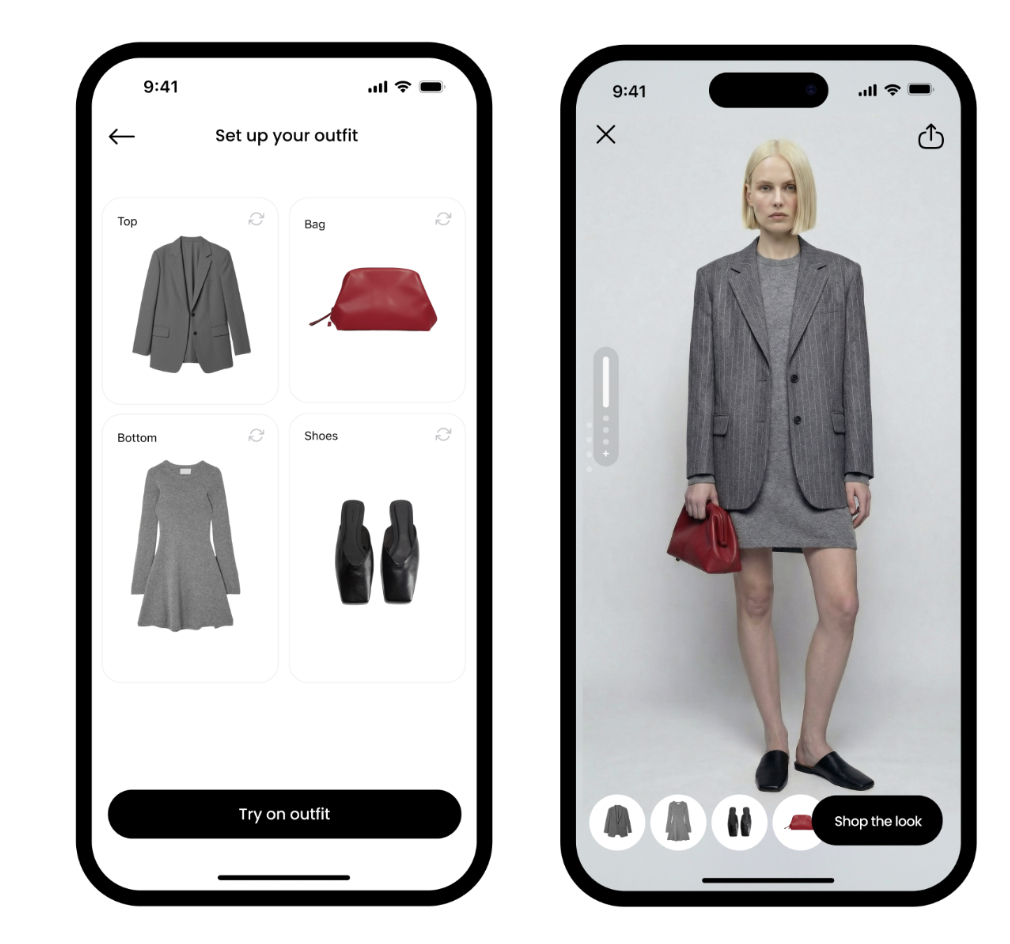
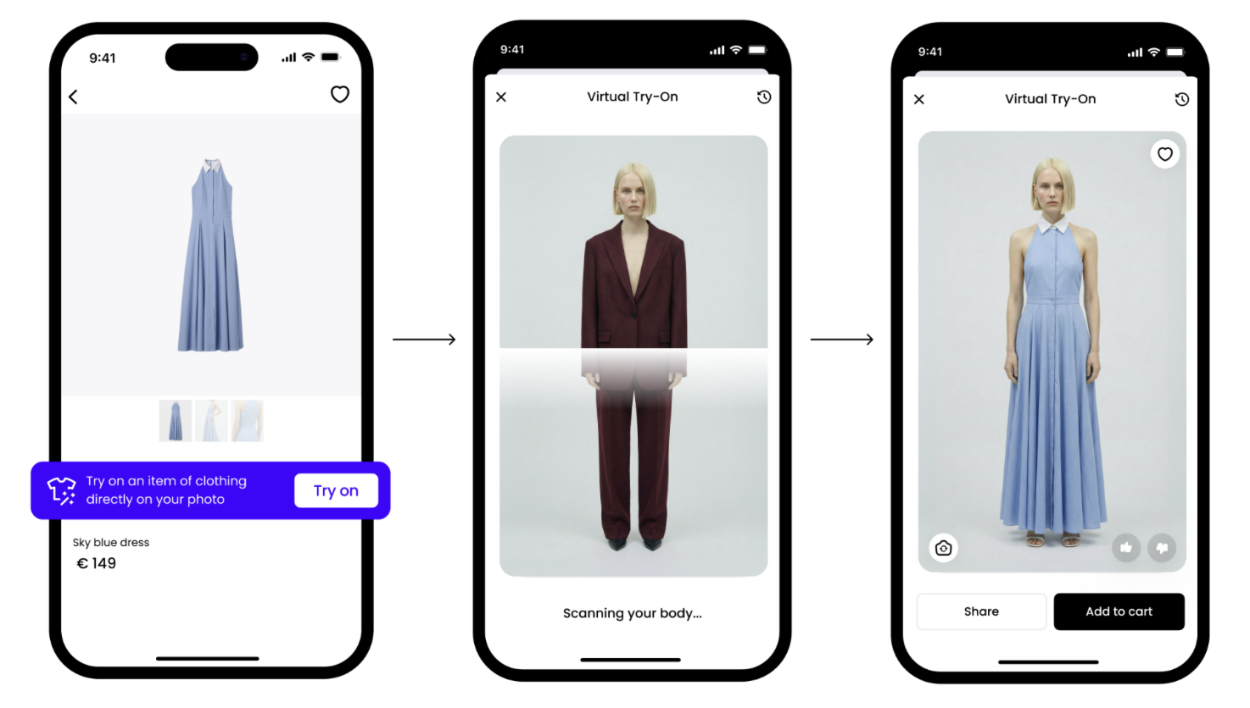
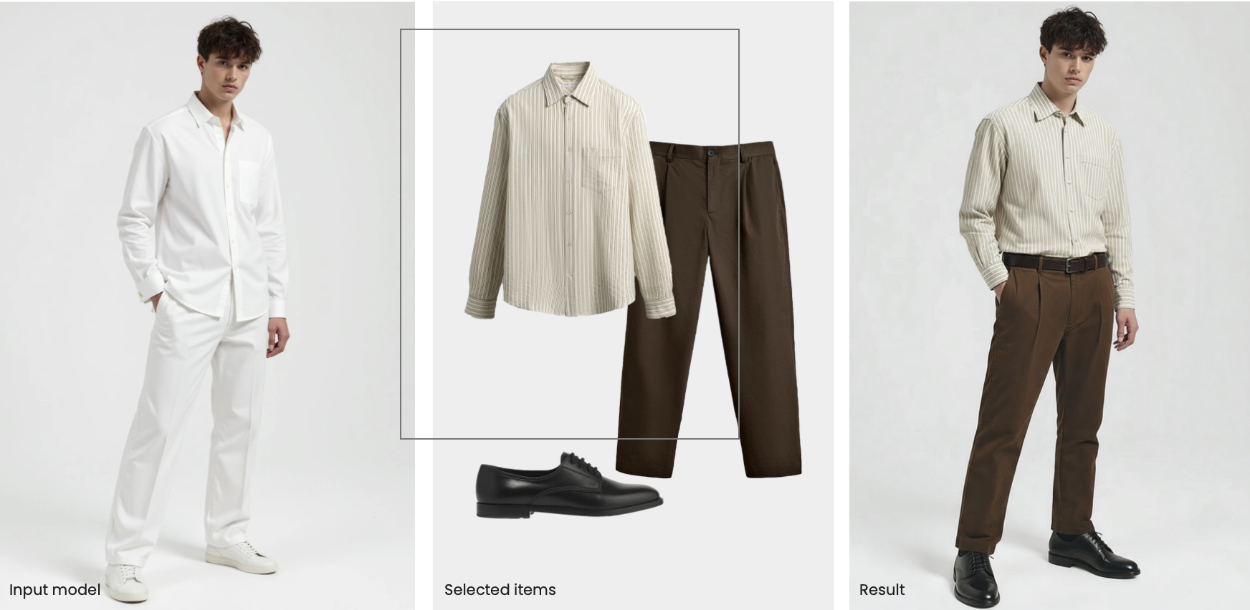
Generative AI has introduced a different approach. Instead of relying exclusively on handcrafted 3D assets, modern systems can use trained models to interpret standard product imagery and transform it into a realistic virtual try-on experience. This interpretive layer dramatically reduces the operational effort required to scale VTO across large catalogues.
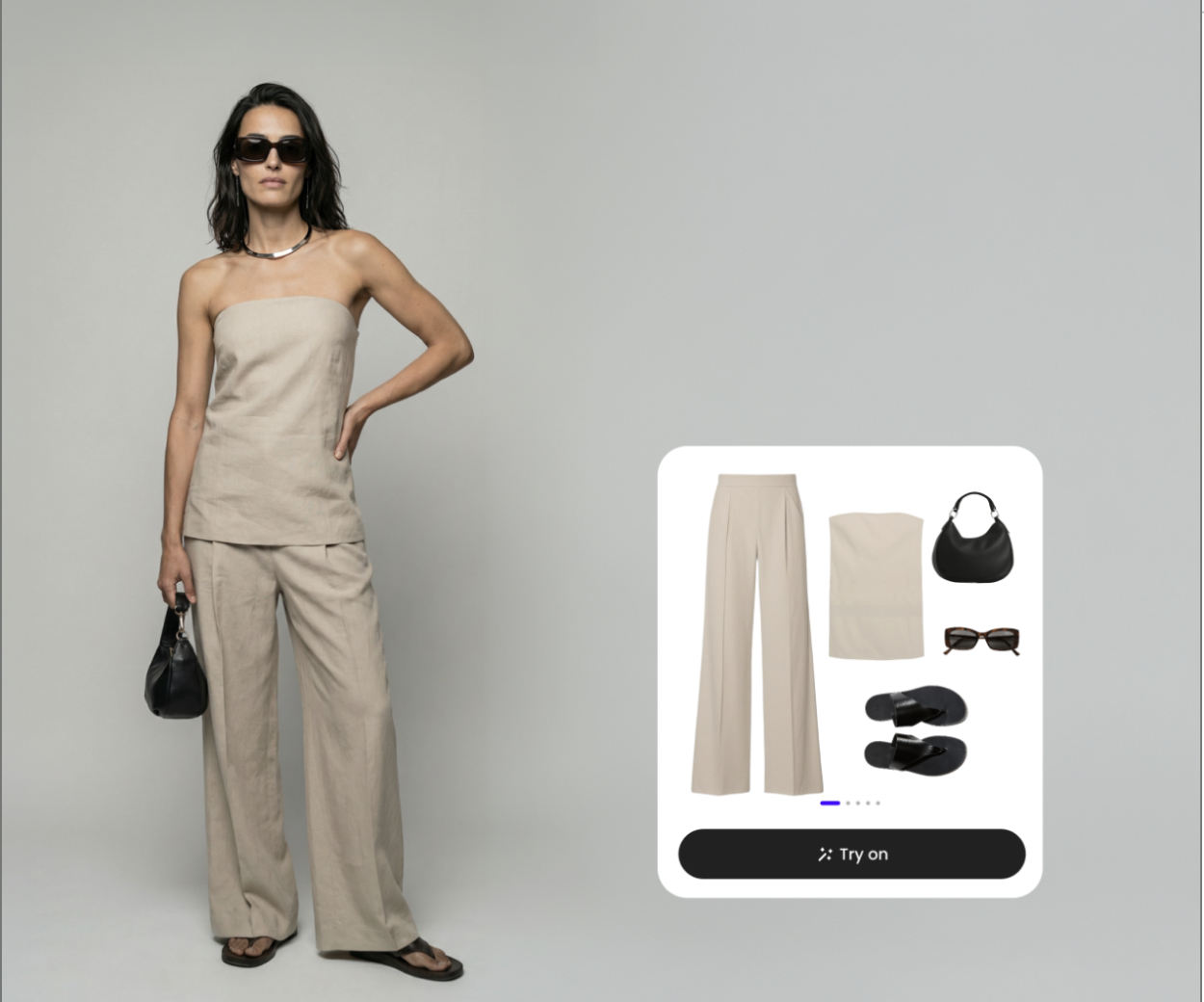
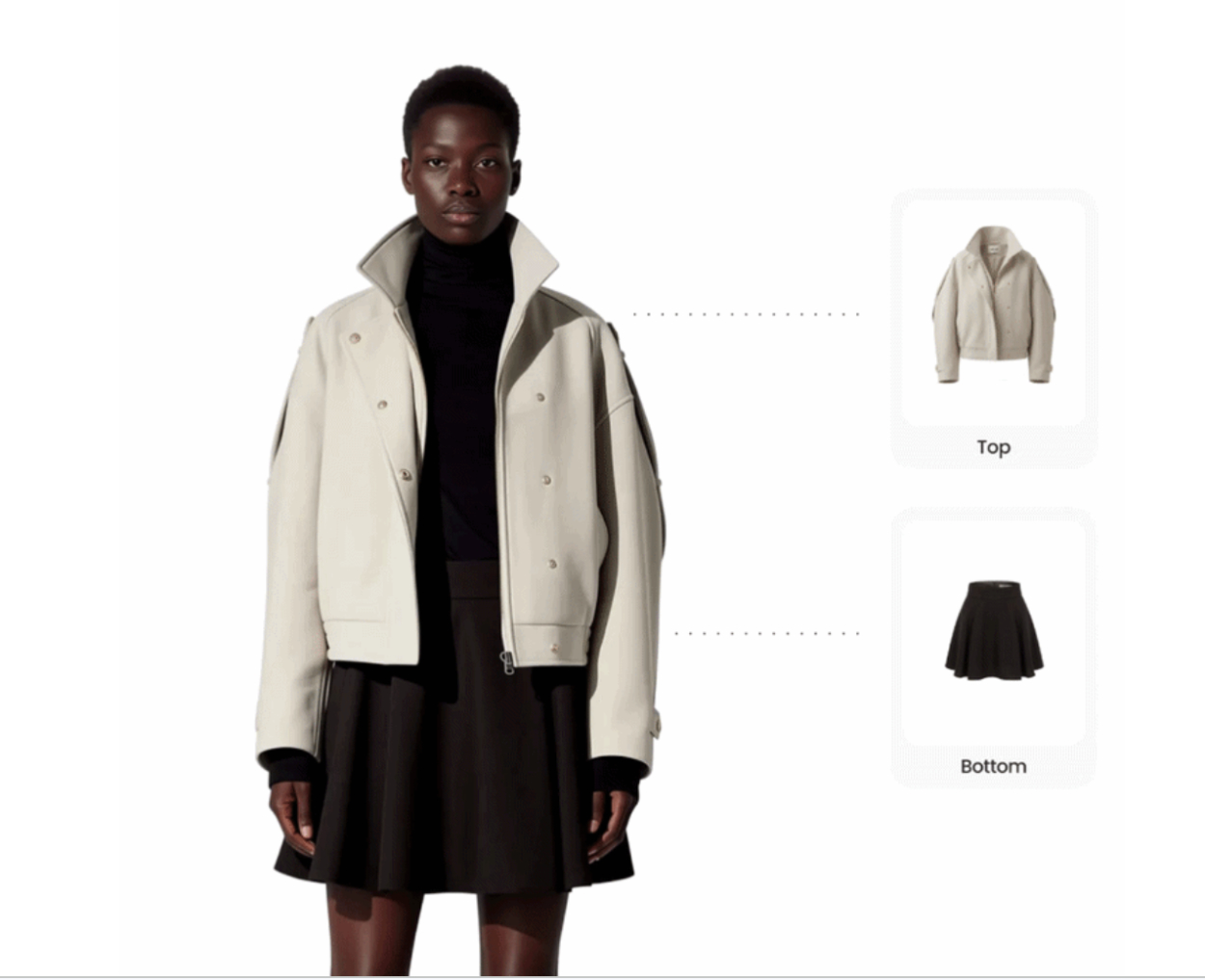
Just as importantly, the technology has evolved beyond single-item visualisation. Modern systems can now render full outfits, allowing shoppers to see how multiple garments interact in proportion, layering, and silhouette. This makes virtual try-on something closer to the way people actually think about dressing, not as an exercise in picking out isolated pieces, but as combinations and outfit-building.
As a result of commodity technology advancements, many VTO tools now look extremely convincing and can operate at speed and scale. Early virtual try-on tools focused primarily on visual novelty. The experience was impressive in demonstrations but frequently disconnected from the practical decision a shopper is trying to make, which is whether a garment will fit and feel right for them.
Modern systems are beginning to close that gap by linking visual simulation with sizing and fit intelligence. When shoppers interact with a virtual try-on experience, the system can incorporate historical sizing data, body-type modelling, and garment measurements to generate recommendations alongside the visual result. The goal is not only to show the garment but to increase confidence in the purchase decision.
Early pilot data from this new wave suggests that when virtual try-on experiences are integrated directly into product pages, engagement and purchase behaviour can shift meaningfully. In one multi-category marketplace pilot, customers who completed a try-on converted at twice the rate of standard shoppers, while in a fashion marketplace test users who performed a try-on added items to cart 52% more often and converted 35% more frequently.
Adoption is still far from universal, though. Surveys suggest that roughly half of U.S. online shoppers express interest in virtual try-on experiences, which means a large portion of consumers remain unconvinced. But compared with the limited engagement seen in earlier VTO experiments, this level of interest signals meaningful progress.

And the same alignment between objective and the enhanced capabilities of the systems is also manifesting itself in brands and retailers’ decision-making. As e-commerce margins tighten, input costs increase, and return costs continue to pressure profitability, tools that improve purchase confidence have an even greater commercial value. Even modest reductions in return rates can have a significant impact on the bottom line.
However, this is also bringing us to a new precipice. For retailers, the value is obvious, but over-indexing on VTO, or inflating its capabilities and overselling the technology, could end up undermining this new wave of AI-VTO before it truly gets underway.
As companies are discovering in a lot of AI applications, human curation, intent, and feeling are irreplaceable, and automation has its limits. They may be armed with better technology, but retailers need to avoid any suggestion that AI can eliminate or substitute for the inherent subjectivity of fashion. Fit is part measurement, part comfort, part identity. The feasibility of deploying VTO at scale with speed, realism, and operational efficiency might have changed, but the psychology of shopping hasn’t.
The question of whether AI has brought fashion to a place where VTO can actually become a more reliable layer within the broader size-and-fit ecosystem, practically speaking, is yes.
The question of whether shoppers will adopt it this time is more subjective. But for brands and retailers that approach AI virtual try-on with a clear vision for what they need it to do, for the first time, the answer may be yes.