
Hey, and welcome back to The Interline Podcast.
When was the last time you paid attention to a delivery van? I mean, really paid attention to it? The last time you thought about where it came from, where it was going next, what promises the company whose products are in the cargo area had made to the recipients, what share of the volume in there was going back in a few days time, and so on.
As someone who’s spent a lot of time in product design and development, I’m definitely guilty of not thinking about logistics nearly enough. And as somebody with a relatively young baby in the house, I’m also guilty of being quietly conditioned to just expect to be able to order anything she or her older siblings need and knowing it’ll turn up less than 24 hours later.
I’m also guilty, I think, of framing a lot of the discussions we have in these shows on what we tend to think of as the big markets in North America and Western Europe. I live in the UK. We have a lot of conversations and do a lot of business with partners in the US, France, Italy, Germany, and so on. But actually, some of the most interesting work in transforming logistics and fulfillment is happening in other markets. Ones with very different delivery cultures and consumer expectations, different levels of digital maturity, and different attitudes to automation.


Weekly discussions, debates, and technology insights for fashion and beauty professionals, hosted by The Interline’s Editor-in-Chief, Ben Hanson.
Find daily editorials, reports, analysis, and stories at The Interline.
Ben talks to Oliwia Guziel, to get a snapshot of the automations and integrations behind eCommerce logistics at Decathlon’s Central European operations, and the lessons they might hold for other segments and other geographies.
This show covers how regional cultural expectations, new ways to push the frontiers of fulfilment speed, and carbon optimisation shape decision-making along the route to final destination.


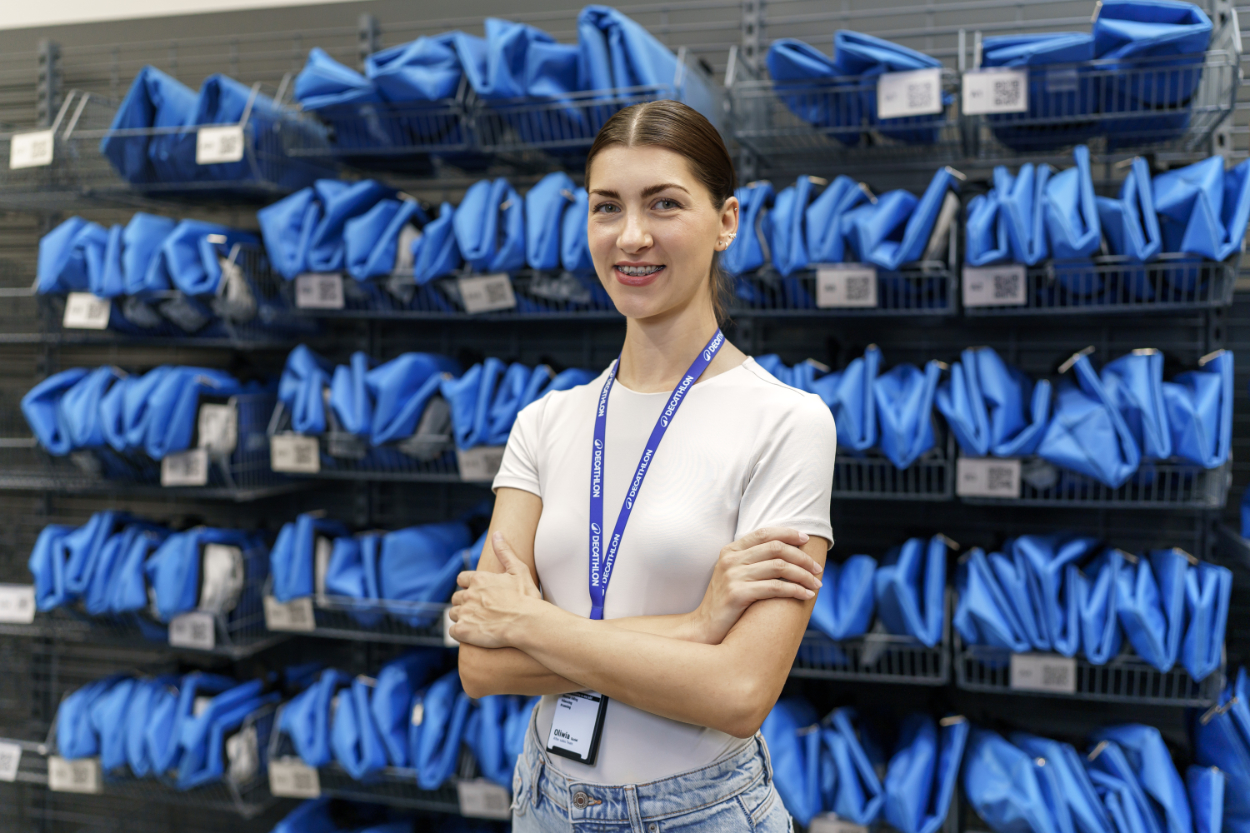
So to plug a gap in my own knowledge, and probably yours, today’s guest is Oliwia Guziel, who is the Head of e-Commerce Logistics for Decathlon in the Czech Republic and Slovakia. From the technology and operations stack behind 20-hour cross-border deliveries to the dominance of parcel lockers and the balance between globalisation, regionalisation, and networks optimised for speed and carbon impact reduction, Olivia has an angle on logistics that I think might have you looking a bit differently at the next delivery driver you see heading past.
So let’s see what she had to say.
Never miss an episode
Get notifications for new podcast episodes, plus our weekly news analysis, events, and more, delivered straight to your inbox.
NB. The transcript below has been lightly edited.
Okay, Oliwia Guziel, welcome to The Interline Podcast.
Welcome.
Now walk us through what your typical working day looks like. I’ve invited you on because you work in a really interesting and under-acknowledged role, in a really interesting and under-acknowledged market for a really interesting company. There’s a lot of layers there. So I want to start us by giving people a taste of what your day-to-day looks like.
It’s always challenging to summarise work in a few sentences. As you said, there are a lot of layers there. This kind of role is both very broad and very detailed at the same time. But if I make it more concrete, my work is actually very much focused on customer experience. In e-commerce, delivery is a critical part. It can really make or break customer loyalty. So behind all the operations, all the costs and processes, what we’re really trying to do is create a great experience through speed, price, flexibility, also how we handle returns and after sales. So that’s the core of the job.
And because Decathlon is an omni-channel business, we also need to make sure everything feels seamless between online and offline.

Yeah. And I think we’re going to get into the Omnichannel side of things in a little bit. I think most of our listeners are going to be familiar with Decathlon, with it being probably the world’s largest sporting goods retailer. But I think maybe fewer people will have a proper understanding of just how complex and unusual the Decathlon model is.
We’ve previously interviewed people, we have friends at Decathlon who are working in the frontiers of digital assets and simulation for the big spread of own brand products that the company makes across all the different categories from apparel to footwear to tents to gym equipment and so on. But beyond that kind of product level, I think Decathlon is also interesting because it’s pretty fully integrated when it comes to a lot of business functions and logistics and distribution are one of those. Logistics and distribution are normally third party service layers for a lot of other businesses. That’s not the case here. Walk me through how this is all set up. How does your function exist within Decathlon?
Yeah, that’s actually very true. I still sometimes meet people who are surprised that Decathlon isn’t just a retailer or reseller, that we actually design, manufacture and distribute our own products. It’s not something people always realise from the outside. And to be honest, I think we should talk about it more as a company. Internally, we are very aware of how unique our model is and how strong the culture behind it is, but we don’t always share it enough externally. So Decathlon is very much about doing rather than talking. We do something innovative and then we just jump straight to the next challenge.
So tell me how that manifests itself in the way that logistics and distribution are integrated and are kind of part of the whole of Decathlon. Because as you said, maybe it doesn’t get spoken about much externally, but it’s different to the way a lot of companies are set up.
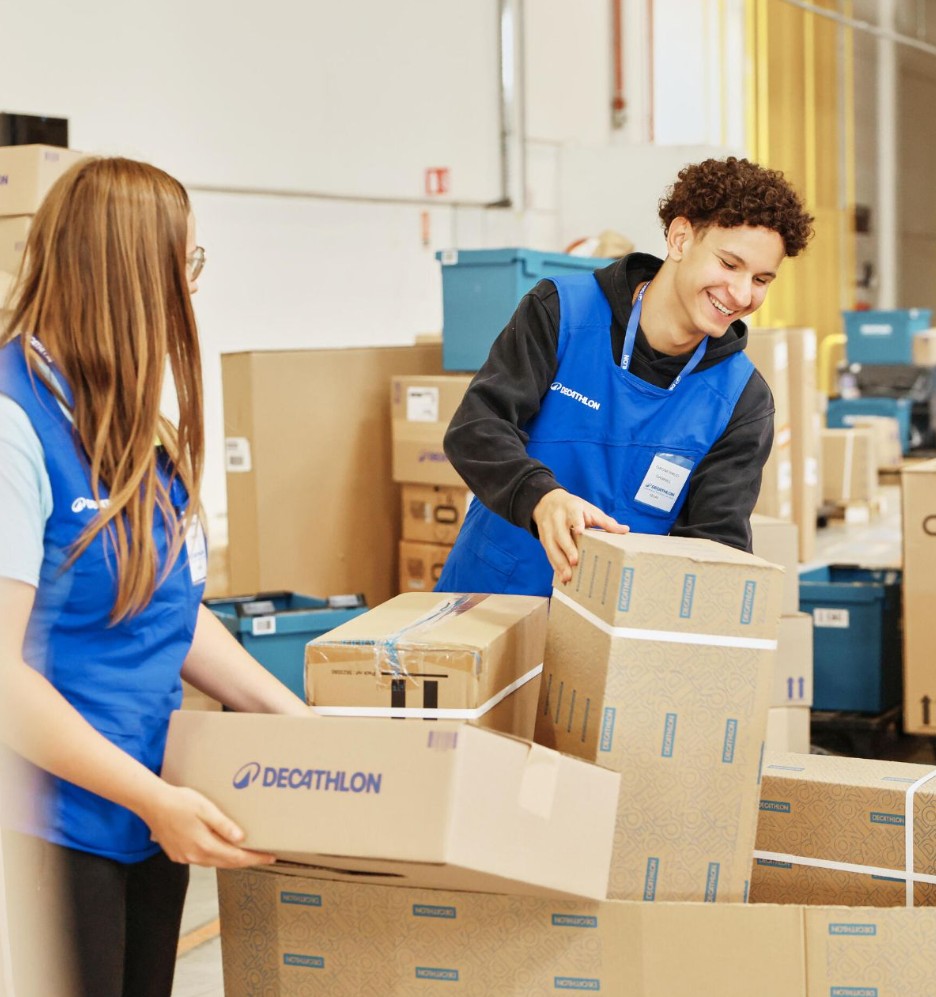
We manage our operations end-to-end from product design, manufacturing, logistics, e-commerce fulfillment and of course retail. On the top of that we also have services like rentals and workshops. So it’s quite a complex end-to-end operation and having that full control over the entire supply chain brings huge advantages. It allows us to really manage product design, quality and costs at every stage, which is what simply enables us to offer such a strong quality to price ratio and also innovate quite quickly.
But at the same time, it comes with a lot of responsibility. We need to build and maintain a very wide range of expertise and skills internally across so many different areas and make sure everything works together smoothly. So you can imagine that there is quite a lot of challenge to that.

Yes, and then we’re going to get into some of those challenges as we go.
I want to ask you some questions about the market that you work in. We tend to focus our coverage on the US, China, and then some of what we think of as the biggest European markets. So UK, France, Germany, and so on. Czechia tends to fly under the radar. But if I understand it correctly, it’s also a bit of a lighthouse in a bunch of ways. You have really high parcel volumes per capita, this deep online and digital uptake to an extent that there isn’t in other markets. And that all translates into a pretty high set of expectations from consumers in terms of what constitutes retail and e-commerce excellence. It’s also, if I’m correct, a bit of a hub for Central Europe as a whole.
So tell me a bit and bring our listeners up to speed on the Czech market and maybe capture what makes it unique for an audience that’s probably used to thinking about some of those mainstay regions I’ve just talked about.
Sure. The Czech market is actually a really interesting case. I joined about six years ago. I’m originally Polish, and moved to Prague six years ago. So I’ve seen it evolve, especially speaking about e-commerce, from a very dynamic high growth phase into something more mature. It’s still growing. We are expecting markets to go from on a pace and around 5% annual growth in the next few years, but it’s definitely more stable now.
What can be interesting and maybe surprising is from an e-commerce perspective that it’s very much a mobile first market. So mobile shopping, it’s around 60% of transactions. And in terms of delivery expectation, the bar is set pretty high. We have two local e-commerce players like Rohlik, which is an online grocery shop, really pushed same-day and time slot delivery to another level of accuracy and reliability which increased the expectations of customers. And Alze, the largest online retailer for electronics and consumer goods here in the Czech Republic and Slovakia. And they basically made next day delivery with late cutoff times the standard and also popularised delivery parcel lockers.
Czech customers are very experienced with e-commerce and they have quite high expectations.
Yeah, and kind of related to that, Decathlon, if I understand it correctly, tilts much more towards physical stores on a pure kind of revenue basis. Maybe I’m off base slightly, but I’ve always seen Decathlon as a physical stores first, online sales second kind of business. But obviously, as you mentioned in Czechia, mobile commerce is pretty dominant, digital commerce is pretty dominant.
How does that balance play out for Decathlon?
Yeah, that’s a really interesting point. For us, it’s true. Physical retail is still very much the core of the business. E-commerce is growing year over year and we are also expanding our marketplace, inviting partners to join our platform and sell their products under the Decathlon website. So this extends our offer and brings more online traffic.
So the balance is slowly shifting, but we are still quite far from digital overtaking offline sales.
You manage the logistics and the distribution for those partners in that marketplace case?
We are, yes, planning for the top partners to offer as well the fulfillment, but for now the majority of partners handle the delivery and logistics themselves, so we act only as a transaction platform and then the operations are handled by them.
Okay, and you mentioned before omnichannel. How do you think about omnichannel from that point of view then? So for a market that is really digitally savvy, and then for a brand and retailer that tilts towards physical, but that has a much kind of a fast growing e-commerce presence, do you think about omnichannel as being a way to make every channel kind of conform to the same standard? Or do you see it as each channel should stand out and should be differentiated in its own right?
That’s a good question. I really believe in the omnichannel model for our business, for Decathlon. I see it in the way that the channels are complementary and not competing. And they should be consistent in a way. So in Decathlon we love meeting our customers in person. And for years in Czech Republic we’ve been intentionally promoting the click and collect over home delivery, to bring our online customers in stores because we know that once they come in, experience the store, interact with our team, they tend to come back and they are becoming much more loyal. So that’s definitely something we want to combine.
But now after more than 15 years in the Czech market, I can say we’ve built a strong base of loyal customers thanks to this omnichannel approach. So maybe today, it’s a time that we are also thinking more about how to grow online in the regions where we don’t have physical stores and really play stronger digitally there because their competitors are also playing quite strong and we should be able to be flexible and in some regions play very omnichannel but maybe in some regions we should prioritise the digital strategy.
And it seems like having ownership of the fulfillment of logistics distribution is a key piece of having the flexibility to do that. For being able to say, we will push into a new region and we will be digital first there because we don’t have a physical presence. But we can also meet the expectations, which we established are pretty high in Czech Republic, shoppers who will. There’s a competitive landscape, there are competitive people going after them. You have to meet a very high bar, and I think meeting that high bar sounds like it relies on you owning as much of that fulfillment as you can.
That’s true, that’s true. This gives us this agility and flexibility to locally adapt to customer expectations. So even though we are a multinational, international company, we have quite a lot of freedom to make local decisions that are adapted. And I think this gives us this leverage to move faster and to be agile and act quickly when the trends are changing, when new players enter the market and they surprise us with something that we didn’t think of before.
And the international side of things. So as well as catering to the domestic Czech market I know you worked on building out a fulfillment platform that covers multiple markets as one with Czech Republic and Slovakia. Across those, do you try to offer a universal customer experience and shared targets or do you try to regionalise things? That’s one question. The second one is, just give me an idea of the scale of the infrastructure involved there because you’re operating effectively an international hub as well as a domestic market. I think it would be interesting for our listeners to just get a feel for just how big the operations involved in –
Sure, sure. So over the past few years, we’ve actually been redesigning our logistic network and overall strategy a bit, mainly to improve stock rotation and product availability across the region. I will speak mostly about Europe, where we have regional distribution centres and continental distribution centres across different countries. Before it was more like one warehouse serving one or maybe two countries, very regionally. Now it’s much more connected.
We decided to collect into multiple warehouses and use cross-border shipping and even offer the store stock as a ship from store, which we can use as an extension to our basic offer in our main warehouse. So when one warehouse runs out of stock, the system can check alternatives and still fulfill the order.
So that’s the approach we’re having now. It’s a bit of a double-edged sword, to be honest, because on one hand it really improves our availability, but on the other hand it creates more complexity. For example, one customer order might be split into two or three separate shipments coming from different locations which obviously increases the operational costs and adds more complexity to the whole operation. So that’s the reality that we’re operating now.
Yeah, I mean, if you pair that with what you talked about before, which is the expectation of next day delivery and late cutoff periods. To me, as somebody who spends a lot of my time thinking about product design and development, every time I look behind the curtain into logistics and fulfillment, it boggles my mind the number of moving pieces that come together in order to just get parcels to people on time in a way that they expect. And this is an example of that.
Mm-hmm. Exactly. And also when it comes to this universal customer experience that you mentioned, it’s a mix. We do have some shared standards across the countries, but as you mentioned, we really aim to have next day delivery to use local courier partners that are preferred or loved by our customers locally. So there is a lot of local adaptations that we are allowed to make, we choose our courier partners, delivery methods, pricing, payment options based on what customers expect locally.
A good example is cash on delivery. It basically doesn’t exist in markets like France, but here in Czech Republic and also in Slovakia, it’s a must have. Same as out of home delivery, like pick up points and parcel lockers – in Western Europe it’s relatively small share, but for us in Eastern and Central Europe it’s one of the main delivery options, so if you don’t offer it, your conversion just drops.
That’s interesting. And that’s exactly the kind of insights that I was hoping to get by bringing you on. So thank you for sharing that.
I want to get your perspective on the technology and the automation side of the complexity we just talked about. And I think that’s got two pieces to it. And I want to start with the back end warehouse and central side of things first. Like a lot of big retailers, I know you partner with Geek+. I was at an event in Manchester at THG ingenuity THG studios, which is The Hut Group. They offer that kind of fulfillment as a service. And they also partner with Geek+ for a lot of the automation and robotics.
I’m less clear on what areas you’ve worked to automate in warehousing. I’d like to know a bit about what the impact has been and I’d like to get your outlook on it. Do you see automation as something that is scaling up over time? It’s like a one way street. Or have you found any hard lines where human judgment and human roles are going to remain necessary? Just start by telling us which parts of the backend and warehousing and logistics you’ve automated. And then give me your take on what you think the kind of medium term trajectory for backend automation is.
Sure, yeah, that’s correct. We are using Geek+ robots to optimise picking by order. Also, we use Exotec in several warehouses plus pocket sorters in some and different packaging lines, different packaging solutions and packaging machines in different places. The warehouse I worked in and the one that I work with now, it’s actually fully manual. It’s the one based in Poland. We have two warehouses in Poland. One is automated, one is manual. So I don’t have a lot of direct hands-on experience with automation, but I can share my observations and what I’ve seen across the network
So I think automation takes time and a lot of adjustments before you really reach the efficiency you expect from it. So it looks very good in the spreadsheets, and it’s of course more scalable than usual operations, that’s for sure. And it’s super important for e-commerce, especially with strong seasonality and dynamic growth. But it comes with a big upfront investment, constant fine tuning and needs to really, really standardise your processes and honestly adapt them to automation, not the other way around. And I think sometimes that’s the most difficult part.
And another interesting insight is the actual product mix, which makes things even more complex, because at Decathlon we have a huge variety of products, as you know. So you’ve got the things like fishing baits that are so little and tiny that some machines don’t even detect them. And then on the other extreme you have boats that simply can be handled in the automated system or, you know, some huge fitness machines. So in reality you still need to create specific zones depending on product type. So this is where people and a lot of critical thinking and combining automation with manual work are still absolutely important to have and to keep.
Okay, that’s a really good perspective. The other side of the technology coin is the last mile. So we hear a lot about kind of the splashy use cases, drone deliveries and so on, but less about what’s actually going on across a complicated network of systems, partnerships and actors to get things to people’s doorsteps or their parcel lockers in a way that underwrites the convenience and the promise of shopping online.
From a technology point of view and an automation point of view, what’s happening on that last stretch that you think maybe doesn’t get talked about enough because people over index on the idea of drones and so on?
Everyone loves the idea of drones dropping our parcels. But realistically, with all the regulations and safety constraints, it’s probably not something that will take over our commercial deliveries anytime soon. But there are still some pretty cool things happening around, when speaking about technology and futuristic solutions. For example, recently I saw Foodora testing autonomous food delivery robots in Prague, which is actually quite fun to watch. You can probably find it online. They are driving around and they are taking tests in some districts of Prague. And so I think in some dense city areas or food delivery sectors it can really work. Also, another interesting example is Škoda Auto enabling parcel delivery to your car trunk. I don’t know if you heard about it?
I did not, no.
So, Škoda Auto, they have a system that allows couriers to deliver packages directly into the trunk of your parked Škoda using a GPS location and they can safely one time open the trunk using some digital access via an app. So, in the new models, there is this option. I don’t know if it’s widely used but maybe that’s the future of delivery.
Interesting. I don’t drive a Škoda, but it’d be interesting to see if that’s something that extends to the UK at some point.
Now, the flip side to this on the last mile is that final furlong is far more than robotic picking and sorting. That’s where the customer experience really lives or dies. If the final step of logistics can delight customers in ways you’ve just talked about, like unique experiences like that, or just hitting targets reliably. It can also frustrate them when it goes wrong. What’s been your experience of where the last mile promise breaks down the most often? And what have you learned about how to avoid those outcomes or mitigate their impact?
I completely agree with this statement, I think the last mile really makes or breaks customer loyalty. It’s the moment of truth. And the real reality is that in logistics, something will always go wrong. The scale is just too big. There are so many orders, so many handovers, so many variables, statistically incidents just must happen. So the real question I would say is not if something goes wrong, but how we manage it, how we react, how we anticipate it and how to minimise that impact on the final customer.
So I will show maybe three key things that I think from the experience that really makes a difference in last mile strategy and last mile operations from my experience. So the first one I would say is cross teams collaboration, making sure that teams actually work together and talk to each other. And I mean, really talk, not just through reports or when there is a fire or some problem. Customer service, last mile team, warehouses, data analysts, they all need to understand how they impact each other. We actually, in Decathlon, organise collective meetings a few times per year, where all those teams come together to discuss operations, issues, priorities.They can work together, they can try each other’s job and of course we do some sports together, we have some beers to get to know each other better. And we do the same with our partners. So the courier companies, we don’t just meet them once a year to negotiate prices, but meet them regularly. And I think if you start to treat your partners or cross-functional team as a partner rather than just contractors, they start to behave as partners and you move from this blame game and start solving problems together and that brings a big change.
The second one is actually very simple. Read customer feedback and act on it. So really read the customer comments because if it keeps coming up, there’s always a root cause behind it and it’s our job to solve it. You can really improve the operations this way.
And the last one is being proactive in end-to-end management. Simply monitoring every day what’s happening, every day catching the exceptions early. Ideally, of course, you solve the problem before the customer even notices. But if you can’t, then just communicate. Honestly, just calling or informing a customer that something went wrong, but you’re really handling it, makes a huge difference. And most customers are actually quite understanding if you are transparent. What they really don’t like is uncertainty. And when they know what they don’t know what’s happening and they think that you don’t really care. So often you cannot control what happens to every single order, but you can definitely control how it feels for the customer and that creates a huge difference in the final experience.
Yeah, and I think that’s probably another one of those things that you can do best if you’re well integrated vertically to have these kinds of operations exist within, like you said, cross-functional teams, collaborative environments, and so on.
So tied to what we’ve just talked about there, I think, is reverse logistics. So we’re all familiar with the narrative that return rates are rising, but I think the fact that between 40-50% of product that’s bought online gets returned, at least in some market segments, it should be crazy. That should be a crazy and remarkable statistic. I think it’s a damning testament to product strategies and consumer behaviours in some ways, but it’s also a massive challenge for logistics. You’re dealing with some apparel and some footwear in your case, but also a much broader product mix, at massive scale.
The things you just talked about, your reverse logistics might be somebody returning a running top or there might be somebody returning a set of weights or a boat or something as you just described. You’re doing these things at massive scale.
Exactly.
What have you learned about getting the reverse side of things running in such a complex operation that could be relevant for our fashion audience? Because I think the scale and the variety story is interesting with Decathlon, but I think the key takeaway is about how to make that run smoothly and how to get that to be as streamlined and meet consumer expectations as possible is the key.
Yeah, reverse logistics is a huge topic, a big challenge, operational one and customer experience point of view as well. It’s a significant cost for the business, but at the same time, it’s also just a natural customer expectation today. So it’s not something we can really fight against.
But of course, there are ways to reduce returns. So we try to work a lot with our teams to have a better size guide, more detailed product pages, good photos, videos, product reviews available. All of that helps customers to make their choice upfront and reduce a little bit the need to return. We are actually a bit lucky in the Czech Republic because our return rates tends to be a bit lower than in many fashion brands, partially because of the type of products we sell, but still the volumes are significant.
I think an interesting part of the return process that I would like to share is what happens to the products that are returned and they are not perfect to be reselled at the original price anymore because there is a little stain or the label is missing. I remember when I worked in the warehouse about 10 years ago, I started as a department manager in the warehouse and it was honestly quite shocking to see how many products were back then thrown away. Items that were slightly used or maybe a bit damaged, missing labels, not perfectly repacked and they just couldn’t go back to sale. So it felt like such a waste, but fortunately now this is behind us.
Now things have really evolved and we’ve developed a more circular approach where instead of discarding those products we give them a second life. So we resell them through a dedicated second life category on our websites. And that’s products that might have like this small cosmetic defects or missing packaging, minor imperfections. They are still perfectly usable and we offer them with a discount to our customers. So this saves our costs, but it also serves the purpose of becoming more circular and more sustainable business model.
Okay, that’s useful insight.
So the industry event that I mentioned before that I went to the other week, that was very fast fashion focused. And one of the key themes that came out of it was that people know – this is the UK, but I think there’s some parallels here – and expect incredible velocity from e-commerce, right? People expect a complete lack of friction. I’m paraphrasing what came up at the event itself. But the core message was that any friction you introduce between someone seeing a product on TikTok and having it land on their doorstep is a point of failure. It’s a point where you lose a customer potentially.
If we just put a pin in the environmental impact of speed for a second, I want to ask you to maybe benchmark what it is that customers in your markets, Czech Republic and Slovakia, actually want and what level of speed is a competitive advantage now versus what is just table stakes.
So I understand you’ve recently talked about how to manage like a sub-20-hour international delivery, which sounds like exactly the kind of crazy velocity we’re talking about. Walk me through what that looked like. Give me an idea of how that aligns with people’s expectations. And is that something that you think you intend to or even can repeat and scale? What’s the bottleneck? Could you do sub-20-hour international deliveries all the time? If not, why not? Could you do it faster?
That’s a really interesting question. Today, next day delivery with a late cut off time is definitely expected and it gives you a competitive advantage. Two-three days delivery is kind of the expected standard, like a baseline. Anything slower than that starts to feel, simply speaking, not that great experience. And then on top of that you have these premium options like same-day delivery, delivery in hours, time slot delivery, two-man handling for big items going upstairs. Those are not always expected but they definitely add value if you offer it, especially for certain use cases.
What’s interesting, though, is that speed is not just about being fast, it’s also about the psychology as you mentioned in fast fashion. If you deliver quickly, customers don’t really have time to change their mind or cancel or abandon and unpick the order because they are still excited about their purchase. We all try to deliver it fast because, you know, they are buying, they’re happy, they want to start using their product, start doing the sport that they bought it for. So it’s important that this next day or today’s delivery is in place.
And also if your system is designed for the next day delivery, you actually build in a bit of a buffer. So if something goes wrong and it becomes two days instead of one, most customers won’t even notice. So it’s like an extra benefit to keep this high level of satisfaction.
But back to your question, a fast promise, it’s important, but I think actually what customers care about today a lot is control and visibility. People are really seeing their orders processing, getting updates, knowing where things are, having these convenience delivery methods like delivery to 24/7 parcel lockers. And I would say that some customers even will prioritise it over extreme speed like same day delivery, especially for fashion or for sports goods. So today competitive edge is not just purely speed, but it’s a concrete promise that is reliable. So if you say two days, it’s going to be delivered in two days and combined with transparency and control and convenience of the delivery.
So I think a lot of businesses can find some sweet spot between maybe sacrificing a little bit of speed to have more sustainable and more cost-efficient delivery, but instead offer the wide range of a great experience that is reliable, that is convenient, that is to your favourite pick-up location and this kind of aspect of delivery.
Yeah, and that’s actually my final question to you was, when we think about speed and complexity and multiple regions all handled from one hub and so on, how do we square all of that with published commitments to decarbonisation? You said customers want a blend of speed, convenience, and everything else we talked about. Do you think you can decouple that from carbon impact? Is speed optimised and carbon optimised logistics? Are those separate things that pull against one another or do you see them as one in the same?
Yeah, honestly, it’s a constant balancing act, I would say. Obviously, trucks delivering big volumes and manufacturing, it’s always having its footprint. We can also speak about electric trucks, for example, they sound like an obvious step to take, right? But in reality, they are still not that widely available and they are very expensive. And in our case, Decathlon operates on more low margin, high volume models. So affordability is a key and the cost efficiency is a core of our business. So that makes it a bit more challenging to adapt those kinds of solutions quickly at scale.
But instead, we focus a lot on optimising what we already have. Things like improving track routing, using one track for several deliveries to several shops. We optimise the route and we maximise the fill rates. So basically not transporting the air. We measure that and it’s good for cost and it’s good for emissions. It’s basically a win-win and I think this is where we can optimise and looking at our scale it actually makes a difference.
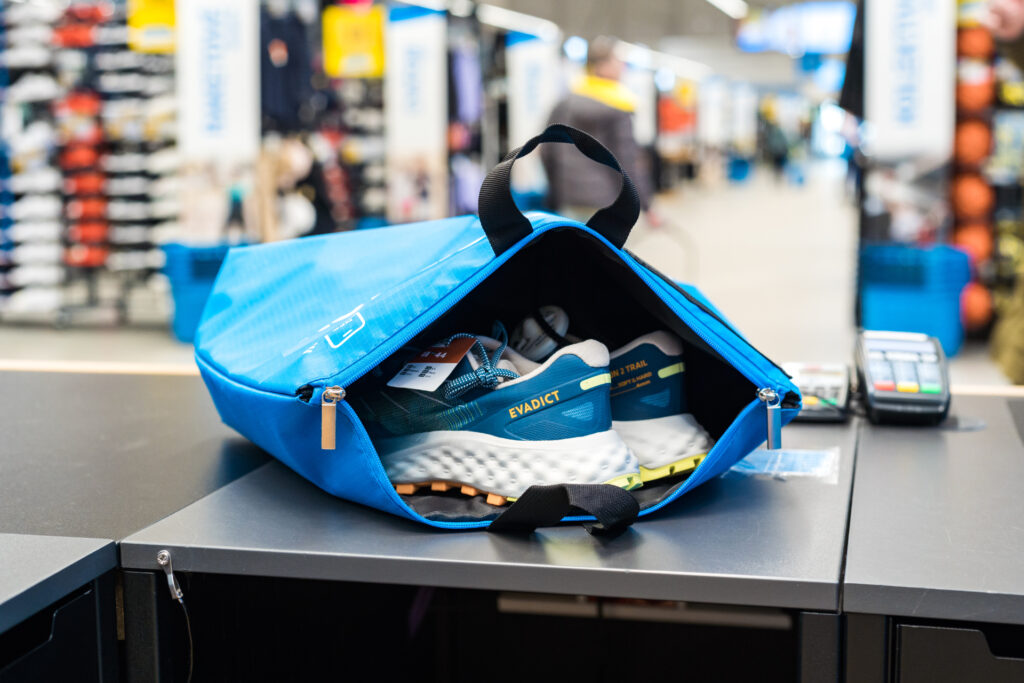
We also prioritise click and collect and pick up points because consolidating deliveries reduces both cost and carbon. And we’ve introduced reusable packaging. So I don’t know if you heard about this project, if you’ve seen it, but in Czech Republic we have 16,000 units of bags in circulation which helps us reduce the waste related to e-commerce.
I had not, but that sounds like a pretty good initiative as part of that. And I think that central tension is also one that a lot of our listeners will be wrestling with. The push and pull between the promise of selling online and the variety and the velocity and the environmental commitments and the impact and the values that people expect.
Olivia, thank you so much for joining The Interline Podcast. It’s been a pleasure to have you.
Thank you. It was a pleasure for me.
And that’s the end of my chat with Olivia. There’s a lot in there that usually flies very much under my radar, and I suspect it also flies under the radar of most of our listeners who aren’t actively working in logistics and fulfillment. So as you go about the rest of your day, my recommendation would be to pay attention to the sheer parcel volumes moving around whatever market you live in. Consider how e-commerce is shaping the cultural makeup of your domestic market and vice versa and try to picture in your head the sheer scale of the hidden network that keeps outbound and reverse logistics moving.
That’s an interesting way to think about things and it’s been helpful for me to break my mind out of having such a focus on product design and development all the time.
I enjoyed stretching my legs into space we don’t normally cover with this show, so hopefully you got a lot out of it as well. I’m going to be back next week with something completely different.
For now, though, thanks for listening and I’ll talk to you again soon.