
This article was originally released in The Interline’s AI Report 2026.
Including profiles and exclusive interviews with 17 AI companies, stories and opinions from 12 different industry perspectives, and real survey feedback from around 100 voices from every level of fashion, bottled and analysed, The AI Report 2026 is essential reading for anyone interested in AI for fashion.
There is a part of the AI story we don’t talk about. The conversation, when it comes up – and it comes up often – is almost always about what AI generates. The bigger story, for an industry like ours, is what AI unlocks — what it can surface, spotlight, or otherwise elevate when it sits on top of intelligence that’s already been built.
A model is only as good as the data it’s trained on. Train one on a quarter-century of expert-validated trend data, and you get something genuinely new: forecasting at scale, with the speed and consistency that only software can provide, and the depth that only proprietary intelligence can give it.
I believe this is the most exciting moment trend forecasting has had in a generation.
After 25 years of building proprietary intelligence about what consumers will want next — what colours, what silhouettes, what fragrance notes, what aesthetics, what mindsets — my global team is about to see that intelligence become more powerful, more queryable, and more deeply useful than it has ever been. AI is the reason. Not because it replaces what forecasters do, but because it amplifies it: the speed at which intelligence can be retrieved, the granularity with which it can be applied, the number of decisions across a business it can shape.


It’s not speculation at this stage to say that the brands that grasp this early are going to pull ahead. So it’s worth setting out — clearly, and without the hype — the things AI actually changes about trend forecasting, and, crucially, what it doesn’t.
1: What AI changes
Trend intelligence used to be consumed in a certain way: reports, seasonal presentations, conversations with senior creative directors. Getting an answer about emerging colour direction in active denim, or about how a fragrance category was evolving in Southeast Asia, meant finding the right report, the right images or the right person. That model still has its place — there is no substitute for a well-argued seasonal forecast in the hands of a creative team. But it’s no longer the only way trend intelligence can travel through a business.
The same forecasts can now be delivered as structured data, queried directly, and piped into the systems where decisions actually get made — from merchandising platforms, to AI assistants, to recommendation engines. Crucial to remember: the intelligence itself is the same. The number of places and the speed it can do useful work is what’s multiplied.
A merchandiser in Dallas can now ask a question and get a confident, defensible answer in seconds — grounded in 25 years of forecast accuracy. A product developer in Singapore can pressure-test a fragrance concept against forward trend trajectory before committing tooling. A buyer in Paris can run a colour palette against years of forecast data before placing an order. A trading team in London can see a behaviour spike on TikTok, ask whether it’s a fad or a movement, and get a longevity score grounded in two decades of lifecycle data — not a gut call.
Same intelligence. Radically more useful, because it’s now embedded in the systems where the decisions that depend on it actually get made.
2: What AI doesn’t change
It’s worth being equally clear about what AI doesn’t shift, because that’s where the real shape of the next decade becomes visible.
The earliest signals don’t show up in a dataset. They show up where consumer behaviour does: IRL.
The first sign of a real trend almost never appears in data. It appears in a conversation at a beauty counter in Seoul. In a swatch that a fabric mill in Como is quietly developing for a niche client. In the gestures and vocab young consumers are using before brands have caught up with their language.
At WGSN, our global network of more than 250 trend experts — anthropologists, designers, analysts, consumer researchers, editors, people physically present in the right cities at the right moments — isn’t a nice-to-have layer on top of an AI system. It’s the input layer to the whole thing. It’s where the freshest, most predictive intelligence comes from in the first place. AI makes that intelligence vastly more useful once it exists.
It doesn’t generate it.
This is why the data asymmetry in fashion is going to grow, not shrink, in the AI era. When everyone has access to similar models, the differentiator becomes what you feed in. A model trained on the public internet is, by definition, generic. A model trained on 25 years of proprietary trend intelligence, taxonomies and methodologies — built and assessed one image, one shelf scan, one runway show, one consumer interview at a time — is something else entirely.
3: The signal-versus-noise problem
Social platforms have introduced a real-time signal layer that didn’t exist a decade ago, and any forecaster claiming not to be paying close attention to TikTok is either lying or about to be replaced. The signal coming off social is genuinely valuable, if you can find it.
The problem is that most of it is noise.
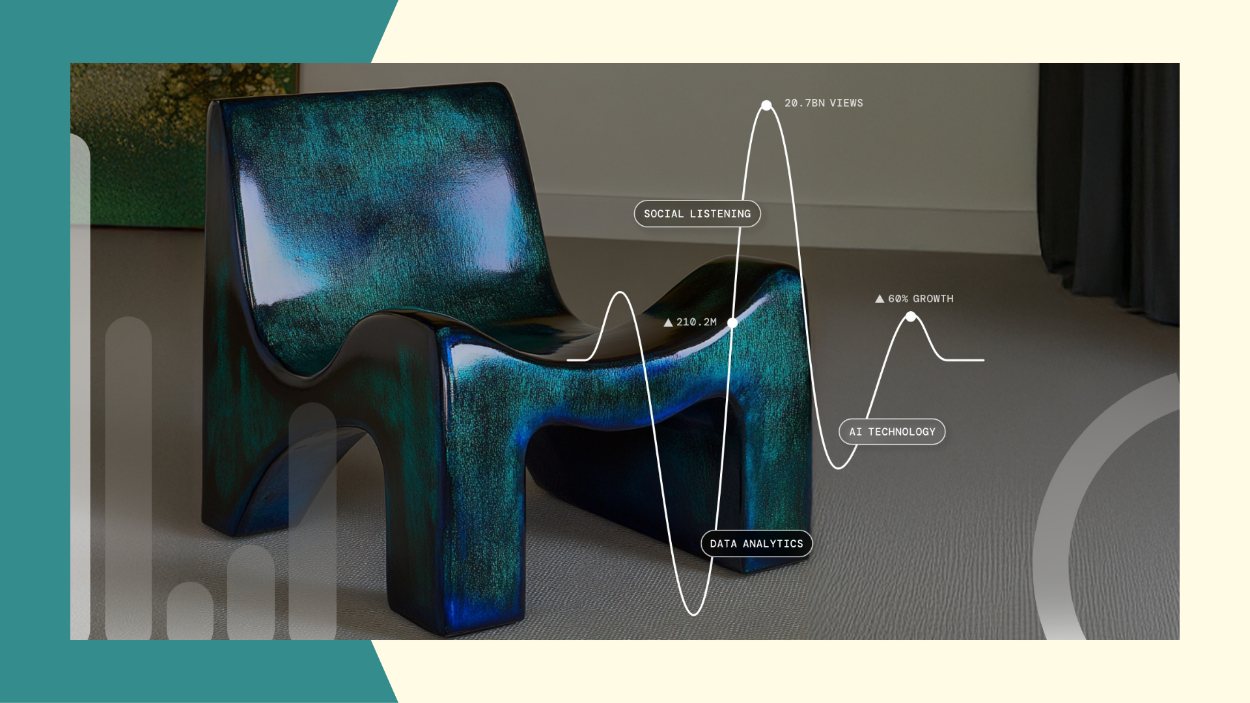
For every emerging behaviour on TikTok that becomes a product shift, there are a hundred that flame out in three weeks. For every aesthetic that defines a season, dozens look identical at week one and diverge wildly by week six. Anyone can spot what’s viral. The hard part — and the valuable part — is knowing what will last.
That’s a prediction problem, and it’s exactly the kind of problem AI is suited for — but only when the algorithm has been trained on the right data. Trained on decades of trend lifecycle data. Trained on what historically grew into a movement versus what stayed a meme. Trained on the difference between a behaviour amplifying because it resonates with a deeper consumer shift, and one amplifying because an algorithm is feeding it back to itself.
This is the territory where AI and proprietary intelligence combine to do something neither could do alone. A generic trend tool can tell you what’s spiking today, whereas a grounded, well-specified tool, like our TikTok dashboard, canyou whether to commit a season’s inventory to it. That’s a different category of insight, and it’s the one that actually shapes commercial outcomes.
4: The implementation layer
There’s one more dimension to this, and it might be the most important.
Predicting a trend is one thing. Making the jean, formulating the moisturiser, landing the fragrance — that’s a different discipline entirely.
It’s the difference between knowing that “quiet luxury” is rising and knowing what weight of cashmere, what cut, what price architecture, what supply chain commitment translates into for your brand, in your market, for your customer. It’s the difference between knowing that fragrance is shifting toward gourmand notes and knowing how a specific note behaves on skin in humidity, how it interacts with the rest of your portfolio, how it survives reformulation pressure from regulators. It’s the difference between calling a colour direction and knowing what dye houses can actually deliver at volume next spring and whether that colour will resonate culturally in all the markets you sell.
That translation work is craft. It’s done by people who’ve spent careers actually making the product — designers who know what a fabric does after fifty washes, formulators who know how a base behaves at scale, merchandisers who know what a category looks like on shelf, sourcing leads who know what the supply chain can absorb. Many of our forecasters at WGSN have come from exactly these roles, and it shows in the work: a forecast that doesn’t connect to that craft is just a slide. A forecast that does is a competitive advantage. AI accelerates this work substantially. It doesn’t replace it.
The brands that lead don’t want a clever AI tool to do their work for them. They want trend intelligence that travels the whole way through — from the earliest signal in Seoul, through the algorithm that tells them whether it’ll last, through the expert who knows what it means for their specific category, all the way to the brief, the buy, the launch. That’s the system. And it’s human + data intelligence, powered by AI system.
5: Where this is going
The next decade of trend forecasting is going to look like this: faster, more granular, more deeply embedded in the operational decisions that determine what gets made and sold, and delivered into more places across a client’s business than ever before. AI is the engine of that change, and it’s going to be transformative.
But the engine still needs fuel. The fuel is proprietary intelligence — generated by experts in the right rooms and the right places, validated against decades of accuracy, algorithmically distinguished from noise, and translated through real industry craft into decisions that actually work in real life. That combination doesn’t exist by accident, and I know this because we’ve built it, deliberately.
Sometimes I’ll be asked to defend trend forecasting. To justify its continuing existence in the face of AI. I don’t believe it needs defending. This is the moment the industry’s foundational intelligence becomes more valuable than it has ever been — because AI is finally able to do justice to everything that intelligence contains, and to the craft of capturing and understanding it. The forecasters aren’t being replaced. They’re being amplified. And the brands that understand the difference are the ones who’ll get the next decade right.