
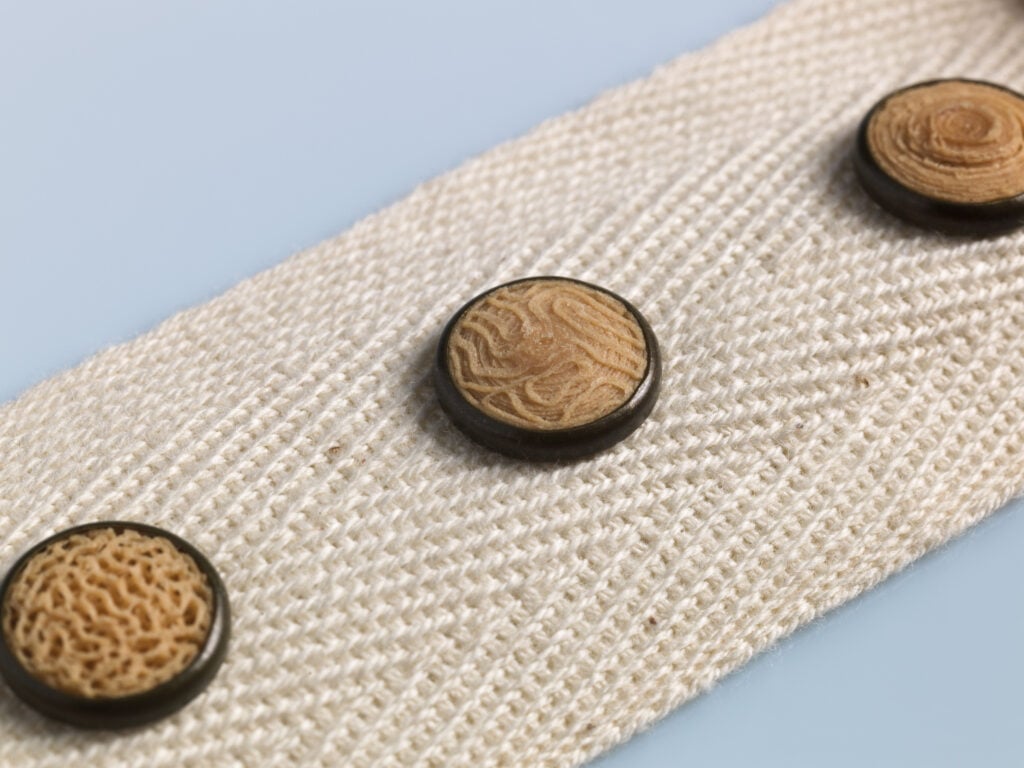
YKK has won Best Product in the Accessories category at ISPO Textrends for a 3D-printed snap cap developed with Variloom. The concept combines YKK’s fastening expertise with an on-demand fabrication process that allows intricate textures and shapes to be produced without conventional moulds. YKK’s announcement
While the snap cap is a concept rather than a commercial launch, it could prompt fashion product teams to think about the links between customisation and order size: YKK says the process can remove the moulding and minimum-order constraints that limit how freely brands can develop distinctive trims.
The material adds another design dimension. The insert combines Variloom’s materials with Sulapac’s wood composite, cotton fibres and thermoplastic polyurethane. YKK says more than 55% of the insert is bio-based, using Sulapac’s material specifications, and describes a surface intended to look and feel more natural.
YKK and Variloom previously developed a 3D Composite Puller, covered by The Interline in April, with customisable shape, texture, colour and branding. The snap cap extends that approach into another fastening component.
Variloom’s wider system also provides useful context for how this might develop into a production workflow. Its design software controls the printer’s path, while a separate operating system manages jobs and progress across a fleet of printers. The company is developing the design and production infrastructure alongside the materials.
For brands, the opportunity is to make variation easier to accommodate. A common printing process could support different designs across capsule collections, collaborations or regional ranges, reducing the need to commit each variation to its own mould. At scale, the useful measure would be how efficiently a supplier can handle that variety across many orders.
The opportunity for digital product creation is a shorter route from design file to finished component. In The Interline’s interview with YKK’s Takayuki Kato earlier this year, he described tools for customising and visualising trims before sampling. Printing trims could carry that customisation into manufacturing, giving brands more scope to produce the details they design.
YKK’s second ISPO recognition went to Revived Replacement Elements for VISLON AquaGuard, due on sale in January 2027. These allow damaged or missing zipper teeth to be replaced individually. For outdoor brands and repair teams, the practical application is straightforward: retaining more of the existing fastening when a garment needs repair.