
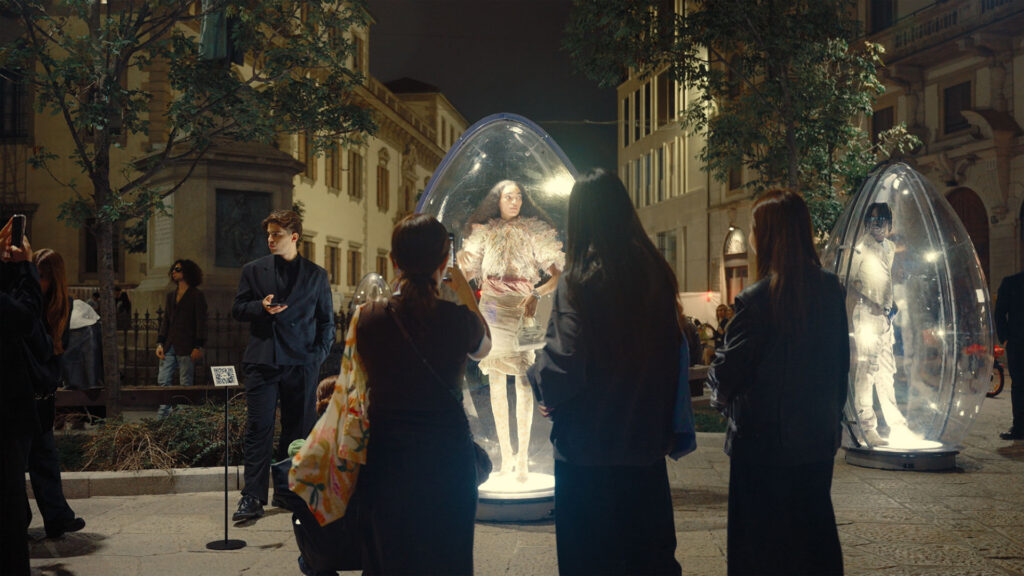
[Featured image: Diesel Egg Hunt, MONOGRID.]
Hey, and welcome back to The Interline Podcast.
Now, I might be biased here because I studied literature and I’m “in the biz” when it comes to writing and talking all the time. But I’ve said before that fashion is a storyteller’s game. And I think that’s becoming more and more true over time.
I think it’s becoming truer because there’s just so much damn content out there that it takes real talent and real craft to stand out. But I especially think it’s truer than ever because there are so many different surfaces where storytelling can happen. Anywhere a customer engages with a brand or product, that’s part of a story. It might be a tiny microchapter for the brand, but it’s heavily deterministic for the person on the other end. It shapes how they feel, how they act, and it certainly shapes where they spend time, attention, and money.
For fashion companies, that expansion of opportunities for narrative is obviously super exciting, but it’s also really testing the limits of what companies can do in-house. If they want to offer baseline unity of experience and brand identity across web, mobile, social, AI, AR, XR, 3D, and so on, and then they want to stack unprecedented personalisation on top of that, it’s a big ask for content teams that were accustomed to dealing with just a few channels and teams whose experience definitely predates the explosion of content creation potential, both good and bad, that generative AI has brought with it.
To help get a handle on all this, today I’m bringing on Francesco Bernabei, who is the CEO at MONOGRID. MONOGRID bills itself as a global creative innovation studio, and it works on precisely these kinds of storytelling questions for a client base of luxury brands.
Francesco is an interesting guy because he can talk not just about activations and campaigns in the MONOGRID portfolio, but also how the content landscape’s changing how the level of brand zone tech maturity is or isn’t evolving alongside the march of tech. And he can talk about what it looks like to make decisions that aren’t always driven by maximum exposure or virality and that push the frontier of storytelling in other ways.
Even if you’re not in luxury, I think you’ll find what he has to say pretty interesting. So let’s roll.
Never miss an episode
Get notifications for new podcast episodes, plus our weekly news analysis, events, and more, delivered straight to your inbox.
NB. The transcript below has been lightly edited.
Okay, Francesco Bernabei, welcome to The Interline Podcast.
Thank you Ben, welcome.
So there’s a couple of things we like to start every show with. One is the day to day and the other is the definition.
So let’s start with the first one. MONOGRID, as I understand it, is about 60 people in a creative studio with international offices and you work almost exclusively with fashion and luxury brands on experiences that span the web, AI, spatial computing, physical installations and gaming, which is a lot. There’s a lot of different technical surfaces there, which we’re going to get into. But there’s also a lot in terms of, I imagine, the logistics of overseeing that many people in that kind of portfolio. So walk me through what a typical workday looks like for you. How much of your work is still hands on and how much is business running and orchestration direction?
Absolutely, absolutely. That is actually a really good question that comes to my mind every single day: where I should focus myself the most now, in running the company more on the day-to-day stuff and hands-on project, or on this vision and strategy and the long-term work now on the company.
So my day is basically divided between let’s say 30% with recurring meetings that help me guide and catch up with the people in the company that are in charge of specific verticals like marketing, operation, sales or creative. I do run the creative team by myself now, all the other teams are, let’s say, in the jurisdiction of other people that report directly to me. So 30% of my time is on following up those main verticals.
The other 30-40% of the time is hands-on on the project, especially credit pitches and kickoff meetings or client presentations. So I do oversee the beginning, early stage of a project or a pitch both from a creative and production perspective and then I attend most of the clients meetings by myself when I can and where I can.
The rest of the time is basically troubleshooting. Having so many people, so many projects, considering that we handle something around 150 projects a year and almost 200 decks and presentation pitches, many things can go wrong in the day-to-day work and so, yes, I keep let’s say 20% of my time as a period of time where I can be flexible in solving problems or focusing on different stuff.

Okay, now I’m going to stretch the definition of the word definition a bit because I want you to tell me what you think it means for a brand to tell a successful story today. So something that stands out in a sea of sameness, something that holds people for the duration, because we’re at a time where people’s attention spans are maybe the thickest they’ve ever been. So, define successful brand storytelling.
Right. First of all, we need to diversify between which kind of brands we’re talking about because, for example – and let’s stay in the fashion luxury segment – for small or medium small brands, to focus on perseverance and consistency, I would say, in the storytelling. I think they don’t have to judge the results of a specific project that they’re doing but in the medium or long term, how the combination of many different projects perform in the storytelling that they are doing with the audience. And of course you can do that with consistency. So consistency both on the same channel and the same tone of voice and the same way of communicating. And this is fundamental because if you do something which is out of the box in terms of platform or in terms of storytelling or tone of voice, you cannot measure how it performs properly because you don’t know if you are intercepting a new audience or you did maybe a small mistake in the process that can change completely the perception that you have about data and about the results.
At the same time, big brands must have consistency as well, but they need a mask, cover many and different touch points. So it means that, for example, if you do a game, you’re doing a game once a year, maybe you’re not doing a game every single week as you do content production for social media or for your e-commerce. So the way that you measure the results is not on the specific activation. It can be, but this is just a part of the piece of the puzzle, but it’s on the long-term communication.
We have, and hopefully we’re gonna talk about a few examples today, projects that were part of a big ecosystem of communication. So you’re not judging the single piece, you’re judging the entire campaign. Of course the result is the sum of every single piece that you are doing.


Okay, perfect, good answer. And I think tied to some of what we’ve just talked about, we will get into the work, but I want to ask something kind of a bit foundational about the work. And that’s something I’ve noticed, which is a lot of the projects you work on, not all of them, but most, they tend to be brand owned and controlled rather than being reliant on third party platforms, gatekeepers, or intermediaries.
Now, you mentioned games. Obviously a Roblox experience needs Roblox to exist as a precondition. It’s not going to happen without it. But it seems like the majority of what you work on lives on brands’ own channels. You know, whether that’s websites, store windows, dedicated devices, installations out in the real world. I want to know where that choice comes from. Is that driven by the longstanding sort of high end luxury desire to control the brand’s own narrative? That’s something I talked to Francesco Bottigliero from Brunello Cuccinelli about recently. Or is it more of a recognition that people don’t really have a whole lot of trust in platforms right now? And if brands want their narratives to endure, then throwing them into that content show maybe doesn’t feel like the correct way to do it.
I’m just keen to know why it is that your clients seem to want to own a lot of this and where that comes from.
So, again, here we need to understand if you’re talking about luxury, you’re talking about fashion, if you’re talking about small, medium brands or big brands, but in general, let’s say luxury must build the communication channel to their clients on the brand owned channel first, and then diversify on the others. So, as you mentioned, of course, if you want to do a game and you want to do it on Roblox, you need to be on Roblox and you would be crazy to develop a Roblox or a Fortnite or a Minecraft kind of experience on your own platform channel. I mean, it would be super expensive, super time consuming, and of course, you will not intercept the people that are usually already on that platform that you choose. So I think the brand must diversify quite a bit.
If we are talking about luxury, of course, they want and they need to have people on their own channel, because if you buy Gucci, you want to buy Gucci in a Gucci flagship store, you don’t want to buy Gucci in a department store. I mean you can, but it’s not the same kind of experience, you know?
So with digital touchpoints I think it’s exactly the same. To elevate, be as premium as possible, you need to own your channel of communication at first, but then of course you need to be smart on leveraging on the other platforms that allow you to maybe reach people that you will not reach on your own, because of course driving people’s attention to your own channel is super expensive, time-consuming and requires a lot of consistency and resources. If you do a game and you’re expecting the traffic that you usually have on a Roblox experience, you need to spend a lot of money and keep the game alive for months, even years. And this is something that is not sustainable from a resource and economical perspective. So diversifying probably I think is the best way.
And then there is another key aspect of this, and that is people that live on a specific platform are used to engaging with the mechanics of that platform in a seamless way. Recreating that kind of knowledge is really complicated. Imagine, I don’t know, Super Mario. You know how to play Super Mario or a Super Mario-like game. Recreating a new brand user experience from scratch and hoping that everybody that is joining your platform will already know how to play that specific game or to interact in that specific way is really complicated. So leveraging an existing platform helps you speed up the learning curve, the learning process that the clients or the audience have with the experience that you are bringing to them.

At the same time, if you are on your own platform, you need to be consistent because you need to teach them how to interact with that specific platform – that could be your app, could be your website, could be your interactive experience or experience in store – you need to be a little bit more long-term driven.
Yeah, that makes sense. I think the part about trying to sort of reinvent the wheel and having people turn up and understand how to interact with it. I think that’s where some of the metaverse experiments and things went wrong – they tried to just cut it from first principles. Like, let’s just redo controls. Let’s redo interactivity. Let’s redo all of this. And not taking account of the amount of work that goes into making platforms smooth to interact with and the education and the grounding that comes with it.
There’s another thing I want to understand before we get too far into the weeds and that’s what share of your work starts from a pure creative brief with no preconceived idea of what technology is going to be the right one to deliver it versus what proportion starts with the technology? So, does the typical client come to you, and again you can separate this by brand type and size as necessary, but does the typical client come to you and say, for instance, we want a 3D experience for the web? Or do they say, this is the end result we think we want to accomplish, and we’re pretty open in terms of how you do it?
I think it’s a mix of both. Sometimes the hype of a new technology or a new platform helps the brand in leveraging on the PR ability, on the shareability of that specific activation. So of course, and it happens every single time a new technology comes out and we’ve witnessed many different kinds of technology from VR, AR at the early stage, AI, metaverse – every single time that a new tech coming up, brands are coming to us asking for a new experience on that platform or using that specific technology because they want to be the first.
On the other hand brands come to us with a need-driven or KPI-driven project that the brief always comes in relation to a specific platform. So they are telling us, look this is our goal, we would like to do that on the website or on a physical experience or in a gaming experience. When they come to us with a brief, they’re really, I would say, sharp in terms of which platform they would like to cover. And I think it’s also because they have pre-allocated budget for every single channel, let’s say, of communication. But they keep us quite free from a creative perspective.
So I think there is a mix of, again, a mix of both. If there is a new tech they want to be the first, if it’s not new tech but is already a known platform or technology they are just sharing the KPIs, what they would like to do and we come out with a creative idea that can perform well on that specific platform.


I’m not trying to aim with a kind of “gotcha” or anything with that previous question, but it does feel like maybe we’re in a bit of a period where fashion companies in particular might come to you with those budgets and say, I want a generative AI experience because that’s where the hype is. And I think we’d also had a period probably where they’d have come to you or to somebody else and say, we want to build something for the metaverse instead because at that time that’s where the funding was.
I don’t personally see there’s a lot of equivalence between the metaverse and AI, except for the fact that they’ve both commanded a lot of money and attention by being shiny and new. But I’m keen to get your take. Are there any lessons that fashion can take away from the metaverse activation phase, assuming the attention eventually ran out there, and not take that baggage into AI? Or are the same kind of themes and ideas from the metaverse still alive and kicking and Roblox and Fortnite and so on. I don’t see a direct through line from Metaverse to AI, but I do see that there are companies with budgets to spend on new technology for storytelling. And I kind of want to see if there’s any lessons we can learn from one to take into the other.
So of course the metaverse hype was the lifesaver in that specific period of time. Now COVID boosted the metaverse ecosystem because the metaverse was the only new way or the only way where brands could communicate to their audience, especially during COVID because stores were empty, shooting was an issue, people were stuck at home.
I think, again, as you mentioned, there is not a direct connection between the two periods, metaverse and GenAI. With the metaverse it was a lifesaver again. People were rushing into the metaverse just because they didn’t have anything else to do and they were hoping to unlock the new channel of communication for their brands.
AI is completely different because maybe last year brands would like to approach AI to be the first or try to leverage on the PR ability or the fact that AI was an hype. Now it’s just a commodity to do something that you usually do on a different technique – so, photo, video, CGI – but maybe leveraging on the characteristic both in terms of quality, time, speed and budget of generative AI.
The metaverse experience or gaming experience in general are not in hype anymore but are still a big piece of the puzzle for a truly omni-channel communication for brands. Let’s consider that there are 3 billion gamers globally. 16% of them are daily users, so half a million people are actually playing Roblox, Minecraft or Steam or Fortnite every single day. To give you a comparison, there are 5 billion people, so 10 times more, active, on social media. For me, metaverse and gaming are the same thing because they are basically digital platforms where people can interact with others and do stuff on a digital level. So basically the same thing. And it’s still 10% of what brands can achieve on social media. So it’s a big part of it.
I think that after the hype of the metaverse now, gaming experiences or immersive experiences are becoming a piece of the puzzle, basically, of the communication. AI at the same time is becoming more a commodity rather than a new thing or a crazy thing to try out and do.
Yeah, and I think that what we’ve found is as the models become commodified, that’s where the differentiation comes from the experiences and the applications you can build on top of them. That’s very much the sort of phase that we’re at.
Let’s talk specifically then a bit more about what you’re doing with AI, because I feel like your AI work, like a lot of people’s, probably fits into two buckets. There are projects that involve generative AI as a way to create visual interest or to test new workflows and push creative frontiers. But where the end results could, at least in theory, have been done with CG, digital art, film, there are other avenues to create the work. The Karl Lagerfeld work you did, the Max Mara project, they’re maybe the most recent examples that come to mind for me that fit into that bucket. Then you’ve got the ones that can definitionally only exist because they’re based on a generative foundation.The Gucci La Familia experience that you worked on as a prime example there, that relies on fuzzy natural language interface that would have been basically impossible to do any other way, or at least incredibly time consuming or impractical to have as a series of scripted dialogue trees. Because it’s based on conversations with characters, and those characters need to have agency. They need to respond to the semantics and the way that the user is interacting with them.
How do you see this balance of work shaking out over time? Where some amount is AI as a novelty or as a way to kind of test the state of the art and some amount is experiences that are only possible because of AI.
Yeah, so with GenAI probably we’ve already reached …as I mentioned before, it’s a commodity now. So brands are used to knowing that certain things can be done in AI, certain things can be done in traditional, let’s say, content production techniques. So it helped us to elevate the quality of the final output and is actually becoming something that is always present in every single bit of communication that brands are doing, not only from a visual perspective, but also from text and sound, etc.
For me, it’s exactly the same thing when stock photography or digital photography arrived. So the average quality of the content actually increased drastically because of that specific tech or because of that specific platform, and it’s exactly what’s happened with GenAI nowadays.
On the other hand, I think we are really at the beginning of what AI can do for experiential activities for fashion, luxury, but in general every single brand. Because if it’s really easy to understand how generative AI for content production works. I would like to do this image. I can do it with CGI, with traditional photography on location, or I can do in generative AI so I choose which is the best tool to use and this is easy because I already know what my final outcome is.
Generative AI applied to interactive experiences is completely different because you now have the blank canvas to build whatever you want. And that’s the tricky part because you need to invent something new rather than try to replicate something that you used to do with other techniques in the past now. So I think that the game would be there in the next few years. So how brands will integrate AI, generative AI into new kind of experiences or already existing experiences boosting, especially the personalisation of the experience through AI, because I think the key aspect with Gucci La Familia for example, that you mentioned, is that this is a game experience that everybody was used to seeing in the past, especially from Gucci. The only difference, which is the biggest difference, is the fact that the experience was completely brand new for every single user because it was generative. So every time a new person arrives and interacts with your piece of content, the result that comes out is different and I think personalised based on the single person.
So I think that is the key aspect of how to shape the future, let’s say, of these kinds of experiences using generative AI because we are going into a hyper-personalisation phase that wasn’t possible to do just six months ago.
That feels like it opens up a new avenue for brand risk. Like some of that, when you think about that probabilistic side of things where everybody’s getting a different outcome. Presumably there’s a lot of work that goes into steering the language models so that they stay on brand and on model and you’re not jailbreaking them and so on. Just give me a little bit of insight into how brands should think about how much risk exposure there is there and the work that’s involved in offsetting it.
I think it’s a matter of going step by step and working with someone that really knows how to use the tool in order to carve the direction in the way that you want and avoiding big mistakes or big errors.
Let’s say if you see every touch point of a fashion luxury brand, you may write down what is the ideal experience for a user, but you don’t have the control of it at every single step. Not because you can say to all your sales assistants all over the world, do this and that, but then you’re not there as a brand to control every single word that they’re saying or every single thing that they’re doing with the clients. With genAI, it’s basically the same. The only thing that is different is that you can create boundaries that it’s not so easy to create in real life. So I think if you go step by step.
It’s also nice with AI that you can do better testing pretty easily or AB testing pretty easily compared to what you may do in real life or with other platforms. And actually on social media you can do AB testing with AI you can do ABCDE testing because you can generate 50 different versions of the same campaign or the same experience and then see which were performing the best compared to the other.
So I think it’s a really ‘try and learn’ approach with AI, but if you do little steps and you build up on what you understood on the previous one, I think it could be really, really interesting for brands to use this kind of technology for sure.
I’m also curious to see how you and your clients approach the question of where to deploy. So we’ve talked about platforms versus own channels. I think I now want to talk about kinds of devices and where an experience lands in somebody’s hands or around them. And I kind of want to understand how much that’s driven by wanting the biggest audience and how much comes from pushing the frontiers and testing the waters.
So my mind goes to the work you’ve done with Gucci and Bvlgari on Vision Pro experiences and they feel like the best case studies because if those had been web deployments, they could have reached many, many more people and been easier to create because all of the infrastructure is already there. All of the user interface paradigms and everything we talked about were already proven and the audience is just much bigger. There are far more people with a web browser than there are people with a Vision Pro, better documented tech stack and so on. The Vision Pro gives you narrower reach but also a more distinctive and unique end result.
So walk me through how those decisions get made, where the choice is between do we want something unique for a small number of people or do we want something that’s bigger? And I kind of want to understand where they happen in the process.
So I think the two brands have different genesis and different briefs and different reasons.
So the Apple Vision Pro for Gucci was, as they always do, let’s be the first in trying out a new platform in the best way possible and try to learn by doing what we may do on this platform that we know that now is for a limited amount of people but in the future would be a mass device. We built up a project that is actually divided by a chapter and is basically becoming a kind of a new platform for the brand where every few months we update the app with a new chapter. So basically it is a way of building up the relationship with the limited audience that you have as you mentioned of course there are just a few thousand of devices around compared to the audience that can reach our website. But the experience is really, really premium and it’s really, really, really, almost tailor-made because people can decide what to do.
And in a website, of course, the experience nowadays is quite passive because you go to a website to solve one of your problems. Now you’re looking for a bag. You go to a website, you browse the bags that you like, you choose the colour, you choose the size and you purchase. Apple Vision Pro is more being able to step into the world of a brand that you are a fan of and discover more. You cannot buy anything in the Apple Vision Pro Gucci app, neither on the Bvlgari one. But it’s like stepping into a store and experiencing the brand in a really premium and interactive way and that is the only device that can allow you to do that. And this is for Gucci. And if you see the app, we basically create chapters for experiences that the brand is doing but they’re not available for everybody. So it’s a behind the scene door to step in the world of Gucci and be really there, really inside the brand experiences, but in a different way.
On the other one with Bvlgari, I think it’s different because the Apple Vision Pro is an evolution of an experience that we did for them in VR for an exhibition that they did in China. And basically the Apple Vision Pro became kind of the next step of bringing that same experience designed to be part of an exhibition for the customers in the flagship stores and in the stores to complete the user journey in the store. Because when you buy almost a million pieces of jewelry, you don’t tap in with your credit card and you leave. There is a certain time that needs to be respected and there is a bit of kind of empty time, I would say, in the store while you’re doing this kind of experience because maybe you’re waiting for something when you enter the store because maybe they need your appointment, it’s not ready yet or they need to prepare something specific for you, or then when you buy and you’re waiting for the product to be packed and ready for the shipment or to be able to take the product, there is an empty time. They decided to use Apple Vision Pro to fill that gap, to fill that empty time that you usually have in the store with the best and more premium VR and mixed reality experience you can possibly achieve through that specific device.
Because you can do the the same experience with MetaQuest 3, but the device is not premium, the quality of the visual is not at the same level as the premiumness, let’s say, of the user experience that you usually have in a Bvlgari store. So the two experiences have two different genesis and two different approaches.
Interesting.
What does it mean from your point of view to be user centric? So user centricity is something that you talk about a lot when you think about all of these different surfaces. We’ve just done VR, mixed reality, web, pre-existing gaming platforms, real world installations. There’s a lot of different touch points and different ways for people to interact with things here. What does it mean to put the user at the center of those?
I think every user experience in a brand ecosystem has the goal to be as personalised as possible. I’m stepping into a store at the time that I want, in the location that I want, the sales assistant is guiding me to find the product that is the best for me. So all the experience against, let’s say, a fashion brand or any brand is about personalisation of, what is the best for myself.
Technology can speed up this process at any level quite drastically. And I think the key aspect of creating a user centric experience is to leverage technology in order to be really, really tailor made on the user characteristic and on the user behaviour and user needs. I think the play, the game will be there for professional luxury brands now using technology in order to create in any platform, both physical or fully digital or social or whatever the best personalised experience possible for the user.
So the experience for me needs to be different compared to the same experience that another person is doing with the same brand, with the same campaign. So I think that is the key. And of course, for example, with genAI we did a project where we created, based on the same campaign, 25 different outcomes that were geolocated according to the region of Italy where you actually were seeing the content on the social media. So if I was in Tuscany I was seeing something, if I was in Naples I was seeing something else, or in Milan I was seeing something else. Because it was personalised based on the user behaviour and user need. Imagine this scale one to one. So imagine having an experience both in a store or in e-commerce or whatever that everything that you see is consistent with the brand in terms of storytelling and tone of voice, but is personalised based on what I’m looking for or how I am as a person.
And that I think is amazing because we have a more intimate relationship between the user and the brand. It’s like being in front of a personal assistant that knows you for many years and is guiding you in the user experience in the best way possible based on what you like or what you would like to do.
Yeah, I’ve had some conversations recently with folks about the way that intent and memory and things are evolving across the web when it comes to the sort of AI era. It feels like there’s infrastructure and machinery and stuff there that’s arguably taking us towards not just being able to offer more in the way of personalization, but actually being able to have a much more granular understanding of people’s intent as well. So you can do, yes, that broad brush geolocation sort of thing, but you can do much more in the way of direct intent and people’s real behaviours than would have historically been possible.
Exactly. Yeah.
I’m sorry, let me make a quick example. I love blue, it is not a good colour, but I always wear white, black or blue. And when I browse my favorite brand, I always filter by colour or looking for blue things. Imagine that I land on the website and they already know that and they showcase me just the blue things. It’s a silly example, but it represents pretty well what a seamless experience may be and a user-centric experience may be for the customer.
Yeah, that’s a great example. Actually, it’s good framing.
We’ve talked about some of your projects, your philosophy, and how that relates to the technology layer underneath it. And I think the logical question for any kind of conversation I’ve had with agencies and platforms and so on is, how digitally mature do companies need to be to take advantage of these opportunities? So, take Roblox as an example again. You can’t have an immersive experience without 3D representations of your products. You also can’t have an on-brand generative AI experience without having well-structured data and assets and understanding of your brand properties and so on.
How much of a consultative engagement is there typically in advance of the storytelling and experience building work for you? When brands show up, do they show up saying, here is our tech estate, here are all the assets, we’re pretty mature in all of this, or is it a fairly mixed picture?
I think it’s a mix, and with emerging technology or new media or new trends it’s really amazing to work with brands that already know what to do in that realm but is really, really rare because of course it’s really hard for them to organise themselves internally to be able to be up to speed on every single new trend, on every single new platform or technology, so they come to us and they ask us for kind of a creative consultancy in that specific field.
It’s nice when we build a relationship with a brand and they know where we can perform well and we know what they are looking for in a specific bucket of content or experiences. So I think it’s really a mix of the two things. Creative consultancy for us became really more important nowadays because maybe a few years ago the platform and the technology available were less. So, it was a website or was an installation, that’s it. Now it can be a website, an installation, Apple Vision Pro or a VR mixed reality, AI, whatever. So it could be multiple Roblox or etc. So it can be very, very complicated for them to be prepared for every single outcome. So our job is to actually guide them in order to use the new media or the new platform in the best way possible or also sometimes avoid doing something on a certain platform because probably it’s not the best and smart choice to do so now.
Two or three years ago there wasn’t this need and if a client were coming to us with a specific need we would just solve it. Nowadays, there are so many variables that we actually become more of a consultant for them in order to guide them not only where to do stuff but also whether to do something or not.
And I think, at least for us, it’s a really big change.
So there’s obviously a proliferation of surfaces and opportunities at the moment. Over time, do you see brands starting to build out more of that expertise so that they can deliver projects like these in-house? I know you also work on R&D and internal process improvements with companies, which is led by what you’ve learned from your own portfolio. I’m keen to know, does this stuff get internalised progressively over time? Because presumably, in the early days of social, it would have been the same situation. You would have had brands say, OK, I don’t fully understand the user-generated content social space. I’m going to work with external providers and partners until I do, until I can upscale and I can take these things on myself.
Do you see that same thing happening when it comes to AI, XR, all of these other sorts of surfaces? And how do you work with companies to kind of educate and elevate their own capabilities?
Yeah, it really depends which kind of technology we’re talking about. Of course if it’s VR or XR, they know that would be too complicated, too long, too expensive to structure themselves in that direction internally. So they know what is achievable, but they leverage on external partners to do so. External partners are always faster, especially against big corporations, big companies, because technology is changing every single month and is not compatible – especially the emerging ones – with the process and the limitations of a big company.
On AI it’s slightly different because people think that, okay AI is a ChatGPT prompt, that’s it, so it’s easy. So they start to hire people internally to do the job that probably a studio can do. This is my personal perspective. They’re going to hit the wall pretty soon. especially in the AI field, because the technology has become really, really complicated. So you need not just one person, but a team of people that are capable of using that tool together with the other tools that maybe you need to create a content or an experience or an image.
It’s good for brands to have someone internally that knows the industry or the technology a bit, but then you need to leverage on existing partners. And it happened with us recently, one of our key team members was hired by one of our clients, but they are still calling us to do the same project that they did with us in the past when this person was in MONOGRID and now is in the brand. Still they need to know what is possible, but probably it’s hard to internalise everything.
We saw this happen with e-commerce, for example, and brands are internalising the e-comm now or in the last five years and the e-comm is on hype, let’s say, for 20 years now. It took them years now to switch and internalise the thing. AI is one year old. So I think maybe it’s too soon.
Well, let’s come back in 19 years then. We can have that conversation about AI.
Exactly. Then of course, everything related to AI is really, really fast compared to any other technology in the past. So probably it will happen, but I don’t see it happening as quickly as they are hoping to do.
Yeah, I think, you know, we talked earlier about the commodification of the underlying models and everything and the need to build applications and experiences on top of them. That’s still the same workflow and talent acquisition processes as any other application shift. You still need people who know how to use the tools, as you said, know how to use them in conjunction with other tools. And you need people who can stay at the cutting edge, like when the state of the art changes so quickly in text generation, image generation, video generation, retrieval, augmentation generation, and so on, it’s a moving frontier at the same time.
Yeah, exactly. I think I saw some brands make this mistake. They basically put in charge of emerging technology or new tech, new media, the more junior people, just because they are younger. And they believe, okay, it’s gaming. You are 25 years old. That’s your department now. Sometimes it may work, sometimes it could be a disaster because it’s not just knowing a technology or knowing what is the latest tool available on the market, but the key aspect is to understand how you can integrate that new tool or the new technology into your brand ecosystem in an effective way. And this is something that can be done only by people that are really experienced in both technology and the brand structure and the brand touch points.
Yeah, you need strategy, knowledge, taste, brand, immersion, and everything else to layer on top of it.
Finally, just to bring us back full circle. So I asked you at the beginning of the show what successful brand storytelling looks like today. Tell me what you think it looks like in two or three years. Do you think new technology, state, the evolving state of the art is going to change that definition? Do you think maybe the luxury sector, the wider sector, is just going to become better at using the tools that they now have? Just walk me through what you think is happening in a couple of years from now.
I think the future is the integration between physical and digital experience in a better way. Now, really we have two different paths for the experience. Actually three. The experience that you do in the store, the experience at the physical level, the experience that you do online on a browser, and the experience that you’re doing on social media. And they’re really, even if we talk about omni-channel communication, they’re really quite far away, they’re not integrated so well.
So I think in the future, and this happened because we’ve seen the hype of department stores and retail, the hype of the dotcom, the hype of social media. And now all the hypes, let’s say, in terms of platform, are probably finished and the technology is much more integrated in every single aspect of our lives. And we are also expecting it to be. So I’m expecting to have the technology hiding in every piece of my experience during the day on any single level.
So I think the game for brands will be how to implement technology in the physical experience and how to merge the two things in as seamless a way as possible. And if you see how advanced the technology is in general and then you see how the technology is embedded in a physical experience, it’s mind-blowing because it looks like something from five years ago, ten years ago. Now we’re talking about touch screen monitors in stores when we have AI that can do the job of a PhD in half an hour.
So I think there is a lot of room for integration between the physical experience and brands would like people to go on their source because buying a white t-shirt from a luxury brand for €1000 or a white t-shirt from a fast fashion brand for €5 online is pretty much the same experience. So online the difference of prices is not justified, but in the physical experience it can be justified because there is a ceremony of the shopping experience, there is a place, there is many different things that can elevate the quality and the value of the product that you are buying in a luxury store rather than in the department store.
So I think the key aspect would be to integrate technology more in that kind of experience because people are used to talking to Siri, used to chatting with ChatGPT or Claude every single day, but they are still going in store and picking up shoes from a shelf and that’s it.
So probably that would be the next generation, let’s say, of storytelling for the brand.
It’s going to be interesting to see that play out. Maybe we come back around to this conversation in a couple of years and let’s see how far that integration has progressed.
Francesco, thank you so much for joining today. I enjoyed this conversation a lot.
Thank you very much. Thank you, Ben. It was a pleasure.
And that’s the end of my conversation with Francesco.
As I mentioned at the beginning, there’s obviously a lot in there about what the top flight luxury brands are doing. But I think it’s important that you don’t file all of that away as being only relevant if you work in luxury. One of the key things about AI in particular, and it’s something we’re going to keep coming back to this year, especially in our AI report, which is due in June, is it puts all of the same tools in basically everyone’s hands all at once. And provided you have the token budget to use those tools to the fullest, you have access to the same level of technical maturity as anybody else.
And the same is true about most of the different surfaces that are available to storytell across and publish on. If you’re a small brand, I’d personally never encourage you to build anything for the Vision Pro because the juice won’t be worth the squeeze. But basically everything else, content and publishing wise, is fair game, no matter your business size. There are experts and agencies out there who are thinking about and pushing the state of the art, and you can go work with them. But there’s also more that you can do and learn about yourself than ever. And hopefully today’s conversation has given you some guidelines for maybe where you want to focus that.
A very different topic next week. For now, thanks for listening, as always. And I’ll talk to you again really soon.