
This article was originally released in The Interline’s AI Report 2026.
Including profiles and exclusive interviews with 17 AI companies, stories and opinions from 12 different industry perspectives, and real survey feedback from around 100 voices from every level of fashion, bottled and analysed, The AI Report 2026 is essential reading for anyone interested in AI for fashion.
I still remember the first time I created an AI fashion image. It was in 2024, which feels like yesterday in some senses, but a lot more distant when you put it on the compressed timeline of technology.
I took a photo of one of our Blue Vanilla dresses on a mannequin, using my ageing iPhone, with nothing but flat, natural lighting. I uploaded it to an online tool, wrote a brief prompt (did I even use the word “prompt” to describe what I was doing then?) describing the setting, model appearance and age, and general framing of the campaign image I was hoping to get, and waited a few minutes.
What came back was noticeably not real. It carried all the hallmarks of early-stage generated content: flawless skin, a complete lack of folds or creases in the fabric of the garment, and a slight, perceptible emptiness in the eyes.
It was an interesting experiment, but I couldn’t use it on our site. It didn’t fit our brand identity or styling. But mostly, it just looked off. I sent it to my teenage daughter, and she replied within seconds (despite being in class where phones were strictly banned): “Is this AI?”
She told me to google the phrase “uncanny valley” -something I hadn’t heard before. It’s always alarming being taught by your kids, especially in a field you consider to be pretty well informed about.

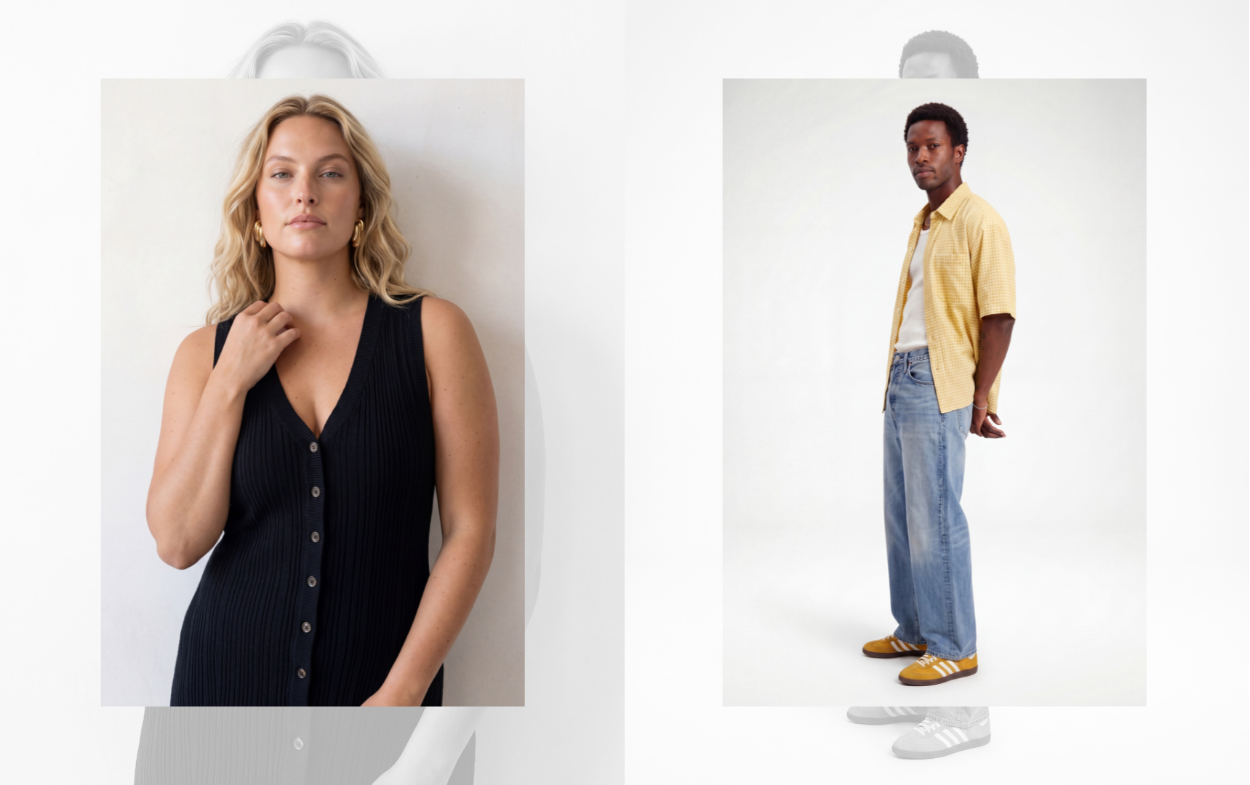
But she was right. AI-generated images of people, at that time, just a couple of years ago, fell into the uncomfortable middle ground of looking unreal enough to prompt a second glance, but real enough to create a kind of instinctive reaction of unease – a biological defense mechanism that kicks in when we see something that looks ostensibly human but doesn’t quite pull the illusion off. Not a reaction you want to elicit in your eCommerce customers!
In the last year or so, the speed of development in AI image generation has been quite remarkable, and outputs pass for real, vaulting over the uncanny valley, far more readily. Today, my daughter rarely recognises whether the images I send her are real, enhanced, or entirely AI-generated.
“The speed of development in AI image generation has been quite remarkable.“
The implications of this for fashion are monumental. Ours is a visual-first industry, and when you’re selling online, images are a brand or retailer’s stock in trade. They make the promise to the prospective customer, and the real product then has to live up to it. For the whole of the industry’s lifespan, we’ve had just a few ways to create those images and articulate that promise: painting subjects wearing the garments, in the early days of commercial fashion; photographing them after the advent of the camera; or visualising them in 3D over the last decade or so. Those methods all have their own results but also their own unique overheads and compromises, so AI is the first time brands have been promised it all: the fidelity and the texture of photography, the flexibility of CG, at a drastically lower cost.
Needless to say, like a lot of clothing brands, we have been inundated with approaches from companies selling their generative AI tools and workspaces since the models hit the point of maturity to make such a dramatic unit-economic difference. There are some great applications out there, in that mix, but after seeing that a lot of them relied on commodity image-gen models to do basically the same thing, I realised we should take a stab at building our own tool.
“Images and video are, as I see it, only “stage two” of AI’s impact on fashion.“
By linking it to Google’s image generation models (previously Imagen, and now Gemini Image / Nano Banana) and working alongside ViZO Studio, we built a bespoke platform that does everything we need. Now, we can create our own high-quality images for around 15 pence (GBP) a photo, depending on the resolution we need.
From a cost-to-quality point of view, this has been transformative. I will run through the maths in just a moment. But the thing I think every brand needs to consider is not just whether or not generative AI can replace photography, but how much more of the product journey we want to apply it to.
Images and video are, as I see it, only “stage two” of AI’s impact on fashion.
- Stage One was written content. Brands have been using ChatGPT since 2023 to churn out words for blogs, social media, ads, product pages, and SEO content.
- Stage Three and onwards is, potentially, everything else. We are already starting to see AI being deeply integrated into analytics, reporting, product design, tech stack replacements, web development, automation, Conversion Rate Optimisation (CRO), pricing, allocations, logistics management, finance, and more.
From where we stand today, I struggle to see many areas where AI won’t be able to automate processes, improve efficiencies, and reduce both overheads and headcount. And although I recognise we shouldn’t just extrapolate straight from the value that generative photography can provide, I believe every brand needs to be prepared to re-evaluate the way they work if AI has the potential to deliver comparable savings in other areas.

The Cost Comparison: Traditional Methods vs. AI
There are, obviously, clear positives and negatives at work here, alongside weighty ethical, environmental, and philosophical questions. You can find those in other articles in this report, and in survey data and public attitudes that are documented across retail and beyond, and I have my thoughts on them below. But taking the positives first, let’s look at the pure unit economics of traditional fashion eCommerce imagery in the UK:
| Role / Expense | Traditional Daily Cost | AI Daily Cost |
| Fashion Model | £800 – £3,000 (plus agency fees/travel) | $0 (AI Generated) |
| Makeup Artists & Stylists | £200 – £500 | $0 |
| Studio & Photography | Salaried/Variable | $0 |
| Total Cost for 50 Products | ~£2,500 (£50/product) | ~£50 (£1/product) |
Although the end result is, in the best case, comparable. The workflow required to produce AI images is drastically different. You simply photograph the items on a mannequin, upload them to the tool, write the creative prompts, select or create your AI model, upload accessories, choose a background, and press a button. The cost for 50 items plummets from £2,500 (around $3,300 USD) to roughly £50 ($66), and from £50 per single item to £1.
Of course, the current state of AI generation means this isn’t entirely seamless yet – and we need to account for repeat generations. Inconsistencies are common – not just the wild “hallucinations” of limbs in physically impossible positions, but incorrect shadows, odd expressions, or hair styled differently across photos of the same model. There are companies that charge only for acceptable outputs, but the primary pricing structure is still per-image, based on token consumption, and the cost applies whether you deem the results usable or not.
This uncertainty requires manual checking, potential resubmissions, and editing or cleaning in Photoshop. The upshot of which is that AI photography isn’t necessarily faster than a traditional photoshoot right now, even if it is cheaper by a factor of fifty. But as newer models debut, I’m confident that consistency and speed will cease to be issues.
The most liberating benefit, though? We can shoot wherever and whenever we want. We are no longer constrained by travel budgets, weather, or studio availability. If a brand wants to explore a campaign shot in Morocco or Paris, the freedom is absolute.
But as compelling as the economic side of the equation is, you also need to take on the ethical and environmental concerns:
- Job Losses:The impact on models, photographers, and makeup artists is deeply concerning. Because models are the largest expense of traditional photography, agencies will inevitably have to lower their day rates to stay competitive, and modelling, as a career, then becomes far less worth pursuing, and the diversity and availability of human models will eventually dry up.
- The Carbon Footprint:From an environmental perspective, does the energy and water guzzled by massive data centres get offset by a team no longer flying to an island for a shoot? I doubt it.
- The Echo Chamber of Creativity:If AI is trained entirely on past data, how will it create something genuinely new? My hope is that humans will justify their existence by bringing fresh, inspiring ideas to the table in a way Large Language Models (LLMs) simply cannot – even if those ideas then get ingested as part of the next training run, and even taking account of the fact that the economic incentive to create is being eroded if rates for photographers, post-production professionals etc. are driven down the way . However, it is possible the next generation of AI will learn to innovate independently.
- Copyright and commercial rights. Who owns the AI model’s face? Can a competitor scrape your AI model? What happens if a real human being is digitally cloned? These are extremely unclear frontiers right now, and there are plenty of actors with the incentive to support regulation.
But if the upsides and downsides of AI for photography are provoking some deep introspection, then the next steps for AI in fashion will be even more disruptive.
Tools already exist where you can upload the previous season’s best-sellers, and the AI will generate an entirely new batch of designs and CADs, and even submit them directly to the factory for production. You can link your website and ad accounts to Claude and let it optimise for conversion, ROAS (Return on Ad Spend), and budget allocation. From demand planning to adjusting RRPs for maximum margin, AI that’s grounded in your context and connected to the tools you use can make retail operations incredibly nimble.
“Who owns the AI model’s face? Can a competitor scrape your AI model?”
Right now, using these tools is incredibly cheap because tech companies are operating at a loss to win the AI arms race. This subsidised pricing will inevitably stop as companies merge or go bust. Unless ultra-competitive Chinese alternatives flood the market, costs will rise… but if adopting AI has flattened your costs in other areas, there’s a good chance you, as a brand, will still come out on top.
Over-dependency on AI is, of course, a major risk. All the cost-reduction in the world cannot compensate for a future where AI models become restricted to select customers, or can be made unavailable at an hour’s notice. Moving forward, human generalists; people who can see the bigger picture and understand how disparate systems work together, will be completely indispensable, because AI will not deliver the right outcomes without them, and because they may be required to bridge the gaps if AI becomes prohibitively expensive to use, or temporary illegal to access.
Roles will also need to change and adapt, otherwise you will be left behind. If you are a photographer or a stylist, you might want to consider becoming an “AI Prompt Engineer” or a “Digital Art Director.”
These are wild times, filled with massive opportunities and equal risks. For any fashion brand, the best advice I can give is this: make the most of it, explore, learn, and try everything. Because what you don’t know and don’t learn, your competitors will use to find a commercial and creative edge.