

[Featured image using Dots artwork for inspiration.]


Key Takeaways:
- For the second time in as many months, OpenAI has released a new product with a fashion workflow featured prominently in the accompanying demo. These hypothetical workflows keep presenting an odd window into the reality of AI deployments and the likely real sources of ROI for actual fashion businesses, and the incentives are difficult to decipher.
- Market data presented by a16z and The Interline’s own survey examine different aspects of AI uptake and measurement, with some correlation showing that AI adoption needs to translate into demonstrable product outcomes – especially if agentic commerce ends up de-emphasising website visits.
- In a new attempt at “sherlocking,” OpenAI launched its own virtual try-on service that hooks into its own in-app shopping experiences and into the company’s new play to become users’ default operating environment.
Summarise and debate with AI:
Take the content and context of this article into a new, private debate with your AI chatbot of choice, as a prompt for your own thinking. (Requires an active account for Claude; works without login for ChatGPT, Perplexity, and Gemini. The Interline has no visibility into your conversations.)
A guy kicks back in a chair and gives the go-ahead for his amorphous, fuzzy AI friend (one of OpenAI’s new “dots” always-on agents) to build a website for the upcoming “fall launch” of his menswear collection, using his approved designs. Later that day, he’s baking a cake and his agent comes back to him with a preview of the site. He looks at it for a couple of seconds. “Nice,” he remarks, before asking the agent to swap a couple of photos around and just get it published, then walking off.
Perhaps The Interline has a skewed idea of how stressful launches can be (big projects like The AI Report 2026, with a lot of moving parts, don’t exactly assemble themselves) but we suspect most people would agree that these are some remarkably placid reactions from someone who’s about to put an assortment of garments, which have presumably been refined over months, their materials, pricing etc. agonised over, in front of consumers for the first time.

But this person is by no means alone in acting strangely detached when it comes to using AI to make high-stakes decisions, or to create mission-critical materials for fashion. In the launch video for OpenAI’s frontier model, GPT-6 Astra, a woman stands in front of a projector and asks ChatGPT (via voice, but before the launch of dots, which is stylised as lower-case) to create a presentation for “next season’s rainwear” to present to retail partners. It should, she explains while she’s swinging a tennis racket and pacing, “feel really high-end and colourful”. Later, she seems fine that the output matched those extremely vague criteria, and asks the AI to book her a tennis lesson instead.
Now, this person might not have been under the exact same launch crunch as the one getting his fall collection live, but presenting products to retail buyers is still a make-or-break situation for a brand. What retailers decide to stock, and what they’re confident they can sell through, can determine the success of an entire season, or an entire year – especially if the brand only sells through partners, and doesn’t have its own direct to consumer storefront. These don’t look like the actions of someone who feels that pressure.

(We should note that the same dots demo also depicts a universe where a cake vendor pulling out of your wedding relatively late in the game is a minor inconvenience, and something you can comfortably delegate the responsibility of sourcing a replacement for to your agent. So perhaps this is just how people in the San Francisco AI bubble actually live.)
Why, The Interline has found itself asking, don’t the people in these fashion demos that the biggest AI labs keep making, seem to care? Or, to put it another way, why do the general-purpose AI companies who insist on pitching fashion professionals with their videos keep promoting a fantasy of running a fully hands-off business, rather than showing examples of more granular and more useful delegation?
One answer is that websites and wholesale decks do require real work to put together, but they have limited influence over the most direct predictors of product success, which are the style, colour, material, fit, price and other choices made much, much earlier in the journey.
In that sense, the brand owner hand-waving his approval to launch a website might actually have his priorities straight… provided the time and attention he’s saving by relying on his always-on agent is then diverted back into planning, design, product development, pricing and other vital gates.
Another answer is that people outside of fashion have a very surface-level appreciation for what goes into making a collection, or even a single product, and the examples of AI workflows they show are coloured by that arms-length understanding. “What do people in fashion do?” the solution-builders might ask. “Sell clothes,” they might answer. So logic dictates that’s where the demos end up focusing.
Before you read on...
Our weekly news analysis will always be available to read here at The Interline, but you can get it (along with notifications for new podcast episodes, events, and more) in your inbox by signing up to our mailing list.
A third response is that the AI labs themselves are ahead of the game, and they recognise that spending time building slides to show to retailers, or perfecting every user interaction on a website designed for human shoppers, is a dead-end, because the recipients of both those things may end up being AI agents themselves in the near future.


That dystopian reading is probably a step too far, although The Interline would someday like to write a sci-fi story about humans spending time in fake-work zoos where they build fictional products and brands, and have pointless meetings, just to maintain the fiction that human effort will always matter. If we ever find the time, we’ll let our audience know.
But there is, though, a kernel of truth to the idea that, for the big AI labs, fashion is just another vertical to automate, in as end-to-end a way as possible given the current limits of the technology.
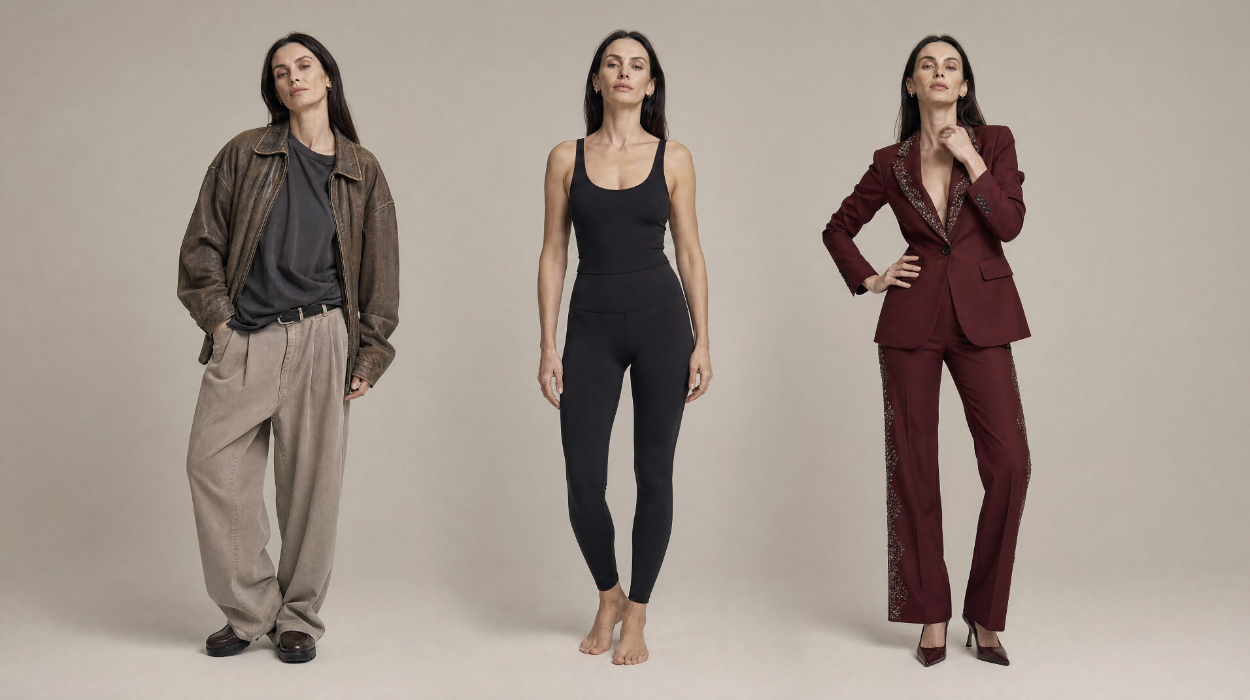
As evidence, just yesterday OpenAI released yet another new product: virtual-try on, embedded into ChatGPT and hooked into the branded experiences and transactional pathways that the company has already built with big-name brands and retailers. This leans on the recently-released GPT Image 2.5 model, and it allows users who are already talking to the LLM, and receiving style suggestions or product recommendations, to try those things on without needing to visit a store, or the retailer’s own website, with the understanding that AI visualisation is not direct fit simulation.
The resulting try-ons then make their way into ChatGPT’s new ‘Space,’ an evolution of the pre-existing Library, which analysts agree seems like the company’s answer to existing productivity suites like Office and Google Workspace, and which are the location where the hypothetical brands depicted in the videos might have done planning, as well as being where OpenAI envisions shoppers keeping their wishlists.
This feels, at first glance, unrelated to the blasé folks in the videos. But ask yourself this: is it a coincidence that OpenAI would show people effectively shrugging aside big decisions about their digital storefronts, if the same company’s mid-term bet is giving the growing number of people who use AI to shop online even less incentive to visit the brand or retailer’s website?

And consider, too, the prospects of specialist AI VTO providers whose business models, in most cases, hinge on shoppers coming to those websites so they can interact with the try-on service. (Last week did show some prescience on the part of one of the best-known of those providers, with a pilot of in-store AI VTO at a single Tesco location here in the UK, provided by AIUTA.)
It’s clear from not just the patterns in this week’s news, but also several of the on and off-record conversations The Interline has had this year, that the wind is blowing towards automated, agentic commerce. Which would, logically and naturally, make website-creation and slide-building into low-leverage activities that are primed for automation.
But we believe there’s something a bit deeper going on. Something that hinges on the understanding that making a storefront low-stakes to operate, and giving people reduced incentive to visit it, does nothing for the art and the science of making good products to fill it with.
And it’s here that fashion has an opportunity worth testing: can AI give professionals more time and better tools to improve the product itself? New solutions built for product development make that a concrete proposition. Whether they deliver better outcomes, or better returns than other uses of AI, still needs to be demonstrated.
For context, we can refer to a source that The Interline doesn’t usually like linking to: VC firm a16z, or Andreessen Horowitz, and its September State Of Markets report. Technology investors have an interest in the growth story they describe. Still, two charts are useful alongside our own AI Report 2026, provided we keep their measures separate.
The first chart puts the share of S&P 500 companies providing quantifiable AI impact at 29.7% in the second quarter of 2026. Our survey of fashion professionals asks slightly different questions, but demonstrates a similar trend: most respondents reported expanding AI activity, and more than half were positive or optimistic about its future.
The second chart concerns public disclosure: only 2% of S&P 500 companies disclose an AI metric they track over time. Separately, around a quarter of our survey respondents believe their organisation has a good rubric for assessing AI ROI. These are not directly comparable measures, but fashion companies do have a strong potential yardstick to use in quantifying their AI cost savings when they can be pegged to the well-documented and long-running costs of product photography.
But the most interesting opportunity is for fashion to start, today, looking beyond those already-identified use cases, and to begin implementing AI where it can make a more concrete difference to the product itself, not just the websites and the materials that promote that product.


Luckily, technology companies are already moving in this direction. The Interline has spoken to several companies that deal in AI image generation recently, both on and off-record (with more interviews in that space coming soon) and the consensus seems to be that the next logical step is for those companies to develop and offer patternmaking and tech-pack-creation tools. Ben’s recent interview with Weber Wong, the CEO of FLORA, captures a lot of this market evolution, so we encourage readers who are thinking about the next stage of AI deployment to listen to it.
Then there is an emerging class of AI-native solutions that are explicitly designed for the intricacies of product development, rather than being existing tools that are stretching their legs in that direction. The most recent example of this approach is Lectra’s Apogy, which was officially unveiled in mid-September, but which has an upcoming launch event in mid-October that Ben is hosting.
Solutions like Apogy are, in a direct way, the antithesis to the idea that OpenAI seems to have: that fashion professionals are in a rush to automate as much of their decision-making as possible, so they can get on with their lives. In The Interline’s experience, professionals and specialists who work directly on the art and the science of the product are unlikely to seize an opportunity to care less… but they should be much more responsive to the idea that AI can help them care more, and can support them in improving fit, quality, cutting sample rounds, optimising material yield, and working more efficiently.
Watching the dots launch video back, it’s hard to either acquit the guy who’s happy to wave his website through, or to condemn him, as tempting as the latter might be.
There’s a fair chance he’s a symptom of big AI companies being disconnected from the realities of working in fashion, compared to fashion-focused companies who understand them all too well.
But it feels like there’s an equal chance that he’s happy to let his website go live with minimal inspection because he’s also using AI to help make more consequential product decisions that happened much earlier.