


Hey. Welcome back to The Interline Podcast. I’m going to be candid pretty early this week. If there’s one area of fashion technology that I’m personally pretty disillusioned with, it’s the amorphous space around impact assessment and sustainability solutions.
Some of that’s down to the fact that the regulatory landscape that was supposed to be the tailwind for all this has ended up all over the place. After a long period of being told that punitive rules would come into effect after decades of self-regulation, what we’ve actually ended up with in fashion is way more carrot than stick, to borrow that old analogy. I’m being reductive here, obviously, but the industry spent a while either preparing to comply with a high standard of disclosure or, depending on the kind of brand they were, trying to find a way not to, or to pay lip service to it while still working the old way in the background.
So where we’ve landed is back in a primarily voluntary space after all. Digital product passports aside, the biggest brands today will tell you behind closed doors that they make sustainable, ethical collections as more of a branding and marketing exercise than anything else. And they do that because they see a stark reality. Consumer behaviour hasn’t really moved in the direction that anybody hoped, irrespective of what’s happening in the legislative space.
Most of the population surveys I’ve seen say that people value brands that make concrete sustainability commitments, or they flock to companies that can evidence their environmental or ethical credentials. And then they go out and buy products from companies that are demonstrably the exact opposite of all of that. Sometimes people do that out of necessity, right? I’m not sufficiently out of touch that I don’t know there’s a cost-of-living crisis going on. We try very hard to make these shows and The Interline in general as professional as they can be, but behind the scenes we’re all still people staring down the same realisation that everyone else is, that everything just costs more now.
Sometimes, though, people do this because this is just the way people are. Values have a tipping point that’s defined by value. If you get my drift, everyone has their price. Point being, this two-pronged effect, legislation and customer behaviour, took a lot of the wind out of the sails of tech companies that were supposed to be selling solutions.
It didn’t help that some of the solutions themselves were pretty thin. They just offered a way to roll up data from other platforms without conferring any real benefit in terms of assessing or sanitising or understanding the provenance of that data. Some other solutions had very closed proprietary methodologies that nobody could really inspect and you just had to trust. But even the robust, fully featured tools that were out there found themselves in a serious bear market.
I spoke off the record to several founders and brands over the last couple of years who told me that technology buyers were basically questioning why they’d invested so much time and money getting ready for a world that still looked really distant from the one they were actually working in. Needless to say, this led to a shakeout and a bunch of market consolidation.
There are now a few big names left in impact assessment and sustainability solutions. Some of those specialise in particular markets, but all of them have something in common. They are data-centric scientific platforms with clear methodologies and they have a focus on measurable outcomes. There’s nothing nebulous really left in this space now.
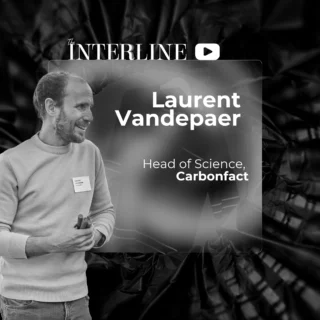
So today’s guest isn’t a tech CEO, which is our usual profile, but the Head of Science for a tech company that focuses on exactly this kind of neatly scoped remit, working with brands like On, GANNI, Carhartt, The North Face and others. Laurent Vandepaer works for Carbonfact, which, as the name suggests, is all about fact-based life cycle assessment with a focus on emissions. Their objective is to turn, and I quote, “raw environmental data into intelligence”. Carbonfact also acquired another company, Vaayu, whose founder our old features editor Emma interviewed way back in 2024, before this podcast came of age.
I wanted to talk to Laurent today because, as you can tell, I think certainty and stability and predictability are in pretty short supply where sustainability and impact assessment are concerned. And I wanted to get a first-hand perspective on what it looks like to try and create all of those things with a scientific backing. Oh, and there’s an AI component to all of this as well, just in case you thought we’d escape that for another week. Let’s roll.
NB. The transcript below has been lightly edited.
Never miss an episode
Get notifications for new podcast episodes, plus our weekly news analysis, events, and more, delivered straight to your inbox.


Laurent Vandepaer, welcome to The Interline Podcast.
Thank you very much. Thanks for having me.
I’m looking forward to talking to you. I think this is quite a timely conversation. We always start these shows by trying to get a feel for what our guests’ day-to-day lives are like. Your title is Head of Science at Carbonfact, and I honestly don’t know if that means you have to wear a lab coat sometimes. You can answer that one as we go.
Before this, you worked on life cycle assessment inside On, the Swiss running and lifestyle brand. So that means you’ve seen most or all of what we’re going to talk about from both sides, right? You worked for a company that’s trying to understand its carbon impact in the most granular way it possibly can. And you’re now working for another company that sells a platform and a method for calculating that.
Explain a typical day to me. How much of it involves “doing science”? How much involves communicating that science to brands? And how much of it is taken up by helping to turn that science into software?
On the lab coat, unfortunately I don’t own one, and I don’t wear one very often. Sometimes we do visit suppliers, so we have to wear some protective equipment.
The way my time is split is pretty straightforward. There’s a lot of time dedicated to answering questions from my colleagues and from customers. Why does an emission factor correspond to that number? Why is it moving? How was it modelled? That’s one big aspect of my day-to-day, communicating about the methodology and explaining how we get to the final numbers that we communicate to brands on the platform.
Then there’s quite a lot of time, as you said, helping to build the platform and translating the different frameworks and methods that exist, such as the GHG Protocol, for example, or the PEF, which is an LCA guideline at the European level. I help our engineering team translate these frameworks into the platform and make sure the calculations we do are in line with the different guidelines.
And then there’s quite a bit of my time spent discussing things with the ecosystem, with different external organisations. For example, in France we have ADEME, the equivalent of the Environmental Protection Agency in France. That’s a stakeholder we spend time discussing methodological choices and scientific choices with.
Cool. The second thing we ask our guests to do is to define something. For you, pretty expectedly, I’ve picked life cycle assessment or LCA. I’ve also heard people call it life cycle impact assessment. At Carbonfact, you talk about LCAs as needing to run cradle to grave, from the initial concept of a product all the way to its final disposal.
I want to use that framework to add a bit more specificity to what I want you to define. A product is only a product in the sense that it’s a finished assemblage of parts pretty late in its life cycle. For most of the duration of a product life cycle, it’s a bunch of separate, unrelated materials, trims, processing steps, sewing operations and things. They only get entangled in one another later on, when they become a product.
I’ve heard people talk about life cycle assessment in two ways. The first is that if you’re going to measure the impact of a product, you have to work from the finished product backwards because, by definition, that’s when the product exists. The other is the opposite. The only right way to do this is component forwards. You have to understand the life cycle of every individual piece before it becomes a product.
Tell me how you think about this. When does that life cycle start? When does it end? Does each piece have its own assessment? If so, how do you get to that level of detail?
The definition of life cycle assessment is pretty straightforward. The goal is to assess the environmental impacts of a product. That means the impact on climate change, but it’s also really important to account for other environmental impacts on water, land use change, ozone, and so on. It’s quite a comprehensive list.
Then how do you do it? Where does it start and where does it go? Maybe it’s not the perfect approach, but the way we do it at Carbonfact, because we work directly with the brands, is that it starts from the product. From that starting point, we usually go backwards, as you said. We look at the weights of the different components, what the main parts of a textile or footwear product are, where they come from and who the main suppliers are. Then we go up the chain to the raw material.
From the raw material, we describe the processing steps leading to the product. Once the product is assembled, it doesn’t end there. You also have to take into account the use phase and the end of life. Why do we account for all these steps? Because when you make a change in one of the steps to try to reduce the impact, you’ll see that the impact may move across the life cycle stages.
Something that’s quite typical is that a lot of the impact is driven by the weight of the component. Intuitively, if you want to reduce the impact of a shoe, you just have to build a super-light shoe. But that might also really reduce the durability. If you have something that’s super light, but also super fragile and brittle, and you can wear it only a couple of times, this will have an effect at the use phase. If you calculate the impact per use or per kilometre worn, if you take a running shoe, then the impact will be much higher.
There are certain materials that are much harder to recycle. If you stop at the product level, and don’t take into account the end of life, you might completely miss that a material that has a lower impact cradle to gate can lose some of those benefits at the end of life. Because it can’t be recycled, it will have to be incinerated or end up in a landfill.
The crux there, I think, is that you’re communicating the life cycle impact outwardly after the fact. Irrespective of which regulation or disclosure requirements we’re talking about, you communicate the impact once the product is finished, but you make decisions about the full life cycle impact while the life cycle is still going on.
I think that’s splitting the difference between the two approaches I talked about before. You have to be able to model the life cycle in a way that allows you to still influence it before the product is finished, right?
Yeah, exactly. There are two main goals that you might use an LCA for. One is just a basis for reporting after the fact. The other, which is really important and more exciting if you ask me, is to help guide decisions about future products and try to minimise their impact based on existing products. That’s also a really important use case.
Based on existing products, but based on the components that existing products are made of, right? If you think about your shoe example, to make a lighter shoe, you want to understand which areas of weight or lightness are going to create the most impact on the performance of the product and which are going to create the most environmental impact, so that you can counterbalance those in your decision-making. That means you need a lot of visibility into the impact of individual components and steps and processes, rather than just how they all come together at the end.
Yeah, exactly. We model every process, every step that leads to the final product. The way we usually prioritise is that once we’ve done a simple version of the model, we look at where the main impacts are. Then we double-click on what we call the hotspot, the most impactful portion of the life cycle of a product.
Perfect. I debated asking you to define two things, but I figured that was a bit unfair because I usually only do one, so I’m going to spin a different question out of this instead. The elevator pitch for Carbonfact, or at least one of them, is, and I’m quoting here, “We’ve turned the GHG Protocol into automated software.”
Walk me through what that means. I think a bunch of people listening will be familiar with the idea of Scopes 1, 2 and 3 and the idea that a lot of emissions tend to be further upstream. I think they’ll also be familiar with the fact that every business has a unique combination of those different scopes and a different permutation. I think people are maybe less clear on what it means to turn that emissions categorisation into a solution that works for everybody.
Pretend I work for a brand and I understand the broad parameters of where greenhouse gases and emissions come from, but I understand them just that way. The GHG Protocol is a framework for measuring, managing and mitigating carbon emissions. What are you selling me? What is Carbonfact selling me that is distinct from the framework itself? How do you turn the protocol into a platform?
The goal of the protocol is to tell you what to measure. But when you look at a textile product, it doesn’t really explain how to measure the impact of these products. What we sell to our customers is help assessing the environmental impact of textile products. We provide them with a set of production sequences per product category to facilitate the calculation. We select emission factors to describe all the typical processing sequences involved in a product. That’s one important scientific aspect of translating these protocols into the platform.
On top of that, there’s a lot of work integrating all the data that comes from the brand about its products, connecting to its ERP or its product life cycle management system, for example. We do full integrations with their internal systems. We really try to avoid having our customers fill out a rigid template. We build a bridge directly from their system to ours. That’s one of our strong suits. The goal is to make the data that lives in their system correspond to the right categories in, for example, the GHG Protocol.
What’s also really important is that the GHG Protocol and assessing data at the corporate level is the starting point for what we’re trying to achieve with the brands, which is to reduce their environmental impact. Once you understand the impact at the corporate level or the product level, we discuss with the brand how to reduce it. We have workshops with them to identify the main levers. These are the different things that are built on top of just translating the protocol into the platform.
When you talk about that kind of mapping and a custom approach per brand, there’s a question that comes up on the show over and over. How much of your work and Carbonfact’s work in general is software and how much of it is service? Because it sounds like there’s a big service component to it before you get to the software implementation.
We use the software to guide our customers. It also depends on the maturity of the customers. You have different tiers. Some customers just use the platform as it is and do a lot of things autonomously. Some other customers, maybe because they’re a bit earlier in their journey, need a bit more hand-holding.
But you have the opposite case too, where they’re really mature and advanced and they push the development of the platform. They also require a lot of working together and some advisory work. We typically partner with these brands to improve the platform for the customer base.
Carbonfact has a case study with On, your previous employer. I don’t know if that dates back to your time there, but it talks about the impossibility of scaling a manual approach to component-level weighing. There’s only so far you can take that when you have people doing it.
Other case studies for Carbonfact talk more about gaps. The problem is less “We know every piece that goes into our products and we just can’t scale the work of measuring it fast enough.” You have people who are more in the boat of “There’s a bunch that we know we don’t know, and we need to try and plug those gaps.”
Give me an idea of what the average maturity is like for the market that you’re selling into. What you’ve just described is a very heterogeneous market. You have customers working with you to push the platform forwards, and customers that need more consultation and are looking to you to help bridge gaps. Give me a rough idea of where most people land. I’m guessing most people have gaps rather than the scaling problem, but I don’t know how many gaps they have. What’s the typical maturity of somebody who comes to you and says, “I want to be better able to manage and mitigate my emissions. I want to be able to understand them”?
As you said, it really varies from one brand to another. Typically, when they start with us, they have the data somewhere, but it’s in many different parts. For some aspects, it might still live in some Excel spreadsheets somewhere. It’s not concentrated in one place. That’s a typical use case. Where we help them is to guide them in bringing all this data into a consistent form that’s usable.
We have really different levels of maturity. We have customers with many gaps, and these customers benefit from the intelligence that already exists on the platform to fill those gaps. For example, if they’re missing some component weights, we can derive statistics from what we’ve gathered from our entire portfolio.
They might not know the exact production sequence to get to a product. If you take a T-shirt as a common example, we have default production sequences embedded in the platform for each product category. To get started and do their first measurement, they don’t have to do the manual work of describing the full production sequence and defining all the weights. That’s something we can really help them with. Sometimes it’s challenging to get the weights of the different components. That’s a reality in the industry, but some are much more advanced than others.
I think the baseline for a lot of impact measurement is that you have solutions and providers who will say, “Give me the data you already have, and I’ll roll it up from across different sources. I’ll give you new insights and put some power in your hands to package those up and make them part of digital product passports,” or whatever means of disclosure they’re looking at.
A lot of the information that lives in existing systems doesn’t have the best provenance necessarily. It doesn’t have the best history. I’ve worked with and around enough brands to know that there’s a lot of self-attested data in PLM and ERP and so on. There’s a lot of averaging when it comes to negotiating with suppliers. Long story short, the data that lives in those systems isn’t necessarily trustworthy, or maybe it’s not as trustworthy or robust as you want it to be.
When you run that sort of enrichment from the wider pool of information you have, tell me where you get the data from. Give me an idea of what happens if the additional data you can provide conflicts with the information the brands already have, which has a different confidence interval.
Don’t get me wrong, I know brands do this work because they care and because they have values. They have limited tools to do it. You have a much wider range of tools to do it and potentially much more robust data. Tell me how you capture that robust data that you extend into other brands. Give me an idea of what happens if your data supersedes or replaces or conflicts with something that people already assume they know.
We have data from quite a wide pool of customers. This is ideal for spotting anomalies when we receive data from one specific customer. If the data is really off the benchmark, a small alarm will ring and we’ll discuss it with the brand. We can start by using our default value and then work with the brand to figure out what their real data is, so we can override the default and use their data. Benchmarking across our customer data is one way to do it, I would say.
Then there’s data from the literature. There’s quite a lot of research about LCA or energy consumption, or any of the other important components of building a footprint. We look at this literature too. If a number doesn’t match what’s expected in the literature, that’s also a way we’ll work with customers to see if there’s an error.
Another way, and it might sound a bit stupid, is to ask for the same data point in two different ways. We typically do this with suppliers. When we collect electricity or energy consumption data from a specific supplier, for example, we typically ask for electricity consumption at the factory level, and then how to narrow that down to the specific product we’re trying to model.
Then we ask for it from the bottom up. We’ll ask, for example, for information about the power of a specific machine involved in the process, the cycle time and the amount of output of that machine. This way we can cross-check a similar data point. We do this, obviously, for the really important ones. And the last way is to go on site, check the process and discuss it with the supplier.
We’ll never override a number without first discussing it with the brand. Usually, when there’s an anomaly, that’s the starting point for discussion and then we figure out what the best number is to use.

In that final stage you mentioned, where the best answer is to go directly to the source, directly to the supplier, is that something Carbonfact does, or do you partner with inspectors or auditors for that?
That’s something we do. We discuss it directly with the suppliers and collect primary data for them.
All right, we just talked about quite a complicated data estate. Let’s make it even more complicated and talk about how we work AI into this. Carbonfact does AI-assisted data mapping. There’s a good example in your changelog for your September release, which adds the capability to extract information from PDFs. Energy bills are a good example.
I see a tonne of value in that. I think a lot of these accounting platforms fall apart when it comes to the reality of somebody needing to put information into them all the time, especially if that person has a day job and doesn’t have the luxury of spending all their time on record-keeping. I think everybody would agree that’s a good use of AI. The same release also talks about using AI to guide user journeys towards the same end, removing some of that friction. Again, great.
There’s another potential use of AI that may be a bit more contentious, but I’ll see what you think. That’s using it to model, predict or synthesise data that could be used in that enrichment or gap-filling we’ve just talked about. I’ve spoken to some tech companies before who think this is the logical next step for an industry that is largely not going to factories and doing primary data collection. If you’ve got a system where there’s a bunch of supply chain data flowing through, you have the potential to start estimating things on that basis.
Jonathan from your team wrote a piece this summer where he talks about something similar to this, which is, and I’ll quote, creating “a data-backed estimate drawn from the patterns of the 2 million-plus weekly LCAs” that Carbonfact runs for its customers. I think there’s validity there. I think this is a sensible use of AI. But I’m going to contrast it with a data point from our AI report for this year, which is that only about a quarter of the companies we surveyed trust AI enough to support critical decision-making.
To be as blunt as I can about it, what are you seeing or building that you think can overcome some of that scepticism and demonstrate that AI is valuable in this process, and that people can trust you when you start to estimate things?
I would agree that it’s really important to remain, at least at this stage, quite sceptical of these systems. The way we do it at Carbonfact, to give a bit more detail, is that to fill these gaps, we’ll always have to be able to map it to the heuristic that we use. We have to understand all the calculation steps that lead to the data point or the heuristic we use to fill the gap.
As soon as you lose traceability and you let an AI guess, for lack of a better word, what the heuristic should be, then it becomes really hard to defend that number across your different stakeholders. If you’re a customer, if you’re a brand, you need to defend that to people in your company or to an auditor.
The heuristic we calculate is always based on existing data. As I mentioned before, we would do statistics to fill these gaps. We do statistics on average weight, for example. If that weight is missing for a component, we would use that. We would also do statistics on average yarn size or yarn thickness, because that’s an important parameter in the final impact.
All the data we use in our heuristics is based on existing product data. But it’s really important to be able to describe the calculation steps leading to the heuristic and then link it to the original source. If you’re not able to explain how a number was derived, I would remain sceptical.
The other use at the moment where there’s really a lot of potential is, as you said, to make sense of messy data and file formats and help aggregate or collect this data using these AI tools.
Do you think people’s confidence in the synthetic side of things there, in that data-backed estimation… “Estimation” is the wrong word, I guess. And I guess “synthetic data” is kind of the wrong word as well. Inferred data? I don’t quite know how to describe that.
Do you think people’s confidence in allowing AI to say, “Based on industry best practice and knowledge gained from years and years of how other people do this and how you’ve done it in the past, this is the likely impact here, and this is a choice you could make to mitigate that impact” will grow over time?
I think we see tremendous progress in all these tools. On the Carbonfact side, the trust can only grow because we get more and more data, and we get more and more use cases with all this data. The quality of these heuristics is already growing thanks to that, and so are the methods for deriving them.
To pick on another case study from Carbonfact, which I’m going to do once or twice more, so apologies in advance, La Sportiva describes using Carbonfact to assess designs early and simulate their impact. This is something I definitely endorse. I’m someone who’s spent a lot of time advocating for virtualisation and simulation as a way to move more decision-making, creative, commercial and sustainability-minded, earlier in the process, where it doesn’t need the time and the impact of physical sampling.
Being able to virtualise or simulate something depends very heavily on how well the model represents reality. Can you walk me through an example of a simulation or a set of scenarios and give me an idea of what kinds of decisions they can influence?
To me it ties together everything we’ve just talked about. When you’ve got confidence in the data that exists, when you know you’re trying to bridge identifiable gaps, and when you’re making decisions on the fly instead of just looking back at a finished product and saying, “Oh, we could have done something better there,” being able to model stuff and run what-if scenarios seems like an essential piece. Explain to me how that works and how you build confidence in it.
Definitely, one really important use case is to help these brands reduce their impact. One of the key tools to be able to do that is to run these what-if scenarios. Usually the starting point, as you said, is either an existing product or an existing model where you have quite a lot of confidence. Then you take that product and try to tweak certain aspects of it.
You can do many different things on the platform. For example, you can switch the materials. If you’re using leather, you can switch to a synthetic version of that leather. You can modify the weight, as we mentioned earlier, or things like the energy mix, so the heat source or the electricity source, because that’s usually one of the important hotspots when you look at the impact of a product. You can look at the effect of changing one factory for another, when you have a lot of granular data. That’s also an interesting use case.
Loss rates are also important. When you assemble a product, you can have quite significant losses of quite impactful material, in particular in footwear. If you can model by how much you can reduce the impact by tweaking this loss rate, it becomes really powerful.
Basically, most of the things you can imagine changing in your materials or your product can be modified. Modifying a process step, for example, is also interesting. Dyeing is quite an impactful step in the textile industry. Changing the dyeing technology can also be modelled.
When we think about making a turn during production based on the outcomes of a couple of different what-if scenarios, I think you’re talking about two things. One is who does that modelling and who makes those decisions? You can think of quite a broad user base there. You can have people in planning, design, development and sourcing who all need to be able to do some of that modelling.
Then you’ve got the cultural question around it. Does the brand give people the power to actually make the right decisions based on that model? You have a case study with A.P.C., and in that they called Carbonfact an extension of their sustainability team, which is a really good sound bite. But the sustainability team in a lot of brands is kind of its own thing. It has some influence over the way products are designed and developed, but ultimately responsibility for making the right choices doesn’t necessarily sit there. It sits everywhere else.
I get that this is maybe a bit of a straw man because the kind of company that’s got a cost-first culture and ignores what its sustainability team says probably isn’t a Carbonfact customer. But I do want to see what you’ve found. Who’s the user for Carbonfact data and for scenario modelling? How big is the user base? And how ready is the typical brand culture to accept some life cycle assessment flags that come up during design, development, sourcing and production, and say, “This might be commercially fine, but it’s going to dramatically increase the carbon emissions of this product to a level that we can’t sustain, so we need to make another choice”?
Definitely, that’s one of the challenges every sustainability team has to face, to be heard in the broader organisation. We’ve learnt different things, and there’s also quite a bit that I learnt from my time at On.
The first thing I think really helps our customers is that we provide them with robust numbers that they can communicate to their colleagues in other departments. There’s nothing worse than when you go and present the numbers to, for example, your CFO, who might be involved in the reporting, and they start to have doubts about the numbers. Then the entire meeting turns into a discussion about the calculation. Providing a really robust calculation this team can feel confident about, without being constantly questioned about it, really helps them communicate to the broader organisation.
For the team to have more impact, I think that providing easy-to-digest sustainability metrics is also a good way to do it. For example, we have some customers with very simple targets, like reaching a certain percentage of recycled content in their products. This is typically a metric that can be quite tricky to calculate in-house and track year over year. We provide a specific metric for that. We can also provide the same metric for bio-based material or anything else. Having metrics that are easy to understand for a broader audience in the company is something that can really help you have a bigger impact, beyond just having these numbers living in the system.

Penultimate question. Carbonfact acquired Vaayu back in May, I think it was, early summer. I previously interviewed Nam from Vaayu on stage in Paris, so I know a little bit about their methodology. A friend of mine also runs a menswear brand that had Vaayu as a foundation for its customer-facing impact measurement tools, which were pretty robust.
How different was the Vaayu methodology to the Carbonfact methodology? I’m guessing if it was the same, there wouldn’t have been much value in the acquisition aside from talent and customer base. Walk me through what reconciliation was necessary there and help me understand how different methodologies can maybe paint a more complete picture when you bring them together.
There were quite some surprises when we could really look into the Vaayu platform, in a good way. Many of the choices they had made were, in fact, quite similar to ours. In terms of philosophy, I think it was really comparable. It was really LCA-based, quite granular, like ours. It was interesting to see how two different teams could converge on similar problems without really talking to each other, because we used to be competitors.
But when you do an LCA, there are so many choices you can make. For example, to come back to emission factors, they can come from different databases. If it comes from database A or database B, the process step or the material you want to represent might get a different impact score. Inevitably, some of these choices were different across the platforms, and that led to two different results.
One piece of work we had to do when onboarding former Vaayu customers was to take their baseline calculation and rerun it using our calculation engine. The final absolute number might change. For example, if you rerun a customer’s baseline for 2022 and want to understand what their progress is this year in terms of reductions, we have to recalculate the impact of that baseline year and the impact of the current year using the same basic data, the same activity data.
The trends stay the same across the different platforms. The levers that reduce impact will remain the same. There were also things we could learn from Vaayu. They’d made some really interesting choices in the way they displayed the results that we could also embed in the platform.
From a consumer point of view, if we think towards the near term and the longer term, people buying products need to have confidence in the data that’s put in front of them by the brands and the way that data is packaged up. Now obviously digital product passports are adding a bunch of structure to this. Do you think that structure is enough? Or does each brand need its own way of talking about these things that goes on top of putting them into digital product passports, for instance?
If you have your own methodology and you have confidence in it, and it comes from one source or multiple sources, what do you think the future looks like when it comes to people buying fashion and trusting the information that’s put in front of them about its impact?
I think it’s really important to have really clear guidance so that all the calculations across different platforms and different brands are made following the same guidance, so they’re comparable. But what also plays an important role is the choice of emission factors, of the databases used to represent the impact of a product.
If those can also be shared, if the methodology can be shared and the basic source of emission factors can be shared across platforms and brands, and we all use the same ones, then the final numbers you get across these different players will be much more comparable.
That’s something we’ve been trying to push by building our own LCA database, which we’ve released as open source so that anyone can use it. The methodology behind each number is also publicly available. Consumers or any stakeholders interested in understanding what led to a certain number can really dig into the method. There can be more transparency about the method and about everything that goes into a final model.
I think a bunch of brands are maybe gun-shy when it comes to this communication for two reasons. One, they don’t have the data, which we’ve already spent a lot of time on. There was a company that tried to become the product-level methodology that would be put in front of consumers in labelling terms. It didn’t go especially well for them. The company still exists as Worldly, but that was a cautionary tale, I think. Do you think the industry’s learnt a bunch from that? Do you think that kind of open-source inspectability is key to overcoming some of that legacy?
I think we’ve definitely learnt a lot from this across the industry. One of the key things we learnt was about being transparent and having a robust method and robust sources that are fresh enough. That helps you have more faith in the final number.
Final question. I think some consumers are disillusioned with the idea of carbon footprints. There’s a prevailing idea now that, to some extent, on an individual level, that was something foisted upon people as a way of transferring liability away from big corporates, petroleum companies and so on.
I know Carbonfact, despite the name, assesses more than just carbon. You’ve mentioned it already. How useful do you see carbon emissions being as a way of assessing, documenting and minimising impact? How much of the impact fashion has is measurable as carbon? What else matters and how much does it matter?
In terms of how important carbon emissions are to the broader environment, I think climate change is definitely one of the most vital problems of our time. I think it’s good that it’s being prioritised across the industry. But as you said, it’s really important to consider other impact categories. In fashion, you have issues with water consumption. You also have issues about toxicity, the use of chemicals and land use change. These also need to be embedded in these assessments.
On the topic of carbon footprints and shifting the burden to the individual, the main use case for the numbers we compute on the platform at Carbonfact is still for companies to use them internally to guide better decisions. A second use case is to communicate them to customers eventually. These are two complementary use cases.
Laurent, thanks so much for joining me. I’ve enjoyed this conversation. I appreciate you letting me quiz you on a whole bunch of different things there. I’d love to have you or somebody else come back on in a year or two to see how things have changed in the interim. But for now, thanks. I’ve enjoyed this conversation.
Fantastic. Thank you so much for having me.
And that’s the end of my talk with Laurent. You can probably tell that I was on the front foot a little bit this time around, not because of anything related to Carbonfact itself, but because of everything I talked about at the top.
The Interline did a sustainability report a couple of years ago, and I went and I leafed back through it in preparation for this interview. There’s so much in there, a lot of which we didn’t write, so I can’t take any real credit here, that could be written today. It still feels as fresh. It still feels as valid. And my hope is that by the next time we pick this topic back up, things will have actually continued to move forward.
It seems clear from this conversation and from a general reading of the sector that facts, science, and certainty in impact measurement are going to be necessary for any real impact minimisation and mitigation.
We’re actually going to be doing an episode on digital product passports and the technology infrastructure behind them early next year, around the start of season three, so we’ll be coming back to this fairly soon. For now, though, we still have another few shows to do here in season two before we take a holiday break. Thanks for listening. I’ll talk to you again really soon.