
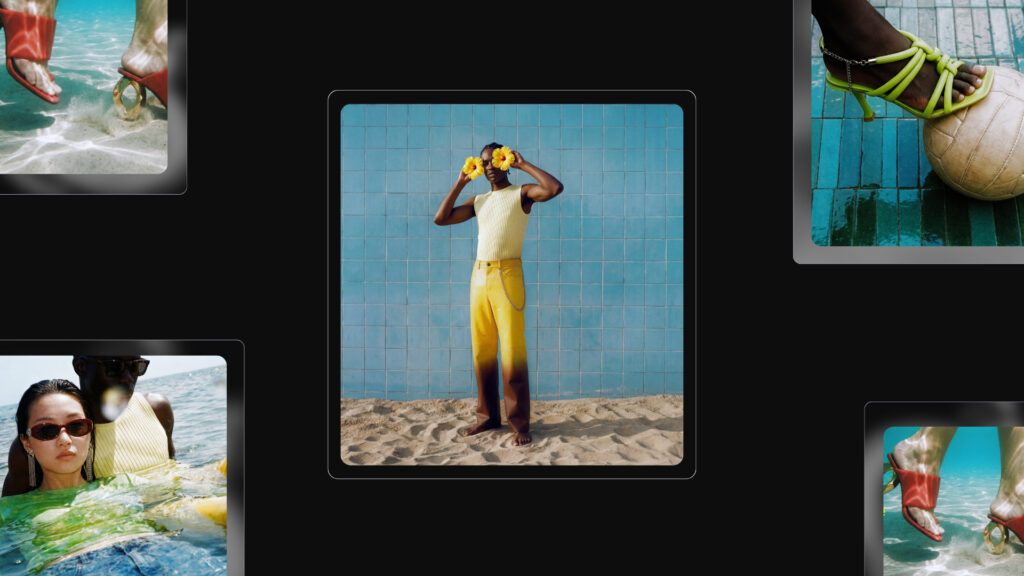
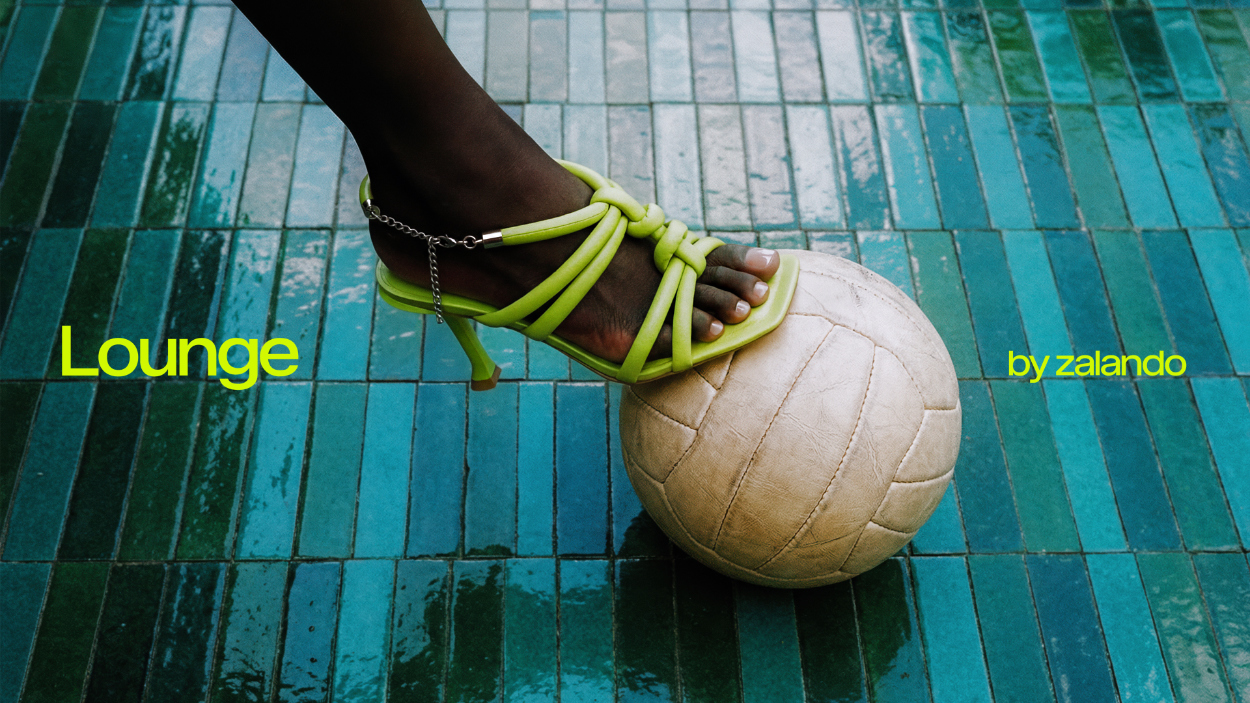
[Featured images: Lounge by Zalando]
Hey, welcome back to The Interline Podcast.
There’s no escaping AI-generated images right now. From some of the world’s biggest retailers to mid-sized domestic brands here in the UK, Europe, America, further afield, fashion organisations are turning to AI at massive scale as a stand-in for traditional photography. Both routine, high-volume website and PDP content, and full-blown creative storytelling campaigns.
In a very real sense, if you pause this podcast and you go shop online for a bit, or even scroll your feeds, I can practically guarantee you’ll be seeing images that are either fully AI generated or at the very least AI enhanced. This is, to put it pretty mildly, contentious. Every study out there has reported what seems to be a basically universal sentiment that consumers aren’t keen on AI being used to sell to them, which is kind of a corollary or knock-on effect of the general groundswell of anti-AI feeling out there.
But this is all also very clearly where the industry is headed.
Technology doesn’t reach this kind of adoption this quickly in that kind of hostile environment I just talked about without some very clear incentives in place. Fashion companies, on balance, don’t invest purely speculatively, which means that AI images are everywhere because they and the workflows behind them have some inbuilt advantages over traditional photography. The advantage that springs to everyone’s mind first is also the reason behind a lot of the AI pushback. It’s potentially a lot faster and easier than photography would be.
If you want to take photos of garments or footwear or accessories for your own storefront or to provide them to retail partners, then you need final samples. You need a studio, you need a human model, you need a photographer, you need a stylist, a makeup artist, and so on. And you need to align the calendars to get all of those things in the same place at the same time, unless you’re big enough to have them on staff and in-house permanently.
If you want to create the same kind of images for the same use case with AI, you need a final sample still. You need a few photos that you can get away with snapping on your phone realistically, and you need a little bit of time. With a generative model and some budget to cover the tokens. There are inarguably fewer moving parts of a synthetic shutter snap than there are behind a physical one.
There’s a tricky continuum here now between efficiency and laziness. And AI detractors would argue that the latter is dominating, which is what the reason is behind us having a flood of slop. The advantage people come to second is cost.
Take everything I’ve just said, and if you switch your decision-making matrix from time to budget, and even if the token prices increase as markedly as people suspect that they will when the big AI labs IPO, it seems inevitably cheaper to generate campaigns or PDP images than it is to photograph them.
The other advantage people talk about is the potential that can come from being freed to some extent of those time and cost constraints I just mentioned. Now, that might manifest itself as more interesting, more inspiring, more unfettered creative marketing campaigns. It might show up as more comprehensive regionalisation of content or more lateral coverage of images and video on storefronts. It might look like the fabled old do more with less.
Today we’re running through all of these. And my guest to do it is Glazione Rocha, who’s the Creative Director at Lounge by Zalando, which is Zalando’s off-price business unit.
I reached out to Glazione for two reasons. The first is that Zalando itself is at the forefront of communicating around its intent to scale AI usage in image creation. It also seems to be at the forefront of AI adoption generally, but specifically it’s the forefront of talking about it openly. You know, this isn’t a company that’s quietly swapping out a few product images for AI alternatives and taking a read on what happens and then maybe walking it back. This is a big retailer listed on the DEX, Germany’s Blue Chip Index, doing more than 4 billion euros gross merchandise volume in its last quarter, saying that effectively generative AI is the future of its entire image and video creation operations.
The second reason is that Glazione himself has been extremely open about how, where, and why Lounge is using AI to create campaigns. He’s also clear-eyed about what he thinks the impacts will be on junior creatives, models, photographers, and more. I wanted this opportunity to quiz Glazione partly because I think Lounge’s most recent AI campaign, the summer one, offers a distilled version of the whole AI images debate. But primarily I wanted to talk to him because, as you’ll hear, the workflow behind that campaign doesn’t come across at all as lazy or driven by cost cutting. It comes across as a company taking its mission seriously, and doing what it thinks it takes to get ahead of its future, all while still recognising that that commitment is gonna rock the boat in some really profound ways in the present.
So, with that context out of the way, let me bring on Glazione Rocha, Creative Director at Lounge by Zalando.
Never miss an episode
Get notifications for new podcast episodes, plus our weekly news analysis, events, and more, delivered straight to your inbox.
NB. The transcript below has been lightly edited.

Okay, Glazione Rocha, welcome to The Interline Podcast.
Thank you very much. Happy to be here.
Pleasure is all on this side of the table, as per usual.
Now, we start every show by asking our guests to do two things. Walk us through their day-to-day, and then define something. Now, the definition thing, it can sound a bit silly where we say, well, we want you to define a really simple low-stakes word. But as you’ll see, and as we’ve seen from some of the episodes we’ve done before, it can end up revealing quite a lot about people’s roles, people’s priorities, and about the direction the industry is going.
Let’s start with your job. And what it entails doing day in and day out. Now, it’s a cliche to say that your job description is changing as a result of AI because everyone’s job description is changing. But yours specifically, Creative Director, is going through some seriously deep practical and philosophical shifts, I think. It might not always be clear to people outside the industry, but people within it, I think your job would have been fairly straightforward to understand. Not to necessarily do, but it would have been fairly straightforward for people in the industry to say, I understand what a Creative Director does if you and I have been having this conversation five years ago.
Now I’m going to guess that your day to day might be pretty unrecognisable to those people, and pretty unrecognisable to what it used to be. I know this because your history is in traditional advertising, agency, big brand, in-house, and now you’re working on direction and campaigns for Lounge at Zalando. And you’re working with internal teams who look like they’ve upskilled really fast into AI native workflows. You’re working with external agencies who have even deeper generative expertise.
Long story short, your job looks really different, I imagine, to what it looked like. Tell me what your day is made up of right now, and tell me how much of that would look real and familiar and intelligible to the Glazione of five or ten years ago?
Of course. My day to day is basically trying to keep the team motivated and having a really structured process that they can follow upon. We have multiple campaigns running in parallel and each one has their own complexity. So my role now is actually to make the whole process a little bit more structured for them. A few months ago we created or we shaped a creative vision for the department or for the whole company. So I think my goal now on a daily basis is that they understand and they can follow this creative vision and the process that they go into making the campaigns is clear and structured for them. And these of course affect their end result.
And that’s independent of the tools, right? So, the way that you’re framing that is, so the creative vision lives and then the tools that you use to execute on it are their tools. They’re what get used thereafter.
Exactly.
One thing just to clarify, because you brought it up there, where does Lounge sit in the whole Zalando structure? So you mentioned multiple companies and things. Just walk me through what the structure looks like.
Yeah. Zalando Group is composed of different companies or different propositions. So we are the off-price one. So we are the outlet. And basically everything that actually doesn’t sell at the big Zalando – we call it like fashion store – our team acquires these products and sells them at discount.
And do you also design products for outlet for off-price? Do you design your own products or is it solely made up of intake from the other brands?
No, it’s totally taken from other brands. So we don’t design anything. We just actually have a different type of products that the main Zalando don’t have, which is homeware. So our units specifically work with homeware, which actually the Zalando main brand doesn’t work with homeware, only fashion and accessories.
I think this is really interesting because it puts so much emphasis on creative direction and storytelling because you’re not creating product to a brief. What you’re doing is you are communicating product to a specific audience. And the communication and the storytelling is all of it. It’s not wrapped up in new product innovation and introductions and everything else. It is exclusively a storytelling and creative exercise, which I think puts a lot of importance on your role.
Absolutely. I mean, I think this needs to be very fleshed out. The creative direction actually is what makes us recognisable and then creates differentiation from other brands. Because we cannot focus on the technical part of each product or different products. We need to work in a more category base. And then that’s why Creative Direction needs this layer that brings attention to our brand.
Perfect. So for the second part of the question, we’ve done your day to day for the definition. I want to dip straight into the latest campaign you did for Lounge, the latest at the time of this recording at least, which was the reason I reached out to you. That was the catalyst for this conversation. The strap line for that campaign is “Summer To Feel”. And I want you to tell me what you think it means to feel something when you’re creating or looking at or interacting with a campaign that is, depending on your workflow, which we’ll get to, partially or wholly generated by AI.
Now you can spin that summer feeling as a vibe. I get that. But no generative model has ever felt that pool side vibe for itself. You can spin it as the tactility of the fabrics, the feel there. But again, the model has never touched linen or so on. So when you’re directing or running evals or retrospectives on this kind of campaign, tell me how it felt and what you think feeling means when you’re working with partially or wholly synthetic media?
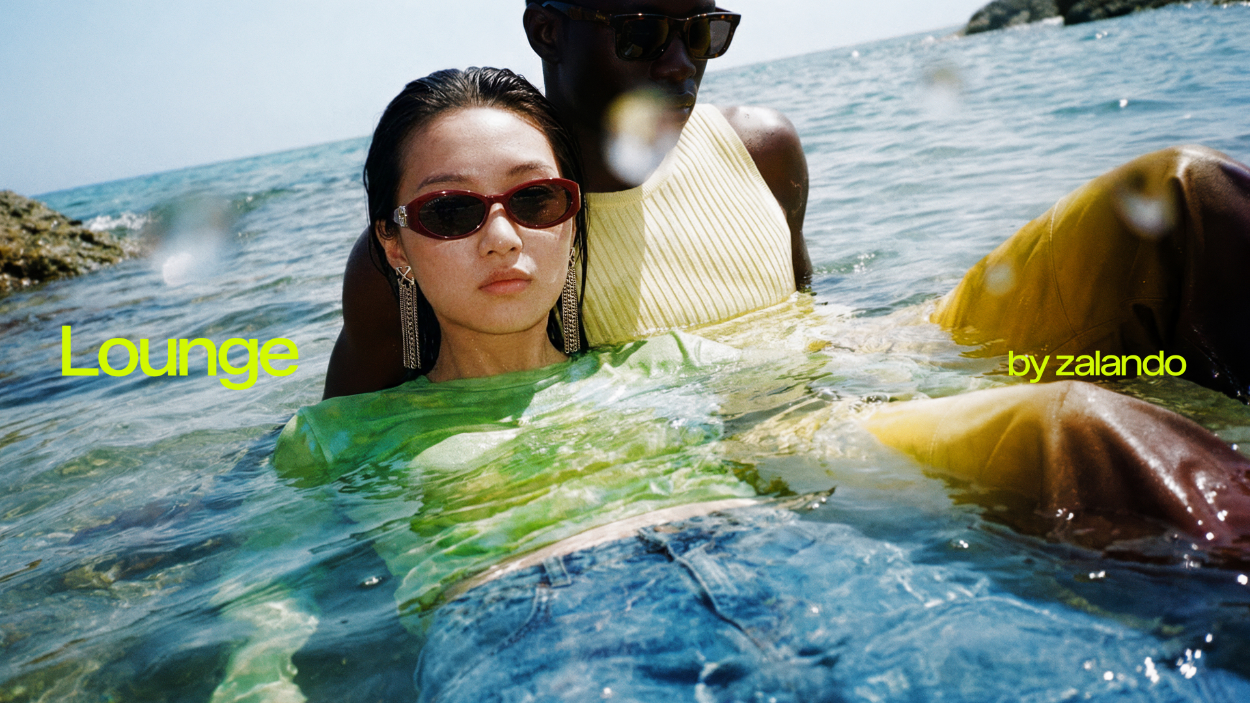
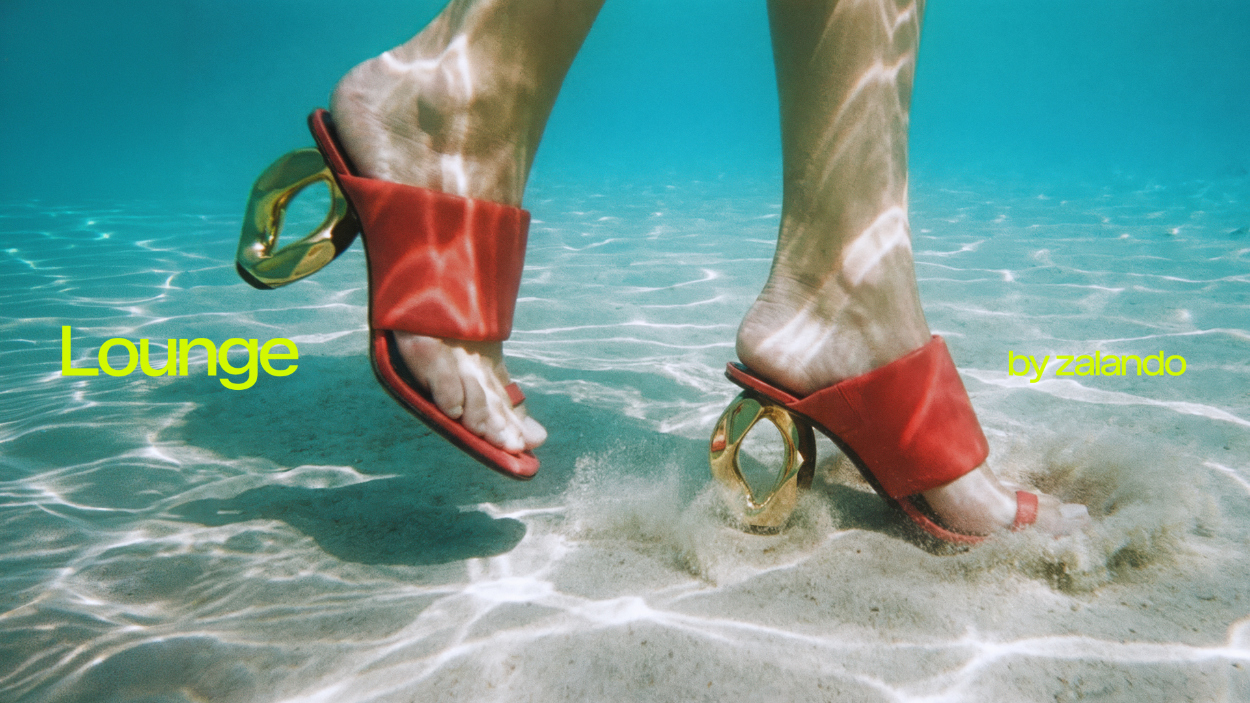
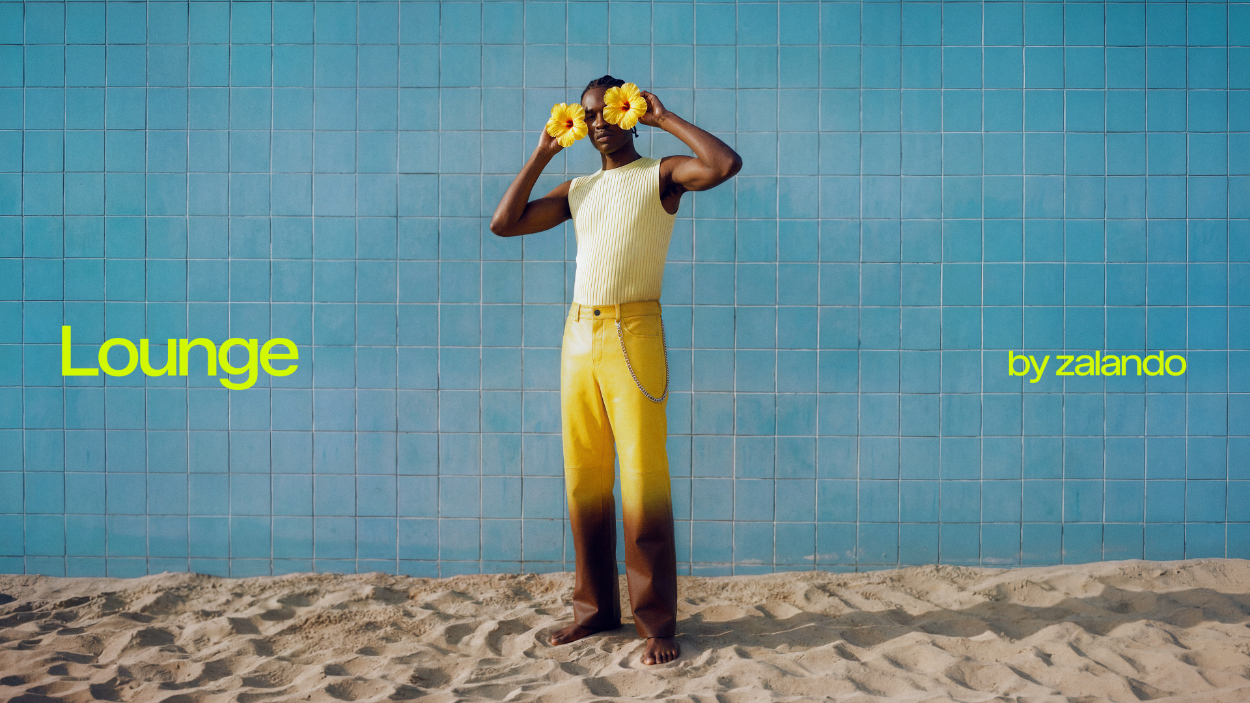
Yeah, I think the whole challenge of like the “Summer To Feel” is because our previous campaigns were very entertaining. I mean, we did two campaigns with AI before and then they were more focused on the storytelling and focused on the entertainment part. This one, our challenge was actually to really focus on how AI could interpret the product, the feeling of the product.
So summer campaign, it’s also something that is kind of all about feelings and in a more abstract way. But our goal was actually to create a process or to focus on the tactile or the the feeling, for that AI to bring the details of the product a little bit more to the forefront and let the entertainment a little bit in the passenger seat and then have the textile feeling in the driver’s seat.
So we work with different categories, of course swimwear, other types of textile and then we briefed our agency to actually take advantage of the latest models and then try to really focus on bringing this tactile feeling to the images. So that was actually our goal.
And was that tactility, was that change from entertainment to tactility, did that come about just for internal reasons because you thought, okay, it’s time to try something different? Or did that come about because you think the generative models are more capable of capturing and conveying that tactility than they used to be?
I think both reasons. I think for us, it was actually the challenge of changing or tweaking the process to bring this more tactility and in the same way to push where the models could go in terms of bringing almost close to reality. So actually both ways we are trying to go.
Okay. Now I’d like you to walk us through the process kind of step by step and tool by tool that went into creating this campaign. Now you mentioned you partnered with an external agency, which I think is called Copy Lab.
Yes.
Tell me how the work was broken apart across two human teams, your internal one and your external partners. And what I’m imagining is a spectrum of different generative image models across the full funnel. So what models are you using? How are you balancing the work? What workspaces are you all collaborating in? How much physical photography did you start with, either on location or of the products? Did you start with any? Just walk me through how this worked.
Yeah. So we started by actually concepting the campaign internally with our in-house team. So we use Gemini for concepting here because it’s the tool that actually we have a partnership at Zalando. So all the Google products are available to us. So we use Gemini for concepting. So of course I briefed my team and then they came up with different ideas in how we could run the campaign.
So after the generation of the idea and the approval of the main concept, which was like “Summer To Feel”, we went to kind of mood boarding. So the mood boarding we were using classical photography, but the goal we wanted to reach is detectality, the summer to feel. So then we created a mood board that actually could express that. And this mood board could be AI generated images that we found to be interesting, or could be normal photography. So we’re a mix. And first we aligned with our in-house stylist. Why? To give an idea that it’s possible that we can reach that concept. And after the in-house style is vetted, they’ll say, okay, it’s something that we can find, these products we can find internally at Zalando, right? Because it doesn’t make sense to create a mood board with products that don’t exist here for us. So we actually source these products internally as SKU, right?
So then after we have the concept, the mood board, and usually the styling process also, we do creating the looks – let’s say prototyping the looks in an avatar in a lo-fi way just to see if the looks and the SKUs that we picked inside the website actually make sense or they look cool. And with this we create – actually this is an interesting process that we learned afterwards – an actual fitting with our in-house studio here that we invite one model, a simple model, or one man and one woman to actually try this real product.
So we actually do a little bit of a hybrid process here. And why do we that? Because in this process of fitting, real fitting, which is quite cheap because we have a studio here, we have the models available. We take pictures of 360 of the model for each look and we take pictures with a phone, with close ups apart from the SKUs. These pictures are handed over to the agency and the agency will get from us the concept, will get from us the mood board, will get from us the SKUs of the look, and will get from us the fitting pictures.
So we discovered that the fitting pictures helped in the prompt to make the prompt better, right? Adding these pictures, adding this extra information – apart from the SKUs – because it gives the models actually how the information, how the product will blend and fit into the body of the avatar that we’ll create afterwards. So then we hand over to the agency or to the studio, AI Studio, and then the AI Studio come back to us after 1-2 weeks with some proposals.
That’s a little bit of the process that we have.
And I have one follow on question for that: why work with an agency? Why hand off that last part? Why not do that last part internally?
Mm-hmm. Because we don’t have the capacity internally to do that. My Art Directors are also following different campaigns, right? Usually our Art Directors work on two or three campaigns simultaneously. There’s not enough time in our timeline to have an Art Director or a Director prompting in back and forth, alone. So my Art Director actually manages at least two AI campaigns at the same time with different AI studios. Plus we have a work stream of non-AI campaigns that they also need to support.
So then the ‘why’ is because of the timelines, right? And does it make sense to stop one Art Director to prompt that? And there will be a lot of back and forth and so on. So this requires a lot of time. So we prefer to be able to execute this in the highest quality possible. We give this, specifically prompt execution, to an agency and then they can come back with the execution for us. However, it’s not like their role is just prompting what actually we already previously executed or created. We give them some freedom to interpret our briefing. In terms of casting, in terms of location, in terms of light.
I think of course we have, as a brand, a specific creative direction that we share with them as well. Our brand book, how a light looks, how our casting looks. So this we share as well, our brand book for them to give an idea. But we actually reinforce to them it would be great for this prompter or this AI artist also to come up with some suggestions for us.
I think that’s interesting because I think externally for people outside of this workflow, there will be the perception that AI is the more hands off, easier, more streamlined sort of route. And I think the way that you’re describing the workflow, the major thing that impresses upon me about it is that it still involves a lot of people. It still involves a lot of work, it is not just prompting, it is not just basic prompting.
What you are describing is a traditional campaign workflow with multiple stakeholders, interpretation, peoples’ different perspectives. The tools are different, but that’s it as far as I can tell.
Exactly.
Our team really wanted to go in this direction because I think the collaboration of different creatives is what makes the work grow and what makes the work better. So if I would just drop this in the table of the Art Director and then the Art Director have to kind of figure out casting, have to figure out prompting the background and have to figure out the styling …this will be just one person’s vision and then that’s, in my opinion, limited.
And what we actually try to do is redesign the process, with the AI tools. And then there’s feedback, the copywriter is involved as well, the stylist is involved as well, me and the Art Director, and then there’s also the agency. So we have check-ins with the agency, we brainstorm in the meeting and say, okay, this is going in the right direction. This maybe is not going in the right direction. Or the clothing is not looking good or this looks a little bit not real or the mood is not right.
So there’s a constant collaboration between the check-ins that we have, following the timeline. It’s not only one person dictating the way, right? And that was deliberately our choice.
Fascinating.
Now, how do you feel and what’s your perspective on disclosure and labeling here? So the final deliverables after the workflow we’ve just talked about are touched by AI to a greater or lesser extent. You know, they are generated or at the very least enhanced. You’ve been clear, this is an AI-native campaign. And I think that’s right. I applaud you for coming on, talking about it, being transparent about the workflow. You’re doing this at a time when the market feels quite conflicted, I think, about having either AI generated or AI enhanced images put in front of them from a consumer point of view.
Trust is hard won. And there’s this perspective that people do not trust AI images. And there’s also a few different looming potential regulations around disclosure and labeling. So what’s your perspective on what it means to put AI content out into the market right now?
I think, for any AI content, if it’s valuable for the consumer, if it’s still inspirational or entertaining, I think honestly, I don’t think that they care. If it’s something that actually gives some information, if we are curating something from our platform to them in a way that they can take advantage of it, or it’s something that we are educating them or something that we inspire them or entertain them.
I think if it’s AI, if it’s not AI, I think, honestly, they don’t care. I think what actually they might be annoyed about is something that is not thought through, right? It’s not intentional. Or it’s something that is just kind of content for content’s sake. You know? And then instead, this is something that is interesting for them. It’s something new. If we take this as a goal, I’m sure that our audience will like it and then they will appreciate it. And even if we label that AI, I think that will be fine for them. We always try to surprise them with the content that we have. And then it just comes up as being AI. But, you know, I think it’s the thought before that actually matters.
Yeah, and I think, you know, again to your credit, talking about the workflow and all of the different people involved and all of the different stages here. I think the reason people dislike AI is because they think it’s used in a lazy way. I feel like that’s the reason people rebel against it.
Exactly.
There are other ethical and environmental concerns or what have you, but generally speaking, people will say, I don’t want to see an AI campaign because I feel like it’s inauthentic or it doesn’t have enough people thinking about it. It’s just a shortcut.
And that kind of brings me to the next question, which is I think the reason that people have pushed back against AI campaigns in the last year or so, which we’ve definitely seen, is that concern that it’s either a quick fix or that it’s definitionally only able to repeat to recombine what’s gone before. So the AI output is not going to be innovative. It’s not going to be new. It’s not going to be, to your point, inspiring because it’s based on what it’s trained on.
Now you spoke at the TED Talks in Berlin a couple of weeks ago, and you said that AI is only as good as the brand framework behind it, which to me sounds like an answer to this, right? It sounds like saying, well, you can get good AI output if you build the right brand framework to create that.
Tell me what that means and tell me if you think AI is capable of creating something fresh despite being pre-trained on existing data.
Yeah, so I think in terms of brand, the big foundation for any brand that wants to work with AI is actually to have a good brand framework already done. I think we were lucky to create and to build these campaigns when we already have our brand framework very well rounded, very well shaped and with an idea of trying to surprise and entertain our customers in terms of creative direction.
So, with that being said, I think it depends how intentionally you want to use the tool. Right? For example, for us we already know where we want to go because our brand framework already tells us where we want to go. So one example we have, one word that defines our brand characteristic, is called ‘soft surrealism’. What that is actually is we get a scene, we want to build a scene, but we tweak that scene to be something there that is a little bit surreal. This is a framework that we created as a brand. So when we create the campaign, we try to infuse this DNA of the brand into the prompt, right? So why? Because we try to create every prompt that infuses this type of creative direction, or we have this as a goal, we try to escape the sameness of, what actually if you prompt a very vague prompt just to create a scene, it will just come up with something that maybe every brand can have that same image. But if we add this specific brand DNA, this specific brand traits into the prompt, which is unique to our brand, then there’s a chance that this image is becoming more unique.
So the question is, what is the unique ingredient of your brand that can be added to the prompt? Right? What actually are the specific traits that intentionally you can brief an agency and then they can add this ingredient as a special sauce, right? That can be added in this recipe.
And then that’s actually where I mean what difference can I create? So if I’m an interpreter now, listen to this talk, what’s special that I can create for me that no one can have, and then how can I infuse this in the process that I use to create AI images or AI videos. This is a distinction. Help AI to create your unique signature. And then with this you can escape the sameness that gets generated in most of the cases.
Perfect. Okay.
So your remit with this campaign and others is global. These are global campaigns. Do you do any regionalisation for them? You obviously have a single hero direction and that gets manifested across the products and the human models that make up the assortment. Do you do any country by country variation in how you present this?
Absolutely. So this is actually something that the AI can help us a lot with, not in terms of content creation, generation, but for example, we have 21 countries that we have to localise. So, AI helped a lot in voiceover generation. So we have a copywriter that is following the whole campaign, and then the copywriter creates the master copy. And with Gemini, we localise this copy for 21 countries. Then with AI voiceover – we use ElevenLabs – we create a process with a copy for each, we create a session for each language. And then in this session we actually simulate a voiceover recording.
So the Art Director, the copywriter, and a local expert from our company here meet for half an hour and they craft in that half an hour the voiceover that needs to be executed. So, more or less we take a week to do these voiceovers. And then we record 15-16 different languages because some countries have the same language. So we do 15 sessions of half an hour each. And then in that session, we prompt the voiceover, and the voiceover and the voice expert validate if that copy is true, if that voice is sounding genuine. And then with that we pass to our internal team that designs and creates the videos, infuses the overlay copy in the voiceovers and then we generate a batch of videos in different formats also with AI and then we end up with multiple executions for all the 21 countries that we have.
And again, that sounds like it’s an intentional process with multiple people involved. It’s not a turnkey, push a button, give me this in French or give me this in Italian.
Tied to that previous question, what’s your perspective on the impact of this on the human modeling industry and on the talent in front of the camera? Because if you’re doing this sort of regionalisation, you’re doing campaigns that appeal to multiple demographics and multiple regions, you’re also looking at representation and inclusivity in casting. And you’re also looking at kind of diversity in front of the camera, everything else. What impact do you think this workflow has on that?
So you mentioned you have one kind of beginning fit model for this, a human fit model who’s part of the content studio at Zalando who comes in for this. Then presumably the models that we see in the campaign are all generated rather than real people. Is that the correct read?
Yeah, exactly.
Okay. And what do you think the future is for …it’s a difficult market right now for anybody whose job is to stand in front of a camera and to embody a collection?
Yeah, I mean the big disruption that we see would be in the modeling industry or the agencies. For example, in this process, in voiceover recording. In the campaigns, these particular two classic processes will be replaced, you know, and that’s the truth.
There are opportunities if we want to create something special or something that requires acting. I think this is something that still will be required to have models. I mean we have some campaigns that we do here that are a little bit more into shaping the brand feeling, then we don’t use AIs for these campaigns. Because I think these campaigns require some nuances on interpretation that is, at least now, pretty hard to get into with AI, mostly in video.
I was gonna say, do you see that changing over time as the capabilities of the models increase?
I think so. I think so. I think also the expertise of the AI artists or the prompter as well into how to transmit this feeling, right? But these campaigns that I just mentioned now, they are campaigns that are a little bit more focused on the product. They’re more focused on fashion inspiration, right? At least now when we are going to talk about brand campaigns where we require a little bit more acting, these ones we are not using AI because we don’t think that is there yet. But maybe in the future we’ll change.
I think that’s an honest answer. There’s two different kinds of frontiers for generative images here. One is the campaign stuff that you’re talking about, which is your remit, and then the other is the broader scope of e-commerce content. So what you would class as product detail page images and video and so on. A lot of brands are pursuing this for unit economic and efficiency reasons. In your case, because these are pre-existing Zelando products, they already had kind of PDP page content done using either traditional photography or generative photography. So you don’t need to revisit that.
I mean particularly my team is not involved on the ecommerce because it’s separated. We have a team that takes care of everything that we call it “on site”, right? PDP images, banners and so on. There’s a specific team that takes care of that. I think it’s well known in the market that Zalando is kind of moving into making almost 100% of this content with AI. So I think this is already announced in the market. And then the studios that we have internally here are closing and then they are working this way. So this is already happening, right? This is already happening. In particular, in this process that I just mentioned, our team is a little bit more in charge on the customer acquisition phase, which is kind of marketing, is kind of AI that actually brings customers to the tool. So working closely with TikTok, with Meta, with Instagram or Snapchat. So we created these AI campaigns that are going outside and bringing customers to us.
Yep. So your KPI, then, is driving down the cost of customer acquisition, essentially, with something like this. Okay.
Exactly.
And, again, I appreciate the honesty and the transparency because what you’re trying to do in both functions, whether it’s you know, ecom on-site images or these kind of campaign things, is to cut the time and the cost. In one case it’s the time and the cost of the conversion and the purchase. In the other, it’s the customer acquisition. And I think in your case you talked about cutting campaign time from weeks to days and so on.
l need to be careful talking about just costs because it’s not the only variable that we are looking at. Zalando has a good reputation to deliver good quality and good content in the market. So it’s not cutting all costs. So, when we evolve a studio that is very specialised in in AI, it’s not cheap. We could do this process in a completely different way, as you mentioned before, just kind of having our Art Director doing it internally. But then I don’t think that the result will be as good as we are having now with many people collaborating. So we are more interested in changing the way that we do campaigns to make it a little bit more technologic and infusing AI in the process and then in terms of curiosity, then actually cut costs. So we end up with less costs.
But this could be done even cheaper, but we decided to not go down that route. Because then what actually happened is to create the AI slop that actually our customer will start rejecting what we put out.
So we are trying to find that sweet spot where we reduce costs but at some point we keep the quality high in the process in a doable way that we can still deliver something that people appreciate.
And do you think there’s a world where that same kind of cost reduction quality up – is there a world where you do more campaigns? ‘Cause this is the thing that people would usually say, well, okay, yes, we use AI to reduce cost to some extent to reduce headcount, but we also use it to enable a multifunctional, busy team to do more. Do you feel that?
The philosophy I think here …I mean, I would not move my team to actually just replicate what they are doing, but it’s to free them time to make our campaigns even more impactful.
So, it’s not to duplicate the output, it’s basically actually freeing time for them to actually think and make the concepts even more impactful. And to have the mindset to say, okay, what actually could we be doing that our competitor is not doing? Could we do some interactive things out of this? Can we do something different in this campaign? For example, instead of just throwing a campaign there in our partners or channels is like, could we do something interactive in this campaign that actually will engage more?
So the way that I would see freeing time or the AI campaigns will come is like how to make them actually even more powerful instead of just duplicating them to make it more because also I think we have to be careful with the fatigue of the content that we’re putting out, right? Okay.
With this free time that we have now, with the digital campaigns that are maybe instead of three months doing a normal campaign, we are doing now in one month and a half and two months, is actually to have more time to think them through a little bit better and then add things that are unexpected.
So if we take somebody with your type of role, you know, senior Creative Director and so on, and senior folks, I think that all makes sense.
You recently said, and I forget whether this was, but you said the best thing we can do for junior creatives is to give them space to experiment with AI before the rules are written. So if we think about somebody who might be joining your team, who might be joining some kind of equivalent function within a similar-sized organisation, what does that look like in practice? ‘Cause I know there are students and people in education or people just entering industry who listen to this show.
What should they be doing and what should they turn to if they want to start to prepare themselves to work in campaign-focused functions that feel like they are very, very different to what they’ve been before?
Yeah. So, something that we do here with the juniors is try to make them part of the process that we are doing but not actively executing the campaign by themselves, but maybe as a supporting role in some campaigns. And by understanding the process and what it takes through the process of the campaign, they are learning what the process actually looks like. So this is one thing that they understand. Looking at the senior director and how the senior director is having to collaborate with the copywriter, collaborate with the stylist, collaborate with the creative director, collaborate with the agency. So they understand what it takes just by being in the meetings, right?
Maybe supporting in the art directoring, collecting some mood boards and so on. This would be one thing. But hands-on, what they can actually do is to be curious and then propose something that could be an add-on on this campaign.
We have different projects that are not only campaigns here that we need to support internal stakeholders. For example, the CRM team, how we can create multiple images from an existing campaign, prompting multiple images that can be, for example, changing the background. The CRM team here, for example, segment the campaigns that they have by region. Usually a task that the juniors have is to, from our already created campaign, how can then they prompt multiple campaigns that have different backgrounds that for example, the same image can have a background that is made in London, that brings a London vibe, or a Madrid vibe, or a Berlin vibe. So we can actually extend that image or build on that image and create different images that could help the segmentation of the CRM.
So not everything is a campaign. There’s a lot of things here, like we could support stakeholders with AI executions that are less heavy or less risky and then the juniors can practice in prompting and workflow in those projects.
But you do see that there is still a pathway for junior creatives. You don’t see the door closing to them?
It’s a different positioning. I think there is room for them. But also, it’s more about them being hungry into deep diving the process and then to try and play around with them and support the team in an intentional way as well.
But in my opinion I think they are still very valuable and I think we should keep the stream of the creatives and bring the creatives across this workflow otherwise we won’t have more creatives to work with AI, right? I mean, we need to have some projects that give them a little bit of a chance somehow.
Yep. Yeah. No, I think that makes sense.
Let’s finish with your own role, Creative Director. Give me two quick perspectives on what you think your job description might look like in 2030, so four years from now. One of them, where let’s say a hypothetical company, doesn’t have to be Zalando, has really figured out how to turn AI to its advantage. So if there is an AI native Creative Director position by 2030, what does that look like? And then on the flip side, what does it look like for a company that doesn’t engage with AI?
I think the Creative Director needs to really understand what the process is in this new way of creating campaigns with AI; what processes are valuable to take and which ones are actually not beneficial to the impact of the campaign? To really deep dive into the process and try to learn and then try to identify, okay, this piece here we can do faster, but is this making the campaign better? Right? So, to really identify where the pieces are on this workflow that actually you should skip or remove or change? And then in the end you are responsible for how impactful this campaign is, and how you can optimise the process in a way that makes it faster and maybe even cheaper but still keeps the quality at a good level.
And then I think about the other question, I think brands should be jumping as soon as possible on finding their own way into creating campaigns with AI or creating content with AI. It’s super important because it’s really something that really can scale and scale in a good way.
But I think as I mentioned before, it’s really important for you to define your own vision because AI can help you, but if you don’t have your own vision setup, your secret sauce, you start to creating content that are not unique for your brand, and you’re not creating differentiation between your competitors. So I think both sides need to be hand in hand. Finding your own voice and jumping into putting this in practice as soon as possible to optimise your campaign process or your content process.
Yeah, the way I framed it before across disciplines is, AI can make you better, faster, potentially cheaper at something you already know how to do, and you already know how to discern good output from bad output. It’s not gonna make you magically capable of doing something you didn’t already know how to do before. And I think that’s key. So engaging with it gives you the technical grounding to figuring out your vision, and your secret sauce is what distinguishes you from somebody who doesn’t know how to do the job and is just trying to use AI as a shortcut.
Exactly.
Perfect. Glazione, thank you so much for your time. I’ve really enjoyed this conversation. It’s been honest, it’s been authentic. And I think there’s a lot to get out of it. So I really appreciate you joining me.
It was my pleasure. Thank you very much for the opportunity.
And that’s the end of my conversation with Glazione.
A few times there, I do admire his honesty and his willingness to engage with every side of this conversation. You can tell, he’s a passionate creator who sees a step change in the tools, and he’s someone who’s already internalised what that means.
Now you’re entitled to feel however you feel about AI. The point of these kinds of conversations, our AI Report, any of our AI focused coverage is not to change anyone’s minds. But hopefully you come away from this episode with at least an appreciation for how some of the foremost practitioners of AI native creative processes are approaching it. And the fact that there’s possibly more to it than you think. It’s not just sticking in a prompt.
Now, anyone who’s listened to enough of these shows knows that I’m pretty down the middle to AI. Part of that is because my job requires some measure of objectivity, but part is that I can really see the value of generative AI in creative design and content and storytelling, but I can just as keenly see the losses being felt by the communities that have shepherded those disciplines for a century or more. You can say that makes me a fence sitter. I’m fine with that. I’m open to that criticism. But given everything we’ve covered today, and given just how much AI content you’re going to see the next time you go online. I think having someone perched in the middle, sympathetic to both arguments, is a useful thing.
So for now, thanks for listening. Very different topic coming up next week, and I’ll talk to you again really soon.