

Originally released in The Interline’s AI Report 2026, this executive interview with Voxelo is one of a 17-part series that sees The Interline quiz executives from companies who have either introduced new AI solutions or added meaningful new AI capabilities into their existing platforms.
For more exclusive interviews, stories and opinions from different industry perspectives, and real survey feedback from voices from every level of fashion, download The AI Report 2026.
We’re observing a big disconnect (in both our own fashion-only data and in wider benchmarks from other sources) between the increasing capability and reliability of AI, in both a general sense and in discrete applications, and the lack of trust that end users place in its outputs. What does trust in your specific applications of AI look like, and how do you achieve and measure it?
Vlad Mulhem: Most of the industry is treating trust in AI as a quality problem: make the output look good enough and people will believe it. We think that is backwards. Trust isn’t a function of how convincing an image looks. It’s a function of where the image came from.
That distinction is the entire basis of why we are building Voxelo. A generative model starts from a prompt and invents something plausible. Our applications start from the object itself. UG3D® reconstructs a real garment, shoe or bag from a short video into a 3D digital twin, so the twin is a measurement of the actual product, not an interpretation of it. Everything downstream – the interactive 3D, the place-in-space AR, the AI product and lifestyle imagery – inherits from that captured ground truth. It can’t quietly drift away from the real thing the way a 2D prompt can, because it never started from nothing.
So, trust, for us, looks like fidelity from every angle. Can a shopper make a keep-or-return decision from our twin and be right?
We measure it on two levels. First, faithfulness to the physical object: does the model hold up against the garment in the hand, from every angle? Second, the signals that follow when people believe what they see – conversion on richer product pages, and the returns that never happen. As agents start mediating the sale, that provenance stops being a nice-to-have. Verifiable product truth becomes the thing the entire transaction depends on.
While AI might be putting a new emphasis on it (or, in some cases, competing for investment against it) 3D in fashion is not new. What indicators gave you the confidence that now was the time to launch a new 3D platform? Was it a case of technology maturity in AI, or 3D itself? Was it increased adoption of Gaussian Splatting in other use cases? Was it something on the user interface side? Or a combination of all those factors?
Vlad Mulhem: 3D in ecommerce has been waiting twenty years for the right reconstruction method. Photogrammetry needed complex studio setups and technical pipelines and fell apart on many product categories. NeRFs were too heavy to render in a browser. Traditional CGI meant artists and modelling time that only made economic sense for a handful of hero SKUs. None of it scaled to a real catalogue volumes and product types.
3D Gaussian Splatting changed that in 2023. It captures the way light actually behaves on a surface – sheen on leather, nap on suede, the translucency of fine fabric – things older 3D pipelines have always flattened out. It is fast to reconstruct. It runs real-time in a browser. It’s forgiving of a handheld phone capture.


Voxelo was built on that breakthrough, but our UG3D® – User Generated 3D – workflow turns the science into something a global studio team or SME can actually use and scale. Video or images in, digital twin out, and more.
The hard problem now isn’t the reconstruction. It’s the automated pipeline, the tooling, and the operational rails that move thousands of SKUs from a studio and shop floor camera to a live product page and new ecommerce workflows. That’s what we’ve spent the last two years building. The twins that we create are the source of truth for 3D, AR and AI imagery – and the data layer the next generation of agentic and immersive commerce will run on. Reality capture for the products designers, manufacturers and retailers care most deeply about, regardless of budget.
There’s a lot of evidence out there – and, indeed, in this report – to suggest that generative image models and workspaces have pretty rapidly pushed 2D AI workflows to the point of maturity and widespread adoption. If a company wants to be able to rapidly visualise their concepts, or to scale downstream content production in a way that makes unit-economic sense, then they’re well catered-for by 2D X AI platforms. On the flipside, that might make it harder for the same company to differentiate themselves. You’re making a significant bet on 3D X AI workflows providing that way for brands to stand out. Explain why.
Vlad Mulhem: Generative 2D is maturing in 2026 to something people can increasingly trust, which means it’s becoming table stakes. It can be created by anyone, anywhere, at a nominal cost.
Over the next 3 years, we believe 3D will become the way brands stand-out and build buyer confidence. And User-Generated 3D – UG3D® – changes the studio economics even further. Any team that can shoot a three-minute product video now has access to ultra-realistic 3D.
Think about it this way: what happens to competitive advantage when the visual layer that used to be a moat for the biggest spenders becomes table stakes? The budget stops being the moat. Speed becomes the moat – the ability to adopt 3D and AI tools while the rest of the market is still in the budgeting cycle. The nimblest, most creative brands will end up with the richest product content, reaching AI agents, AR platforms and immersive surfaces with faithful representations while slower competitors are still publishing flat images.
We are a new player in this space, but we’re built on what I see as an inevitability: that UG3D will be the unlocker for 3D at scale, which will become critical for brands and retailers looking for the next leap in distinctiveness.
As we just discussed, we’re observing just how quickly generative AI has become a cornerstone of the content-creation pipeline, and the benefits to brands seem pretty clear-cut. Consumers, though, are decidedly less clear on how they feel about flat images that have been generated by, or even enhanced by, AI. Is there something about 3D X AI workflows that can close the confidence gap, between observing and purchasing, in a way that 2D X AI workflows are maybe struggling to?
Ben McKay: Generative AI has given fashion and footwear a remarkable new toolkit, and brands are using it well. Mood, atmosphere, campaign worlds, lookbooks rendered in minutes instead of months. The category has never had more ways to express its distinctiveness.
But there is a quiet split happening in what AI is being asked to do. Most of the imagery being generated is selling the brand – the feeling, the styling, the world the product lives in. Very little of it is helping the shopper understand the product itself. The stitching. The range of silhouettes. The fine weave. The light across a fabric. The cues a customer would take for granted in a store, and the cues that decide whether a parcel is kept or sent back.
That split is the gap Voxelo was built to close. We are not in the business of stylised imagery alone – plenty of excellent tools already do that. We are in the business of faithful representation. Capturing the product as it really exists, so that whatever surface the shopper meets it on – a product page, an AR place-in-space, an AI recommending it inside a chat – they are seeing the thing itself, not an interpretation of it.
Brand distinctiveness and buyer confidence are not the same problem, and they need different tools. We think the brands that pair the two will be the ones that pull ahead – using generative AI to build the world around the product, and faithful 3D to make sure the product itself can carry the weight of the sale.
There have always been two routes to getting a 3D representation of a finished product: to natively design and develop it in 3D, or to capture it afterwards?
The first of those is already the subject of a series of Digital Product Creation reports from The Interline, so we don’t need to rehearse the amount of skill, time, and process engineering that goes into obtaining great results that way – results that feed directly into the rest of the product journey.
The second of them is one we don’t talk about quite as often, but it’s arguably both the most popular and the most visible, since a lot of the demand for 3D product experiences comes from use cases that put them in front of people (consumers or in-house teams and partners) who use them to make a decision. The process of capturing those representations has not been quick or easy itself: it can take days, or weeks, to get good, web-ready results. What does it change, in your opinion, if you can compress that time to a couple of hours?
Ben McKay: Almost everything. Traditional 3D has been too slow, too specialist and too expensive to deploy at catalogue scale, which has forced brands to treat it as a campaign asset at best. UG3D® takes a 3-minute product video, processes it in the Voxelo cloud, and returns a web-ready, 3D digital twin plus AR plus AI imagery in around two hours. Roughly 30 times faster and 10 times cheaper than the workflows it replaces.
The interesting part is what teams do with the new headroom. When 3D stops being a hero-SKU privilege, use cases compound. SportsShoes.com has been deploying our twins into their website and digital point-of-sale, taking 3D out of the PDP and into the physical store. Other customers are stacking UG3D® into multi-AI workflows – the twin as the input layer for generative campaign imagery, videos, lifestyle rendering. Same source asset, half a dozen surfaces, no re-shoots.

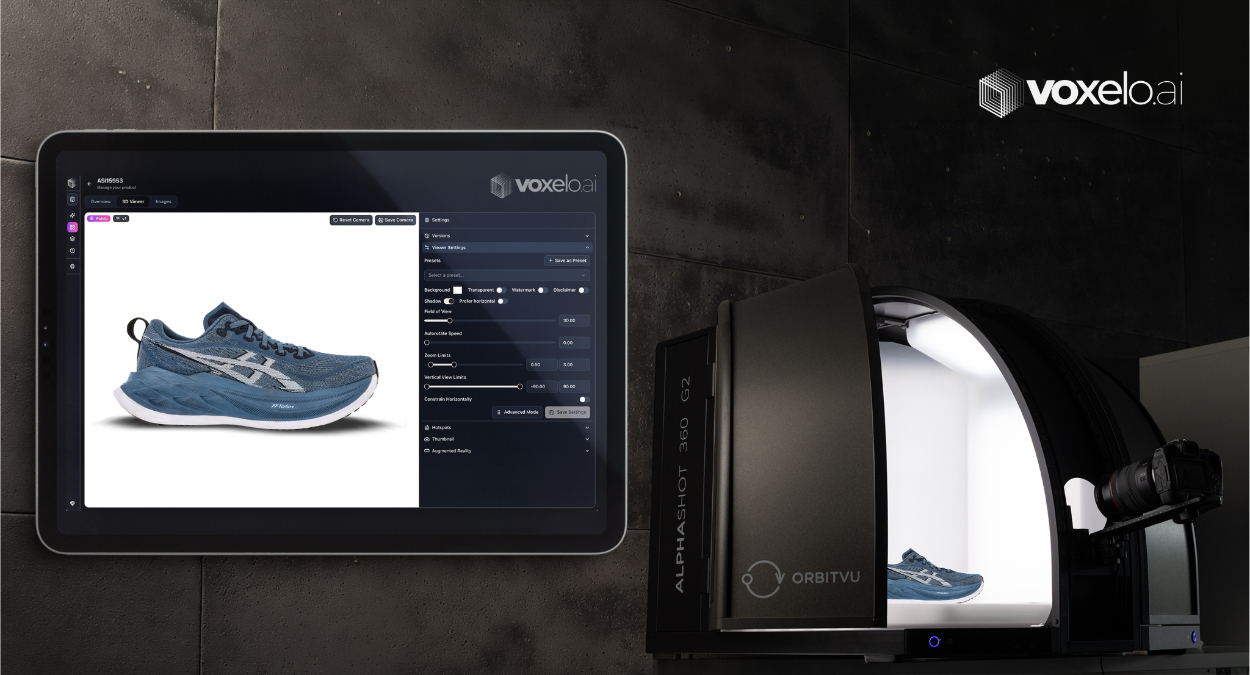
The 3D production constraint was suppressing the imagination of an entire category. Removing it lets product teams design content systems that were not economically possible eighteen months ago. Being new to the market, we want to partner, research and grow with the most ambitious brands in this space – exploring how workflows that start with accessible 3D digital twins can evolve in new directions that build buyer confidence faster and faster.
Last year, we asked technology executives whether they predicted AI would become more obvious, as a primary interface paradigm, or whether it would disappear into the background in the way that vital but invisible platforms like AWS and Azure have done. This year’s data suggests that the answer is both: fashion professionals that use AI interact with it as both the engine and the steering wheel. But we also see that, for a lot of companies, both kinds of applications are still largely in the scoping or refined-pilot stage. What do you see being the trigger for deeper adoption and wider roll-out?
Ben McKay: Most pilots aren’t stalling because the AI isn’t good enough. They’re stalling because teams are running clever AI on top of inputs and workflows that were never built for it – flat 2D images, fragmented assets, content that was never a faithful record of the product in the first place. You can’t automate your way out of a weak foundation. Better steering wheel, same potholes.
So the trigger for deeper adoption isn’t another model release. It’s trust in the inputs. The moment the source asset is reliable and versatile – a faithful 3D twin of the real product – the outputs become trustworthy enough to run without a human checking every detail. That is the line between a pilot and a roll-out. A pilot is ten hero SKUs and someone QA-ing every image. A roll-out is ten thousand SKUs moving from a single capture to a live ad, a live page, a live customer. You only cross that line when you trust what is going in.
Two things are about to force the issue. First, economics. When a 3D digital twin costs £10 to £20 – not hundreds – and takes just minutes to capture, 3D stops being a campaign luxury and becomes the default source of truth.
Second, agents. As AI starts mediating discovery and the sale, brands will need faithful, verifiable versions of their products – the thing itself, not an interpretation – or they simply won’t be surfaced accurately. That isn’t a creative nice-to-have. It’s a condition of being found at all.
Trust – from consumers and agents alike – is going to be one of the biggest factors in what wins at content and brand experience from here. And whilst much of the market scrambles to assemble new AI workflows, there’s a real calm and confidence in getting the foundation right first: a faithful 3D digital twin of the real product. That’s the future Voxelo is building for.