
Hey, welcome back to The Interline Podcast.
In case it’s escaped your notice, there’s a lot of generative AI in fashion right now. Just a couple of weeks ago we published our Annual Report about it, as a matter of fact, so if you haven’t read that I’d encourage you to grab a copy. I think it’s going to sit well alongside today’s show, and I think there’ll be some things in both that you might feel like cross-referencing.
I also recently released a standalone essay about the top findings from the survey portion of that report. You can go read that as a human-written article called ‘Arm’s Length AI’, or you can use the accompanying toolkit for AI to work with some of the most important findings in your agent of choice.
That agent toolkit is a new thing for us, and it’s something I think we’ll only do a couple of times a year at most for big projects, depending on how it’s received. It came about because after we released the report, I was inundated with LinkedIn carousels and newsletter emails from companies and people who were taking the survey results by parsing the full 230-page PDF and interpreting those results in some, let’s just say, interesting ways, and not always with the right amount of nuance or care.
And while there’s nothing wrong with sharing your thoughts on free-to-read content, we think there’s a better way for readers and listeners to interact with the big things we research and write. So if you want to try that agent toolkit out, I’m keen to hear what you think. It’s something we’ll iterate on over time for the big essays that warrant it, and I think it should be shaped by reader interest or disinterest.
The real reason I bring this all up, though, is that one of the pillars of that survey dataset is the finding that people in fashion, on aggregate, think AI is the most mature in the image-heavy early and late stages of the product journey. So think creative experimentation and ideation, and then think all the way downstream in content creation, marketing, ecommerce and communications.
The opposite is true in the middle. People see technical design, patternmaking, sourcing, production and so on as the places that AI is the least mature and the least advanced.
Or if I wanted to be a bit cheeky about it, making pictures of fashion is approaching being kind of a solved problem. Turning those pictures into real garments is a whole other problem, and one that I think a lot of the companies that make generative image-first tools for our industry are wrestling with.
If you’re making one of those tools, these are the kinds of questions you’d be asking yourself. How far do we go? Are we a design tool? A development tool? A marketing platform? Do we just build our own pixel and vector editing functionality into these things? Are we a PLM? A DAM? Are we all of that at once? Does being AI-native and generative at the core support those kinds of ambitions, or does it work against them?
This is all deeply interesting to me. Now, like a lot of people, I think recently I just sort of mentally filed image generation away in that weird kind of bracket where you appreciate that something is technically amazing and that it’s advanced in a remarkable way in a very short span of time, but it’s also kind of become background noise. It’s a bit like drones, which, unless you live in a war zone, are a prime example of how quickly a cutting-edge, sci-fi-y sort of technology can disappear into the texture of everyday life.
Talking to today’s guest, though, reminded me that what we’re dealing with really is a much bigger rebuilding of the creative process, and that image generation and editing models aren’t always interesting in their own right, but that the platforms people build on top of them just might be.
That guest is Weber Wong. He’s the CEO of FLORA, which is a generative creative platform used by more than a million people according to the company’s own metrics, including teams at some of the world’s biggest brands.
FLORA raised $42 million at the start of this year, and one of the biggest outcomes of that investment has been a strategy of industry verticalisation that started, just a few days before we recorded this conversation, with fashion.
You’ll hear this as we get into it, but Weber’s plan is to basically create a new version of the Adobe Creative Cloud for the generative paradigm, and to do that in a way that’s driven by different industry needs.
But as everybody listening to this knows, fashion doesn’t get built in Adobe. It gets conceived and sketched and pixel-edited and colour-graded and motion-graphic’d and everything else in that suite, but the product data lives in PLM and in other places, and the decisions are made there. There’s a lot of other places in a typical enterprise.
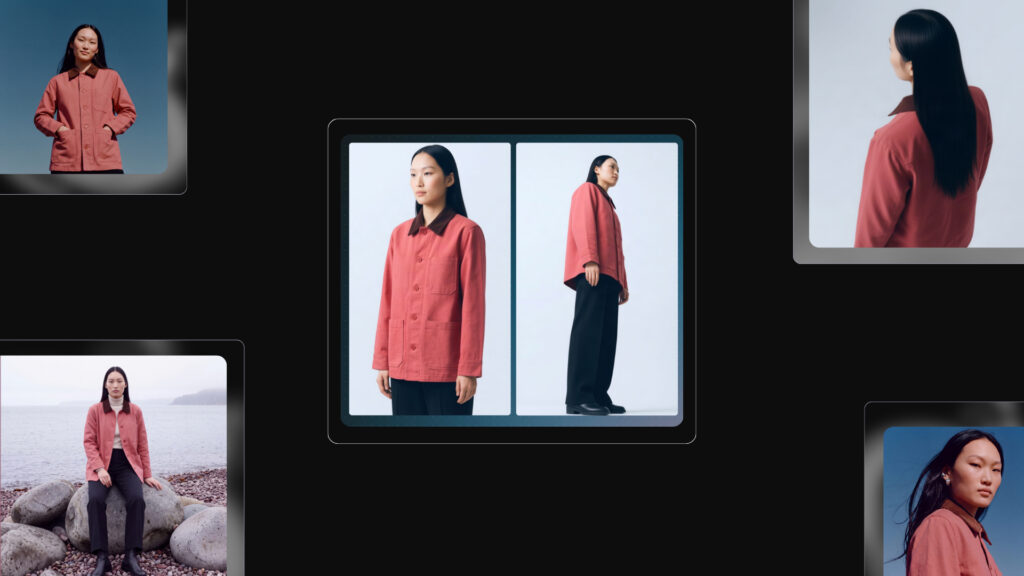
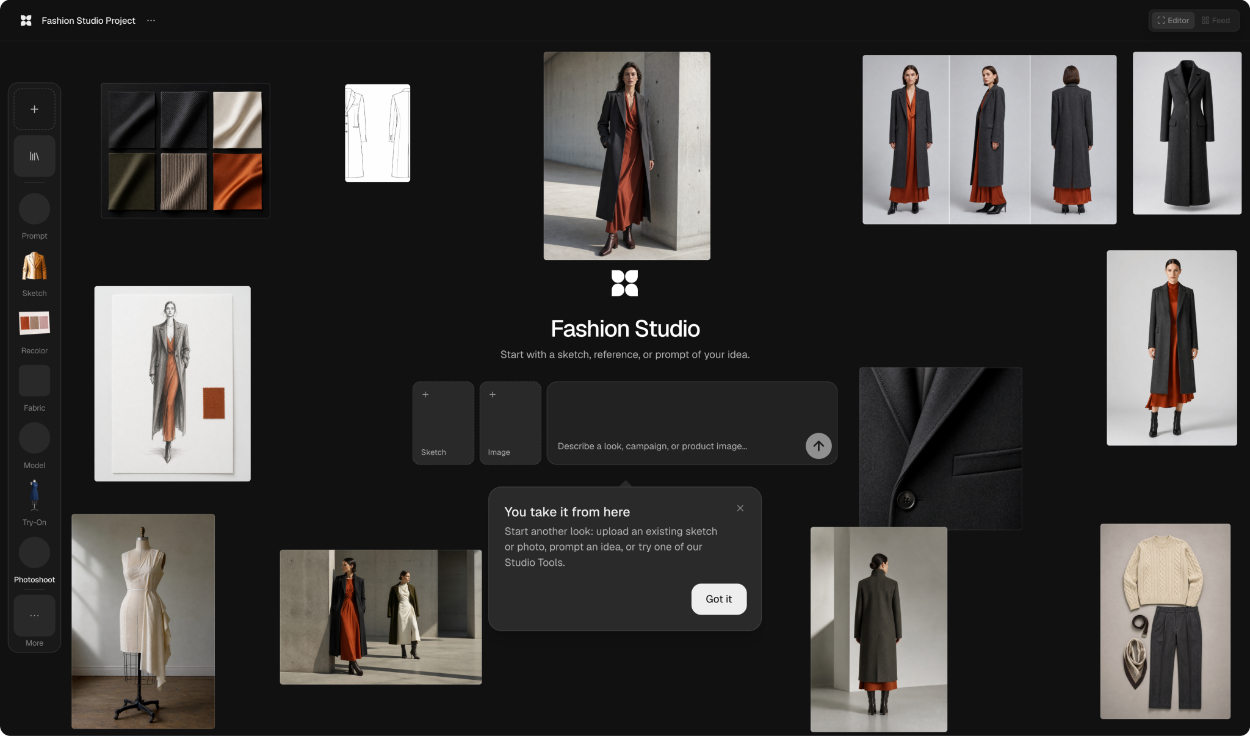
FLORA’s Fashion Studio, which is their packaged version of the product for fashion professionals, started, unsurprisingly, with a lot of image-focused tools. But the company’s goal is to go from, and I quote, “sketch to finished campaign” in one place without skipping over the middle, which means engaging with all of those other places we just talked about. And probably the most telling part of that strategy is the fact that the roadmap includes tech pack creation, managing trims, importing from CLO and Browzwear, and a few other capabilities that vault it firmly out of “generative image tool” and into “platform aimed at disrupting how fashion gets designed and developed”.
And that’s all just a fundamentally interesting proposition for what is, at least based on outward appearances until pretty recently, a node-based canvas for interacting with a combination of generative image, video and text models, with some traditional deterministic tools like layering and colour grading built in.
So I think the watchword for this episode is ambition. And whether all of that ambition ends up being realised in FLORA or not, I think the scope that Weber and I are going to talk about should be a reminder to everyone that we’re really not done with generative tools changing the definition of design, communication, and maybe development as well.
As a final disclosure, The Interline uses FLORA in our generative image workflows. We don’t ask for or accept free licences from any technology companies, so we’ve been paying users for the last, I think, seven or eight months or so. We also use plenty of other generative tools across text, image, research, etc. So us being customers doesn’t influence how I talk to CEOs like Weber, except where it gives me some extra insight into pricing or into features that I wouldn’t have as an outside observer. This does, though, I think represent the first time that I’ve interviewed the CEO of a company that we are also paying customers of, so I wanted to draw attention to it.
For now, though, let’s talk creative platforms for the generative era with Weber Wong, CEO of FLORA.
Never miss an episode
Get notifications for new podcast episodes, plus our weekly news analysis, events, and more, delivered straight to your inbox.
NB. The transcript below has been lightly edited.

Okay, Weber Wong, welcome to The Interline Podcast.
It’s great to be here.
I’m excited about this conversation, as I will extol several times in the course of the questions that I want to ask you today. Before I get too far ahead though, we start every one of these shows with the same two things. We try to build a snapshot of what the guest’s day-to-day work looks like, and we ask them to define something that we hope elicits a slightly unexpected answer.
For the day-to-day, I think the question to you is as much about how you arrived where you are as it is about what you do when you sit down and you open your laptop in the morning. You’ve had what I’ll call a fairly non-linear route to being the CEO of a 30-person-strong, AI-native creative platform that’s raised more than $50 million in funding. Your bio, if I’m correct, is: you were in investment banking, then venture capital, then you did an art programme in New York, and now you lead FLORA as the CEO. You also seem to spearhead a lot of the philosophy and the thinking behind it, and do a bit of essay writing and that side of things. How did you get here, and how does that trajectory influence what your day-to-day looks like?
Yeah. I think, probably a non-linear path, but my first love was actually poetry, and I really loved art. I did realise at some point that I needed to make money for a living, so that’s why I went into investment banking. I thought, hey, if I’m going to sell out, might as well go all the way out. And I also do enjoy some aspects of it, and learning about how businesses run.
And I especially did venture. My thinking there was I’d work at a top venture capital firm, invest in the best startups, and then learn how to do my own. So I worked at this firm called Menlo Ventures. I was the youngest ever investor hire. Looked at everything from Anthropic to RunwayML.
And I was mainly there to learn how to do my own thing, but I realised after some time there a couple of things. One is that none of the companies I had seen were ones I would have wanted to start myself. They could be making a lot of money, but they just weren’t that creatively interesting to me personally. I wouldn’t start that company. I also realised that I wouldn’t back myself. At the time, I didn’t feel I was a one-of-one founder, and I have very high standards for founders. I didn’t have any unique insight or worldview. And the third thing I realised is that I really missed art. I spent three years in finance grinding away, doing a lot of great work, and it turned out that I was pretty good at it, but I just wanted to make things.
So as part of my quarter-life crisis, I quit my job and moved to New York to work at a coffee shop and explore the art world. And it was through that that I found out about NYU ITP, the art graduate programme that I went to, where they use technology to make art. Because I think during all of my time in finance and in venture, I saw all these people trying to use technology to make money. I didn’t know you could use technology to make art. It just blew my mind that you could do that. And it turned out to be exactly what I was interested in.
So I started doing a lot of that, and I talked my way into that programme, they gave me a full scholarship, and yeah, I just started making art. It was actually in the course of doing these art installations — I was experimenting with real-time AI installation, interactive projects, and a bunch of other things — that I started building a creative tool for myself. And that turned out to be the first version of FLORA.
A lot of people started using it, and then eventually my venture brain kicked in and I realised, hey, there’s a big opportunity here. And at the time, the opportunity was quite obvious. No one was building professional creative tools. It was all just consumer AI stuff for model companies to quickly prompt things. But as someone that had learned 10 to 15 different creative tools at that programme, had built my own tech stacks to do my own art projects, I knew that there was a huge gap in the market and that creative professionals were not being served. So I decided to build FLORA to go do that. So at my heart, I’m a creative tool builder.
It’s been two and a half years since then, and we’ve been growing quickly since, have been used by folks like Pentagram, IDEO, Nike, a bunch of folks that we’re proud to call customers. But yeah, we’re just getting started.

Okay. Excellent. And as somebody who studied classical literature at university, let me tell you, it’s not exactly a straightforward route to making money out of that either.
Yeah. But it’s fun. It’s great fun, and that’s what’s important.
So for the definition, I’m going to cheat slightly and I’m going to put two things side by side, and I’m going to ask you to tell me how they fit together in the creative process. So one is generative models, and the second is what you would call creative systems: things that are made up of reusable tools and components and repeatable workflows.
Now the creative process until pretty recently has had one creative entity in it, the human designer — creative designer, tech designer — who, to be a bit reductive, brought the ideas, and then one toolkit which has been made up of clearly scoped deterministic analog and digital tools that the creative then used to execute on those ideas.
The things look pretty different today. You now have two entities potentially doing the ideas, or more: humans and generative models and agents. And then you have a toolkit that’s also not exclusively deterministic anymore. It incorporates more and more of a blend of traditional software and new, more probabilistic and AI-native steps.
Now your bet with FLORA is clearly that you can build repeatable components and systems and workflows out of AI foundations. But that feels like an easy thing for us to just sit here and say, and a much harder one, I think, for the people listening to this, particularly designers, to map to the way that they’ve worked for their entire careers. So walk me through how you define an AI-native creative process, and what it means to then stack that up to make a creative system.
Yeah. So at FLORA, fundamentally, what we do is we look at what are the creative technologies available, then we look at what is the creative process, and then we try to build creative tools that best reflect the creative process using the best technologies available.
So I think a great way to help understand how the creative process is different now is that there’s two layers here. There’s a creative technology of a given era, and there’s a creative interface for a given era.
Before AI came out, it was basically just normal computing. So Adobe was founded in the 1980s to build creative interfaces for the personal computing paradigm. That was about controlling what was called the graphical user interface, which is a concept of being able to control every single pixel on the screen. The screens you look at, being able to change the pixel colour of one pixel — that’s personal computing. It was about making one piece of media at a time. And that creation paradigm has been the same for the last 30, 40 years.
Illustrator came out in 1987, and all image editing is about altering and reordering layers. Adobe Premiere came out in 1991, and since then, all video editing is about altering and reordering time. It’s like crafting. It’s very bottoms-up, almost kind of programmatic. You slowly build up what you’re trying to do.
Then a new kind of computing paradigm came out: generative computing. It’s very different. It’s non-deterministic. It’s kind of random. You ask for what you want. You get it really quick, and that’s great, but it’s not exactly what you want. So the benefit there is speed. You ask for what you want and you get it with the snap of your fingers. The downside is control. You don’t control every pixel that comes out.
So the benefit of that technology is that you can explore extremely quickly now. You can explore hundreds of logo variations, dozens of different designs, and just see all those things in front of you and pick one and then refine from there. It doesn’t give you the control of exactly making the garment where you want, or having the pattern have the curvature of the exact angle you want, but it gives you that starting base really, really well.
And what we’ve done is we’ve kind of combined the best of both worlds. We have this node-based tool originally that helps you generate a lot of things at once, but then you can also use an image editor or a video editor directly in FLORA that looks like Premiere, Illustrator, to then change a thing specifically.
So that’s kind of like the difference in process. And of course, one benefit of the fact that you can make a single piece of media with the snap of your fingers is you can connect them together. And now you can come in and kind of almost map out a creative process.
What used to be like making one piece of media in Adobe Illustrator taking two hours, now it takes two seconds. So now you can zoom out one layer of abstraction, and that’s really, really powerful.
So I would say that’s one of the biggest changes here. And I think it mostly benefits the first half of the creative process, when you’re in that kind of divergent exploration phase of many different ideas. It’s not great yet at giving you exact control, but I think that’s where the role of more traditional creative tooling paradigms — image editing, video editing — come into play. So that’s how I phrase it.
Yeah. And I do have some follow-up questions on a couple of those. Just thinking about what you’ve just described though: how often do you think the typical creative, the typical FLORA user, takes what is their final output, let’s say, from FLORA, and it then becomes an input to those traditional tools? Just for argument’s sake, if I’m going into it and I’m trying to create a piece of social ad creative or something along those lines, and I get to where I’m happy enough with it, am I then pretty universally taking it into Photoshop and elsewhere to prep it for final use?
I mean, it depends. One way you can think about it is that when the models are really bad, only like 5% of things that someone would want to do could be finished completely in a generative tool. As the models get better, maybe there’s a broader amount. But there’s a lot of nuance there. The biggest use case for AI right now that can be done in one generation is stuff like those really flashy social media videos that you see. But you can’t make a brand book with one generation.
I generally don’t think you can make a great fashion item with one generation. You can make a cool concept, but if you want to have deep control over every aspect, you still need to go in and have a deeper amount of control, which we have more of, and we’re adding even more over time, especially for fashion specifically. But yeah, it really depends on what you’re doing.
Okay. Alright. And I do want to drill deeper on some of the things that you just talked about. Now I only got around to reaching out to you pretty recently because we finished our AI Report 2026. And as part of that I was like, oh damn, I’ve been meaning to reach out to that guy for a while. And the reason I’ve been meaning to reach out to you was, I read an essay you published around the time of your Series A — so I think that was last year, correct me if I’m wrong. I think in that you drew a distinction between traditional creative workflows and tools and AI-native ones, and it’s one that stuck with me since. You alluded to it a minute ago.
Now I’m going to paraphrase you slightly for speed and expediency, but your argument was that most traditional digital creative tools work bottom-up — you said that before. People use them to assemble the final product piece by piece. AI is more top-down. You described it as like a version of sculpting with a big shortcut at the start, where a journeyman sculptor has done 80% of the work and then you, the master, come in and chisel away at the rest.
I spend a ton of time thinking about, writing about and speaking about AI in general, and I haven’t come up with a better analogy than that. I really do like it. I think it comes loaded with some positive and negative connotations. Chief among them is the fact that when you’re building something up layer by layer, you can take the last layer away if you mess it up. It’s reducible to components.
And this is a bit of a torturous analogy, but if you’re sculpting with marble, for example, when a mistake gets big enough to see, you kind of have to start all over again. You might be able to get another piece of marble from the same quarry; it’s not going to look exactly the same, and so on. That really does mirror my experience of generative image workflows. Yes, you can create elements and techniques and loops and reusable things, or you can go back to earlier nodes, or you can use generative inpainting to address something that went wrong, but it still feels to me, at least when I’ve played around with these things, that we’re dealing with something brittle and idiosyncratic in the same way that you are with stone, which is why I liked your analogy so much.
Now not to bog down in philosophy too early, but tell me a bit more about what prompted you to write that essay, and if you feel like the state of the art has moved on since.
Yeah. Well, what prompted me to write the essay was I explained that probably like 10,000 times already, because I went to a lot of different creative firms and talked to a lot of people individually, because there’s a lot of scepticism around this, and for good reason. But the reason why I’m building this tool is I genuinely believe that it can help your creative process. It helped mine. And I don’t want creative professionals being left behind here.
I think the mindset for a lot of creative professionals is that this is going to take my job. This is a bad time to be a creative. When actually, I think this is the best time to be a creative. You can see your idea in like five minutes at greater depth than you ever could before. And we’re doing everything we can to make it so you can get to the final result of your idea. So I wanted to explain why we believe that. And when I explain it individually to people, it works, but I want to try to get it out to more people.
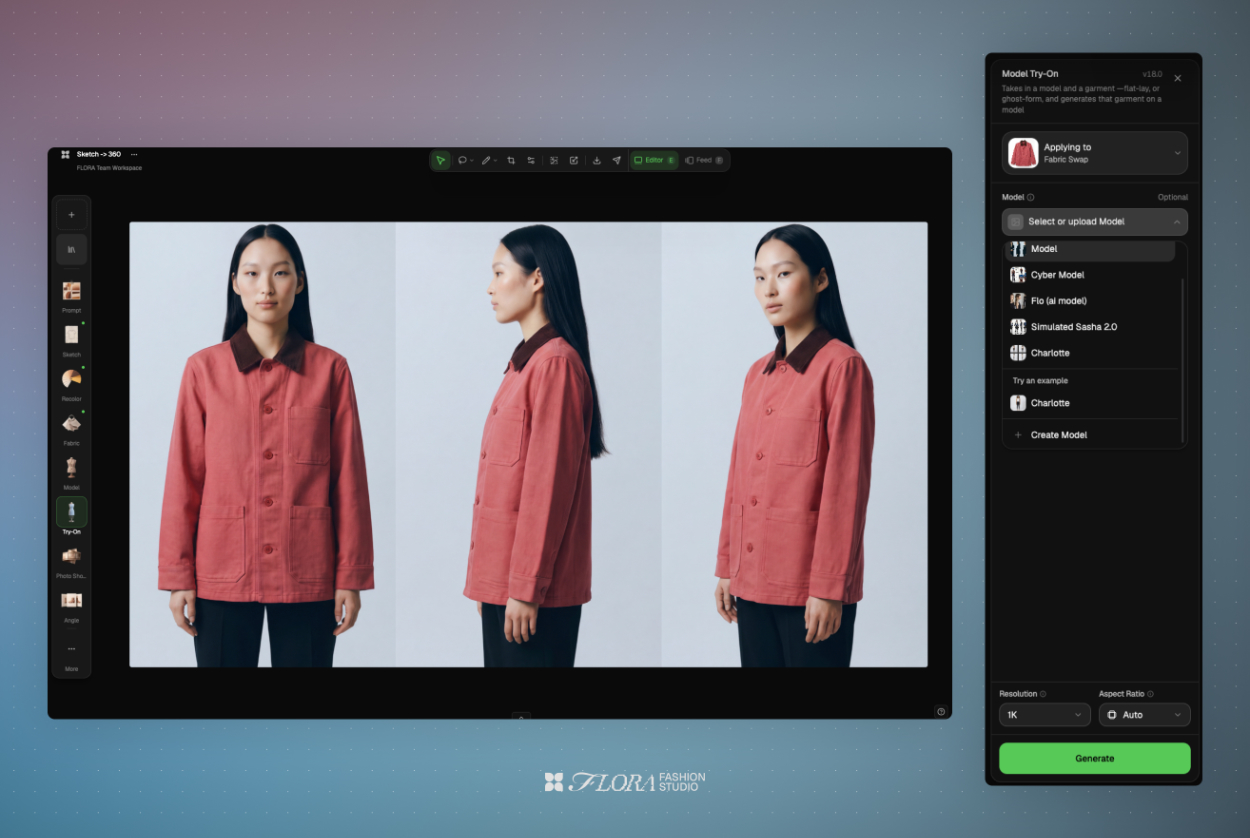
That’s an interesting point on destructiveness. In traditional tooling, there’s Command-Z, which is fantastic, of course. For generative tooling, in this era, we do have an image editor. And even if you’re not using FLORA, you still can generate something and then segment out stuff. We have this in Fashion Studio where you can segment out a given fashion item, like on the person, and then edit that specifically.
So there are versions of that where you can do it with traditional means. But also for generations, let’s say you have an image reference of a clothing item and you want to do a different concept of it. Let’s say you generate out four versions, you don’t like any of them, you can go back to the starting reference and then do it again. So it’s non-destructive in that sense.
It’s a little bit different, but there is, especially in FLORA, that kind of view of different steps. And even in Fashion Studio, we’ve kept that as well. Fashion Studio looks more like Adobe Illustrator, although a lot simpler, where you have the asset in the centre, let’s say you have a fashion item, and you can use any of these fashion-specific tools, like making a flat lay, a ghost mannequin, or vice versa. And when you do that, you still see the initial ghost mannequin that you can go back to and then try something else. So it’s non-destructive in that sense.
Okay. I think that’s right. And I think maybe the mindset shift for the team here, and the way that we’ve seen it as well, is you have to think about it differently. You have to think about it as multiple generations, as you described earlier. It’s not a single shot, but neither is it the traditional paradigm of I will steadily layer things up and then subtract them through Command-Z or Ctrl-Z when I need to. It’s a slightly different mindset, I think.
Yeah. And one thing I will say, and part of the reason why we built Fashion Studio, is that we wanted to deliver the most powerful generative tools in a creative tooling interface and context that more people are used to. A big blocker is just the fact that FLORA is node-based. It’s the most powerful way to use FLORA, but you have to learn which model to use, although we have auto mode to help pick the best one. You have to learn how to prompt, although we try to help you with that on the back end. And you have to learn how to think about workflows, which is a new way for a lot of people to use a creative tool.
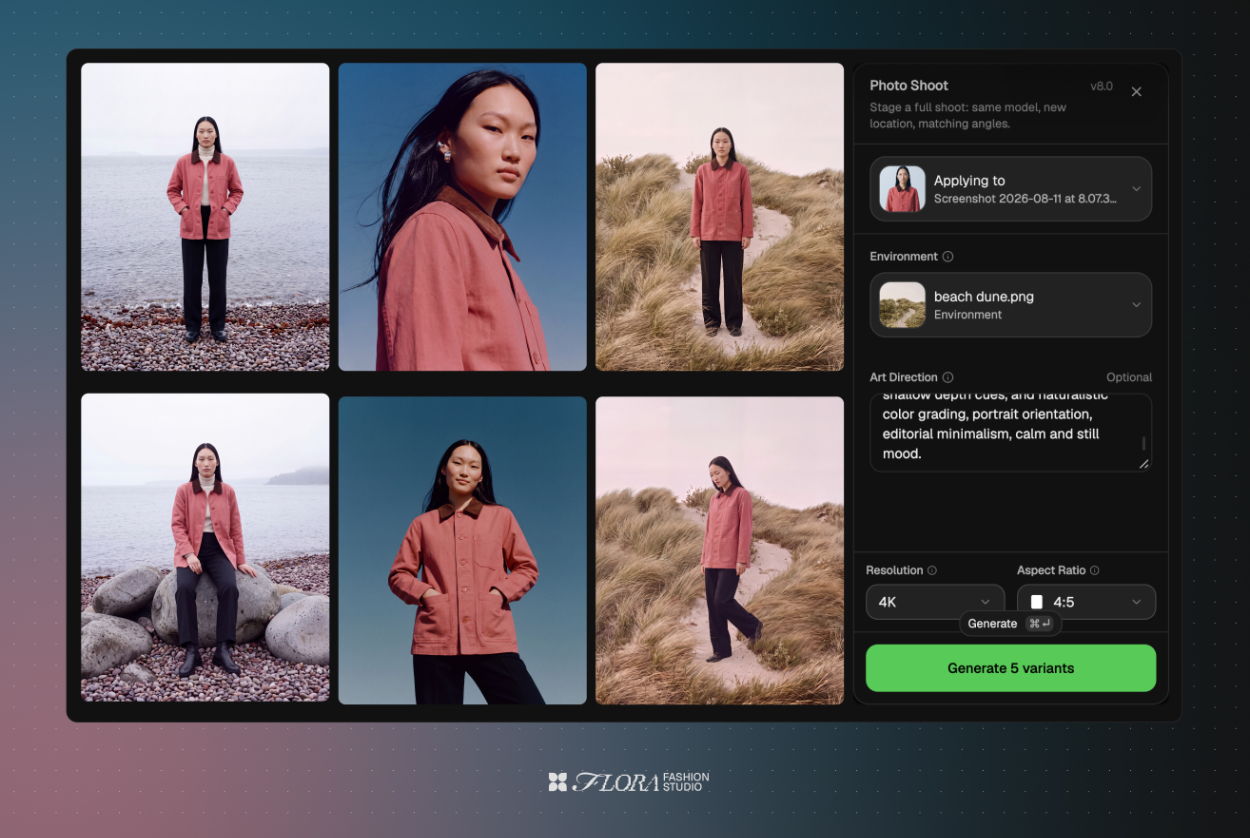
In Fashion Studio, we’ve basically taken the generative workflows that we see most common among all the fashion teams we’ve worked with, like the 10 to 15 ones. We’ve thought about what is the end-to-end fashion process, and then what tools correspond to that in sequence. And we’ve delivered that in concepting, refining the garment, and then showcasing, and having a set of tools that map to that. And then over time, adding things like vector editing, tech packs, which is probably next week, to be able to get even more control there, including some of the traditional stuff.
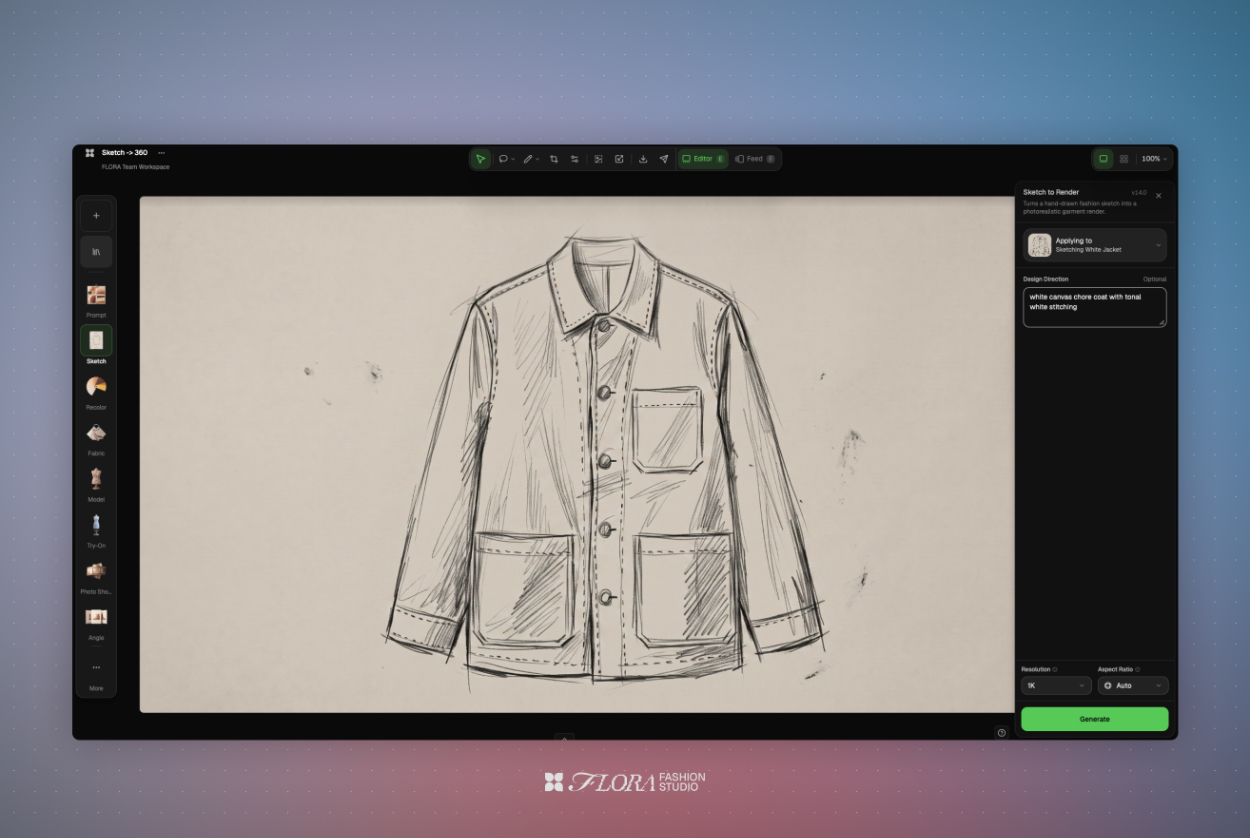
So as a result, we’re framing it less around the technology and more around your creative process. That way you can think about it less. And my hope with Studios is that these really powerful generative workflows that typically are a couple of steps to really turn a great sketch into a render, is just a click of a button. And it just feels no different than like lassoing in Adobe Illustrator. That’s my hope. Because then we really can give professionals the power they want without them even needing to think about a prompt or think about AI at all. Because I don’t think they should have to. It just gets in the way a little bit.
Okay. No, I think that’s right. And I’m somebody who’s used these tools. And disclosure, The Interline does use FLORA, although we use a bunch of other AI tools. I’ve always used them in the node-based interface because it’s one that actually does make sense to me, I think. But I get that it’s not intuitive and instinctive for everybody.
Yeah. I believe both that node-based is platonically correct, in that it gives you most direct control over this creative technology. But I also know now from — we have over a million users, but Adobe has 40 million. There’s a lot more people used to different interfaces, and I do think there are ways to deliver the same power that you would get from a node-based tool in a much simpler entry point. So really focused on doing that to help a broader class of creative professionals.
Yeah. Okay. And we’re going to talk a little bit more about Fashion Studio as we go. Just as a heads-up for the audience, these conversations sometimes get recorded a couple of weeks before they go live, so there’s a good chance that some of the features that Weber’s describing will be live by the time that you listen to this. The perils of interviewing fast-growing companies who ship a lot is there’s a delta between the conversation you have and the conversation that people hear.
Now I do want to take some of the theory that we just talked about there, and look at how it manifests itself in the capabilities of this tooling as you evolve it. Because one of the qualitative responses we got to the survey we ran in the AI Report this year was: generative design tools are, and I quote here, “good at creating very rough ideas but terrible at refining those ideas.” You’ve written and said a bunch about that when you’ve talked about getting speed at the beginning and then losing control and precision when it matters.
People largely in fashion seem to agree with the idea that these tools are most mature and most effective at the beginning and the end of the product journey. So when you’re dealing with initial design direction for a collection, or you’re taking existing products and bringing them to life in marketing content and so on. The real value, though, does lie in the precision and the control.
And like a lot of people I spend more time than I care to on LinkedIn, and there’s a huge cohort of people on there who seem variously proud at different stages of the coherence and fidelity and consistency that they’ve been able to get from generative workflows. You’ll routinely see people being like, hey look, here’s six images that I’ve generated from this completely synthetic campaign, a synthetic model wearing various pieces and so on. And the issue is not anymore, at least, do those images look realistic. One by one they do. I’m reasonably well trained, not a massive expert, and it’s becoming harder and harder for me to distinguish between a generated image and a photo.
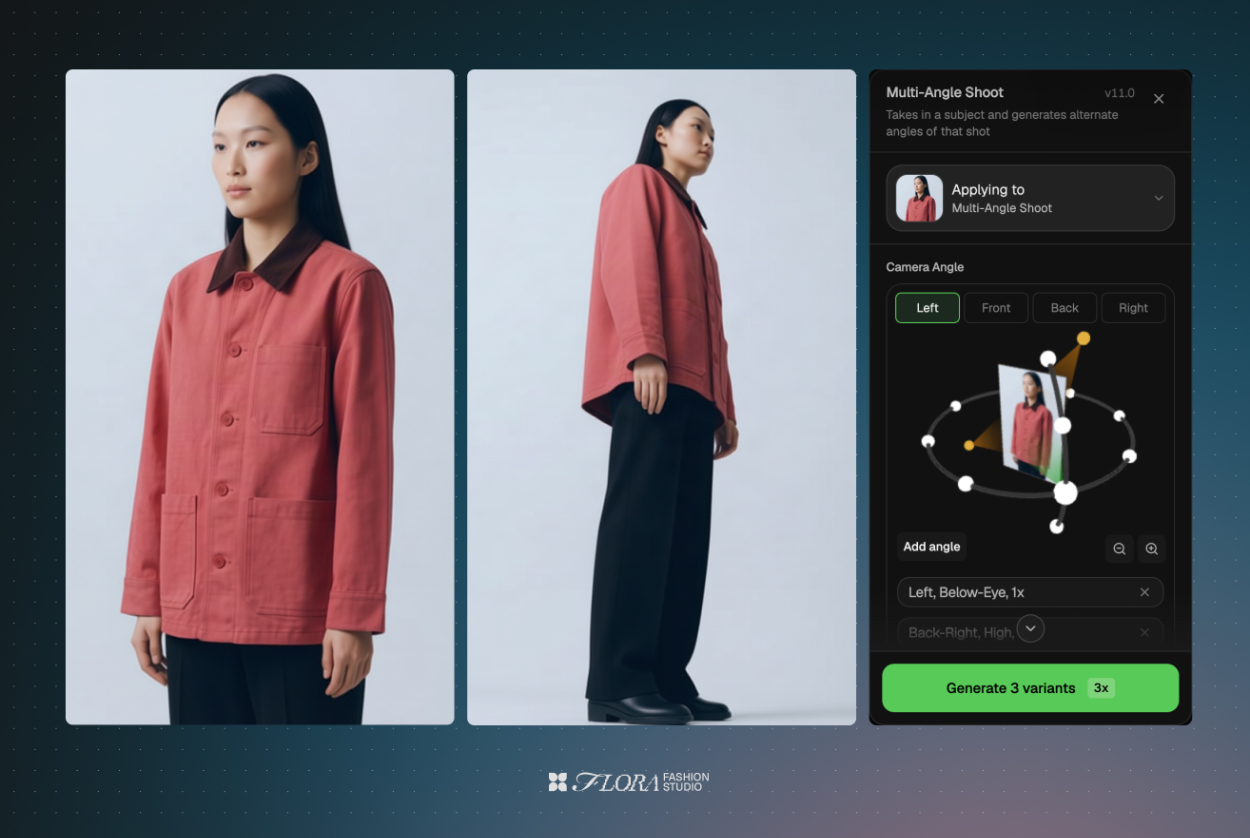
Where they fall down is in the consistency across all five or six of those generations. So you would have one where a model is wearing glasses, for instance, and the glasses look real in every individual shot, but the arms of the glasses are different in each of them, despite beginning presumably with the same prompt and so on. How far do you think you can push that precision and coherence and consistency between generations?
Yeah. I think it’s good enough to look at, but not good enough to put on a billboard. It’s where we’re currently at, if that makes sense. And it looks good on LinkedIn, and it’s useful for concepting and stuff, but I wouldn’t necessarily recommend that you do that for a massive billboard necessarily. Maybe for social media. But I think it’s really useful for the concepting stage for sure.
And just to touch on the literal model limitations there. There’s some stuff that is in the purview of the model companies to improve. We actually have an applied AI team that comes from Scale AI, which helps train a lot of the models initially. Then we work with the frontier labs directly and tell them our learnings from working directly with fashion professionals, because they care about improving this for real-world use cases as well. And we’ll tell them, sketch-to-render, not so great because of X, Y and Z. Garment swap, or consistency across sunglasses on different models, not great. So we’ll inform them there too.
So part of it is just the model. The other part is how you use these different models together. How I would do that specific use case is have one image reference for the sunglass item, and then connect that to different shots and try to use the same model there. It is somewhat varying. I think a lot of them work quite well, but on that side, there’s not much more to do there. So I would say it’s mainly in the model. And I think the models will continue to get better, and you can already do a lot with it today.
And I am, to be clear, picking at the details here. I am consistently impressed at how far image generation as a class of technology has come in a very, very short span of time. So I do want to reiterate that I think the 80% amount that you got to before — the amount that you can get done quickly — is seriously impressive, and it does change the way that we think about these workflows. I just think it eventually does hit this precision barrier. I don’t know how to call it that, the roadblock, whatever you want to call it. But I agree with you. I think it’s on the model providers to improve some of that.
Where it’s not on the model providers, I think, is how you distinguish FLORA at the industry verticalisation, specific-tooling level. You’ve mentioned Fashion Studio, which I will quiz you on a little bit more as we go, but FLORA began life as a cross-industry tool, artistic and creative for a range of different purposes. There’s a difference between saying, okay, I’m going to take this cross-industry tool and target fashion with it, and then actually building verticalised best practices, tools, integrations, capabilities and so on. It sounds like you’ve done a good amount of that already.
There are multiple fashion-focused AI creative and content workspaces out there already. Off the top of my head, non-selectively: Raspberry, Fermat, Vizcom, Mercer, which I know used to be called CALA, on the creative end, and then on the visualisation end, Caimera, Botika — there’s a whole range of those campaign and marketing and content-focused ones. Where do you think FLORA sits in that landscape?
Yeah. So the context for why we’re focusing more vertical-specific is, again, our product philosophy is: study the creative process, study the best technologies, and then build the best creative tool that reflects the creative process, helps creators go from the idea to end result with as much control and speed as possible. How do we help them make great work?
We started by thinking that there’s a universal creative process, because every team operates differently. So let’s build a general tool that you can shape to map to any creative process, which is a node-based tool. It was almost more built around the technology.
We obviously got a lot of users in fashion, and they were using the node-based canvas both for concepting, garment explorations, and also in brand and marketing for exploring there, and also for batch generation and bulk generation at scale, which the workflow tool is uniquely good at, and that no one else in the industry had.
Increasingly though, a lot of fashion designers at a lot of these firms were like, hey, this is really powerful. This is more powerful than any of these industry-specific tools that are more like AI-wrapper types. It’s a bunch of different small tools. It doesn’t feel like a creative tool. It’s not a medium for the fashion professional. It’s a way to access models in some ways. So they wanted something for the broader team.
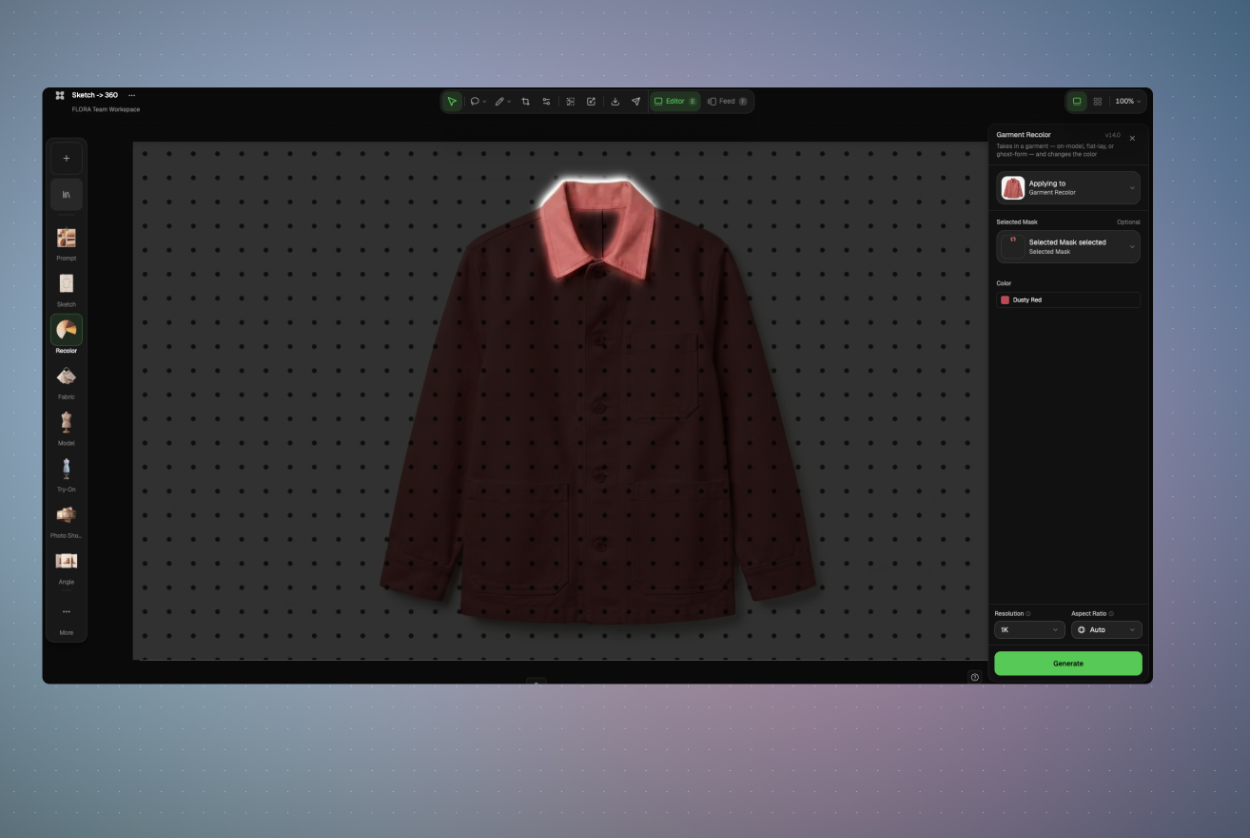
And we realised that a lot of these fashion professionals, in the workflows, they’re doing the same 10 to 15 things. So why don’t we just take those generative workflows, optimise them really, really well — like a sketch-to-render workflow, for instance. Just optimise the exact right model, the exact right prompt, so they don’t have to think about it. Let’s collect all these tools together into one studio where you can focus on the asset. And now you can just go through the full creative process with the 10 to 15 tools that best reflect what you actually need that generative tools can provide. And let’s also build in, for what it’s worth, traditional image editing there too. Cropping, colour grading. We’re adding Pantone colour selection this week. We’re going to add vector editing too. It turns out it’s quite easy to build Adobe Illustrator. So we’re going to add that in too.
So now you can just have it all in one place, a proper creative tool. Not like a place where you’re going just for a sketch-to-render thing here or another thing there. A full-on creative tool specifically for fashion professionals. We’re building the new Adobe Suite. And it’s because there was so much value there that people just couldn’t get to. People that got pilled on the canvas really loved it, but it was just taking too long, and there were so many people that could see that value but just couldn’t get to it.
So by focusing more vertical-specific, we can design the creative tool not around how the technology works, but around how you work. Can study that process end to end and do exactly what we need there. Right now, I think what we’re missing is deeper control in certain areas: vector editing, tech packs, storing the metadata of the swatch so it can go into the tech pack. So when you place that order, all the metadata is there perfectly. We want to try to help you with the full fashion process.
From studying it over the past two months of talking to 200 different fashion professionals, I don’t think the current way it’s being done is very effective. It’s switching between all these different tools, Illustrator, Excel, mood boarding in Figma. It can be done a lot better, I think. And we’re not just an AI company. We’re a creative tooling company, and we’re going to try to figure out the best way to do it there.
So think of it as the first kind of tool in the new Adobe Suite, but instead of being grouped around functionality — like image manipulation for Photoshop, or vector editing for Illustrator, or video editing for Premiere — it’s grouped around one creative process. Fashion Studio, then Film Studio, then Brand Studio. So we can really tailor it around you and make it bespoke.
Okay. So you mentioned tech packs a couple of times, and you just said something else there that I want to pick up on. Being the new Illustrator is an interesting goal for fashion for the reasons that you’ve just described. Illustrator is where 2D design work gets done, creative design, technical design, and so on. It is not where tech packs, technical specifications get made, and bills of materials and points of measure and so on. It is part of an integrated suite, ideally. There was a whole — I was around for it — messy push about five to ten years ago to integrate Illustrator into the dominant product lifecycle management, PLM, platforms of the day, because what you needed was a handoff from the sketch to the platform that housed the product data that was then required to manufacture it.
And I think people see this now when they look at generative workspaces in particular. I’m going to quote somebody else from our survey again, talking about generative images as saying it doesn’t exist. It’s just pixels. Somebody else needs to go and make the pattern. Somebody needs to sew it. Somebody needs to fix it, and so on. Or to put it another way, you can sell tools that make pictures of fashion, or you can sell tools that make fashion. That sounds like I’m picking and being derogatory. I don’t mean it that way. There’s a lot of value in visuals, but there’s arguably a lot more value in doing the whole thing.
So tell me how you see it, because you’re not just trying to build Illustrator if you’re trying to do the whole fashion workflow. You’re trying to build Illustrator with a PLM attached to it.
Yeah. We’ve looked at the PLM. I’ve talked to a couple of DAM librarians. There’s a way to do this end to end where it’s not just the pretty pictures, but all the details you need to actually make the thing.
It is deep though. And we’re going to start with the parts that are lower-hanging fruit, I suppose. And in some ways, this problem technically could have been solved before generative AI, in some ways. But it just wasn’t, I guess.
And if we think about trying to help with the full process, what you’re talking about is a natural end conclusion. I do think one additional reason why it’s easier for us to go after this over time is that the speed of building software is a lot faster now. And for us, we’re a very high-growth venture-backed startup with a very technical team. We are pretty good at building creative tools well for professionals, and fairly quickly. So it is more likely that we can go after this. For now, we’re going to start with the more straightforward stuff, the more digital side of the process, but yeah, we obviously see the need here, and we’ll move more into that over time.
Okay. Because the other element as well is using real inputs to the generative steps. So I’ve just focused on you have a sketch and then you want to turn it into a real garment. The other way is you have a material library and you have a colour library and you have pre-approved seasonal colours, you have materials properly, the way you’ve used them.
There’s a lot of different ways to then take that into a workspace, and instead of going, let me manually draw a new pattern or a new block and let me put some swatches next to it and maybe I will experiment in 3D or what have you — if the technology is up to it at the model level and the platform level, you can drop all of that into either the more intuitive tooling you’re talking about or the node-based canvas. That’s a very different way of creating then. I see that very strongly.
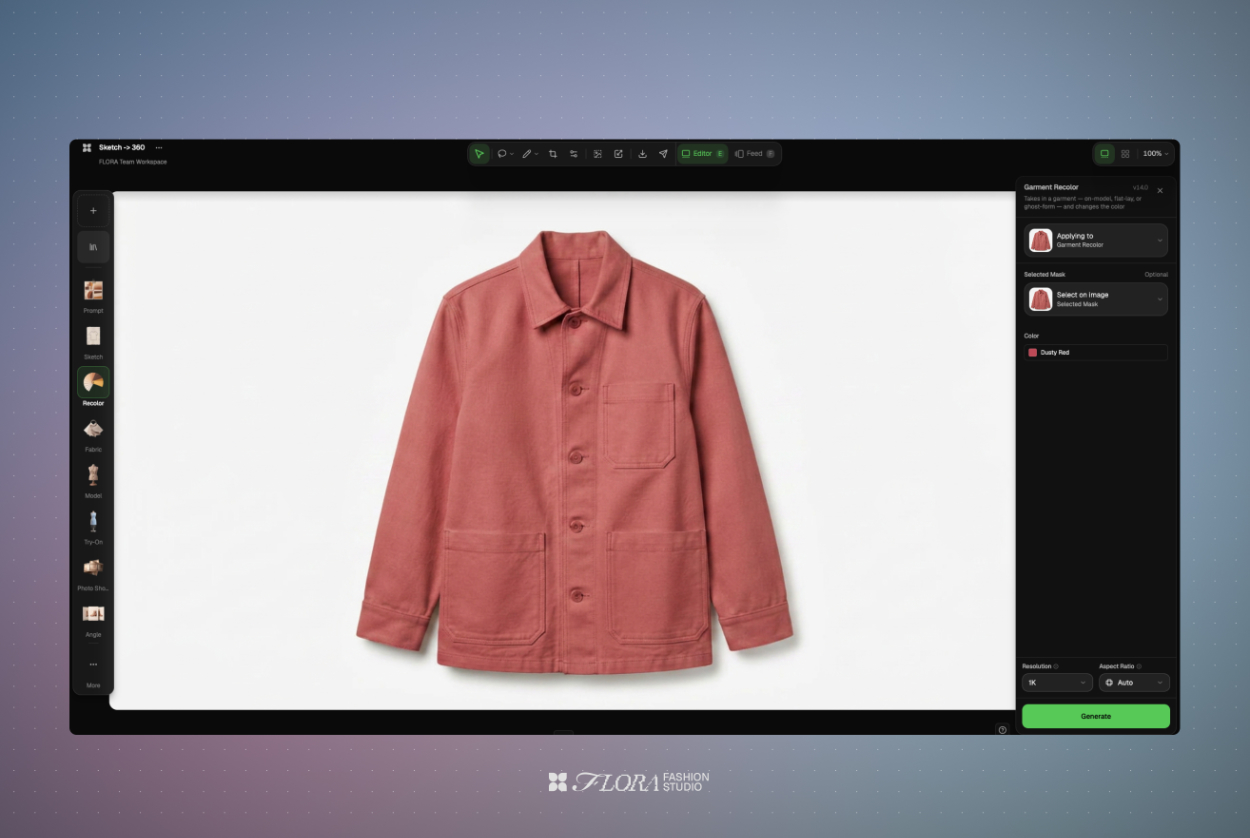
Yeah. Definitely, Ben. We have a recolour tool and there is an input for a swatch, and you can upload a library of your swatches. You need to do that with your colours as well. Right now, you can already do that, but we want to make it across the workspace. So for your team, everyone has access to exactly the right swatches and whatnot. And if you use that swatch, we want to store that metadata, so when you turn that into a tech pack, it exactly says what it needs to say. So yeah, that stuff, we want to go in that direction as well.
Honestly, candidly, this I actually don’t know if we’ll go in this direction, because I have to separate what I think is creatively interesting and what is a good scope for us for the business. But the most extreme version of this is any single fashion designer can go into FLORA, make their item, end up with a tech pack, and we actually just go help them manufacture it because we have relationships with the mills or whatnot. That’s the most vertically integrated version of it. It has a lot of work, but that would be really cool too at some point.
It would turn you into a fashion company exclusively, I suspect, depending on how much you want to stand up that side of things.
Yeah.
Okay. Now just very quickly, the final thing on Studio. I think we’ve done all of the functionality ambition stuff to death now. But who do you think is the audience for Fashion Studio right now? I know you’ve got some brand testimonials and things out there you might want to reference. Who is your ICP within fashion for this? And who do you think becomes your target customer as you extend the footprint out, either earlier into the design phase or later into the development and production side of things?
Primarily professional fashion designers at larger firms, and the brand and marketing teams there. An interesting thing about FLORA is it doesn’t serve just the fashion design process, but also the brand and marketing side. And one Studio project is collaborative, so you can go in there, work together, use that as a system of record for one project.
Also getting a lot of traction from freelance designers and also indie brand owners that are experimenting on their own. And this is sort of a new way for them to explore different ideas and whatnot. I’m going to launch a big Shopify integration soon to make it really easy to go from here onto Shopify. But I would say that’s our main focus.
And yeah, some of the customers we’re working with: Jordan Brand, Prada, Skechers we’ve been working with for a while, and a bunch more that we’re also iterating with very closely and have been instrumental in helping us develop this.
Alright. Cool. That’s helpful. So the economics of image generation are really interesting to me because if I just put my cold commercial hat on, it’s incredibly compelling to look at the unit cost of a traditional photograph — I don’t mean on film, I mean a digital photograph here — and the unit cost of an image generation. It’s a slam dunk. I can generate a 1K, 2K, 4K image, pull in elements and inspiration from wherever I want, it’ll cost me less than a dollar. I can do a whole campaign for the price of a stop at the coffee shop on the way to what would have been the studio, or the airport to the location.
I’d probably have some challenges if I did that around the provenance of the inputs and stuff, and there’s a bunch of legal conversations I’ve had on the show recently, but if I wanted to do fashion photography faster and cheaper, this would be an absolute slam dunk for me.
I find the pricing bizarre, like in generative workspaces, and to be fair to you, that’s not a problem that’s unique to image generation. Anyone listening to this who’s looked at their Claude usage page recently will be like, how the hell did we get here? There’s three, four different kinds of limits, usage credits, promotions, boosts, all that sort of stuff.
You’ve been through a bit of a pricing shift for FLORA as well. Now I think you used to have pooled-token billing, and then everyone on the team would share credits, you didn’t have a need to pay for seats, which made sense on that unit-economic level, but it also puts a weird layer of abstraction between it where you’re pricing image generation in credits instead of cents and dollars. You have to do a quick maths to figure that out.
Now you’ve got clearer pricing in that every generation has a cent and dollar cost, which I appreciate, but you’ve also moved to a seat model combined with token allowances, which means customers need to be more selective about who should be a user.
The short version of all this is I don’t understand what the final form of pricing for images is going to be, whether it’s subsidised or not. You have people who are doing guaranteed outputs and you don’t pay for things that don’t meet a quality bar if you’re an enterprise customer, and so on.
What’s your take on this? Because on the one hand, I can understand people looking at it and saying this is so much more effective, it’s faster, it’s cheaper, it’s better than traditional photography. And then on the other hand going, actually, how we pay for this and how it’s priced and what the costs are going to be incurred in the long run is arcane to figure out.
Yeah. Well, I’ll start by saying the two main assumptions here that determine pricing are: how much do these models cost per inference, and what is easy for customers to buy.
So for the most part, both for self-serve, like people that just come in and buy, and also for enterprise, there seems to be a preference for just buying a seat and just getting started, because that’s what people are used to.
In terms of the cost of things, yeah, as mentioned, we switched away from this abstract unit of credits to just telling you exactly how much you have, which is typically more than the actual price of a subscription, because it’s just easier to track. And in some ways, by buying seats and pairing that with a certain amount of usage, it just helps them determine how much to buy. Otherwise, it’s a little bit confusing.
In terms of where this goes, I think those two factors may shift. Maybe people become more inclined with paying for usage, but some of our enterprise customers that are quite used to it now, that’s more of the arrangement we have. They roughly know what they spend, so they just buy that up front, and we price more on that than seats. So I typically find that the more used to it people are, the more they want to buy based on usage. Because they have a sense for it, of how much that gets them.
I think the other thing is the price of it. So one thing about media models is they are relatively expensive compared to LLMs. So some LLM products like a basic ChatGPT subscription, it’s just $20, and it’s kind of like unlimited usage. You don’t think about it. But an LLM generation is de minimis. I don’t even know how much it costs. It’s very little. A video generation can cost like $2, right, for a really good one. So you definitely can’t give that unlimited, and you do kind of have to limit that a bit. Having credits or usage limits is typically helpful for that.
If it got really, really cheap, I think that pricing ends up being seat-based, because you’re just buying software again. And it’s a de minimis cost in the same way that using Adobe Illustrator and the electricity it takes to run it is also de minimis, and you’re basically paying for the software.
So it depends there. In terms of models in our space, the models have actually slowed down in improvement. I don’t know if you agree, but it feels like it to me.
I would agree with that. I don’t know if plateauing is necessarily the right word, but I mentioned earlier that I am continually impressed by the rapid progress that was made in image generation, but I think that was all shoved into like a six-month window, and then since then I don’t think I’ve seen anything that is massively impressive. And to be honest with you, I find the newest GPT Image, GPT Image 2 or whatever it is, I find that one very weird. I see generations from it and they have this textured, granular, overly detailed look to them that I think is worse than what went before, and it’s incredibly obvious. So yeah, I’m with you. I think plateauing, but also in some areas, developing an idiosyncratic look that is off-putting in a way that the previous ones weren’t.
Yeah. And we’re pretty well connected with the frontier labs and a fairly technical team. And I think my answer here is that they don’t have good data to train on. They’ve been training off the aggregate of the internet, but they’re not getting the feedback of creative professionals. So there is a gap that can be bridged there, that can help improve the models even better for creative professionals.
And there’s stuff that we’ll work on there as well. Part of which is defining what the actual professional use cases are, which if you look at our Studios, the tools that we’ve chosen there basically reflect our opinion on what are, based on our research, the most valuable use cases for fashion professionals. So I think once that sort of data pipeline, which exists for many other things in the LLM world, for instance, gets built out, we should start seeing more of an improvement in the media models.
Okay. At the risk of oversimplifying things, a lot of what you’ve described both in Fashion Studio and in the node-based canvas is an interface. You sell an interface. You’re not a lab in the sense that you don’t have a frontier model of your own, and that describes a lot of companies in AI. Unlike a CRM or a PLM or an ERP though, which is based on commodity LLMs underneath, the goal for you is for people to like sitting down and working with FLORA and to build those new creative workflows and so on, which means that the web interface, the canvas, is the product. That’s the way that I would think about it.
So help me understand the MCP / API / CLI play here.
I actually think it’s not just the interface. We have an applied AI team that helps deliver better generations in FLORA than other places. So there’s the models, but there’s also the workflow behind sketch-to-render, which is proprietary to us. We’ve optimised the prompt, the workflow, the agent behind it, essentially. And we will hill-climb on that and improve that in particular, deliver better generation than the rest of the industry. That is probably something that we do that other folks don’t.
Another example here is we have this thing called auto mode. We have text, image, video node. Most places you have to go choose the right model and figure it out yourself. We’ll pick the best model for you based on a combination of do you want it fast or do you want it good? So we have a slider. So we also pride ourselves in delivering better generations, and I think that shows through in terms of our usage and also why people like it. I will say, yeah, most of it has historically been interface.
In terms of the API, MCP, I view that as a way to operate FLORA from the outside. So the most interesting thing is I’m seeing some people use MCP and Claude to operate FLORA for them, almost like autonomously. And this is pretty crazy because in Claude, people will, in their instructions, say, I’m a generative workflow builder. Here’s how I approach prompting. Here’s things I do and I don’t do. And then they’ll open up a project and put in the brief, chat about it, and then just ask it to generate entire workflows in FLORA. You have FLORA open on the side, you just see it spawning like 50 images at once, completely on brand.
And then you can take a screenshot, put it back in Claude, and say, actually, make the background for all these black, or make it more like this or that. Claude will think about it with the best-in-class text model, and then just run it in FLORA again. And at the end of it, they’ll take that chat, ask it, hey, summarise what worked and what didn’t, feed it back to my instructions so I get better at prompting. And then all of a sudden, the way they are using that, they just look superhuman comparatively to even the average FLORA user.
And the average person that uses that generates about a 100x more than the average user in FLORA. And of course, the average user in FLORA maybe generates 10 or 50x more than the user of a very simple tool, where you’re just hitting one generate button at once. So there are levels.
I think the hard part for me is, even I’m not that deep into the MCP, because I need to run the business and stuff these days. I haven’t been in the tools as much as I’d like to. But even really deep creative professionals sometimes aren’t oriented into using Claude or know what an MCP is. So candidly, one thing I’m trying to figure out is how to bring that power to everyone else. Still trying to figure that out, but there is some crazy stuff going on there.
Yeah. I will say to anyone who thinks that generative workflows, generative image models and so on are just picking away at a traditional surface, or a bit of a shortcut to something: describing those kinds of workflows and people doing that kind of orchestration, it underlines to me that this is a fundamentally different way of working.
I think one parallel I would say is, unfortunately I used to be in finance, I used to use Microsoft Excel a lot. It’s kind of like watching someone use Microsoft Excel instead of watching someone use a calculator. They’re just calculating a bunch of stuff at once, and it’s pretty crazy to see.
Well, there are world Excel championships for a reason as well. I have a couple of friends who work in finance in London, and they are in awe of some of those guys.
Two very quick final questions. So everyone’s obsessed with the idea of taste right now, whether we’re talking about text, images, general decision-making. The big conversation swirling around AI, the big debate, is that execution is cheap, and I think you’ve just described that. If you’re saying generating 100x what somebody else would be, the doing is relatively cheap. The discernment is where the value sits.
And I buy that idea, as somebody who likes to think I have taste that I earned through my classical literature education we talked about. I’m no artist, but I do question how that develops over time. Do you think this taste thing is a bit of a cat-and-mouse game over time? Because it feels like when the models get better, the reusable repeatable techniques and things get better, it feels like we’re progressively encoding taste, and then over time the taste becomes less important.
Interesting. Well, one of our first customers was Pentagram, and I remember them telling me about in the 1990s when Adobe Illustrator came out and they started switching from hand-drawing fonts to using fonts in Adobe Illustrator, it was a very similar mood to the initial V1 AI. There’s a lot of taste in — I didn’t use the word taste, a lot of craft in doing it by hand versus doing Adobe Illustrator. Now Adobe Illustrator holds the role of what doing it by hand used to be. They view Adobe Illustrator as doing it by hand.
Now we work with Pentagram a lot, and I think probably over half of the folks there are using FLORA a decent amount now. But yeah, I think there’s some parallel there to what you’re talking about.
But I feel like there is some aspect of taste or decision-making there that probably will never be touched. I don’t know. The problem is AI literally doesn’t inherently care. I have a poster up at the office that I’m looking at right now, I think it’s a nice poster. AI can look at that and replicate it, but it won’t actually be like, I like that, if that makes sense. It’s just putting it back out. So at some point, someone has to decide that this is good and that is not.
Sure, you can train a model on aggregate to do that, but that’s not going to be fit for your exact creative problem you’re trying to solve, or even just what you want. So at some point, there is some core seed of agency that just is fundamentally human and is a prerequisite to starting a creative project almost.
I would agree with that. I think that’s right. I think if you sit down and you want to do something creative, that is a fundamentally human act, and the tools that you use for that — that’s where the frontier moves.
Very final question is about forward deployed creatives, which is a term of art of yours and is a play on the forward deployed engineer concept that Palantir pioneered. How far do you see forward deployed creatives mirroring what forward deployed engineers did? Because I think people get confused that FDEs were basically just consultants and advisers and they were there to help people get maximum value out of things that already existed. That’s a consultant’s job. An engineer’s job is to build.
So what does a forward deployed creative actually do at FLORA? Where are they embedded right now? And if they do their field work properly, what do you expect them to bring back and build that improves the viability of FLORA for industry-wide fashion workflows in the near future?
Yeah. So the reason why we created that role back in December of last year was we were going to these firms and I was presenting FLORA. And as soon as I showed them the value of what you could do there, and framed it into their creative context, they saw a lot of value there. But before that, it requires a different way of thinking.
We started bringing in our first FDC, was Kat from Pentagram, actually. She had been using the tool for a year at that point. And she was just far superior to me, of course, at explaining that creative process, and how to work with it, and how to think about it, than even I was. And every time that she would go and do a demo at Red Antler, a different agency in New York, everyone there would just be blown away about what they can do, and immediately get it, get to a lot of value there.
So it was just very obvious that we need to show it to them. Typically, what they show is they maybe first talk a little bit about the high-level concepts of it, the tops-down, bottoms-up thing. It’s different for different industries. So for instance, Kate, she goes up a lot on LinkedIn, our forward deployed creative for fashion. We have two actually. And yeah, she’ll go into a firm, show them a bunch of examples of how they can use it, how to think about it, and how it fits into their use case, and helps train them up a little bit.
Like any powerful creative tool, it takes a little bit of effort to learn. Honestly, I think it’s easier than Figma even, once you learn the core basics. It’s just the node-based thing sometimes confuses people. So they help bridge the gap there. And then they work with those teams over time, build relationships, and also do a lot of content education to get this way of building and the power of these tools out to more people. So that’s roughly what they do.
As for what they bring back, like, during every product meeting. I’ll just bring them in and be like, what do you think about this or that? Because just literally having the customer in the room. They represent like 50 customers. They’ve talked to 50 customers. They know exactly what’s going on, and they’re in many ways the most valuable input as we think about product. Where I still talk to a bunch of customers, but they talk to even more. And they’ve been doing it for a living for like ten years. So they just know it like the back of their hands even better than I do.
Alright. Perfect. Weber, thank you so much for your time today. I really enjoyed this conversation. I think we got through a lot. I’ll be keeping tabs on how Fashion Studio and FLORA in general evolves from here. Love to have you back at some point in a year or so, see how things have evolved, but for now, thank you for taking the time to chat to me.
And that’s the end of my conversation with Weber. I enjoyed this one a lot, and I hope you’ve also come away from it with some fresh ideas about how far generative tools might end up being pushed, even if the underlying models don’t make any more big leaps in the near future.
I think if you put this episode in your head next to the one I did with Gloria and Luke from Fabra, you’ll be in the right mindset for understanding the potential shake-up that’s coming for design and development as technology categories, and design and development as disciplines.
It’s an interesting time, and we haven’t properly touched on how AI might be putting long-entrenched categories like PLM back up for reinterrogation and rebuilding either, and that’s something I want to come back to pretty soon.
Something different on this interview show next week though, and make sure you come back on Tuesday for the next edition of The Edit, where Grace and I spend 25 minutes or so running through the top headlines from the last seven days. It’s a breezier, more conversational, more commute-friendly show than this one, but I think you’ll like it if you’ve never listened to it before.
For now though, thanks for listening, and I’ll speak to you again really soon.