

Originally released in The Interline’s AI Report 2026, this executive interview with VibeIQ is one of a 17-part series that sees The Interline quiz executives from companies who have either introduced new AI solutions or added meaningful new AI capabilities into their existing platforms.
For more exclusive interviews, stories and opinions from different industry perspectives, and real survey feedback from voices from every level of fashion, download The AI Report 2026.
We’re observing a big disconnect, in both our own fashion-only data and in wider benchmarks from other sources, between the increasing capability and reliability of AI, in both a general sense and in discrete applications, and the lack of trust that end users place in its outputs. What does trust in your specific applications of AI look like, and how do you achieve and measure it?
Trust in AI has to be understood at the task level. There is no single threshold where an organisation suddenly “trusts AI.” The question is: what is the AI being asked to do, how easy is the output to review, and what is the consequence of getting it wrong?
In product creation, image generation is already in a place where the value is clear. A designer or merchandiser can evaluate an image quickly, reject what is off-brand, and use what advances the conversation. That does not mean a brand should generate an image and put it straight onto an eCommerce site without review, but the review loop is visual, fast, and intuitive. The trust model is straightforward.
Tech pack generation is a different kind of trust problem. It is more detail-heavy, and the output needs to be checked against construction, materials, measurements, trims, and vendor requirements. But it is still fundamentally reviewable. AI can take on a significant portion of the drafting burden while the designer, developer, or technical expert validates the result before it moves forward.
Merchandising and line planning decisions are harder. A line plan is not just an artefact; it is the result of many linked decisions: carryovers, newness, price architecture, margin targets, volume expectations, regional needs, channel priorities, and assortment balance. You cannot look at a line plan the way you look at an image and instantly know whether it is right. You need to understand what drove the recommendation.
That is why trust in AI for fashion cannot be reduced to model performance alone. The models many companies use will often be the same frontier models. The differentiator is the context, the workflow, and the audit trail around the output. For product creation, trust looks like knowing what information informed the output, who reviewed it, what changed, and why the decision was made. The right analogy is not blind automation; it is a capable team member whose work is reviewed according to the importance and complexity of the task.
One of the foundations of the kind of trust we’ve just talked about is confidence that the answers you’re going to receive to a query, whether that query is aimed at generating an image or providing the essential groundwork for a mission-critical decision, are based on accurate context and relevant facts. In some ways that’s a new version of the perennial search for a “source of truth,” but it’s also something bigger than traditional systems integration and data model definition, because we’re talking about platforms, or agents, that are active participants in decision-making, not just new ways to consolidate and surface information that previously lived somewhere else. Do you see the industry making progress on this kind of grounding? Are companies pointing their AI investments at the right places and the right stages of the product journey to have them actually contribute to confidence?
The industry is making progress, but many investments are still pointed too far downstream.
Fashion has always had a source-of-truth problem, but AI exposes that problem in a more consequential way. Traditional enterprise systems are very good at capturing end-state data: the final product record, the approved bill of materials, the costed style, the purchase order, the plan. Those systems matter, but they are usually destinations for product data. They are not where the earliest and most expensive product decisions actually happen.
The context AI needs most is often the context that has no proper home: the original intent behind a concept, the merchant’s view of assortment balance, the planner’s margin concern, the regional team’s feedback, the sales signal that changes a colour story, the MOQ issue that makes a style commercially unrealistic, or the meeting where a category was overdeveloped and then rationalised. That context usually lives across presentations, spreadsheets, emails, chat threads, and informal reviews. By the time the data reaches PLM, many of the important decisions have already been made.

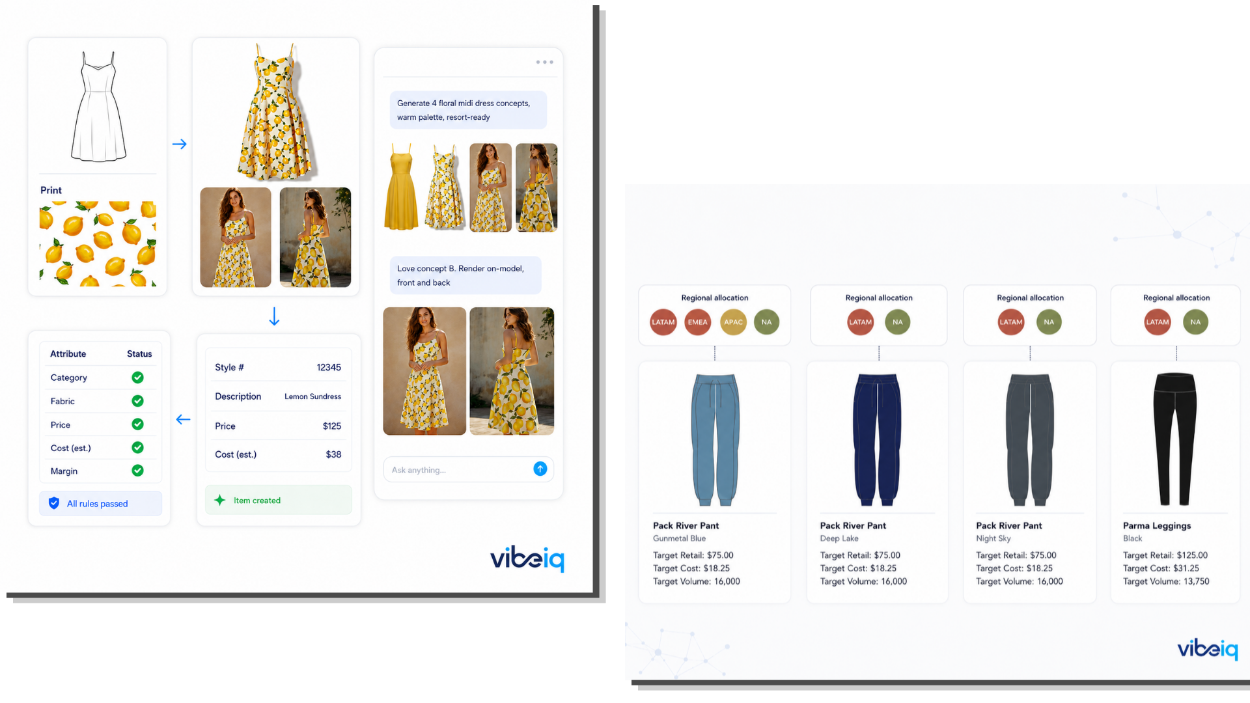
If AI is going to support confidence in product creation, it has to be grounded where teams are actually working. That means capturing the in-progress context around ideas, lines, assortments, feedback, costs, and commercial intent before those decisions harden downstream. It also means maintaining an audit trail of what was used to generate an output and what drove the recommendation or decision.
That is the distinction between adding AI to existing systems and creating an AI-native product decision layer. The goal is not simply to consolidate information from PLM, planning, ERP, and sourcing. The larger opportunity is to create a shared decision environment that connects creative, commercial, operational, and regional context while the product line is still malleable. That is where AI can move from producing plausible answers to supporting better decisions.
It’s fair to say that the wider world is wrestling with how to calculate the value of the gigantic investments being made in AI. With so much of the promise of AI being based on fuzzy definitions of efficiency, or productivity, or creativity, rather than the hard metrics that should ideally come out of the other end of technology spending, this seems like a very hard question to address. It’s also a question you need to address at VibeIQ, because the whole point of the platform is to capture value that’s being missed, and cut out inefficiency that’s hidden. How do you draw a line between something that isn’t there, fragmented decisions based on incomplete hand-offs between presentations, spreadsheets, meetings and so on, and tangible returns measured in markdown and waste reductions, SKU rationalisation, and margins?
The first step is separating three different kinds of value that are often collapsed into one conversation: automation, speed, and decision quality.
Automation is the easiest to measure. If work that previously required manual effort can be drafted, structured, or prepared by AI, then you can look at output per dollar, the ratio of manual effort to product volume, or whether a team can support additional categories, channels, or regions without adding the same level of operational overhead. That matters, but in fashion it is not the whole answer.
Speed is also measurable. Brands can set a clear hypothesis against a season or milestone: we believe this process change will remove a specific number of weeks, allow earlier stakeholder review, or reduce the time between concept and commercial decision. Then they can measure whether that calendar compression happened. The important point is to tie speed to a product creation outcome, not to activity for its own sake.
The most interesting value is decision quality. For us, one of the strongest leading indicators is sample-to-adoption rate. A brand should be able to create and explore more concepts, but sample a smaller, more deliberate subset. Once something is sampled, the organisation should have higher conviction that it is commercially, creatively, and operationally viable. Sampling ten products to adopt one is very different from sampling ten and adopting eight. The second scenario uses development capacity, vendor attention, materials, and internal decision time much more effectively.
That same logic applies to SKU rationalisation, assortment balance, and margin risk. We have seen customers get value simply by seeing the full product line earlier and more clearly: recognising they had too many versions of the same print, not enough depth in an important category, or a weak connection between apparel and footwear stories. Earlier MOQ signals can stop teams from spending time on products that will not meet sourcing thresholds. Regional and channel feedback can reveal that a product has limited demand before sampling and costing work goes too far.
Sell-through and markdown improvement should absolutely be measured, but they are harder to attribute cleanly because many forces affect market performance. The more directly attributable measures sit upstream: fewer low-conviction samples, better sample adoption, faster calendar decisions, earlier margin visibility, clearer assortment discipline, and fewer products developed past the point where the organisation should already have known they were not right.
It’s clear from the data contained in this report, and from the market at large, that generative AI has matured and been adopted incredibly quickly at the beginning and the end of the product funnel. Visualising a sketch, or creating eCommerce-ready generated photography, are approaching the level of being solved problems. But there’s also a gap between those outputs and manufacturable, costed, thought-through products, at least some of which is going to stem from the fact that generative image workspaces aren’t typically the places that product data lives. What do you see as the next turn here?
The next turn is connecting generated product expression to the data and decisions required to make something real.
The industry has made a lot of progress at the visual edges of the funnel. You can move from a text prompt to a sketch to a product-on-model image very quickly. That is powerful because it allows teams to “demo” a product line before they build it. A designer or merchant can share a concept, collect stakeholder feedback, and test whether the direction has energy before committing to samples. In apparel and footwear, that is a meaningful shift because physical sampling has historically been one of the first expensive proofs of an idea.
But an image is not a product. A manufacturable product needs materials, construction logic, measurements, colour and trim decisions, costing assumptions, MOQ visibility, vendor feasibility, margin expectations, and a point of view on where it fits in the assortment. The gap between an inspiring image and a sourceable product is not just a content generation problem. It is a product decision problem.
In the near term, AI will help connect generated images to the right product data and automate some of the artefacts required to move toward sourcing, including technical documentation. But the larger change is not simply “AI-generated tech packs.” The larger change is that the workflow of product creation itself is being rethought around a more native, contextual experience.
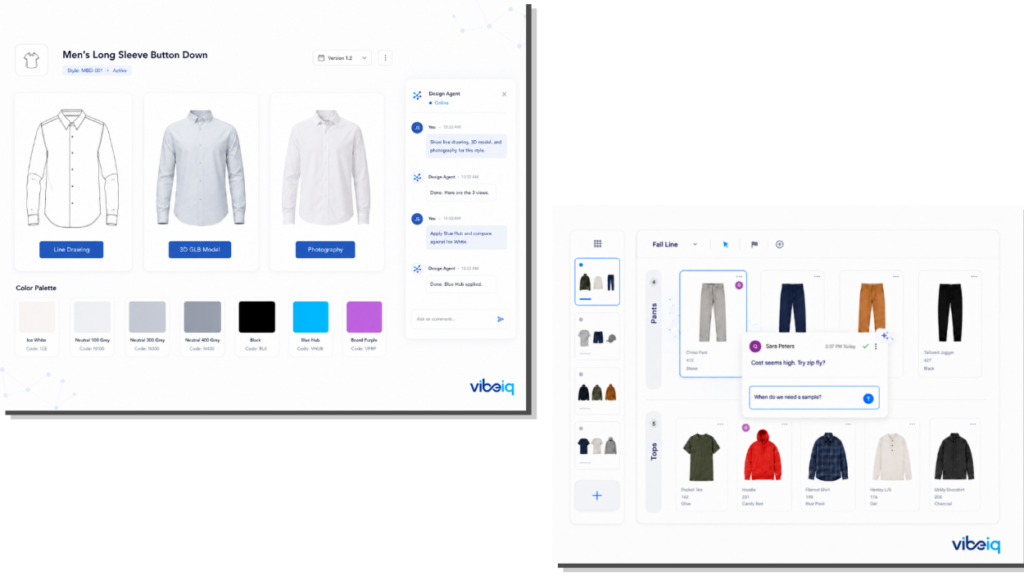
That raises an important question for the industry: can legacy systems simply have AI added on top, or does the process need to be rebuilt around how teams now work? PLM will continue to matter, particularly for approved product records and downstream execution. But the origin point for better AI-assisted product creation is the workspace where ideas are formed, reviewed, edited, commercialised, and either advanced or killed.
The next generation of product creation will not start with an image generator on one side and PLM on the other. It will start with a shared decision layer where design, merchandising, planning, sourcing, and regional teams can understand whether a product deserves to become a real product before they invest in making it one.
In other sectors, where AI uptake is perhaps deeper, we’re now seeing a new challenge: AI token spend is ballooning, as well as being spread across multiple different platforms, and new tools and skills seem to be creating more work for expert professionals, not less, which means re-training and up-skilling on a constant basis. Do you see a pathway to AI in fashion actually allowing teams to do more work with reduced overheads, or are we destined to observe the same budget and talent squeeze happening here as well?
The economics are still being defined, and I do not think the industry should pretend otherwise. But there are two useful hypotheses to test.
The first is a speed hypothesis. Even if the cost base stays the same, or increases in some areas, does AI allow a brand to make better product decisions closer to market? If the answer is yes, then speed has value. Shorter calendars can mean more current trend reads, faster regional feedback, earlier commercial alignment, and fewer decisions made with stale information. In fashion, being closer to market is not an abstract efficiency gain; it can change what products are selected, sampled, bought, and allocated.
The second is an operating cost hypothesis. Can AI automate enough of the manual preparation, documentation, structuring, and coordination work that the cost to bring the same number of products to market comes down, even after token spend and platform costs? That may be true in some workflows, but brands should be precise about where they expect the savings to come from and how they will measure them.
The mistake is defining success as more output. Most apparel and footwear companies do not need ten times more tech packs, ten times more concepts, or ten times more SKUs. In fact, more output can create more complexity if the organisation does not improve its decision discipline. More ideas without better filtering can increase sample waste, overload merchants and developers, confuse assortment architecture, and push margin risk downstream.
The better measure is whether teams can make higher-confidence decisions earlier. Can they see the whole line with enough context to identify duplication, gaps, cost exposure, regional demand, and assortment imbalance? Can they reduce low-conviction sampling? Can they move faster without creating more downstream rework? Can they use AI to focus expert attention on the decisions that actually matter?
There is a path to doing more with less overhead, but it will not come from every function buying its own AI tools and generating more disconnected work. It will come from applying AI to the shared product decision process, where the same context can be reused, refined, and acted on across the organisation.
Last year, we asked technology executives whether they predicted AI would become more obvious, as a primary interface paradigm, or whether it would disappear into the background in the way that vital but invisible platforms like AWS and Azure have done. This year’s data suggests that the answer is both: fashion professionals that use AI interact with it as both the engine and the steering wheel. But we also see that, for a lot of companies, both kinds of applications are still largely in the scoping or refined-pilot stage. What do you see being the trigger for deeper adoption and wider roll-out?
The trigger will be operationalisation. AI has to move from individual experimentation into the actual product creation process.
Right now, a lot of companies are encouraging people to use AI, and many individuals are doing useful things with it. They are generating images, drafting documents, summarising information, creating code, or experimenting with new workflows. Some of that is valuable at the personal productivity level, but it does not automatically create enterprise value. If the output does not flow into a shared process, influence a decision, or become reusable context for the next team, then the organisation is mostly spending tokens on isolated activity.
For deeper adoption, AI needs rich inputs and meaningful outputs. It needs access to the context that makes a product decision intelligent: line architecture, consumer and regional feedback, cost and margin assumptions, prior decisions, sampling history, commercial targets, channel needs, and assortment intent. Then its outputs need to land somewhere useful, where other teams and systems can build on them rather than starting from scratch.
That is the difference between AI as a collection of point tools and AI as a contextual layer in the product creation process. In the point-tool model, every user lights their own small fire. It may keep that person warm for a moment, but the company does not get much leverage. In the operational model, the same energy is put into the furnace that heats the building. The context compounds, the outputs become part of the work, and the organisation gets more value from every interaction.
In fashion, the companies that move fastest from pilot to roll-out will be the ones that stop treating AI as a separate destination. It has to sit inside the work of deciding what products to create, how to assort them, where to invest, what to sample, and what to stop before it consumes more time and margin. That is when AI becomes both visible and invisible: visible in the moments where users need to steer, and invisible in the way the system continuously carries context forward.