

Originally released in The Interline’s AI Report 2026, this executive interview with Caimera is one of a 17-part series that sees The Interline quiz executives from companies who have either introduced new AI solutions or added meaningful new AI capabilities into their existing platforms.
For more exclusive interviews, stories and opinions from different industry perspectives, and real survey feedback from voices from every level of fashion, download The AI Report 2026.
We’re observing a big disconnect (in both our own fashion-only data and in wider benchmarks from other sources) between the increasing capability and reliability of AI, in both a general sense and in discrete applications, and the lack of trust that end users place in its outputs. What does trust in your specific applications of AI look like, and how do you achieve and measure it?
Kirti Poonia: Successfully taming the powerful chaos of AI into consistent usable consumer facing results for the fashion industry has been Caimera’s USP.
We build trust through accuracy. Our Sketch to Image accuracy is the highest in the world. It doesn’t provide many options because it provides 1 absolutely consistent output. When designers see that the output faithfully reflects a product’s print, construction, and seams, not a vague interpretation of it, they start using it. That’s the shift. Our sketch to image results are so accurate that they are being used for consumer facing points of sale as well.
Trust, for us, is measured very simply: whether a large brand, extremely critical and focused on quality will put our output in front of their customers?
Our Bulk Catalog Images Tool is the most consistent in the world, it is able to achieve the exact same backdrop, model, lighting and poses across thousands of products in a single batch job.
We also measure trust operationally. Image approval rates sit at 95% on our platform. That number tells you more about trust than any survey. When your creative team is approving nine out of ten AI-generated images without changes, you’ve earned it.
And then there’s legal trust, which often gets overlooked. We offer legal protection for enterprise brands, knowing their AI journey is legally protected removes one of the biggest hidden blockers to adoption.
And this is why our customers are already using AI in greater capacity than other brands. Our customers are already processing over 1000 styles a month with consistency required for consumer facing images. While companies working with other partners are coming out of failed pilots.
Partnering with the wrong AI tool can decide the future of adoption in a company, and this decision should be a function of so many factors across – accuracy, speed of building new features, continuous improvements, team, support, customer success and so much more.
One of the defining characteristics of generative AI is that the image-generation and editing models, by default, transcend domains, disciplines, and functions. The same technology is underneath different use cases, from turning a rough pencil sketch into a compelling concept, to then translating that sketch into what looks like a finished campaign photoshoot.
This flexibility is both powerful and potentially paralysing; if a technology can do virtually anything, then simply slotting it into existing workflows and business structures is potentially a recipe for confusion rather than focused adoption. What’s your approach to unifying a full design-to-marketing lifecycle in one generative workspace, and how hands-on do you find you need to be with customers to make sure the different capabilities don’t crash into one another?
Prateek Gupte: The way we think about it: a brand’s workflow starts with design, someone sketching a product idea, and it ends with content going live on a website, social media or an ad. Everything in between is friction. Our job is to remove that friction, not to hand the brand a box of tools and wish them luck.
So we built Caimera as a Concept to Campaign platform.
We don’t just provide a single prompt window with all possible ways to use it. But properly fleshed out tools that perform exactly one function. It’s our job to test the dozens of language and image models out there, and pick the best one for the job. Along with the best prompt for each model.

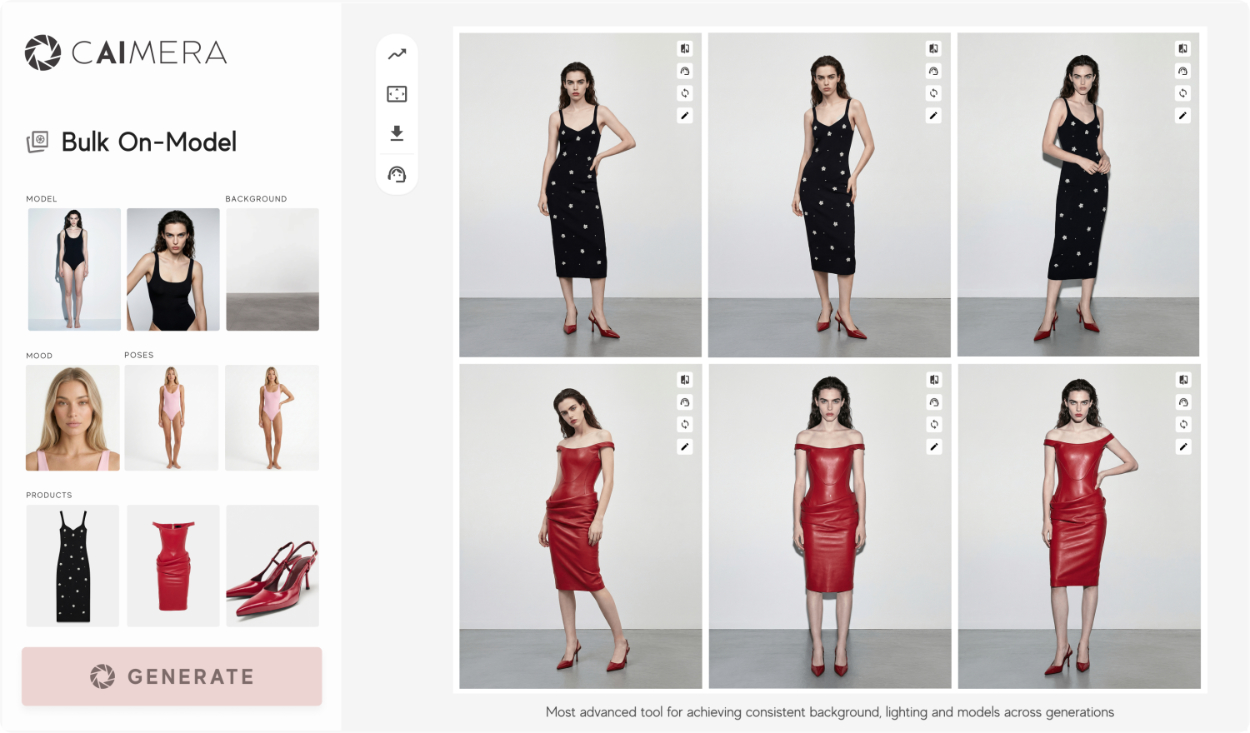
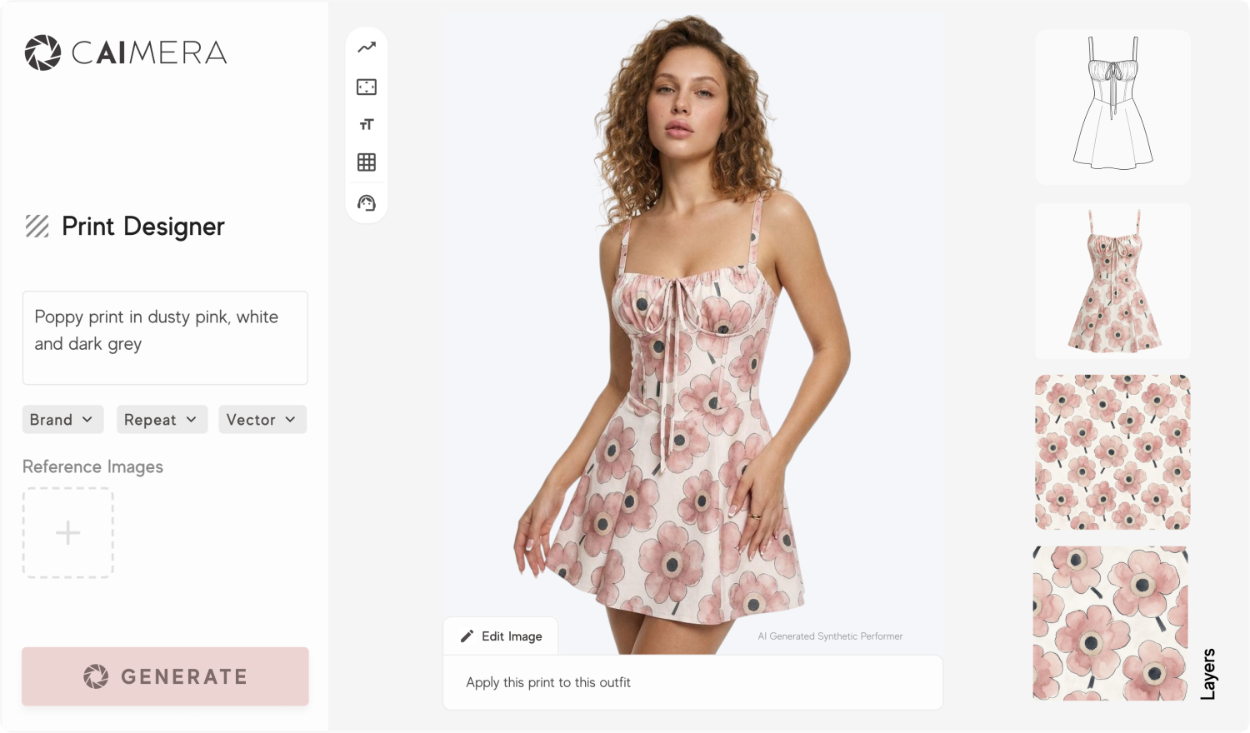
Design tools – like, Sketch to Image, Print Generator and Extract Ghost. Marketing tools – Editorial templates, Bulk On-Model, Lifestyle imagery and Video. They’re connected by the same underlying data: the Product. When a designer approves a sketch, that product can flow directly into a marketing workflow. There’s no handoff, no re-upload, no briefing from a separate team.
We are often asked what is the learning curve? And hence from day 1 we have focused on a UI that is very intuitive. We constantly measure the % of users that are able to come and make their first few results without any guidance. And I’d proudly share, it is close to 100%.
The biggest challenge is for non-tech users to get past the fear of logging into a new tool. Once they are in, they are absolutely delighted.
On the question of being hands-on: yes, absolutely. Especially in the early stages with enterprise brands. We run 1:1 training sessions, we have in-app human support, and we run weekly live prompting sessions. The technology being powerful isn’t enough. People need to feel confident using it before they can become independent with it.
As mature as image generation and editing models are, they’re mostly still used in single-shot mode – i.e. one-by-one generations with manual prompting. This is obviously still less time and labour-intensive than physical photoshoots, but it represents a very real time requirement for either internal teams or external partners and agencies. How are you seeing this change now that generative AI is becoming more embedded into enterprises, where things like bulk workflows are considered mandatory?
Prateek Gupte: One-by-one generation is the way to go for explorative workflows on design, editorial images and videos. It’s not what people want for operations. Enterprise brands don’t want to generate one catalog image at a time, they want to process a hundred SKUs overnight and wake up to a full catalog. That’s table stakes now.
We’ve built bulk workflows into the core of what we do. Bulk Sketch to Image (you can process 1-100 sketches on app) Bulk catalog generation for thousands of products to go from flat lay to on-model), bulk product extraction, all this in one click.
Our APIs are custom-designed for specific team use cases, not generic endpoints that require engineering effort on the brand’s side. A team can set up an input folder, define the output they need, and let it run for thousands of images.
What’s changed recently is expectation. Two years ago, showing a brand that AI could produce a clean white-background product image was impressive. Now they want 99% consistency across hundreds of images, pixel-accurate output, and the ability to push directly to their DAM or website. We’ve built to meet that bar.
The brands winning right now are the ones who’ve stopped treating AI as an experiment and started embedding it into production. That shift is happening fast and it’s the brands without bulk infrastructure who are starting to feel left behind.
The spectre of “slop” isn’t going away. It’s especially prominent in the conversation where image generation is concerned, but other sectors of work are equally concerned that “just good enough” is now being seen as a high enough benchmark to ship – whether what you’re shipping is code, marketing copy, or campaign ‘photography’. Part of the issue here is the lack of structure and the preponderance of one-shot working patterns we’ve just talked about, but the justified concern is that being able to generate something that’s 90% accurate at high speed is not, on a proper production timeline, much better than getting something 100% accurate using traditional means.
How do you think about this? What are you doing to increase the accuracy, accountability, and adoption rate of images, whether they’re used in ideation or in final communications?
Kirti Poonia: Slop is what happens when AI is used without art direction. And art direction is exactly what most AI tools are missing. AI still very much needs an operator for that sort of content.
We’ve taken a very deliberate position on this. Our marketing templates aren’t generic. They’re handcrafted each season by our team of creative directors: Spring/Summer, Fall, Back to School, Graduation, Pride, Christmas etc. They’re built around what’s actually trending in visual fashion content. When a brand uses one of these templates, they’re not just prompting AI, they’re working within a creative framework. The result looks intentional, because it is.
The same logic applies on the product side. Accuracy is non-negotiable for us. If the print on a dress is wrong, or the construction of a jacket doesn’t match the sketch, the image is useless, regardless of how good it looks. That’s a hard problem to solve and most tools don’t solve it. We do.
We also personalise the experience to each brand. Add your website, and Caimera learns your aesthetic. That’s how you move from generic AI content to content that genuinely looks like it came from your brand.
There’s a sentiment floating around – it’s one we’ve expressed in these reports before, in fact – that AI is a skill compressor, in the sense that the floor for entry is low, but the limit on what people can accomplish also gets pushed down as the tools normalise. Do you see things this way? Obviously, as a company creating an AI platform, you’re invested in making that platform easy to adopt and use, but how do you also build in headroom for companies and users that want to try and push the frontier and distinguish themselves from the pack?
Kirti Poonia: There are two user paths in Caimera. One that gets them from the login page to the first generation in less than a minute, plain and simple, no excessive buttons, no random features being thrown at them – it helps every user taste success. Second, that the user begins to notice when they need more features.
I’d say AI has been a de-compressor of the spectrum, where it is a lot easier to start. But the upper end has shifted even higher. Users are no longer constrained by budgets of the shoot, but mastery to achieve the best outcome possible. The possibilities are infinite.
I’d say our product team is a master of human psychology and behaviour, they map each action not from what should happen but what a human expects should happen.
One of the other things we have done is make the tool smart when it comes to inputs. The user does not need to declare what kind of input has been uploaded, PDF, SVF, 3D the tool will do that job of recognizing the kind of input and processing it accordingly.
That’s how we’ve intentionally designed our tools as well. You can single click and get the output you want, but if you want to be a power user, open up the prompts and tweak things, you can extract a much better outcome. We’ve seen this from our power users.
We’ve invested a lot in making Caimera easy to master without going through training programs. No prompting expertise required to get good results. But for users who want to go further, advanced workflows, custom models, API integrations, seasonal templates; the capability is very easy to uncover because of placement within the tool. And the enforced journey by the tool. We’ve seen users go from their first generation to running fully automated production pipelines within a few days and become a pro pretty quickly.
What we’ve found is that the brands pushing the frontier aren’t necessarily the ones with the biggest teams. They’re the ones who’ve taken the time to understand what the tool can do and built their workflows around it. A lean e-commerce team at a mid-sized brand can now produce content at the same quality and speed as a large brand with a full in-house studio. That’s not compression, that’s a genuine user friendliness of the tool.
The differentiator, increasingly, isn’t access to AI. It’s knowing what to do with it.
Last year, we asked technology executives whether they predicted AI would become more obvious, as a primary interface paradigm, or whether it would disappear into the background in the way that vital but invisible platforms like AWS and Azure have done. This year’s data suggests that the answer is both: fashion professionals that use AI interact with it as both the engine and the steering wheel. But we also see that, for a lot of companies, both kinds of applications are still largely in the scoping or refined-pilot stage. What do you see being the trigger for deeper adoption and wider roll-out?
Prateek Gupte: Competitive pressure. That’s the honest answer. Brands that have embedded AI into their workflows are reaching market 3x faster and spending 90% less on content production. When your competitors are moving that much faster, ‘let’s pilot this’ stops being a viable position.
We’re already seeing it. The brands we work with, like Steve Madden, H&M, Superdry, GAS, aren’t treating AI as a future consideration. They’re using it in live production. And as those results become visible in market, other brands are taking notice.
I also think UX has been a real hidden barrier. A lot of companies tried AI tools, found them confusing, and quietly stepped back. The tools that are going to unlock the next wave of adoption are the ones that are genuinely easy to use – not just powerful. That’s been a core design principle for us from the beginning.
The scoping and pilot stage is ending. What comes next is production at scale. The brands that have their workflows figured out now will be the ones setting the pace.
The overton window of where consumers will accept AI is shifting gradually as well. As guidelines and the legal framework around AI develop, we’re seeing brands move ahead with more confidence. Take a look at our AI Consumer Report for more info.