

Originally released in The Interline’s AI Report 2026, this executive interview with AIUTA is one of a 17-part series that sees The Interline quiz executives from companies who have either introduced new AI solutions or added meaningful new AI capabilities into their existing platforms.
For more exclusive interviews, stories and opinions from different industry perspectives, and real survey feedback from voices from every level of fashion, download The AI Report 2026.
We’re observing a big disconnect (in both our own fashion-only data and in wider benchmarks from other sources) between the increasing capability and reliability of AI, in both a general sense and in discrete applications, and the lack of trust that end users place in its outputs. What do you think trust in AI looks like, and what’s the right rubric for measuring it?
Trust in AI looks different depending on who you ask, and fashion has two distinct groups to answer to – brands/retailers and shoppers.
For brands and retailers deploying AI at scale, whether that is AI-generated catalog content through AI Studio or virtual try-on experiences embedded in a product page, trust looks like reliability. It means the output consistently meets brand standards, so teams do not have to second-guess every asset before it goes live. The measure is operational: does this replace a workflow or create a new one?
This is where I think the industry has a real problem to solve. AI at scale is not as predictable as a human production process. It will produce results that look right but are not. A garment detail rendered incorrectly. A body proportion that drifts. A try-on result that looks convincing but does not reflect the actual fit. Without a trained eye reviewing the output, those failures reach shoppers. And once they do, the trust that the experience was supposed to build starts working in reverse.
For shoppers, trust looks like accuracy. A consumer using virtual try-on is asking a specific question: will this garment look and fit on my body the way it looks in this experience? That question only gets answered honestly if the system is built around body preservation, showing the shopper as they actually are, not a smoothed or idealised version of them. Early virtual try-on eroded trust precisely because it optimised for visual impressiveness rather than truthfulness. Bodies were flattered. Results looked good. But shoppers could feel, even when they could not articulate it, that what they were seeing was not quite real. We have been uncompromising on this at AIUTA. The shopper’s body is the fixed reference point. Garments render around it. That is the only architecture that produces a result a shopper can actually trust.
The measure is whether they come back and use it again on their next purchase, or whether they try it once and never return.
AI is genuinely accelerating creative production and amplifying what shoppers can imagine for themselves. That is real progress. But what AI generates and what can be trusted are not automatically the same thing.


The human layer is what closes that gap. I believe this is the most underinvested part of the AI conversation in fashion right now. Only people with genuine fashion expertise, who understand garment construction, fabric behaviour, and how clothes actually fit different body types, can evaluate whether an output is accurate rather than merely convincing. At AIUTA, that layer sits between every AI-generated asset and the moment it reaches either a brand’s catalogue or a shopper’s screen. That is not a quality control step. It is the foundation of the whole thing.
We think about trust as something that accumulates output by output. So we built the human layer first, and the AI sits on top of it. That is what makes it trustworthy.
AI is very much a seller’s market right now. If you have a problem, as a business, then there will be numerous companies ready to sell you a solution. This is true to essentially as finite a degree as you can break down your processes. You can look at this proliferation of AI tools as a natural consequence of a sector where investment is flowing and the full capabilities of the technology haven’t been explored yet, but you can also look at it as a looming issue for brands and retailers who might feel like they’re addressing pretty atomic problems today, but who are potentially undermining their bigger transformation objectives.
Your belief is that fashion needs “visual infrastructure,” rather than an avalanche of new tools. What does that mean? And what would it do to reverse the trend of buying AI tools everywhere they have the potential to solve a granular problem?
The pattern we see most consistently across fashion right now is brands stitching together solutions. One approach for virtual try-on. A separate one for catalog content production. Different vendors, different teams, different quality standards, often with no shared foundation between them. Each solution was chosen to solve a specific problem, and individually, most of them do. But the result is not a system. It is a stack. And the cost of that stack is real, even when it does not appear on any single invoice. It shows up as inconsistency, duplicated effort, and a shopper experience that feels fragmented in ways nobody can quite explain.
Inside most fashion enterprises, the teams responsible for visual content are not working from a single foundation. Creative operations owns studio production. Ecommerce owns the PDP. Digital product owns the shopper-facing tools. None of those decisions were wrong in isolation. But the shopper does not experience the brand in isolation. They move through all of it, and they feel the inconsistency when it is there, even when they cannot name it.
Visual infrastructure is a different idea. And at the center of it is something we think about as Liquid Content. A brand creates a digital understanding of a product once and, from that single foundation, generates every visual representation it needs. On-model imagery, editorial, virtual try-on, outfit visualization, adapted for different shoppers, different channels, different contexts. The content flows. It never repeats itself because it is always responding to who is shopping and what they need to see.
AIUTA is that infrastructure. Not a collection of products that happen to sit under the same brand, but a single foundation that understands what a product looks like and how it should be represented across every context and channel. AI Studio and Shopper Experience share the same models and the same product knowledge. The outputs are consistent because they come from a company built to do one thing completely, not several things separately.
The way to reverse the trend is to change the question being asked before each purchase. Most teams are asking: does this solve my problem? The better question is: does this connect to the rest of what we are building, or does it stand alone? A standalone tool might solve today’s problem. It will almost certainly create tomorrow’s. The organizations that ask that question and mean it stop talking about AI pilots. They start talking about scale.
Brands and retailers are extremely keen on personalisation of the shopping experience – and that objective seems to be behind a lot of the investment being made in AI at the moment. If everyone is implementing the same kinds of solutions, though, what does it take to stand out? Walk us through what you see as the idealised consumer journey, and the milestones where brands can differentiate themselves, whether it’s through the quality of the visualisation, or the ease of the experience.
Personalization has become a strange word in fashion retail. Everyone is pursuing it. Everyone is investing in it. And the more universally it is adopted, the less it functions as a differentiator. If every brand offers a personalized experience built on the same category of AI tools, then personalization itself becomes the baseline, not the advantage.
The question I find more interesting is not how to personalize, but what to personalize toward. And the answer, when you look at how shoppers actually behave, is consistent.
Consumers no longer want to imagine how clothing will look on them. They expect to see it. A static image on a white background was once sufficient. Now it is the floor, not the ceiling.

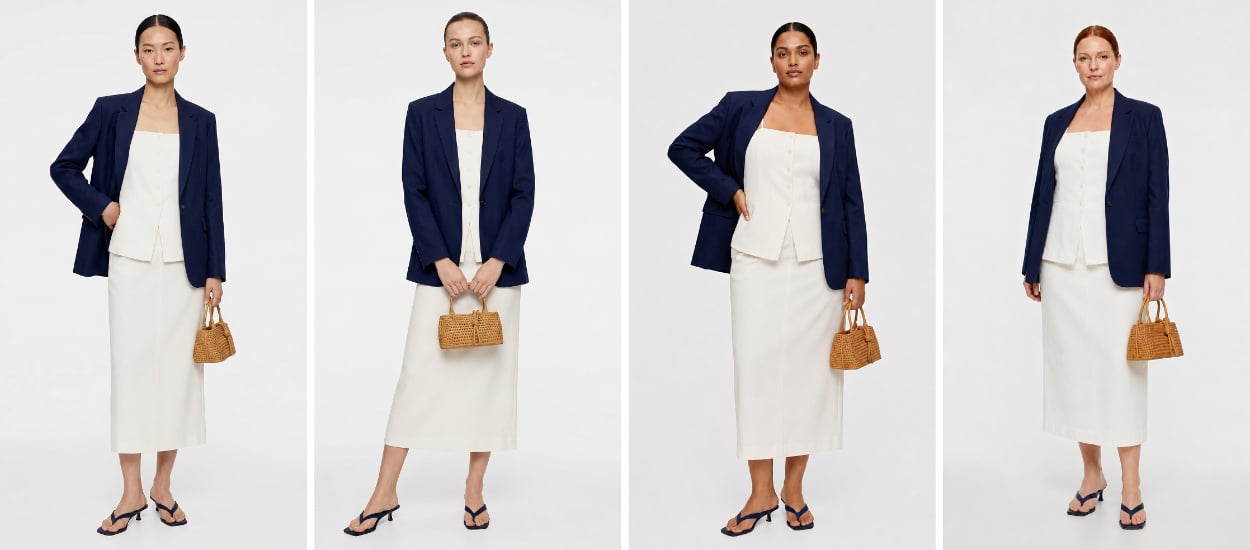
The milestones where differentiation actually happens are specific.
The first is accuracy of visualization. Virtual try-on that preserves body shape honestly, that renders garment construction and fabric behaviour correctly, that shows the real product rather than an idealized version of it. Impressive visuals and accurate visuals are not the same thing, and shoppers know the difference even when they cannot articulate it.
The second is outfit-level context. Single-item visualization answers one question. Outfit visualization answers the question that actually drives a purchase decision: does this work as a look? Brands that can show shoppers how pieces interact on their own body are answering a question that most competitors are still leaving unanswered.
The third is Liquid Content. The ability to create a digital understanding of a product once and generate every visual representation from that foundation, adapted for different shoppers, different channels, different contexts. When the content is consistent across every touchpoint because it comes from the same source, the shopper experience feels coherent in a way that fragmented production cannot achieve.
The shift from imagination to visualization, from static to liquid, is where the real differentiation is. It is available to any brand willing to build toward it rather than collect tools around it.
Image generation and editing is very clearly one of the most mature use cases for generative AI, but it seems fair to say that the capabilities of the models (and the workspaces and applications built on top of them) have advanced much more quickly than the governance around what goes into them. Obviously every brand is concerned about their own intellectual property, but when you’re generating images with people and products in them, there are much bigger questions and risks concerned with consent, ownership, compliance – as well as a wider set of legal, ethical, and operational concerns.
Aitua falls directly into this space. How are you balancing the demand to innovate and to push the frontier of image generation with those responsibilities? What promises are you making to customers and partners versus how much of this governance needs to come from within?
This is one of the things we hear most consistently from our clients. And I think it reflects a real gap in how the industry has approached AI so far. Capabilities moved fast. Governance did not keep up. The question of who is responsible for closing that gap has not been answered clearly enough.
My view is that the infrastructure providers are responsible for closing the gap. When a brand deploys our technology, they are extending trust to us over their products, their visual identity, and in the case of virtual try-on, the photos their shoppers upload of themselves. That is not a small thing.
We are uncompromising on three things.
Data. Shopper photos and brand assets processed through AIUTA are used for inference only. Not retained, not used to train models, not shared. Before any data transfer, we execute a Data Processing Agreement and a Data Protection Impact Assessment with every client. This is a design decision, not a legal minimum.
Transparency. Every AI-generated asset carries a visible disclosure label and C2PA-compliant metadata. This covers the EU AI Act, CCPA, and the frameworks emerging in Korea, India, and China. Unlabelled AI imagery that is indistinguishable from photography creates a trust problem for the whole category. We do not want to contribute to that.
IP. We do not train on brand assets without explicit agreement. A brand’s creative standards do not become our training data by default.
Responsibility and innovation are not in tension. In my experience, the opposite is true. Brands that have a governance foundation they trust are the ones willing to push furthest on what AI can do. You cannot move fast on output if you are uncertain about what is happening underneath.
The promises we make are specific. Your data stays yours. Your shoppers are disclosed to. Your brand standards are protected. The rest has to come from within. We have to believe these things matter before any regulator requires them.

Taking account of just how many AI solutions there are, and the data contained earlier in this report that suggests that a lot of AI initiatives are operating top-down, it’s practically a guarantee that fashion companies will be asking themselves whether they should just build their own tools – vibe coded or otherwise. We’ve said before, many times, that fashion companies will need to start acting more like technology companies… but should they be acting like AI companies, or does that end up being a distraction from the things that actually matter?
I have seen this question from the inside. At FARFETCH, as Size and Fit Product Manager, we asked it. The answer seemed obvious: we are a technology company, we should build this ourselves.
What followed was one of the more instructive experiences of my career. The MVP worked for a subset of categories, but each category required a different model with a different approach. Finding the right technical talent was genuinely hard. We faced the same data challenges that external providers faced, and we were limited to our own data on top of that. The project cost far more than partnering would have. And when we ran the AB test, we lost to the external provider.
I wrote in my notes at the time: learned through pain. Three months are never three months.
That was size recommendations. Visual AI is a harder problem with a faster-moving technology underneath it. The case for building has not improved.
Fashion companies should act more like technology companies. Rigorous about data, intentional about digital experience, fast about iteration. But acting like an AI company is a different commitment entirely, and for most retailers it pulls resources and attention away from what they are actually trying to build.
The competitive advantage in fashion is the customer relationship and the creative vision. The AI infrastructure underneath does not need to be proprietary. It needs to be reliable, accurate, and governed well.
Last year, we asked technology executives whether they predicted AI would become more obvious, as a primary interface paradigm, or whether it would disappear into the background in the way that vital but invisible platforms like AWS and Azure have done. This year’s data suggests that the answer is both: fashion professionals that use AI interact with it as both the engine and the steering wheel. But we also see that, for a lot of companies, both kinds of applications are still largely in the scoping or refined-pilot stage. What do you see being the trigger for deeper adoption and wider roll-out?
I have been watching pilots stay pilots for a long time. And when I look at why, it is rarely the technology. It is that the question being asked of the technology is wrong from the start.
The conversation has been dominated by cost reduction. That framing keeps AI in pilot mode because savings are easy to model and hard to feel. But cost is not actually the trigger for deeper adoption. It is a consequence of it.
The real trigger is content volume. Personalization at scale is not a creative brief. It is a production problem. We are already in conversations with clients who are not talking about hundreds of thousands of images. They are talking about millions, because genuine Liquid Content requires a volume of visual output that no traditional production model can sustain.
That is when the conversation changes. Not when someone calculates a cost saving, but when they calculate what it would actually cost to produce the content that personalization requires, and realize it is impossible without AI infrastructure underneath it. The creative ambition is already there. The personalization strategy is already there. What AI unlocks is the ability to execute both at a quality and a scale that was previously out of reach.
The organizations that have moved from pilot to production have reached that moment of recognition. The content they need to stay competitive cannot be made any other way. Everything before that realization is preparation.