

Originally released in The Interline’s AI Report 2026, this executive interview with Threedium and Custom Wrkshop is one of a 17-part series that sees The Interline quiz executives from companies who have either introduced new AI solutions or added meaningful new AI capabilities into their existing platforms.
For more exclusive interviews, stories and opinions from different industry perspectives, and real survey feedback from voices from every level of fashion, download The AI Report 2026.
We’re observing a big disconnect (in both our own fashion-only data and in wider benchmarks from other sources) between the increasing capability and reliability of AI, in both a general sense and in discrete applications, and the lack of trust that end users place in its outputs. What does trust in your specific applications of AI look like, and how do you achieve and measure it?
The fashion industry is asking AI tools “can I trust your output?” when it should be asking “what makes this tool impossible to get wrong?” Those are fundamentally different questions. The first is about confidence intervals. The second is about system design. The brands that will move fastest and with the greatest confidence aren’t the ones running the most AI pilots – they’re the ones that have been ruthless about identifying where in their value chain a wrong AI output is catastrophic, and demanding that their vendors build hard constraints around exactly those points.
At Threedium, we build AI that generates physics-aware Digital Twins from images, prompts, or CAD files. Our outputs sit inside product development pipelines, packaging sign-off processes, and e-commerce content workflows at brands like L’Oréal and within LVMH group. These are environments where a millimetre of dimensional inaccuracy or a wrong material render can have real downstream cost. So trust isn’t a soft concept for us. It’s measurable, and it has to be earned at every stage.
Fashion and luxury brands have extremely high aesthetic standards and relatively low tolerance for ambiguity in brand expression. That’s not a conservative culture – it’s a precision culture. So the trust gap is rational and it reflects real experience with AI tools that over-promised in the past.
When a brand’s packaging designers start using Threedium’s “Pack” to iterate concepts without reverting to their legacy agency, that’s trust. When a product developer uses “Wrkspace AI” to run a line review without needing a physical sample in the room, that’s trust in action.
The second signal is compressing the review cycle. In fashion and luxury, the number of revision rounds before sign-off is a reliable proxy for how much teams trust what they’re seeing. With high-fidelity digital twins, we track the delta between AI-generated outputs and what makes it to final approval without human rework. That’s our internal quality benchmark, and it’s something I’d encourage every AI vendor in this space to be forced to report transparently.
The industry talks a lot about agentic workflows and autonomous decision-making and agentic and commerce, but those different actions rely on products that are “agent ready” as much as they rely on the systems that are intended to carry those products. How do you define an agent-ready product? And what does it mean to create one?
An agent-ready product is one that a machine can understand without being told what it’s looking at.
Most 3D assets today are visually convincing but usually in many of the times it is a mesh with textures, nothing more. An agent trying to act on that file has no idea what material it’s made from, what its structural constraints are, or how it relates to the broader product system it belongs to. It’s the digital equivalent of handing someone a photograph and asking them to manufacture it.

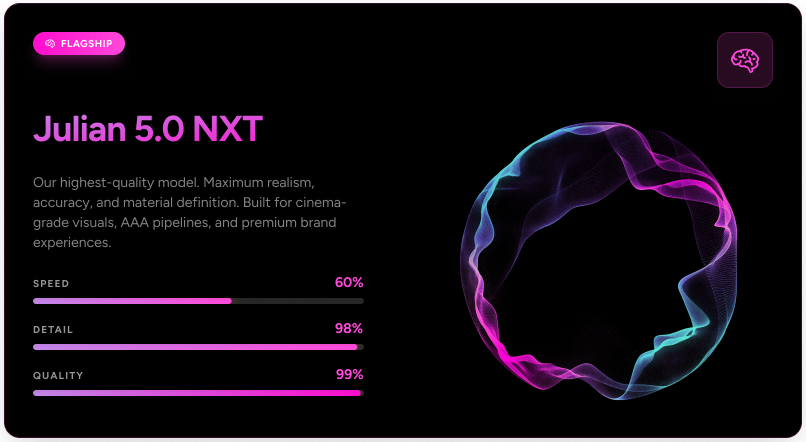
What Julian NXT produces is fundamentally different. When it generates a Digital Twin, it doesn’t just build geometry it segments the product into its constituent parts, tags each with material identity, physical properties, and dimensional metadata. It inherits contextual intelligence from the source database the product lives in. The output isn’t a file. It’s a structured, queryable object that agents can see and act on – minimum human interaction layer required. We have solved this for hard-surfaced goods and we are now doubling-down to nail it for any kind of product or surface.
That’s what agent-readiness actually means: not that a product can be processed by an AI workflow, but that it arrives already fluent in the language those workflows speak.
The bottleneck for agentic commerce was never the agents. It was always the product data.
Fashion has a complicated legacy where the term “digital twin” is concerned. Everyone largely agrees on what it should mean – a direct, accurate, and complete digital analogue of a real product – but there’s a lot less clarity around how close to that vision it’s been possible to get, and what’s currently missing. As a company that brings together 3D and AI, you talk about the digital twin as a new source of truth across the extended product journey, which sounds familiar, but the technology involved is new. What does a digital twin mean to you?
A digital twin isn’t just a 3D file. It’s a living record of a product.
The fashion industry has been calling things digital twins for years: high-res renders, obj files, glb files, without understanding the true meaning of what they need. Visually impressive, structurally hollow. They look like the product. They don’t know the product.
To me, a true digital twin has three non-negotiable properties. It’s geometrically accurate. It’s physically aware. And it’s semantically complete, every component is identified, tagged, and queryable, so any system downstream knows exactly what it’s dealing with.
What Julian NXT changed for us is the third property at scale. We’re not manually tagging metadata. The model absorbs, segments, and understands the product during generation itself. The twin arrives intelligent.

The “source of truth” framing resonates because it shifts the question from does this look right to is this correct. Those are completely different standards. And when a digital twin is genuinely correct (geometrically, physically, semantically), it stops being an asset and becomes infrastructure. That’s the transition the industry is only beginning to understand.
Specifically, how do you see AI, as it’s deployed in your Wrkspace AI platform, changing the way creative design and development run? That’s a sequential journey that’s been pretty fixed in its form and function for a long time, so people immersed in it are going to want to really understand what’s being proposed when it comes to AI disrupting that process.
For decades, creative design and product development have operated as a fairly linear process. A designer creates a concept that then gets refined, sampled, photographed, merchandised, documented, and eventually handed off to manufacturing. Each stage is separated by time, teams, and tools. A change made early in the process can ripple through the entire chain, requiring new samples, new photography, updated specifications, and revised marketing materials. Wrkspace AI allows us to connect those stages in a way that simply wasn’t possible before.
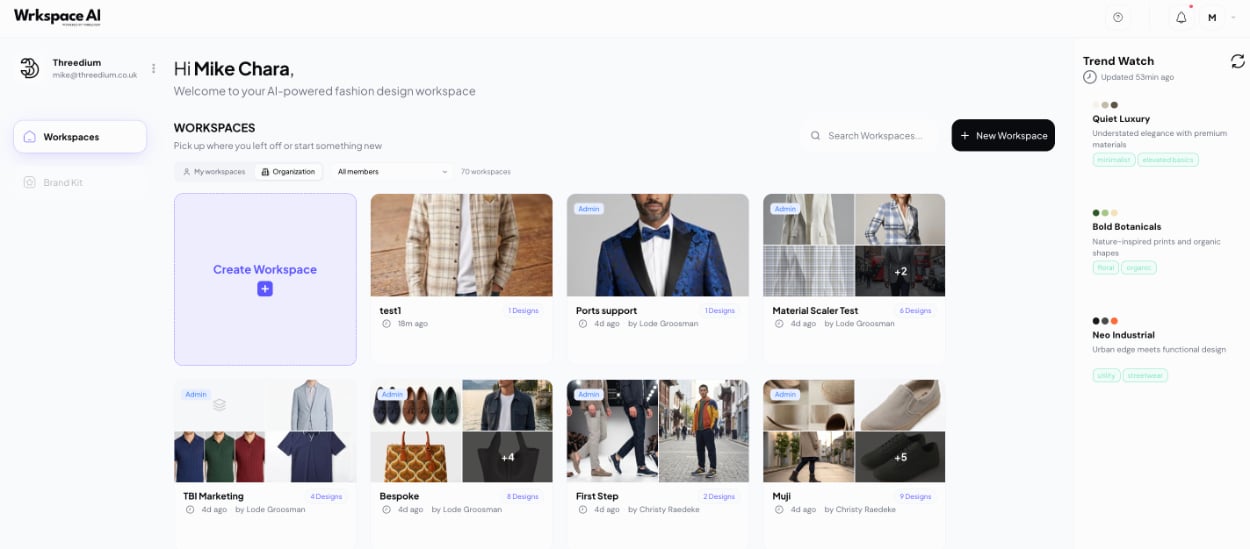
With Wrkspace AI, a designer can start with a sketch, see it rendered photorealistically, explore dozens of fit, material, and color variations, place it on a model, generate images and video, see it on the store floor, and create a tech pack all from the same source asset. What previously required multiple teams and weeks of iteration can happen in a single collaborative workflow.


The real disruption isn’t that AI creates images. Many tools can do that. The more significant shift is that Wrkspace AI understands products at a component level. The platform’s segmentation layer allows users to edit specific elements, such as fabrics, trims, colors, or garment sections, without regenerating the entire design. That’s the kind of control professionals need if AI is going to become part of real product development rather than just a source of inspiration.
We think the three biggest shifts we’ll see are 1) design becomes more iterative and less sequential, 2) development starts much earlier, and 3) marketing and merchandising are no longer downstream functions.
None of this diminishes the role of the designer. If anything, it elevates it. The designer spends less time waiting, less time recreating assets, and less time managing revisions, and more time making creative decisions.
Wrkspace Ai provides the opportunity to rethink the entire workflow as one connected system, where ideas move from concept to commerce dramatically faster than they do today.

A lot of money is flowing into AI, at every level, but brands and retailers can’t invest speculatively forever. There are several different takes on where the return on that investment is likely to come from, contained in this report and captured in marketing and communications from technology vendors across the industry – and those vary from quite narrow use cases to much broader ones. If you look across the development cycle, where do you see the real business impact of AI coming from?
The industry may be too focused on where AI can automate a task or save a few hours. Those efficiencies matter, but they’re not where the biggest return will come from. The real business impact comes from compressing the entire product development cycle.
Today, fashion organizations spend enormous amounts of time waiting. Waiting for concepts to be visualized, physical samples to be produced, revisions to be completed, and assets to move between teams. Those delays create cost, but they also create risk; by the time a product reaches market, consumer demand may have already shifted.
Wrkspace AI has the potential to remove many of those bottlenecks at once. Product teams can think about manufacturability earlier. Marketers can begin creating assets before physical samples exist. Merchandising teams can visualize collections before anything has been produced.
The first layer of ROI is straightforward: fewer physical samples, fewer photoshoots, less manual asset creation, and less rework. But the bigger opportunity is speed and better decision-making.
When teams can instantly test materials, colors, fits, and styling directions, they make smarter decisions earlier. When product and marketing teams can work from the same digital asset before physical samples exist, development and launch timelines shrink significantly.
In fashion and retail, getting the right product to market faster often creates more value than reducing production costs by a few percentage points. The companies that see the greatest return from AI won’t be the ones using it as a feature. They’ll be the ones redesigning their workflows around it, creating a faster, more connected path from idea to consumer.
Last year, we asked technology executives whether they predicted AI would become more obvious, as a primary interface paradigm, or whether it would disappear into the background in the way that vital but invisible platforms like AWS and Azure have done. This year’s data suggests that the answer is both: fashion professionals that use AI interact with it as both the engine and the steering wheel. But we also see that, for a lot of companies, both kinds of applications are still largely in the scoping or refined-pilot stage. What do you see being the trigger for deeper adoption and wider roll-out?
We believe the trigger for deeper adoption and wider roll‑out will come from a shift away from fragmented experimentation and toward purpose‑built, enterprise‑grade AI infrastructure. Right now, AI is both everywhere and nowhere in fashion. Enterprise leaders are declaring AI a strategic priority, while designers on the ground are quietly stitching together a patchwork of niche tools to get through their daily workflow.
That fragmentation creates real operational pain: assets become scattered, teams can’t collaborate, and generic AI models introduce distortion or hallucination because they were never trained for the nuances of garment construction, pattern accuracy, or brand‑specific aesthetics.
The real trigger for deeper adoption will be the shift away from using fragmented tools to purpose‑built, end‑to‑end platforms. When companies can rely on a single system designed for fashion where every tool in the workflow lives in one place and every asset is organized, traceable, and shareable, that’s when AI moves from pilot to scale.
A platform like Wrkspace AI becomes the catalyst because it’s not just a creative tool; it’s an enterprise‑grade component of the tech stack. With secure infrastructure, strong data governance, SLA‑backed reliability, and flexible APIs that allow PLM systems to push and pull data, it can be fully embedded rather than bolted on.
Once AI is integrated at a stable, governed, and connected level, and built for the nuances of fashion, that’s when we’ll see true enterprise‑wide adoption.