
Technology gets a ton of hype in fashion, especially AI. But is technology a true competitive edge? We would argue that the answer is no. Instead, the unglamorous work of process innovation is where the rich opportunities exist in the fashion supply chain today. In fact, this is the most undervalued and underrated area of opportunity for brands, retailers and tech vendors alike.
John Thorbeck argues in his whitepaper Under the Banyan Tree, that rethinking end-to-end processes is a critical, but underused, approach for reducing both chronic overdevelopment and excess inventory. These issues are major drivers of lost profitability. Analysts at TD Cowen echo this, calling for a supply chain reboot after decades of low-cost sourcing without a clear risk management strategy. Today, risk is more pervasive than ever due to geopolitical conflict and uncertain tariff policies.


Clearly, we must re-think the processes behind how we bring products to market. Further, digital tools will deliver the most value when layered on top of meaningful process change.
Tech Without Process Change is Value Destruction.
Vendors selling to brands and retailers should focus less on selling solutions and more on partnering to drive process transformation. In fact, in our conversations with AI startups focused on the fashion supply chain, most of their work is process focused.
Without this effort, technology spend falls short of delivering a return on investment. For instance, a 2023 PwC survey of supply chain executives indicated that 83% of them did not believe that their technology investments were paying off. One of the main reasons identified is that the underlying processes were not improved first.
This is also why treating “go-live” as a success metric is flawed. Implementation is the easy part. Adoption, actually using the tool to impact decisions and enable workflows, is what matters.

Balancing High Tech/High Touch.
Process innovation is, in many ways, a modern extension of John Naisbitt’s “High Tech / High Touch” concept: the more technology we surround ourselves with, the more we need human judgement.
Self-checkout kiosks are a simple example. The tech works best not when it replaces store staff, but when it’s supported by associates who can supervise and intervene when needed. The same dynamic plays out in product creation, sourcing, planning, and merchandising. Technology should amplify human expertise, not route around it.

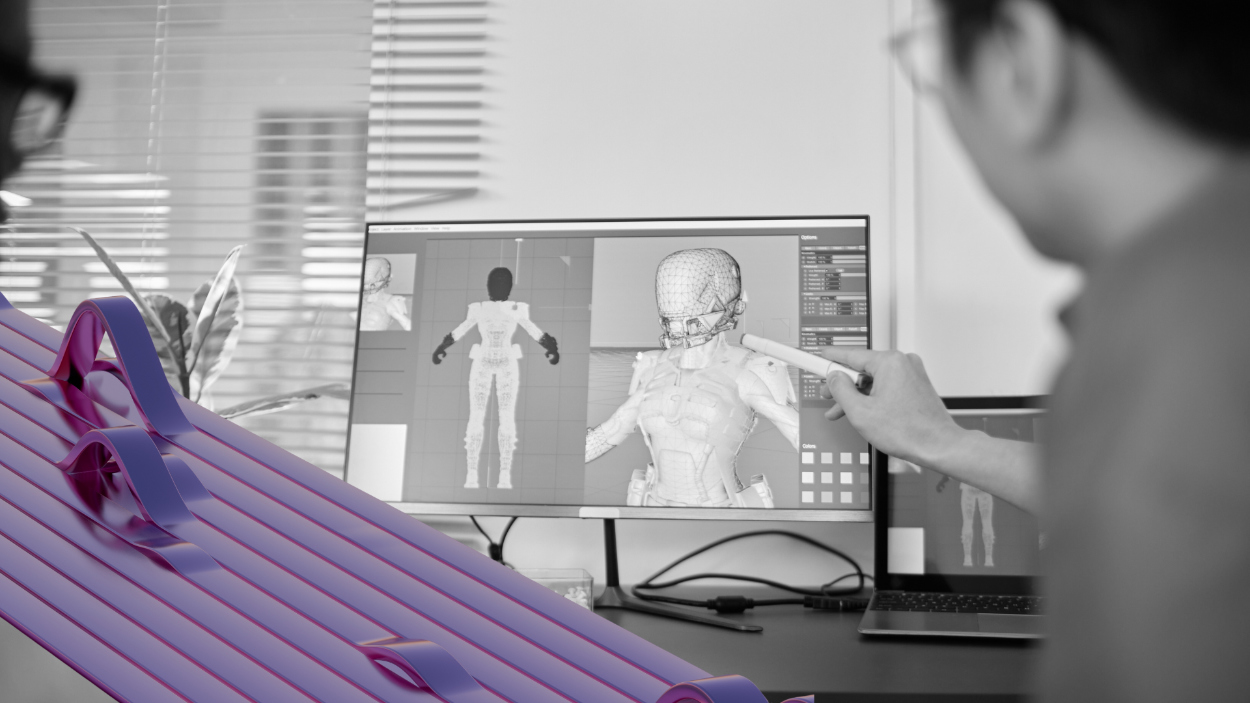
Digital product creation (DPC) and digital materials are good examples. The goal is not to go “all in” on digital or abandon physical sampling entirely. It’s to deliberately segment the assortment and decide which products can be developed primarily digitally, and which still require more physical iteration. On the other hand, widespread adoption of digital fabric and color libraries is accelerated when the strategic value of the materials team at the brand is elevated first. These are process decisions first, and tooling decisions second.
Case Study: Multi-Track Calendars.
One practical form of process innovation is a multi-track product creation calendar.
Instead of forcing every product through one linear, seasonal calendar, multi-track calendars decouple products and their value chains from a single rigid timeline. The starting point is an acknowledgement that not all products are equal, so they shouldn’t be created in the same way or at the same speed.
When brands classify products into different “tiers” or “classes,” they can then assign them to distinct assortment tracks. Once the assortment is divided into tracks, decisions about physical vs digital development become much clearer.
For example, a fast track can be implemented as a means to rapidly respond to emerging trends or specific market feedback. A seasonless track is reserved for core products and basics. Capsule tracks are for special collaborations or regionally specific assortments. An innovation track is reserved for the most unique of products and has the longest lead time.

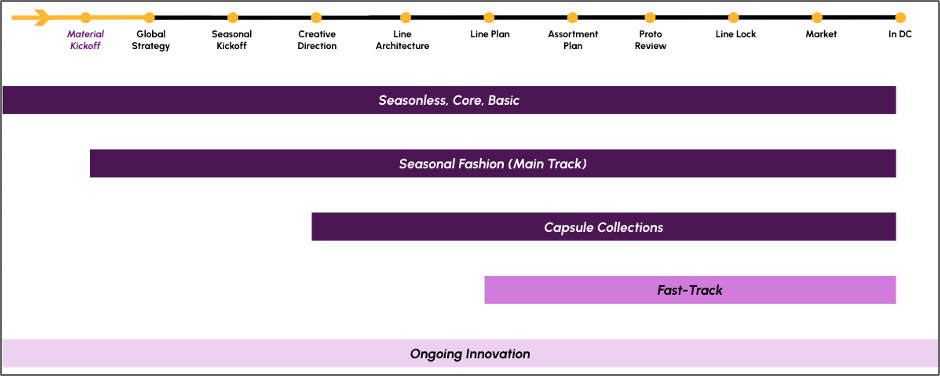
Setting up a multi-track system requires quite a bit of work behind the scenes for it to be successful. Some of this work includes assigning digital, physical (or in some cases hybrid) development pathways to each track. For instance, physical development is reserved for the innovation track. Meanwhile, digital and hybrid pathways are best assigned to the fast track and seasonless track. This is because such tracks will handle existing styles, style refreshes, silhouette adjustments, and new styles built on existing materials.
In this way, deployment of technology is guided by the underlying process change. Digital product creation is essentially mandated across several tracks. Digital color and fabric libraries become key components in many workflows. Further, this approach preserves physical sample capacity for only the most innovative of products. This is precisely the way in which technology needs to drive results and elevate performance.

Brands Are Reframing the Work. But Still Need Help.
Some brands are starting to treat process innovation as a discipline in its own right. Consider, for instance, that Gap Inc. has created a Principal of AI Process Excellence role, with a mandate to reimagine end-to-end processes through the lens of AI to drive cost savings and operational speed. At the same time, there is a mandate to upskill teams alongside those changes.
Also, Lululemon is quietly building a Go To Market Evolution function, essentially an internal consultancy focused on problem framing, process design, and cross-functional governance across the value chain. There are a number of active postings to build out the team, but the most notable from our perspective is their planned hire for a Senior Manager of Raw Materials Operations. This is a clue that signals that the brand is moving to a more strategic, process-led approach to materials.

However, the formal discipline of process innovation in fashion is fragmented and immature when compared to industries like pharmaceuticals.
And this is where vendors have a valuable opportunity.
For tech vendors, the takeaway is clear: lead with process first. Positioning software as a solution is no longer enough. Rather, the product is an enabler of process change and the corresponding business outcomes. Vendors should act as a partner, and maybe even a pioneer, in driving process change with their customers. When fashion talks about “digital transformation,” it really means process transformation, enabled by digital. The industry doesn’t need more tools. It needs better ways of working and vendors willing to build them, together with brands, from the process up.