

Hey, welcome back to The Interline Podcast. Is AI ‘good enough’? That might just be the central question at the current moment. If you go looking, you can find evidence to support both answers.
I’ll put our evidence first, because it’s the data I have closest to hand. We surveyed about 100 fashion professionals earlier this year. They are broadly optimistic about AI, but in the here and now they report that they don’t trust it with critical decisions. They don’t have a good rubric for assessing its value. They fear that their companies are overestimating its capabilities versus what it can actually deliver. They consequently haven’t connected it to their wider tech estates. Good enough? Maybe.
But the size of the market and the investment statistics that brands themselves are disclosing to us suggest that the available applications clearly are good enough to invest in. Nine in ten professionals use AI every day at work in some capacity. Nearly 85% of companies have accelerated their adoption of AI in the last twelve months. Almost 70% expect their spending on it to increase as we go into 2027.
You can also look at the huge landscape of AI tools for fashion that exist, both as additional capabilities bolted onto existing solutions, as pivots, and as whole new platforms built with AI as their foundations. There’s a lot of all of those.
We interviewed some of the executives behind all those types of tools in the same AI Report that the survey data I just mentioned is taken from. I think it’s fair to say that they all see a pretty unprecedented market opportunity in front of them. Plenty of their existing customers and new prospects see the same thing, or at least they think they do.
I’m not about to debate the existence of a market for AI solutions in fashion today. We actually did that earlier in the summer when I interviewed Ara Kharazian from Ramp about AI adoption and economics. The short answer is that the market very clearly does exist.
But ‘good enough’ is subjective. If you’ve been listening to these weekly shows for a while, you’ll be familiar with the idea of the jagged edge of AI: the principle that a single model or a family of models can at once outperform people in incredibly deep, complex domains like higher mathematics, but then periodically declare that it isn’t connected to your Google Calendar when it is. Then you remind it, and it goes, ‘Oh yeah, I totally am.’
Those are two very glib and extreme examples. Let me give you a couple of more nuanced and practical ones. It can be simultaneously true that AI is very good at generating images of fashion products, and that it might be terrible at understanding how those products are made or what they’re intended to do.
We see this discrepancy in our data. The fashion professionals who took part in our AI survey told us that they perceive AI to be most mature in analytical use cases — planning, market analysis, competitive benchmarking and so on — and in concept generation. Then, all the way downstream, in visualisation, campaign photography and product detail page gallery content. They perceive AI to be least mature the closer it gets to real product development and specialist disciplines like patternmaking.
That spread of opinion seems right to me. It’s a reminder that there’s no single, monolithic AI that you can reasonably grade on aggregate. A platform that’s good at applying AI to one part of the product journey isn’t necessarily going to be as good at applying it elsewhere.
But put a pin in that for a second. Are we or are we not seeing plenty of generative AI companies testing new features that are clearly pretty far outside their established lanes? We are.
If you listened to my interview with Weber Wong, the CEO of FLORA, a few weeks ago, you’ll have heard him talking about why a generative workspace can and should be the place to build features that cross over into territories traditionally occupied by product development tools and PLM.
If you do a quick canvass of the wider market, you’ll see the same thing from other generative AI companies in fashion. Most seem to be coalescing around the idea that you can go from generating images of products — the most mature use case per our survey data — to building tech packs, all within the same suite of software. That latter one is one of the least mature use cases according to our data.
I don’t know how far I buy that, but I do know that I shouldn’t dismiss the idea outright. Today, I’m bringing on the CTO of a company that’s squarely in the middle of everything I just talked about. That company builds what they call an AI-powered design suite for fashion.
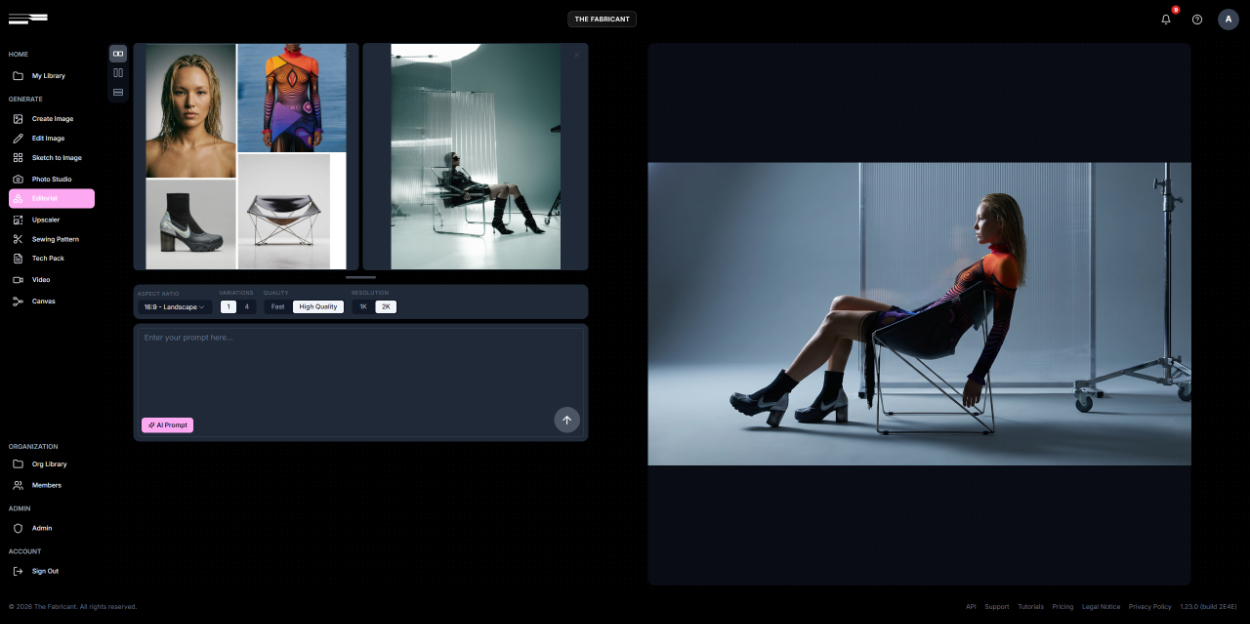
They surveyed their user base this September and reported: ‘Fashion has stopped debating whether AI is good enough. Amongst teams using it daily inside live collections, that question is settled.’ Which, okay, we’re going to have to talk about that. They’re also now building tech pack and sewing pattern capabilities as beta features — or ‘beta’ for our American listeners.
That company is The Fabricant. You’ll be familiar with them. If you listened to our Mailroom episode recently, you’ll also have heard one of the co-founders tackling a question about starting a brand in the age of AI.
Today, I wanted to get more into the weeds. My guest is Marco Marchesi, The Fabricant’s CTO. I figure one of the best ways to get another angle on whether AI is good enough, and what that question actually means, is to talk to someone building for it and building with it. So let’s have that conversation.
NB. The transcript below has been lightly edited.
Never miss an episode
Get notifications for new podcast episodes, plus our weekly news analysis, events, and more, delivered straight to your inbox.

Marco Marchesi, welcome to The Interline Podcast.
Hello. Thank you for inviting me.
Pleasure. Looking forward to this one. I’ve spoken to a few people from The Fabricant in the past, but you and I have never directly spoken. This is a conversation I’ve been looking forward to. We might as well start by defining what you do there.
We run every one of these shows with two things up front. We ask the guests what their day-to-day working life looks like, and we ask them to define something. I’m curious about your day because, in the time I’ve been running The Interline — six and a half years — The Fabricant’s been through a few different iterations or guises. They’ve all been pegged to different technology waves.
Simplifying this a little, you’ve been a digital fashion and blockchain company, which I think is the first iteration most people know about. You were a 3D consumer co-creation company at one point. You’re now an AI tools company. As the CTO, you’ve presumably been influential in each of those directions because they align so strongly with tech.
I want to understand what you do when you sit down at your laptop in the morning, how you determine which technology waves to go after, and how your work right now differs from what it did in 2018 or 2022.
Let me go in order. The first one is the iterations of The Fabricant. The first iteration, I was just a spectator, because I was a big fan of The Fabricant. They started, I think in 2018, doing 3D photorealistic animations of digital garments. I was so impressed by that. I told my previous company, ‘Guys, this is the future. I want to do this. We should do that.’ They said, ‘No, nobody cares about digital fashion. It will never happen.’
Then in 2021, I had the opportunity to join the team. The idea for the second iteration was to build a digital marketplace for digital garments. From there, we were still doing traditional 3D and VFX, but then we decided to pivot into AI.
That was because of my background in AI. I’ve been pioneering AI for creativity for almost ten years. We had a lot of support from NVIDIA and Google. Everyone was telling us, ‘Guys, you really need to pivot. This is the right time. You have the right skill set.’ We decided to go into AI. It’s almost three years that we’ve been working on that.
Going back to the second question, about myself: I’ve been in tech and creativity for ages, without quantifying too much. It’s a job that needs to be reinvented every single day. We can predict a lot of what’s going to happen, but at the end of the day a lot comes from what users want, and there’s a lot of unpredictability in new tech.
No one would have predicted how much impact AI would have on the creative industry in the last two or three years. When I started doing work for fashion using AI ten years ago, we knew that nothing was ready for the industry. But you say, ‘Something will come.’
I remember, I think it was eight years ago during a panel, I predicted to the crowd, ‘In ten years, we’re going to see completely AI-generated movies at the theatres.’ I said that eight years ago. I think I was basically right in terms of timing. But I had no idea that we would arrive at this level of craziness and quality.
I think on that one you’re right on the technology capability wave. Maybe time will tell if you’re right on, ‘Does anybody want to see an AI-generated movie in a theatre?’
Why not?
Okay.
I can tell you, I’m a big supporter of AI, but also a big critic. I don’t know if you know much about my past, but I used to produce music videos for ten years. I was on the creative side. I totally see the pain of giving up the creative process to AI, not just because of the quality, but also the storytelling and the whole pipeline. There are many things we can debate on that.
We can, and I think we may get into some of those as we go. The interesting thing you said to me there, amongst a few interesting things, is that the CTO role constantly needs to be rewritten. I think that’s true, and it’s become especially true over time.
If you were a CTO fifteen or twenty years ago, you would be like, ‘The cloud is a very clear direction, and we have a decade to execute on it.’ You could see the way things were going. Desktop applications were on the way out, and the web was to become the distribution layer. You had time to react.
The difference now is that you don’t have a lot of time to react to how quickly the role and technology are being rewritten because of AI, right?
Yeah. But the risk is about focus. The moment you decide to react too quickly to everything, you’re going to lose focus. The focus should be on the product, on what you really want to build for users.
The big challenge for me is no longer the technical part, the trivial code. People in general think coding or software engineering is something really esoteric, where you need a lot of preparation and a high skill set. That’s true for part of it, especially when you want to do R&D and really innovative things. But 90% of what the code does is very trivial and repetitive.
I was really hoping, looking forward to AI solving that, automating that. That part is solved — or solving, in the sense that it’s completely changing the way we have to deal with it. If I compare even six months ago, or two years ago when I started using AI agents to support my job, my day is completely different now.
In some ways it’s much more relaxed, because I know I can solve things very easily that were trivial but still needed time. At the same time, there are other things that open up: cybersecurity risk, testing. You can never assume that something is true. You always need to think, ‘There is some percentage of hallucinations that I’m probably bringing on top of everything.’
The job is different, for sure. I think the CTO is one of the most affected roles in that sense, because things are moving very fast.
I think that’s right. If I look at my own work, I don’t use AI to write. I do use it for a lot of other stuff. My working life looks very different to what it looked like six months ago, certainly a year ago, just in terms of where I’m doing the work.
That brings me to the second question, the thing I wanted to ask you to define. I interviewed Adriana, your CMO and one of the company’s co-founders, on our first Mailroom episode recently. She fielded a listener question about what it means to launch a brand and to be an AI-native company. She pretty well covered that from the brand side: if I want to design and sell clothing, what it means to be AI-native there.
The thing I want you to define is what it means to be AI-native from a technology point of view. Both in terms of what an AI-native brand starting right now would have as its technology stack, and how you as a technology provider are changing the way you work and your setup to develop solutions.
To go back to the difference between AI and cloud, everybody knows what the e-commerce tech stack is and was, even if they can’t name all the individual parts. But there are so many different solutions and a huge diversity of AI models and things that sit on top of them right now. It’s much harder at this minute for one brand to understand what another might be doing technology-wise, and the same for software development companies to understand what others are doing.
Tell me what you think it means to be AI-native as a brand. What does your tech stack look like? What does it mean to be an AI-native technology developer?
I have a very different opinion on that, mostly because I don’t believe in the concept of AI-native. I’ll try to explain. The concept itself contains a hype element. AI-native means you bring some technological stuff as part of your background, but what exactly does it mean? For me, it’s almost nothing.
I compare it to when people put on their CV, ‘I know how to use Word. I know how to use Excel.’ But they don’t say exactly what they can do with that.
When you are a brand, you should know that the world is going in some directions. But you don’t necessarily need to make sure you are native to be able to embrace it and get the most out of it. That’s why I prefer to see ourselves as the people helping brands embrace AI, rather than, ‘You need to be AI-native to come and understand what we’re doing.’
For me, the best replacement for ‘AI-native’ is that you are a curious mind. You are happy to try different ways to be creative, but you’re not necessarily adopting AI because people are using it. It’s more important that brands come with their own strong opinions and identity about what they want to build in terms of storytelling, taste and brand identity. Then they ask, ‘What can AI do for us?’ That’s where we are happy to help with the tools we have, or by building new tools.
I’ve managed artists of all different kinds in the past: VFX, graphic design, motion design. I always found it very difficult when artists were really attached to the tool. They felt like the tool made them creative, rather than that they were creative.
When you think about AI-native, I still have the same opinion. I don’t think there’s such a thing as AI-native. It’s more, ‘You are curious, and you see there is something new that needs to be used because it can actually give you a benefit.’ That’s it. Nothing more than that.


Fine. I see things a little differently. Being an AI-native company, as a brand or technology developer, would mean the way you work and the offer you have couldn’t exist without the underpinning technology. That’s what I consider to be native.
The example I would go to is that Facebook could not have existed without occurring at the time it did and taking advantage of the LAMP stack: Linux, Apache, MySQL and so on. That, to me, is what it means to be AI-native.
There are e-commerce-native brands in the same way. You have the whole wave of direct-to-consumer brands. A bunch didn’t pan out very well, but you had brands that could not have existed without the e-commerce stack. That was a precondition of their entire business model.
To me, AI-native means there will be brands whose entire business model requires AI, that AI is a precondition of it. That could mean AI from a creative point of view. It could mean they sell through AI-only channels. It could mean a bunch of different things. It’s not a very fixed form, but that would be my definition.
Yeah, that’s good. Fair enough.
I don’t think that does anything for the creative side necessarily. I think you’re right: being curious, having your own brand and applying the tools to it afterwards is definitely a way to think about it. If you’re a pre-existing brand, that’s the right way to frame it, I would say.
We talked about developing software. I want to quiz you a bit on how much of The Fabricant’s business you would describe as software. Over the different eras the company has been through, there’s been one consistent thing to me as an observer: I’ve never quite been able to figure out whether you’re a tech company or a service company. I originally felt that around the time digital fashion was all the rage, because there was a lot of misrepresenting something as a turnkey technology when it was actually a bespoke service.
AI demonstrably isn’t that. You can feel however you like about the capabilities of generative AI, but you can’t deny that the models are real and you can go and use them. What’s the balance of your business right now between building tools on top of that and offering training, hands-on work and that bespoke side of things? How does it shake out between software and service?
The moment you are able to automate and accelerate software development, the importance of software itself is less than before. It’s much more important to push and test the product you’re building on top of the software. Software and product are two different things.
If you notice, most companies in the AI field, using AI for their business, are forward-deploying their employees to accelerate the adoption of AI and their service. Everything is becoming a service in that sense. OpenAI, Anthropic, Microsoft: they’re all adopting the Palantir model of forward-deployed engineering, because that’s the way to really introduce these new technologies to people.
We have to do the same for brands. We don’t want brands to spend time trying to figure out something where we’ve gained the technical expertise. We have the opportunity to move quickly by customising tools and making them completely tailored to their needs.
That’s why we are a service. I think we are in the industry of listening a lot. Most of what we do at The Fabricant is listening. It’s not building software; it’s testing, but it’s mostly listening to people and understanding their pain in their daily fashion process. There are many different challenges and tedious tasks that still need to be solved.
Just an example: we are working with UAL on a sewing pattern tool, automating patternmaking. One of the things that impressed me was how many button clicks, mouse clicks, they do for their tasks when they do patternmaking on digital tools. That’s where you need not just to build the software, but to listen to them. I listen to them and see them in action. That’s most of what we do.
The software part is becoming something where you can run agents that can build the result of hours and hours of listening to people. But the listening part is still very human, because it’s difficult to automate. That’s where you may say it’s service. Let’s call it service, but in a very modern way.
I think that’s right. I agree. The software/service delineation is a very consultancy mindset. I spent some time in advisory, so that’s probably a legacy of that.
If we extrapolate, and say you’re listening to a brand or a creative person, then coming away and building something that reduces the number of clicks or changes the way they work: as a CTO, how are you working backwards to figure out what you need to build as a tool provider, and what is already covered by the frontier commodity models from the major AI labs?
Tied to that, how do you keep what you’re building ahead of the evolving frontier of model capabilities? It’s certainly not a technology that’s standing still. You listen to somebody, then translate that listening into a solution that improves their day-to-day work. How much of that solution are you building, and how much is architected on top of commodity models?
You have two choices. If you have a problem to solve and you want to solve it in the most trivial, standard way, you just tell the problem to the LLM. It gives you the most trivial solution, because it learned on billions, trillions of examples. Most of that knowledge was based on standard solutions. That’s how to make it just right.
If you need to build the UI, the interface for a specific task, you tell it, ‘This is the task. Make a UI.’ AI is going to make a UI tailored for that, but it’s going to be the most standard one. This is not enough, of course. That’s where we build on top.
I can start from there if I want to go very quickly. In five minutes, you get a working prototype. But then there are many times where I say, ‘That’s a good starting point, but this is wrong, that is wrong.’ That’s where I put myself in the role of a product person, or start chatting with the team: ‘How do designers and patternmakers work on that? It’s not going to be like that.’
You realise it’s not that standard way. Designers have other ways and conventions for how they want to deal with the interaction. That’s where we build on top of a foundation model. That’s one thing.
Then there is all the harness we put on top with our agentic system, to make sure what we build adheres to our standards as a platform: quality, performance, things that are very specific to our platform. That’s a second layer of building on top of a foundation model.
The third is data. Data is very specific to a brand. Most of what we do is try to create tools and solutions that improve and learn from the brand’s data in a sealed way. Each brand has its own knowledge, and the tools learn from that knowledge specifically to improve themselves. All this happens on top of foundation models.
Fine. That’s a good insight, and I think it’s correct. In the very early days, you had people derisively saying, ‘X solution is a wrapper around existing models.’ No doubt that was true in some cases. It was a very thin interface layer.
I think you’re right. The process of verticalising AI for particular industries or adjusting it for disciplines like design and patternmaking relies on understanding. As you mentioned, the harness in a lot of cases makes the difference more than the underlying model, because it’s built with an understanding of the way people actually work. I’m with you on this.
One little follow-on: if the interface steers adoption, if it makes up the delta between a generic model and a tool useful for a particular industry or role, how do you think about things if the interface goes away?
How do you think about people using some of these tools through MCP within an LLM they already use, or through a CLI? That seems to be a place creative platforms are increasingly getting into. I’ve had a couple of interesting chats with people about that, where you would say, ‘The interface is the main thing, but we’re also making a play for the post-interface era.’ How do you think about that?
We are already working on a bunch of things related to APIs and integrations with tools, where our layer is invisible but still gives the quality needed that the LLM cannot give. It’s as simple as that.
We don’t care about the UI much. The UI is very important because people love our UI, but also because that’s what we use as a playground to test things. That’s fine for us. If at some point users say, ‘I just want to use my agent or AI assistant, Muse even,’ they can do whatever they want.
We have the mobile version of the platform now. If you go there, it’s a chat. The moment users are able to insert the input, ask our tool what they want to do and get the result, that’s fine. We are not keen to be locked to a specific interface. The most important thing for us is providing the quality our users want. That’s the focus on everything.
When I spoke to Adriana for the Mailroom show, she told me that The Fabricant had, and I’ll quote, ‘left 3D to embrace AI’. You referred to it as a pivot earlier. The reasons Adriana gave were that 3D had proven, at an industry level, not for The Fabricant but for brands, to be too expensive, too technical and too slow for the audience you wanted to court.
I understand the commercial argument. If you’re aiming to build tools for everyone, then specialist solutions like those under the digital product creation umbrella are not the way to do that. I also understand the technical argument. There’s no easy turnkey way to build an end-to-end digital pipeline and get a digital asset that serves as a single source of truth. There is no full and complete digital twin. The biggest and best-capitalised tech companies and brands are still trying to build that, so there’s not much a more boutique kind of company can do.
What I don’t understand is whether you believe the choice is really that binary between 3D and AI. You showcased workflows recently where you put a 3D render of a jacket beside an AI image of the same thing to highlight the discrepancy in time and cost required to achieve a visual standard. That makes a ton of sense if your remit is purely visualisation. If you’re just trying to get to something people can look at, then AI is unambiguously a faster, cheaper way to do that.
I personally feel there’s a much deeper need for simulation than ever in near-future pipelines, because they need to sit either side of generative visualisation. Visualisation is not the whole purpose. If it were me, I don’t know if I would have the same rush to embrace AI and leave 3D behind. Maybe that’s not what you’re doing. I’m keen to see what you feel about this. What role do you see AI and 3D playing in your toolset over the next couple of years?
Five years ago, when I pitched myself to Adriana, I told her, ‘At some point, we’re going to have camera apps where you point at yourself or someone else, and you’re going to change what you see in real time.’ You’re not going to superimpose AR, augmented reality effects. You’re going to change what you see by literally rotating things, regenerating the whole image from scratch.
If you follow world models, that’s what’s happening. The idea is not that AI is just generating images, frames or videos. It’s generating the entire world in terms of physics rules, dynamics, all the things that make a simulation possible.
If you look at the long-term vision of people working on AI, the image will just be a subset of this, a render, a 2D representation or projection of what you see. But the whole world behind it will be generated as well.
So in that sense, what’s the need for 3D — things made of meshes and vertices, all this usual terminology and elements of traditional 3D technology — when you can generate things that are very accurate, at the same level as deterministic 3D?
Of course, the need for a mesh or vertices is because you can manipulate them. Also because you can transport the information, pass it to someone else and to tools that can render that information or manipulate it themselves. There’s not a real need for 3D itself if people can render, manipulate and do whatever they want with the 3D input in a different way than using Blender or Maya. It’s a problem of tools.
In the short term, I would say no, this is not black and white. We need 3D. We still need it because 3D is still the highest quality you can get to manipulate three-dimensional content. Apart from rendering, where you may debate, ‘AI is actually even better now,’ everything where you need total control of every single pixel, you need 3D.
But this is the short term. I don’t think that in five years we may need it at the same level. It’s very difficult to think about, considering the curve of progress we are experiencing now.
Of course, it doesn’t mean it’s going to happen at all costs, because there may still be situations where, for some reason, 3D is the best solution. Maybe because it’s more affordable, cheaper to do. That could be the case, because you don’t know if using world models starts to cost too much to be sustainable. People will say, ‘I still believe it’s better to do 3D.’ At the end of the day, cost has always been a massive element in determining the success or not of technologies.
From my perspective, there are two ways that plays out. On the second one, I think you’re right. There is a world where 3D becomes the more affordable and efficient option. I see it now, not in world models, but in pipelines where people are like, ‘Let me generate a visual representation of this thing I want to make. Then let me use a vision model to segment out the product I want to change from that generation. Let me recolour it with AI.’
All of this is brute-forcing around a gap in the middle: an accurate digital representation of the product that would allow you more efficiently to do the things you’re describing, potentially at lower cost, particularly if you start to inject world models around it. I do agree with that one.
You and I probably diverge on world models as they currently exist. I don’t find them very persuasive, because they seem to do a very good visual approximation of simulation without actually doing real simulation. Is there a horizon where the distinction stops mattering? Maybe. If you can get a visual approximation of a simulation right 99% of the time, is that good enough? Yes, for most use cases. But it’s not a simulation if it breaks down sometimes.
I have an issue with the fundamental architecture of world models that I think is distinct from simulation. Barring a real architectural shift in how we approach them, I think that will always remain the case. On your five-year horizon, do we get an architectural shift? Maybe. I think that’s reasonable.
That’s exactly the thing. I wouldn’t believe in the short term for this, for sure, but it’s definitely something we can expect. Even deterministic simulation thirty years ago didn’t have the quality of what you can look at now, because computation is more accurate. Many things technically improved in a way that makes calculus much more accurate than before. That makes simulation more accurate in the deterministic world as well.
I expect better architectures that hallucinate less and understand more what is wrong and right. Of course, that would massively change the scenario.
I want to ask you about something tied to what we’ve just said. We’re both fully aligned that if you can realistically depict something earlier in the product lifecycle, you can get people aligned on that. I fully buy into that idea. I’m less clear on whether alignment on a visualisation actually translates into the full product lifecycle running any faster or more efficiently.
I looked at a recent paper you put out which talks about faster design-to-approval processes as a result of AI. Great, 100%. It also talks about faster production as one of the primary gains for design and product teams. Explain what you’re seeing, and your experience as a technology builder, that shows those two things are related: that visualising something faster means you can produce it faster.
That’s a good question, because to be honest I’m not someone who is manufacturing things. I know from the report Adriana produced from our users and manufacturers. I’m not going to argue that comparison, because it wouldn’t be my personal experience. But I’ll give you an example of what I’ve done in the past.
First of all, I agree with you at some level that it’s not necessarily going to accelerate. One of the things that’s always funny for me is when we discuss rendering time over the decades. I started using Maya more than twenty years ago. My first 3D thing. You were able to render things that looked very nice and cool at the time, but it took quite a while to produce one image.
Every single upgrade you got on machines, you realised you were getting the same time. Why are you getting exactly the same time to render things when the machine is four times faster? The reason is simple: I was trying to get four times better results than the previous generation. Every generation, we try harder to get a better result than before.
Going back to this comparison, getting AI doesn’t necessarily give you faster production. It’s the mindset that’s going to give you better production time and faster iteration. The moment you use AI but spend more and more time experimenting, you may still spend more time than before on steps where you were spending one hour or one day doing something. Now you spend one day trying multiple versions of the same thing that you were doing just once before. This applies to so many things.
Another example: when I was a video director, I was also filming with film, with Super 8 or 16mm. I produced a four-minute video using twelve minutes of film. At the same time, a friend of mine produced four hours of footage for a video of the same length, because it was digital. He spent days and days editing that footage, understanding what was in it, because there are limited resources to get something.
The same happens with AI. It needs to translate into a way to select and filter out what is good and what is not. AI generation doesn’t necessarily translate into faster iteration if you don’t change your mindset: be very selective, prepare what you want to achieve beforehand, have the storytelling very clear in mind, and have tools that help you select and filter what is nice and what is not. I’ve seen that on so many levels.
I think that’s right. To play devil’s advocate for a second, one of the primary criticisms people point at 3D and digital product creation is that it went a long way, got a lot of investment, and didn’t meaningfully change the product calendar. Whether the same criterion ends up being applied to AI, I guess we’ll see over time.
Your enterprise tier currently lists tech packs and sewing patterns as beta features. A lot of generative companies are doing this now. There seems to be a market need, or a market opportunity that people have identified. Tell me how you ended up here. You start with visualisation, as we mentioned. What is it about the work you’re doing with brands, customers and educators that leads you to say, ‘We’ve done this. It’s logical for us to do that’?
A lot of tech companies are converging on this idea that you can build generative workspaces that do a great job of early-stage and end-stage visualisation: concepting and exploration, then replacing product photography. A lot now seem to be saying, ‘Let’s do the middle as well. Let’s do tech packs and patternmaking.’ How did you land there, and what needs to happen on that journey now?
It’s a feature request. Simple as that. Brands asked if it was possible. We actually pitched patternmaking almost two years ago for the first time, but we weren’t happy with the results. We parked it to focus on other things. Then we resumed last year when we started working with UAL on this project. The reason is because people are asking.
To be honest, I don’t think patternmaking is the simplest one. It’s kind of trivial to say, ‘We can do that.’ But I’ve seen a few examples, and the quality is not there yet. The fact that many companies are doing it doesn’t necessarily mean they’re doing it right.
Very true.
Of course. I see that there’s probably a need to be competitive by showing a richness of portfolio and offer. There’s another big problem affecting the whole creative industry. Everyone is offering all the AI models and all the possible tools. The fundamental idea of most creative suites is, ‘We need to show as much as possible.’
The problem is focus. I’m not naming names, but I see many tools that look very average, not necessarily in quality, but in how they create an interaction with the user. It looks like they’re not listening too much to users, because they’re very generic, vibe-coded solutions sometimes.
True. We get pitched vibe-coded patternmaking platforms every day. That’s not even an exaggeration, I don’t think.
No, yeah.
They’re very clearly vibe-coded because the UI looks exactly like every other Claude-designed UI.
If you literally go to Claude or ChatGPT and ask, ‘Can you generate a pattern for me? Can you generate a tech pack for me?’ of course you get an answer. The idea of creating a tool is trivial, because it’s five minutes to start prototyping something.
The massive problem is when you want to make something that can be used in production. That’s months and months of conversation with users. It’s not, ‘They give me the brief, and it’s done.’ I wish it was like that. There’s a lot to do.
It’s not technical. The tech pack is probably not even the most challenging thing. But the amount of nuances and details you need to put in place is knowledge you create only by talking directly with brands. It’s not something where you can get a dataset, get a paper and produce it.
There’s nothing about running a generative workspace, even if it’s specifically calibrated for fashion, that makes you qualified to do tech packs or pattern development without spending that time in the industry you’ve just described. There’s no straight shot from, ‘I have image generation tools,’ to, ‘I have patternmaking tools.’ They’re fundamentally different disciplines.
With my cynic’s hat on, again not naming names, a fair amount of these companies are venture-capital-backed or private-equity-backed. They will be looking to expand their user base. The simplest way I can frame it is, ‘We’ve tapped out the marketing department, merchandising and early-stage creative design. Who else can we reach?’ I think that’s a big part of it.
I don’t want to take you away from your work for too much longer, so I want to prod at something else. In your September paper, which we’ll link to in the show notes, you say that amongst the fashion teams surveyed — the work Adriana did, all using AI every day in developing real collections — the question of whether AI is good or capable enough is ‘settled’.
The survey we ran earlier this summer says the opposite. It was around 100 brands. That tells us 90% of fashion professionals use AI every day at home and at work, but only about a quarter trust its output enough to base important decisions on. Around half are concerned that there’s a gap between what people assume AI can do and what it can actually do. That doesn’t sound settled to me.
I know these aren’t apples-to-apples comparisons, but what are you finding that we’re not? I also want to know how you personally feel, because I come up against the jagged edge of AI a lot in my own experiments and everyday use. I pinball pretty strongly between, ‘AI is amazing,’ and, ‘AI is useless, and I’ve just force-quit Codex because it’s annoyed me that much that it can’t do something fundamental and basic.’
What are you seeing that leaves the question of whether AI is good enough as settled, whereas what we’re seeing is that it’s not?
First of all, you’re interviewing people who are visibly not using our tools.
Sure.
No, I’m kidding. But of course, the results Adriana collected were from our users. I don’t want to sell what we do, but probably the way we support our users makes a big difference to how they perceive AI and its utility for what they need to do.
Going back to the initial questions about software and service, it makes a massive difference. If you leave AI as a tool with someone who doesn’t have much knowledge of how AI should improve their life, it’s very difficult to tell whether AI is going to make a difference. You can see this in so many industries and contexts.
That, I think, is the most important thing that may differentiate your results from ours. Of course, I don’t know the users you interviewed or how they use AI. I know our users and how they use AI. Anytime they reach out, we don’t just tell them, ‘You can do this and that.’ It’s a hand-in-hand thing, where we try to tell them what AI is capable of, but also what it’s not capable of. That’s more important than what it is capable of.
That’s the overall big differentiation and the biggest challenge. Everyone needs education. The problem is that when everyone is creating fear about AI killing everyone, getting all the jobs, all these things, they’re not helping. They’re creating this layer of conflict and tension between technology and humans that, honestly, is useless.
Fine. I’m going to support you on that. There’s a big difference between our general survey, across different disciplines and use cases, including people who don’t use and don’t like AI in some cases, and what you’ve described. The harness makes a difference. The support makes a difference. Industry knowledge makes a big difference.
If you sit down and interact with a tool that is opinionated — I mean that in the literal software sense, where it comes ready-made with ideas for how you should use it and is intended to steer you — you’re going to land with more trust and a better opinion than if you’re presented with a blank slate and told you can play around with it.
You mentioned Meta Muse before. Again, it’s not available in the UK, so I can’t test it right now. But the reason it’s become so popular is not because it can do something you couldn’t already do with Codex, Hermes Agent or OpenClaw. It has a friendly face, and it comes with ideas. There’s a literal Ideas tab: ‘You should do this with this. This is what it’s good at. Let’s leave out what it’s not good at.’ That seems to make the biggest difference to how people think about and trust things.
Final question. Going back to the same paper, there’s a conclusion that most brands are stuck in what you call ‘phase one’. That aligns pretty closely with our survey. Very few companies have a really good rubric for judging the return on their AI investment, and most haven’t connected it to their wider tech estates. With my analyst hat on, those are fairly immature deployments.
To bring us to a close, tell me what phase one is and why companies are stuck there. While you’re at it, tell me what it’ll look like for fashion to get to the next phase.
What I think is most challenging is educating leadership teams at brands, or the teams managing the actual users of AI. I see a lot of anxiety on leadership teams about how to really use it. There’s a lot of word spreading about, ‘With AI you can improve this and that.’ It’s all about numbers, right?
Translating numbers into actions — what are the things we can do to improve these numbers in our business? — that’s the whole thing. They may rush into, ‘Let’s buy a business licence with Claude. Let’s buy an enterprise licence for The Fabricant or any other tool.’ Then they realise, ‘But how do we use it and make our work better?’
To leave phase one and make sure they know how to work properly with the tools, they need support. That’s where companies working on tools should really work a lot more. Speaking for us, of course it’s very important to do. But I’m curious to understand where the industry is going in general, how they are helping everyone.
From discussions I see, many brands are stuck in, ‘We spent, I don’t know, 10,000 this month on Claude tokens, but we didn’t improve anything.’ There are many reasons. First of all, nobody tells them how to use this stuff properly.
I’ll give you an example. A very honest piece of feedback I give internally to my team is, ‘Don’t produce a document with Claude or any other tool that hasn’t been reviewed by you, yourself.’ Claude and anything else like that will produce very verbose documents. That’s the standard.
I can’t say if that’s on purpose to spend more tokens. I don’t know if it’s a strategy, of course. But they are definitely very verbose. Whatever you ask it to produce, the document will be, I don’t know, ten times larger than what a human author would ever do.
The problem is that someone needs to read it. If you pass a document to someone to read, the risk is that they’re going to pass it to an agent to read. Garbage in, garbage out: if you don’t review something you produce, and I don’t review something you produce, we’re going to propagate and amplify errors.
I’ve seen that. I stopped it a few times when it happened in my company. Now we are all much better on that. It was also me producing stuff sometimes, because we’re in a rush and need to produce something. I’ve seen it in many places. Victor, the CEO of Synthesia, posted once about it on LinkedIn. It’s a very common problem.
You get the tools and believe they’re there to reduce your time. Actually, you spend even more time, because you need to review something that’s becoming incredibly large. That’s phase one: we have the tools, but we still don’t know how to use them in the way we should. It’s very common. The way is education. It’s taking time.
I agree. We see it in the data and our conversations with people. If the incentive or mandate is to use AI, but it’s not clear what you’re using it for and where you measure the return, you end up with a lot of output but not a lot of outcomes. That’s exactly what you’re describing.
We’ll see changes over time, if only because people start to enforce token budgets and get more restrictive about where AI spend and returns are measured. That kind of scrutiny is inevitable. It lends itself to tools calibrated for delivering outcomes within specific industries and disciplines.
Marco, we’ve gone long, but I enjoyed this conversation. It could have gone a bit longer. Maybe we’ll have you back sometime and see how some of this, particularly world models, plays out over the next few years. For today, it’s been great talking to you.
Thanks very much for your time. Thank you so much. Bye-bye.
That’s the end of my chat with Marco. As you can tell, he and I don’t exactly see eye to eye on everything. That’s probably true of me and a fair few C-suite members of AI companies, to be honest, even though I consider myself pretty optimistic about AI in general. You’re going to hear some more of that come out over the next few weeks.
I appreciated Marco being as game as he was to talk about a lot of different things with me today. When you listen to these shows, it maybe sounds easier than it is to be in the hot seat and field my questions. But we try to go after some big topics, whatever subject we’re covering, and it’s better to do that with a guest who’s open to being challenged. I enjoyed today’s conversation. Hopefully you did too.
As I mentioned at the top of the hour, we’re going to be coming back to some of these themes before the end of the year, so keep an eye out for that. In the meantime, I’ll be back next week with both another one-to-one interview and a fresh instalment of The Edit. Come back on Tuesday to hear Grace and me debate the headlines from the last seven days, and on Thursday for the next instalment of this series.
For now, thanks for listening, and I’ll talk to you again really soon.