Hey, and welcome back to The Interline Podcast.
Now, I don’t want to trivialise anyone’s work here, but there are parts of fashion, entire categories in fact, that are just inherently less complicated than others. Take a block-colour five-panel cotton monomaterial t-shirt. It’s a relatively easy thing to grasp, in the sense that anyone could understand the design, the construction, the material. Even if the sewing operations required to put it all together aren’t exactly common knowledge.
Then on the other end of the spectrum, you have knitting, which is probably the closest analogue our industry has to software engineering and execution at the product level, in the sense that designers create binary pixel grids that specialised software translates into machine readable code, a knit program, that then drives industrial machinery. None of that is instinctive or easy to grasp in the way that cutting and sewing is.
Now, I’m nothing close to being a knit expert. And I say that with some confidence because knit experts are, like patternmakers, one of fashion’s deepest drafts of scarce specialised skills. And both the floor and the ceiling for talent are incredibly high. You don’t casually walk into the world of knit and just figure it out, is what I’m saying.
All of which is why knitting as a discipline and as an industrialised production process, has become so heavily concentrated and consolidated to the point where a small number of hardware and software vendors and a narrow pool of specialist producers exert a lot of control over the market. If you want to make knitwear or products with a knitted component to them at anything approaching industrial scale, there’s a very narrowly scoped way to do it. One that’s deeply technical and one that’s steeped in a lot of history.
That all sets a pretty high bar for disruption. Not in the usual digital disruptors dilemma sense, where someone is coming from outside a sector, armed with technology, ready to tell an analogue world how to do things differently, mind you, not that knitting, as I’ve said, is digital already in a pretty meaningful sense. More in the fact that it’s all so entrenched, and from the outside at least, it’s so arcane and complex that upending any part of it, let alone all of it, feels like an impossible order.
But that’s an order that today’s guest, Garrett Gerson, CEO & Co-Founder of VARIANT3D, has taken on. His company’s vision is, and I quote, “to create a platform that allows anyone to knit anything of any complexity with any yarn using any machine anywhere in the world”.
So I wanted to bring him on to do two things: to update and challenge my own understanding of knitting and where it crosses over with some of our most popular topics of the last few years, digital product creation and AI. And also to grill him a bit on what he thinks it looks like commercially to do something that big, to push a completely different model into a category and a process that’s as embedded as they come.
So let’s see what he had to say.
Never miss an episode
Get notifications for new podcast episodes, plus our weekly news analysis, events, and more, delivered straight to your inbox.
NB. The transcript below has been lightly edited.
Okay, Garrett Gerson, welcome to The Interline Podcast.
Ben, thanks for having me. Excited to be here with you.
Very much pleasure on this side of the table.
Now, we like to start the show by getting an idea of what the person on the other side of the interview desk actually does day in and day out. In your case, you’re the CEO of a software company, which is a fairly typical profile for these shows, not super unique to be talking to somebody who runs a software firm.
You’re also someone who has a bank of their own knitting machines on a ranch in Malibu, which is fairly atypical. I don’t think we’ve had somebody on with exactly that profile before.
Walk me through how you spend your time. It can be day by day or week by week. Give me an idea of what your time looks like.
So, Ben, you know a lot of my time is working with customers, sourcing new deal feed. A lot of what I do is really working with current customers and then, you know, just speaking with people, educating them on what we do, hosting guests here on property. And, you know, sales – at the end of the day I think a great CEO has to be a great salesperson.
We do a lot of fundraising as well. I can’t say that’s my favourite thing to do, but I guess the things you don’t like are the things you should lean into is what my grandpa used to say. Those are the things you should really strengthen. So I’ve really leaned into that and learned how to, you know, really fundraise so we could grow the company.
Road mapping is a big thing as well, right? And then I’ve got an incredible Co-founder, Will. And maybe at some point it’d be great to have him on too, because between the two of us, we really have taken an idea or a dream that everyone thought was well, quite frankly, the whole industry thought was impossible, and made it a reality. And it is a long road, but we’re not adverse, or have never been adverse to doing things like that. People think we’re crazy because I always think there’s a big opportunity if you can break through on the other side of that.
But day to day …I really don’t like to micromanage. We have an amazing team of probably some of the best engineers, both software and knit engineers and development professionals within the company. So it’s really just let’s set the North Star, let’s do our quarterly goals, let’s do our daily stand ups and then just try to tap the wheel and really I’m here to run interference. But ultimately my responsibility is to bring in customers and then meet with our investors. And I do quite a bit of travel, so it’s not bad.
Good. Well, I mean, I always like talking to readers. We are bootstrapped rather than funding backed. I think I would be terrible at talking to investors. Maybe that’s one of those things I’ll lean into over time because I don’t like it.
So, I mentioned the ranch, you said “on property”. Just for anyone in the audience who’s not familiar with VARIANT3D, walk me through what “on property” means.
Yes. So my great grandparents started Calamigos Ranch back in 1937. It’s a 400-acre ranch, it used to be a working ranch, now we’re a big hospitality company. That’s how I actually got introduced to the apparel and garment industry. So about 22 years ago when I left college, I took over our family business which was super rustic. But I ended up building a vertically integrated apparel manufacturing for uniforms and textile company, in downtown LA. The site about ten thousand square feet.
That’s kind of the origin of how I got here, why it’s here in Malibu. The other piece of that is sustainability, and kind of closing that loop and localisation – bringing manufacturing back more locally and being more responsive has always been something I’ve been passionate about.
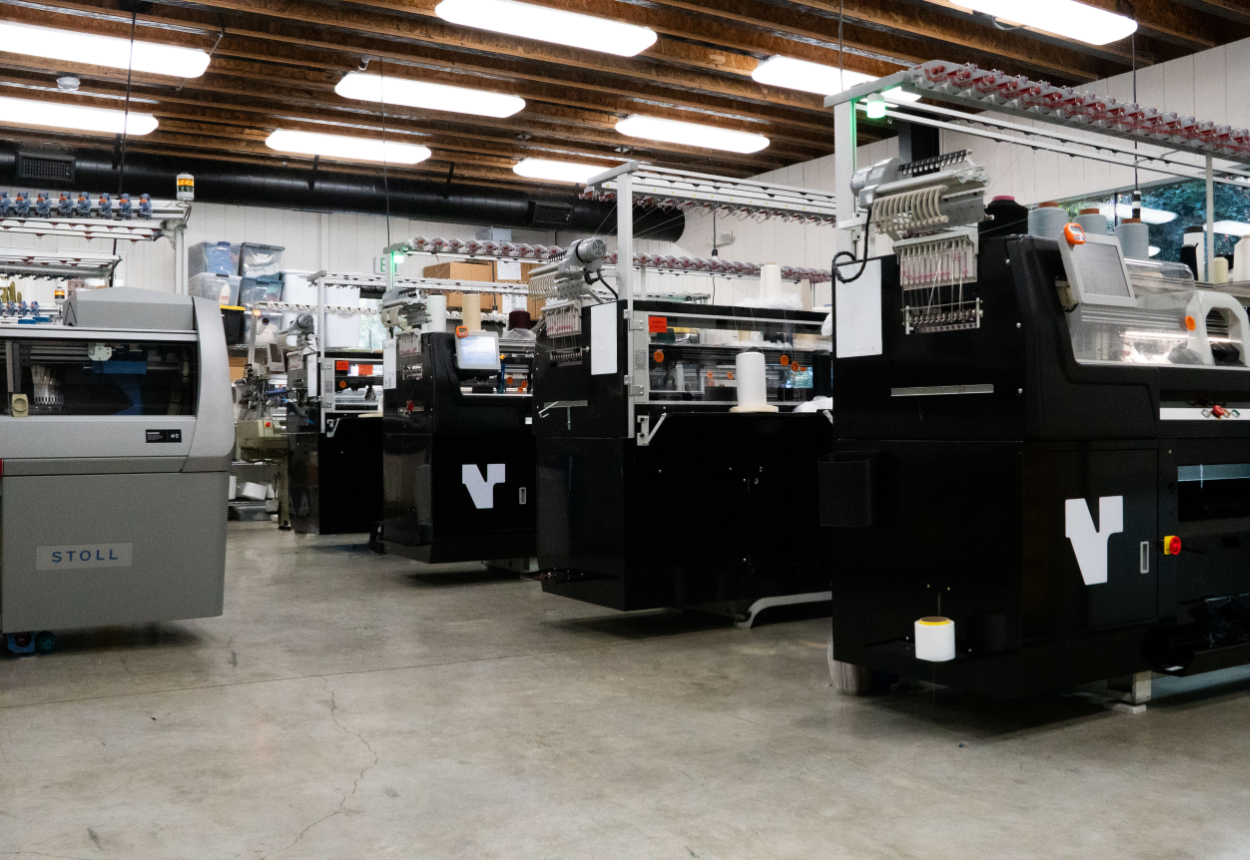
I think nothing speaks volumes to coming to a 400-acre ranch in the middle of Malibu and the Santa Monica Mountains and seeing probably one of the most advanced textile knitting facilities in the world with some of the best engineers, where we are run on Starlink – it’s actually a retrofitted horse barn – working on taking it off to show that industrial manufacturing could literally be stood up anywhere in the world. So if I could do it here, you could do it in an industrial park, you could do it on a farm in the Cotswolds or you know, you name the place, you could make it happen.
Yeah, and we’re going to get into the domestic production side of things, I think, a little bit as we get on.
The other thing I always try and do up front with each show is to pin down a definition. Pin down something about the person’s expertise that helps to ground the rest of what we then talk about. And the term I want you to define is ‘knit to shape’. Now that’s something that sounds pretty self-explanatory, right? It sounds like you you’re knitting something to a given shape, but it actually runs basically completely counter to the traditional method of garment construction, which is based on cutting pieces and sewing them together.
Tell me what it means to you, that definition, and tell me how that meaning has influenced what you’re trying to build.
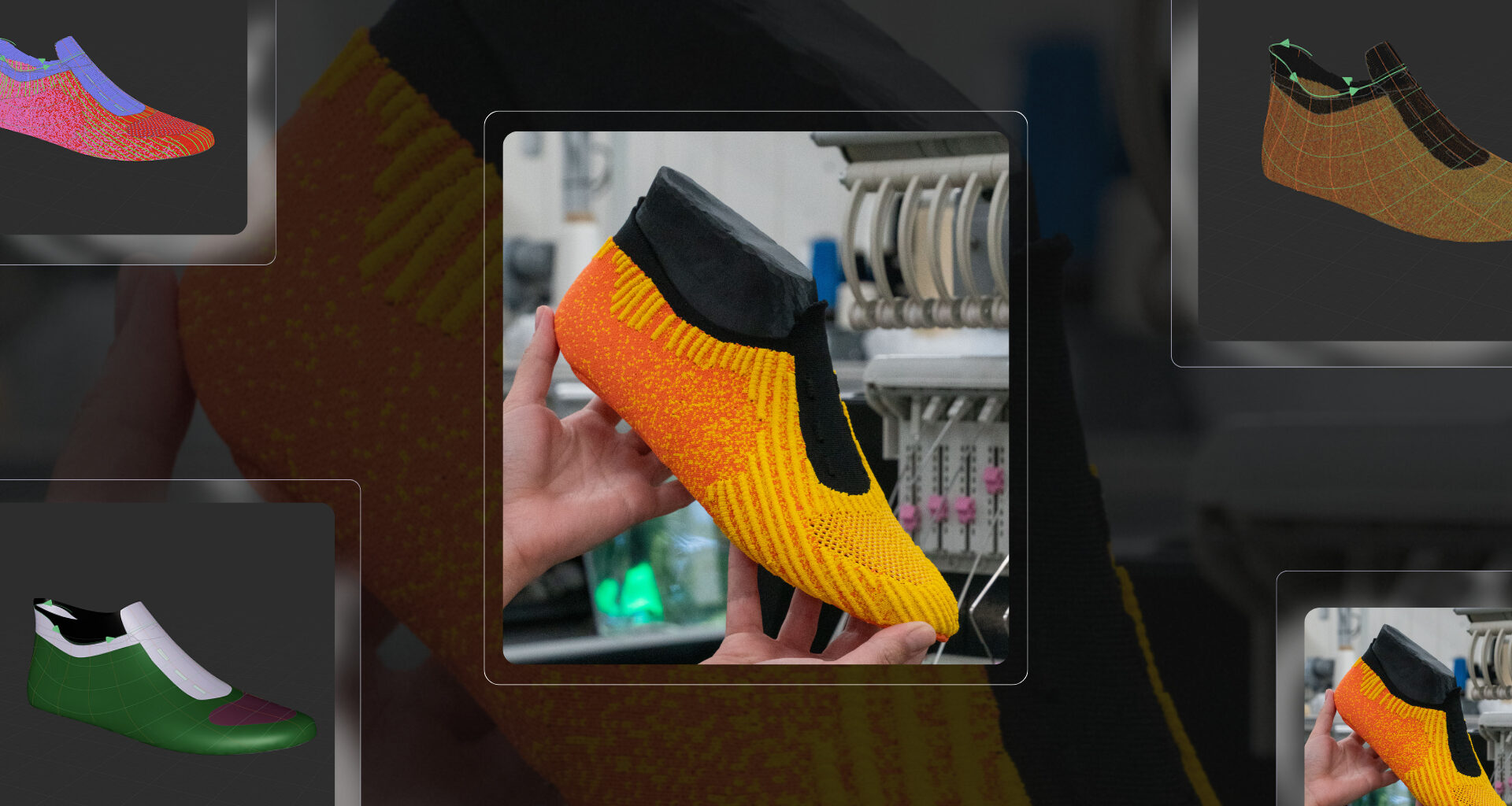
Well, it’s interesting. If you’re not from the knitting space, knit to shape sounds kind of weird, right? It’s like, well, what do you mean by exactly what you’re asking? What does that mean? I’ve got a lot of heat for this for many, many years, but I really do think this is the closest thing to 3D printing textiles that we’re gonna get to using these types of machines. It is additive manufacturing at its core.
Why I was drawn to this …I didn’t actually realise how complicated it was to be honest, Ben. Eight years ago when I started this company and looked at the problem, I didn’t realise the complexity of what I was trying to do.
So today when you design, whether you use CLO or you know, any of these other kind of patterning softwares, you design in flat panels, you take roll goods, you put a pattern on top, you cut it out, there’s quite a bit of waste. You then take a 2D, effectively a 2D shape and wrap it around a 3D form. You know, ‘knit to shape’ or ‘3D knit’ is what I actually like to call this, is effectively 3D printing textiles using flatbed knitting machines.
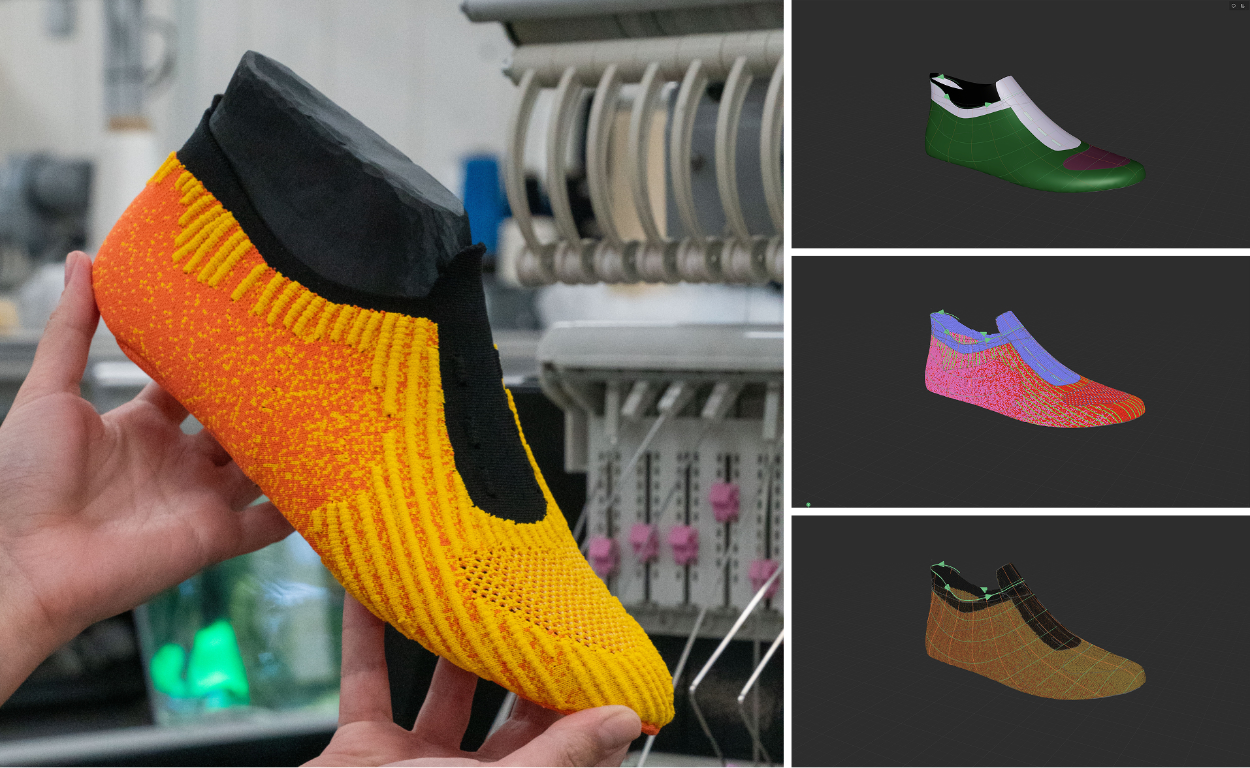
It’s really additive manufacturing. You’re taking yarn, using computational design tools that we built internally to take a 3D any type of 3D file. So right now we’re working in footwear, apparel, a bunch of different other product categories, but very complex geometries. We’re able to pull that into our software. And what would take, you know, sometimes weeks or months or and in many cases what we’re doing with products now is almost impossible with the traditional CAD tools out there. You have to design pixel by pixel on a flat, you effectively wrap the surface, you tape it up, you wrap it, then cut it out, flatten it. You measure all those pieces and you take a 3D shape, flatten it into a 2D pattern, and then you programme it in 2D. We’re going from 3D to 3D to the final product. So we’re eliminating a lot of steps.
But knit to shape is at its core, additive manufacturing in textiles. Because you’re taking yarn, it doesn’t matter what kind, you’re spooling it up on or threading it up on the machine, and you’re knitting those pieces to the final shape of the product. And a hundred percent of that yarn in that material is actually used to finish the covering of whatever you’re creating.
Yep, that’s a really good definition. I think it helps to cast it in contrast to the traditional approach.
Now, to lean a bit further into the platform and software side of things, which you just alluded to. Earlier this year you launched Loop, which I think your Co-founder described as – and I’m gonna use a direct quote here – “a platform for knitting anything of any complexity with any yarn using any machine anywhere in the world.”
It’s a very tall order, right? Because knitting, as you said, is a complex discipline. I would not class myself as an expert. I’ve come to this as an outsider. I know enough to know how hard it is, as you just alluded to. It’s also a sector where the hardware side of things is dominated by a few major suppliers and where a lot of some of the same suppliers are also working to own the software, both solo and in partnership with some of the leading 3D vendors you talked about. It’s very complex and very consolidated, I guess, is the simplest way of putting it.
Is that an accurate read of the knitting ecosystem? Am I missing something? And if so, how do you propose to upend basically all of that consolidation at once?
So yes, so Ben, yes and no, right?
So, machine manufacturers, typically and I think this is across the board in all industries, you’re amazing at one thing, but not both, right? You make the machine, but the software is a derivative to sell more machines. And the software that is available now, it’s very complex, takes years to master and learn. There’s a lot of nuance to it. I mean, I taught myself, it took me two years with a mentor to learn how to programme. And I realised that was the glass ceiling.
It’s not so much upending the industry, but we’d like to democratise the space, create accessibility to this amazing method of manufacturing, which right now is a very minority subset of how we make products owned by a few very big brands. This is kind of where my passion for sustainability comes into play; if we can get the majority of people designing, manufacturing and thinking how to make product like this, then we can drive down waste. That has always been my core motivation in a lot of the things that we do – just to create accessibility democratisation.
But there is a consolidation, right? I mean right now we just lost Stoll, right? So Stoll is being, I think, acquired by another machine manufacturing company. But now there’s SHIMA, which is a Japanese manufacturer of flatbed knitting machines. There’s Steiger, which is bought by Cixing, which is a Chinese manufacturer, and then you have Santoni Lenati, the Italian company. Stoll will probably fall into one of those categories, so it’s further consolidating that the industry …no one’s been crazy enough to try to solve this problem.
When I first ventured out into this, when I first ventured out to work on this and I met Will, I can’t tell you how many people told me, it’s impossible, you’re crazy and you’ll never figure it out. It’s too hard. There are too many variables to it. And that is totally true. But if you boil it down, and one of the attributes I like to lean into is I can take a very complex problem and then try to break it down. I also have an amazing Co-founder that’s worked hand in hand with me to do this. But we broke it down into steps and you just layer it like a cake, right? If you try to boil the whole thing, try to take on all of it, it’s like eating an elephant. You gotta start at one end and then you work your way to the other end. But you can’t do the whole thing at once. It’s just not possible.
So we started breaking it down into little pieces and then mapping it out and saying, okay, once we do this, it unlocks this, and then it unlocks this. And what it’s done is it’s actually opened up a whole new design methodology on how people will design in the future, how you will think about design. And in all honesty, this was actually a tool to allow me to build something quicker, faster, and bring it to market, because we were gonna launch our own brand. Once we realised the power of what we built, it was like, we should really pivot this, we should open this up and give this to everybody.
Well, let’s talk a little bit about that democratisation side of things, because that’s something I want to pick up on the platform side especially.
So I’ve seen Loop referred to – and I forget whether this is from your materials or from outside – as Figma (the famous web design and interface design platform) for textile design. Because Loop is web-based and because it leans into the WYSIWYG (what you see is what you get) acronym, pretty hard.
Now, anyone who uses Figma or any kind of comparable web native design tool or workspace, they will know that the value of those comes from speed, alignment, and accessibility. I’ll tell you what I mean. It’s faster to design interfaces in a web-based environment with components and standardised tools. Right? It’s quicker than doing it offline, desktop software that you can’t work in components the same way. It’s better to collaborate on those kinds of things in an environment that everybody has access to because they don’t need specialised desktop software. And as a result of both those things, those tools have exploded the user base for design in general.
I think it’s important to note that most of the people who interact with Figma are probably not designers, or they are probably not historically designers. They’re people who are looking at work that’s been done on that basis, or the people who have the capacity or the taste to become somebody who works in design. Same is true for Canva, right? But they are not people who would historically have used bespoke software for it.
And if we think about that from the point of view of Loop, if you’re somebody who uses or used the specialised software that you talked about, it takes years to learn, fine. Something like this makes it faster and more collaborative. If you’re somebody who’s never used those things, but you’re somebody who’s interested in network or you work in that sort of space, this kind of approach has the potential to put more power in your hands.
I specifically saw an announcement from your side earlier this spring where the Variant team were able to design and knit something like 10 different iterations in the space of 24 hours, going from CAD files that were created in a browser to directly driving the production machinery, the 3D to 3D you talked about. So that sounds like you’ve got the speed thing in your sites. What about the other pieces? So the Figma for textile design needs to be collaborative in the sense that it’s not just for a narrow audience. It needs to be for everyone. And I don’t think I’m spoiling anything by saying that computational knit design traditionally isn’t for everyone.
So what do you think it actually means or looks like to have a Figma for textile design?
I mean, you hit all three, right? It’s speed, accessibility and then collaboration. And I think the best thing about Figma or one of my favourite things about Figma is it creates a real time space where everyone can come into it, see, make comments, collaborate, and it creates a lot of visibility on a project. You don’t have that right now when you design or create a product. It’s the biggest issue for designers. The user that we’re focusing on right now is the designer. Designers typically need a knit engineer to create whatever sketch or 3D model file that they’ve sent to this knit engineer. They need to wait then weeks to get an abstraction of what that’s going to look like. Typically it’s not it’s not what they want. So then it becomes a negotiation over months of I want this, but you can’t do that. There’s a lot of give and take.
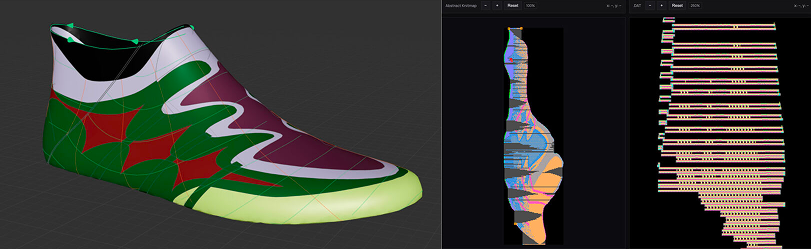
So why we created a WYSIWYG, kind of what you see is what you get, is the designer now has the access to be able to drop in the 3D file, be able to upload, you could use Rhino, create your curves, your design tools. You can then populate in our software all of your structures and designs, pull that into the platform, including – and I’m talking about shoes now – you can also then pull in outsoles and actually have a full 3D design of your shoe. Then you can export it out if you wanted to put it into Vizcom or Nano Banana if you wanted to create a high fidelity 3D model or an animated book model. Or you can effectively export out the file and plug it into a machine and knit it.
There are a lot of blockers in the design textile industry. Those who are listening that aren’t familiar with it, I could really quickly run you through how a product goes from idea to finished product. I can talk about a shoe because we’re doing quite a few of those right now, or even apparel. But you effectively take a sketch or you take a 3D model that you design, like a visualisation. Doesn’t mean what you sketched or what you designed in CLO or some visualization 3D model tool. You actually can make that. Right? Because certain structures, which are different types of fabrics that you can make off the machine, don’t play well with others. They don’t actually go around the product the way that you may visualise or want. There may be pixelation. You may actually not be even able to make that product, right?
There are limitations when you are 3D knitting a product or knitting something to shape. Then further down the line, you need a pattern maker, right? You effectively need someone to take your design, wrap a last. So today you tape it up or you use other types of software to create the pattern, then you give that to the engineer. The engineer then spends a week or two trying to program that thing, setting up the machine, trying to get your ideas close to what you want, but it’s never what you actually want. So when you get it and you ask any designer, what you get is not what you gave them. And that’s the worst, right? I was a designer, and when I handed off something to my pattern maker and I got my sample back and it didn’t look anything like what I actually had sketched, designed out in the tech pack, it was really disappointing.
So now you’re not starting from let’s make it better, you’re starting from how can I get it closer to my original design? And that’s what takes months. That’s what all the waste comes in. Time, money. That’s why a lot of products end up dying, you know, during this development cycle. And all these big brands take anywhere from six to eighteen months to get through the whole process. The majority of that is in that beginning stage.
So we say we’re the Figma for designing towards that as a kind of a North Star, it’s we’re creating a single point of truth, where anyone can make design edits, changes, notations in a single file format and in that single file format then you can export that out and you can create versioning history. So Ben you may say, you’re the merchandising, you may be in merchandising, I may be design, someone may be in costing, right? You just are on the manufacturing side. They can make updates and changes and it updates and creates versions of that product. So you have V1, V2, V3.
Right now, it sounds crazy, but you don’t have that. Whenever I create a new knit program, I need to save it. I need to then create my own file naming system on my server and then the only way for me to actually know what I saved, if I can’t remember, say it’s a year or two later, and I wanted to go back to a shoe that I designed or a garment I designed, I actually have to spool up the machine, I have to knit it down, I gotta look at it. It’s very disjointed right now.
So all we’re doing is bringing all these things together into one place. So you can see it, make decisions. And by the way, you can actually see a high fidelity 3D model. And we’re building our own visualisation tool for knit and textiles right now. Cause there’s just nothing out there that exists. So that you can actually see a thumbnail and then pull up the actual image of what that product looks like. And you can see who made changes when and what it looks like.
And a lot of what we’re building is coming from direct feedback from partners that we’re working with. So we’re not just building into a vacuum or a void. It’s like, what do you need? I think I know what you need. And then we’re building these tools in collaboration. It’s creating the ultimate collaborative tool because at the end of the day that creates speed and that creates a product that everyone wants to bring to market faster. And at the end of the day the designer ultimately guides a lot of that. If they don’t like it, you kill the product. Or they may love it. It may cost too much to make. So therefore then you kill the product, too.
A hundred percent. I think even people who are in the industry, they underacknowledge just how much of the typical product journey is made up of reconciliation. We’re made up of different people pulling in different forces pulling in different directions, getting those different work streams together in one room and figuring out how to make them make sense together. And it’s too simplistic if you call it creative versus commercial tension or what have you.
But I’ve been surprised when I’ve worked with brands in the past, and I’ve sort of said that so much is happening here that is not consistent with a single reference frame. I think that was also the promise of a lot of digital product creation in wovens and other parallel areas was that what you need therefore is a digital representation of something that is or should be or ideally should be accurate to the thing that’s actually being made. Now that’s a different prospect in wovens than it is in knit because it’s not driven the same way and so on and so forth.
You know, Ben, I didn’t realise this either until I went to go and visit probably one of the most advanced footwear factories in Asia. There it’s still a very manual assembly process. There were 35 people on the line putting together a shoe. I couldn’t believe it. So, you’ve gotta rethink. If we want to onshore stuff or do things locally or be able to create new products that are more sustainable, you’ve got to rethink how you actually put that product together. And that’s what we’ve done.
It’s forced us to think outside the box. If you look at a software platform, I keep going back to CLO because it is a great, amazing platform. But what they’ve done is they’ve created a digital tool for traditional manufacturing. We stepped back and said, that’s fine. We can be a piece of the manufacturing system, but what if we rethought the whole thing and what and where are all the blockers? Where are all the things that are frustrating? The things that take time, that waste money, that kill an idea from the get go, or even worse, it’s three quarters when you’re almost on the eleventh hour about to finish the product, the product dies because it’s just too expensive, you can’t make a revision. So we just thought, okay, let’s rethink this thing.
And the other thing which sounds crazy. This should be the norm. If you make a decision, it should cascade and waterfall all the way down. Instead of, like today, you make one decision anywhere in the process, you gotta change it four or five times in your tech pack to your manufacturer. And that’s where mistakes happen. That’s where time’s wasted. That’s where products get all goofed up. There’s no cohesion or link between a change in the process right now.
Yep. I think what we’ve talked about a lot there is internal alignment and internal collaboration and internal communication. Let’s engage with the external side of it, right? So we talked about the Figma comparison aiming for ubiquity and democratisation and accessibility, right? Let’s pick up the bit from the quote before, which was the ‘any knitting machine anywhere in the world’ side of things. Walk me through what you think the process of industrialisation and drop-in, swap out whatever you want to call it, kind of integration into the supply chain, into the existing upstream infrastructure looks like.
So let’s say we’ve worked in the browser, we’ve come up with a machine-ready file that was born in CAD in a web browser. What needs to happen on the manufacturer’s end to make that workable? And by extension, what would it take to take the setup you have at the ranch you talked about earlier, and make that a viable thing to scale out further in California, or like you said in the Cotswolds, or anywhere else in Europe, the UK, Asia, and so on?
So having anybody be able to design anything from their browser, that’s a cool vision. And I think we’ve got the software part of it pretty well sewn up from the conversation we’ve just had. But there’s more than software to stand up there.
Absolutely. And I have to go into size wide open, right? We have a lot of partners. What we’re proposing is the future. And what we’d like everyone to adopt. We really have to understand there’s still a lot of network engineers that can help accelerate what we’re building as well. So, standing it up on the manufacturing side, what we’re giving right now is when I say any machine anywhere in the world, today we’re focusing on SHIMA and Steiger and Cixing, right? Because that’s the bulk of flatbed knitting right now. We paused development on Stoll because of what was happening with the company, right? It just didn’t make any sense until everything shakes out and we see where it ends up.
But the majority of products will be made on those three types of machines. We’ve created our own knit code called knit block that we can abstract into our own knit language. You can effectively code it like JavaScript. It’s really interesting how we’re building this out again to make it more accessible. What we’re giving manufacturers now – or effectively designers and brands – is the expanded DAT files for, say, a SHIMA. An engineer can go in, make modifications that they want, but effectively then take that and put it into production. Because there is still a process that a product needs to go through. And it’s gonna take time for everyone to adopt this new way of manufacturing. We need to prove it here in Malibu. And then we’re talking with another group that’s looking at standing up responsive manufacturing here in LA and Portland that will be adopting the software. And then as we show it and prove it, how we can go direct-to-machine, do all the grading, everything, and how much more efficient it is. And further rethinking how you actually make products. So, instead of garments coming in five or six pieces and then having to be assembled together. With our software you actually can make it in one piece with two seam lines. You can make a shoe as a full 360 booty instead of having to create a horseshoe and then do a strobel and all those other components.
There’s other ways of creating products, but that does change how you manufacture. And a lot of these Asian manufacturers who we work very closely with have a setup where they’ve invested hundreds of millions of dollars into an assembly line and there is a little bit of pushback to want to change that overseas. There is opportunity to change that here domestically because we’re effectively starting or building something from the ground up.
Yeah. For me, with anything that is sufficiently disruptive or is poised that the posture is sufficiently disruptive for something. The part I always want to press on is what will it take to put it into the infrastructure that already exists. And I think you give a good answer to that, which is to say you need to prove it out by developing new infrastructure in country, domestically, so that the benefits are more visible. And then companies that are heavily entrenched and have a lot of inertia around traditional assembly line production then start to see that it’s not just an experiment. It’s something that they will need to reorient their businesses around.
And at the end of the day, it’ll be faster, more efficient, and allow them to actually create diversification with the machines that they have currently in stock.
I mean, right now, which is kind of crazy, Ben, you go to a factory, it’s set up only for garments. But that garment machine can actually make shoe uppers, furniture covers, could make automotive seat covers, could make medical products. All of these machines are so adaptable. We should think outside the box instead of categorising – and not to get super technical – but like a CMS 530 from Stoll, which is your traditional flatbed machine for shoe uppers. Well, now that we’ve re engineered how you can make a legging on it, we can take a very narrow needle bed, so like a very short width machine, and now make a legging on it because we’ve redesigned, reengineered how you make that legging and made it make it better. So now your machine can make more than just one product, which is a shoe upper. Now as a manufacturer, you don’t have those lulls in production.
I was a little naive. I mean I made plenty of mistakes, and I’m totally self aware of this. I was totally naive that everyone would be open arms and willing to adopt this. I knew I would get some pushback from knit engineers, right? Because there’s a lot of skepticism. And then there’s fear too that we’re going to automate out their jobs, and that’s just not the case. What we’re doing is taking 90% of the lift of the monotonous kind of making the base program. What if I flipped that to the 80-20 rule? If 80% of the kind of the monotony of making the base program and then only left you 10-20% of the time to innovate and actually engineer. Well, what if I flip that? Loop, did all the heavy lifting, got you 90% of the way there, and then allowed you as the engineer to then really push the boundaries of what you could do, and then reinvest 90% of your time into that. That’s what we’re talking about. And that’s what we’re doing. And that’s where that’s where I had to change a bit of my perspective on it, after talking to a bunch of the engineers, and realise, no no, this is what we’re doing. It’s a bit of a superpower, you know, that allows you to do the fun stuff.
Yeah. No, I think I think that’s right.
Now you mentioned sustainability at the top as something that you’re passionate about. Since then, we’ve said faster, better, more efficient a lot, instead, as the kind of wedge. Now, at last year’s Sourcing Journal Sustainability Summit, I think we were interviewed by Kate Nishimura, who is a friend of mine, and as part of that Summit, I’ve watched the interview back, you said you were finding it hard to sell the sustainability benefits of everything we’ve just talked about. Like reducing waste, doing things domestically and so on. And that you’d started purposefully treating sustainability as kind of the riders in the Trojan horse thing, and instead putting cost, time, logistics, and things first that have a secondary benefit in sustainability terms.
Do you still feel that way? Do you still talk that way? And does that sentiment have anything to do with tech and innovation budgets being reassigned away from sustainability initiatives? Or do you think it’s just a case that brands respond far more readily to something that directly hits the bottom line?
I think the latter. Being really passionate about sustainability …I mean we even hired a PR company that really put us on the sustainability path of being kind of a thought leader in that space. But I realise it didn’t really move the needle. What moved the needle and what brands did care about, because it’s a business at the end of the day, is how can I bring a product faster, cheaper, and more efficiently to market? I mean all these things are huge in environmental wins, right? Can I quickly change a program? I mean, if I design a program out of a polyester fibre and I want to change it to a wool, I have to start over right now if I use traditional machine manufacturer’s CAD software. It’s a redo. So most people don’t do it, right? You just stick with it and I’m just gonna run this thing because I’ve invested a year’s worth of time and a few hundred thousand dollars to develop this thing. I’m gonna run it all the way to the end.
Well we give you that flexibility now. Now you can swap it out because we do something called stitch density, which tells you how dense the knots are, effectively knots between each fabric, and then we take that calculation and instantly create a new program for you. So we’re removing a lot of those barriers.
But it was very hard to walk in. I love it because everyone’s heart is in the right place. But at the end of the day, everyone has a business and you have either shareholders or you’ve just have to pay your bills. I’m not naive to that. So why near shore? Well, because maybe it’s a little more expensive or maybe not, right? Because everything that’s going on with shipping lines and you know, what happened with COVID, there are shipping disruptions and when you factor in all the costs of lead time, shipping costs, right? And it’s a bit volatile right now, fuel costs, you know, warehousing, distribution, it almost does create cost parity when we lay the whole thing out and you talk to the right people within the company, they understand the time savings and the cost are about roughly the same as if you’re to do it overseas.
We don’t have the infrastructure currently here domestically, but there are ways to do this with 3D knitting that allows you to effectively have the same cost parity if you’re to make it overseas in Asia. You have to rethink how you make the product. That’s all. You can’t have all the pieces. You can’t have 35 people mainly putting together a shoe. It has to be a two-step process. So it has to be a new type of shoe. It has to be a new type of product, right? Same thing with a legging. It can’t be a Lululemon or an Alo legging, right? It can’t be 35 different pieces with seam lines everywhere. No. You should actually engineer all of that into your legging. Couldn’t do that before ’cause it was too expensive to pay an engineer to do that, but now we’re removing that barrier to entry.
Yeah. Fine. And I buy that. I think I agree and I’ve heard brands talk about it to be fair. Behind closed doors you will hear companies say sustainability is not a marketing term …that’s being a bit uncharitable. Sustainability doesn’t directly drive behaviour and things the way that that you would think, and instead what they lean into is, how do they become faster? How do they become more profitable? And the sustainability benefit is an upshot of that. So, yeah, I think I agree with that.
Just to follow on that is, at the end of the day the consumer is the driver of what a business is going to provide. If sustainability was, for a majority of people, at the forefront of what everyone wanted, then we probably wouldn’t have the H&Ms, the Zaras. It’s quite expensive, so there’s businesses supplying to consumers that want something. What I’d like to do, and call me a bit of an idealist, but what I’d like to do is, I think everyone’s got their heart in the right place. All brands, every brand. I don’t think any brand really does it, right? They want to do the best and they want to serve their customer the best. That’s how you build a successful business. Maybe that’s where I get from the hospitality side of my upbringing is you listen to your customer and deliver more value than what you’re charging for is if we can create accessibility in this space and then other spaces across the line to every brand, and give them the option where onshoring or localised shoring, local manufacturing or sourcing more sustainable fibres has some cost parity, then I think everyone would do that.
I don’t I don’t think that people would intentionally say, no, I want to use really resource intensive or pollutive fibres that aren’t great for the environment. I think people would, including brands, designers, they would all choose to kind of go in that direction. It’s just very tough right now.
I would 100% agree with that. And I think I’ve come under some fire for it before, but you know, people particularly in Europe are very up in arms about SHEIN and the ultra fast fashion side of things. And I get it, I understand it’s an extractive business model and what have you. They’re making what people want to some extent. They are making what people are willing to buy. And I think it requires you to do something different and demonstrate that thing in order to showcase that there is an alternative.
Now, we’re a fashion technology publication, but apparel and footwear are just two of the few verticals that it seems like you want to go after with Loop. And I think you’ve already hinted at this. If a knitting machine can do one thing, it can be pressed into service to do multiple things. Everything from interior design textiles to medical compression wear and maybe even the knitted skins that you see over humanoid robots, which sounds far-fetched, but clearly somebody is making that material.
Fashion’s got a pretty long history of asking / demanding industry agnostic platforms to adjust what they do to fit fashion’s idiosyncrasies and priorities. So I’m curious: first, how big of a fixture do you think fashion is going to be on your roadmap going forward? And ‘fashion’ I’m using as a catch-all term for apparel, footwear, accessories and so on. And second, whether you see Loop as a platform that just works for every use case without adjustment and that the principles of 3D knit are the same for everything, or if you think it’s something that needs to be progressively verticalised in order to realise its full value.
So, fashion is our focus and that’s what we started off, really focusing on. We’ve kind of shifted our focus into footwear because we realised the allowable tolerance to that and the accuracy has to be near perfect. And the complexity of footwear actually covers a multitude of different industries.
And like we talked about earlier, these knitting machines, it’s not an apparel knitting machine, like a sweater machine. It’s not a footwear machine. It’s not a furniture machine, right? And that’s what everyone loves to call it, right? It’s like, this is what it does, this is all it does. No, actually, if you step back, look at it a little bit differently, that one machine can actually go across products across a multitude of different industries. And we’re doing that today. We’re working in humanoid robotics, we’re working in the medical space, we’re working in footwear, automotive, apparel. We did some stuff in aerospace – the list goes on and on. And Ben, we’re using the same machine. And in some cases we’re using the same fibres, to be able to create these products.
So it’s all about, how you set the machine up is how you can actually leverage the machine. A lot of the kind of linchpin of how we do this is using our VARIANT3D Loop platform to be able to do this. But it’s kind of just rethinking the business overall. I mean that’s why again, I think domestic manufacturing is gonna be possible because, now with one machine, you’re not stuck waiting for an order, right? Now this machine could really be running 24 hours a day, seven days a week. Well, maybe not 24 hours. There’s always a couple hours of downtime. But you could maximise the efficiency of these machines. Therefore, you could amortise that cost, making it more affordable for manufacturers, making products across the board cheaper.
Does apparel lead design in automotive, or does automotive now inspire apparel and footwear? Now we’re taking all these cross disciplinaries and we’re allowing them to kind of feed off each other.
Okay, so we talked about democratisation. Who do you see as your long-term customer though? Because I think there’s the idealism point that you talked about, which is making it available to everybody and creating the Figma for textiles, lowering barriers in software and so on. It’s easier to do that, I think, to put together a potentially massive addressable market through a browser than it is to do the kind of distributed domestic production side of things and make it more viable on demand.
Who, in the long term, are you selling to? Do you think the brands are the lever for making this kind of change? Do you think it’s their factory partners? Do you think it’s whoever’s setting up this new infrastructure for domestic production?
So, brands are gonna lead this. And we’re working with all of the major brands right now. Designers are actually who we’re focusing in on and that’s who we’ve been building the software for. It’s giving designers the accessibility. And with a click, either it’s computational design or just traditional designers. We do need to teach traditional designers how to use some of these, you know, computational design tools. But I would say the majority of new designers coming into the industry are really very familiar with these new computational design tools or CAD tools that are coming out.
And we’re not trying to be everything for everybody, right? We’re focusing on designers, we’re allowing them to use third party CAD tools, pull those 3D designs into our software, then you work within our software, then you can export it out into all these different types of machines to make samples immediately.
As we go forward, the goal is to have it trickle down. So brands will lead this, we’re pushing this into manufacturers like large global manufacturers right now. That allows us to open up or rethink how we manufacture products, even onshore products. Then we’d like to tear it down to smaller brands. And then ultimately allow anybody to be able to come into the space and create, design, and make products, and launch their own brands. This is. to me, like the nexus of what DCG printing or embroidery …this is the ultimate abstraction of that, right? Whereas instead of taking a blank that someone made and then putting a graphic on it, what if you can make the whole garment with your graphic, with your design, with all the physical attributes of that textile and then effectively be able to stick it on your own knitting machine and then knit it out.
Yeah.
Okay, so when we think about the letting anybody design anything, democratisation point of view, you talked about computational design a few times, which I think is probably right to say those tools are still primarily aimed at people with formal design education. Then when you think about actual kind of unit one directed garment, digital print sort of workflows where literally anybody can design anything and get it on a t-shirt, get it on a hoodie, or so on. It’s a very interesting time to be talking about letting anybody make anything they can imagine because there are an awful lot of tools in people’s hands from a generative point of view that allow people to imagine an awful lot. What do you see happening there? Do you see generative kind of algorithm? Do you see that being more of a force in that kind of future design that you’re talking about?
What we built is, we have our own algorithms that are able to abstract these designs or abstractions of what people are creating. We’re already in a lot of ways proving that. We’re lowering the barrier of entry into the space. So traditional network engineers don’t actually need to come in to create a product right now. We’re working with just designers who
don’t have any knitwear background or engineering background and they’re designing, creating, knitting products in real time.
There are other things that we’re looking at. We’re using Claude to create knit structures. Some of our engineers internally are doing that. It’s really interesting in populating our back end internal system. We’re leveraging all kinds of different tools to do this. Why do we have tools like Viscom or CLO? Our people are creating these amazing abstractions or 3D abstractions of designs? It’s because, to me, it’s a substitute for the physical product, right? You want to show off to you know leadership, hey, this is the idea, this is what it’s gonna look like, how amazing, and then they say, Okay, yeah, now go make it. Well, what if I could tell you the same amount of time it takes you to make that Viscom hype high fidelity 3D model, that I can actually export out and give you the real thing in your hands at the same time. And that’s what we’re doing.
And finally, what do you see as the timeline for this? Wealistically, what do you expect apparel or footwear production to look like in 2030? And that’s one of those dates that feels really abstract and felt like a long way off for a long time, but we’re halfway through 2026. So it’s coming down the tracks pretty quickly.
Do you think the industry setup you’re talking about can meaningfully change in the next few years? Or are we looking at a longer timeline for turning things around?
Yeah. Three years away. Three and a half years away.
I do and we’re already kind of proving that out right now. We’re doing it with a few partners on a kind of beta test model. That’s why we haven’t overly opened up Loop to a broader user base. There’s some conversations of you know being able to prove this out in a high velocity way with a couple of big brands that really understand the space so we can build out the infrastructure correctly.
But I do think in three and a half years, you know, the landscape of how you make products, it’s not gonna be like the dream of anyone can just log on with their iPad, you know, log in to Loop, design something, you know, print it out on their own knitting machine. I don’t think it’ll be there yet, right? But where it’ll be is I think we’ll be able to take ideas …what we’re doing right now, today one designer with no knit engineering background …we did this in a work session internally with one of our computational designers that has no idea about knitting. She created 12 different variations of a shoe upper. This would take years, hundreds of thousands of dollars right now in the current system to be able to do this. I mean we’re currently proving this out internally, we’re doing this with partner brands, and we’re now deploying this into their ecosystem.
So I think in 2030 you’ll be able to see generative design products coming out much faster. And I think you’ll see a lot more co-collaboration or inspiration coming from anywhere from architecture, automotive, footwear, apparel. You see a lot of this crossover in design, effectively feeding on each other, and quite frankly, I think it’ll all come from the Loop platform that we’re building.
Well, let’s aim to sit down again in 2030 and see how all this plays out. Maybe not that long, but at the very least we can pencil it in for that.
Well, I hope not that long. I hope we talk sooner than that.
For now, though, Garrett, I appreciate this conversation. That’s insightful from my side and network, not something I spend a lot of time immersed in, but would like to. So this has been a good crash course for me as well. And I’m sure the listeners have got a lot out of it.
Thanks very much for joining.
Thank you. Thank you, Ben. And pleasure. Love being on your show.
And that’s the end of my conversation with Garrett.
Hopefully it’s given you some insight into knitting if you don’t already spend your days immersed in it. And if you do, then I’d be keen to hear what you think about the viability of what VARIANT3D is trying to do.
I like doing these weekly prestige interviews with CEOs because, for me, they’re an opportunity to kind of press people on what the practical implications of their visions are, irrespective of whether those visions are confined to the selling software that’s generally available and that caters to a narrow category, or whether they’ve got like whole industry transformation scope and ambition in their sites.
I’ll have another one of these for you next week, the week after that, and so on. So while we’re still sounding out and feeling out new ways to talk about industry news, which you might have already listened to by the time we hear this, my promise to you is that you’ll be able to come back here every week and listen to me quiz someone senior in the world of fashion technology for the foreseeable future.
So until next week, thanks for listening and I’ll talk to you again really soon.