Hey, welcome back to The Interline Podcast.
Now, I’ve made no secret over the years of the fact that I like 3D. Computer graphics were a really formative part of my childhood and my teenage years, and as long as I’ve been in fashion I’ve been interested in how a 3D representation of a garment, a shoe, a bag or what have you can enhance and transform the way that product gets planned, conceived, made, marketed and sold.
And while I’m also pretty interested in AI — you’ll see that in our AI Report 2026, which will be out by the time you listen to this show — the rapid rise of generative image models has actually really solidified my opinion that technical engineering and accurate simulation are more important foundations than ever for basically everything that fashion says it wants to accomplish as part of digital transformation. But as bullish as I might be on the outlook for 3D, I don’t think there’s any denying that it’s been a specialist discipline for a while now.
As well as being reliant on costly, beefy local hardware and a reasonably complex set of software, digital product creation — DPC — has really been targeted at, and used by, a pretty narrow pool of scarce talent. And when we talk about scaling DPC, which we often do in that community, we rarely mean getting more direct users into 3D design and into the applications that 3D designers use. Instead we mean enabling a wider audience to take the outputs of 3D, either rendered out or as objects, and use them for other upstream and downstream purposes. I don’t know if I’d quite go as far as to say that 3D teams have ended up being gatekeepers necessarily, or bottlenecks on product creation in general, but the industry at large certainly hasn’t seen 3D as a user growth segment in the last few years, and especially not since AI has offered a quicker shortcut to simple, low-stakes idea visualisation and communication.
But a decade or so ago, I could have said most of those things about 2D design as well. Not in fashion necessarily, but certainly in web design, graphic design, desktop publishing and so on. I’m definitely old enough to remember when any kind of layout work or mood boarding, pixel or vector work was done in dedicated desktop apps by people with very specific and narrow job titles. Now that might be set to change for 3D.
If you’re keeping tabs on 3D scanning — which is a very different idea, but shares something at the output — you’ll have noticed recently that it suddenly got a lot easier to show good-looking 3D objects on the web. But just as platforms like Figma and Canva shifted the actual creation activity into the browser, there’s now also a lot of interest in doing the same for 3D design and simulation for garments and accessories: taking what’s been a pretty isolated activity and exploding the distribution for it away from the desktop and onto a much wider user base in the web browser.
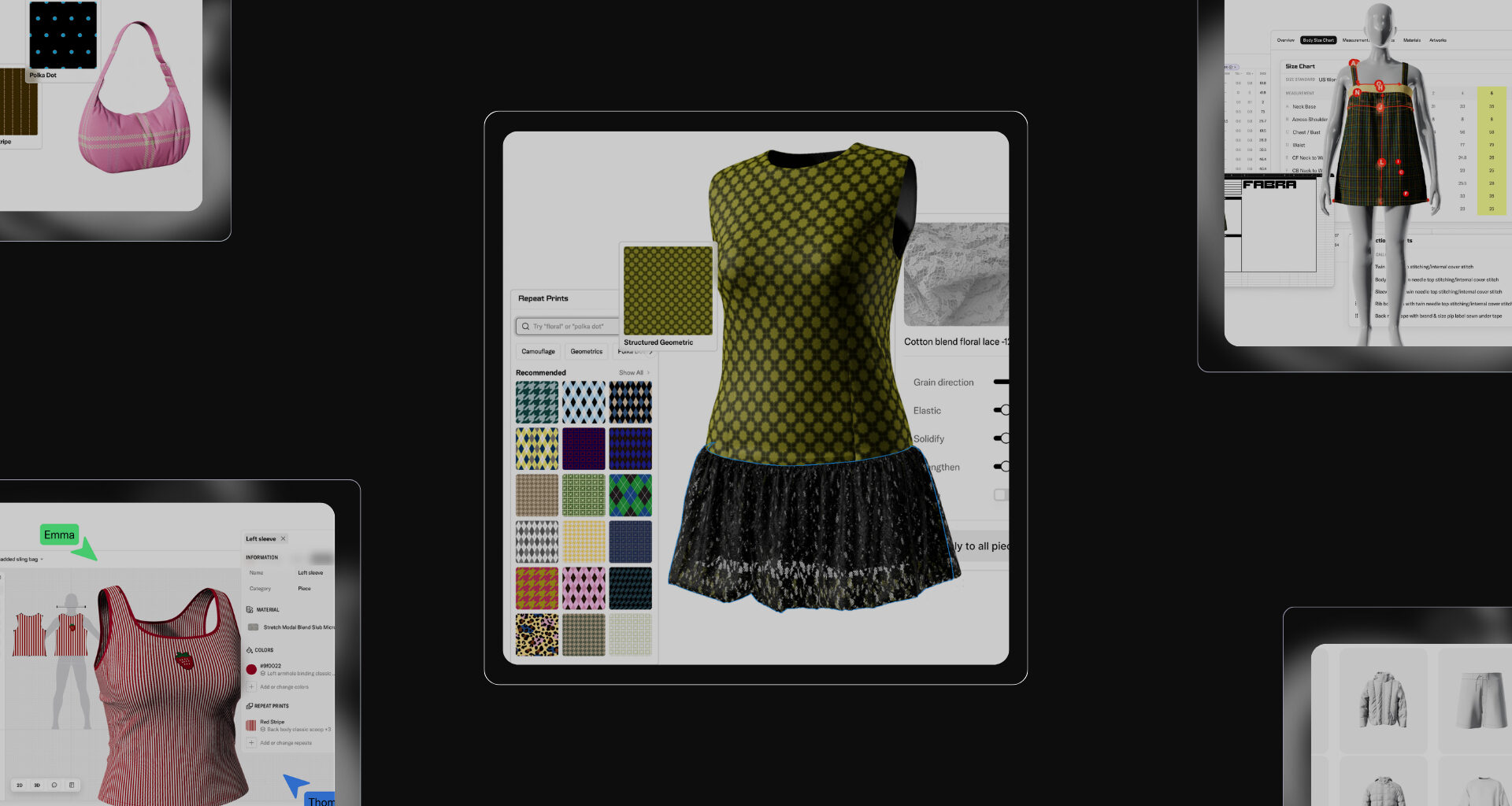
Today’s guests, plural, are Luke Grana and Gloria Yu, who are two of the three Co-founders of Fabra, a web-native 3D design, simulation and collaboration platform that is intended to cover the full spectrum from initial idea to what they refer to as production-ready specs. It’s based on the new WebGPU standard, the replacement for WebGL, and it has some interesting ideas, I think, about who 3D and DPC are actually for, and how far 3D can follow that playbook set down by the likes of Figma, Canva and Miro.
I first chatted to Gloria and Luke a couple of months ago, and I came away interested enough in what they’re building to want to quiz them further. Whether you’re in 3D already, or whether you’re part of the extended user base that Fabra is targeting, I think you’re going to be interested in what they had to say.
So let’s get rolling.
Never miss an episode
Get notifications for new podcast episodes, plus our weekly news analysis, events, and more, delivered straight to your inbox.
NB. The transcript below has been lightly edited.
Okay. Luke Grana, Gloria Yu, welcome to The Interline Podcast.
Gloria Yu: Thank you for having us.
Not at all. It’s a pleasure. I’m glad we got the opportunity to do this, and I’m glad we’ve had the time to do this. Now, we open these shows with two things every time. The first is an overview of what the guests’ day-to-day lives, and working lives in particular, are like, and the second one is a definition. We usually try and get somebody to define something that seems simple but that maybe ends up being a bit more slippery and revealing in practice.
So let’s start with the everyday stuff, which is a bit trickier to do sometimes when you’ve two guests — we’ll make it work. You’re both co-founders of Fabra, and we will get into what Fabra is over the course of the next hour. Tell me how each of you got here, to become founders, and tell me how you divide the time and the labour of running a start-up or a scale-up.
Luke Grana: Yeah. So, Luke Grana here, the CEO of Fabra, and also Gloria, Chief Product Officer of Fabra. Fabra is a new 3D product design tool. Gloria and I both come from the fashion industry — we’ve both been working in it for the past fifteen years each. And we’re building a design tool to really make product design accessible to everyone. It’s web based, there are templates, it’s 3D, and our mission is to make product design accessible to everyone.
A bit of my background. I grew up in Sydney, and then back in about 2012 I learned about the new direct-to-consumer business model. I got very excited by that. My brother was living in Peru, and I learned about Peruvian pima cotton and started sampling with a producer in Peru, and then thought, okay, I’m in Sydney now, but where’s the best place to set up a global distribution hub? And I actually bought a one-way ticket to Hong Kong.
I was living in Hong Kong for about eight years building an e-commerce DTC brand, just selling basics. It was a great journey living in Hong Kong and I learned a lot about fashion and product design and production, commerce, and really selling on the internet. We built revenues up to about $20 million, we had a warehouse in Hong Kong and shipped to 60 markets. So I learned a lot through that process.
But one thing that I really learned is that the product design tools are fantastic, but it’s really hard. You need a lot of training, and there’s a steep learning curve. Our product team was about 10 people, and there were only two people out of that team who could really do technical product design. I just thought it was a very slow process, and the sampling was slow with producers. And I was very lucky to meet Gloria, who is now my business partner, but also my fiancée. We’re getting married later this year.
Congratulations.
Luke Grana: Thank you. And during COVID we actually moved back from Hong Kong to Sydney, and we kept coming back to the same thing: that product design is really hard. The tools out there are amazing, but they’re really built for experts. You need pattern-making experience. You really need to know how to create a 2D pattern. And we got very excited by the likes of Canva and Figma and the whole new web-based design movement, and we kept saying, why doesn’t physical product design exist on the web? And this was back probably three years ago.
I think the technology has come quite far since then. So that was the original thesis for Fabra. And how we split our time: I’m very focused on the business side, the team management, fundraising, and really looking after the strategy and the direction of the company. Gloria is really fixated on the product and the user experience, and really into the details of how the product works.
Gloria, a quick rundown of your background. What brought you here?
Gloria Yu: Yeah, sure. So I come from more of a design and craft background. I grew up in Hong Kong, and for university I went to New York City in the States, studied at Parsons, and did my degree in fashion design. So I really learned pattern making and garment making, and after university I had my own brand, which was sold at retailers like Net-a-Porter, Lane Crawford and Moda Operandi. Through that process I learned the whole gamut of running a brand, from design to production to sales to marketing.
I did eventually pivot my career more into tech and the product space, and that’s when I met Luke, and we eventually started Fabra together. What really drew me to building Fabra, aside from making design accessible to anyone — even someone without technical fashion design training — is also simply making the user experience of getting a product from idea to sampling to production more intuitive. Right now I’m a trained designer. I know a lot of other trained designer friends. We know how to use all these tools, but we’re not singing praises about them. I think there is still a lot of room for improvement in making the whole process of designing and bringing products to market more collaborative and more intuitive, and that’s what we’re here to solve.
I also want to say that we have a third co-founder called Nick as well. He’s our CTO, and he’s really the backbone of our whole software and engineering — he’s responsible for that part of our company.
Okay, cool. That’s a good overview. Now I want to hit you with a definition of something, and I’ll let you split this burden up however you see fit between the two of you. Tell me what you think digital product creation means.
So, for long-time readers and listeners at The Interline, DPC is the acronym that we settled on — and the industry largely settled on — as a way of referring to not just 3D design, simulation and visualisation, but the whole extended software and hardware ecosystem that grew up around those core capabilities, as well as all of the jobs, the roles and the disciplines that came from that. Now, you position Fabra as a 3D design tool and as a way of collaborating on, and I’ll quote, “creating production-ready specs”.
So this is a question of market positioning as much as anything else: do you see Fabra as part of that existing DPC ecosystem, or is it a play for something different entirely? Because when I look at it, when I scroll through the website, when I talk to you, I see the combination of material library, tech packs and fabric simulation, and even though the whole thing lives somewhere very different to what we’re used to — which we’ll get to — I think to myself, this is familiar.
I understand what this is. It feels like a space we’ve explored. That space we’ve explored, though, the whole DPC ecosystem, comes with some baggage. You’ve hinted at some of it, Gloria, and not least the idea that it’s the domain of specialists, with steep learning curves and so on. So what is DPC under your definition, and does that definition include Fabra?
Luke Grana: Yes, I think this is a great question. We see DPC as 2D and 3D design, material simulation, the tech packs, and then getting the product, within the team and in collaboration, right through to production with your manufacturer. And the way we see it is that we’re trying to broaden the uptake of DPC. There are some amazing tools out there, they’re expert grade, and they’ve been built upon for a long period of time.
But what we’re trying to do is broaden the market of who can actually interact with DPC. We are trying to bring in untrained, non-technical designers, designers who don’t have pattern-making experience, solo entrepreneurs building a brand, small businesses and communities, into the DPC space. So we see DPC as a fast-growing space, which is going to continue to grow in a really big way, especially with the democratisation of commerce that we’re seeing, and also on-demand production and small-batch production, which just continue to drop the barriers to building brands. But, ultimately, we just want to broaden the market and make it more accessible to everyone.
Do you think there’s a pathway where somebody starts their 3D-DPC journey in Fabra and eventually graduates to one of the big desktop suites?
Luke Grana: I think that’s a great question. What we’re building at Fabra is a browser-based version, and our vision is to make it as easy as possible, with drag and drop and sliders. But eventually Fabra will have the minute detail of being able to edit products and 2D patterns, and material simulation, and the full soft-body physics that we’re building into it. And ultimately we believe in Fabra, but also in other players in the industry moving online. So we believe that 3D on the web is definitely the future. Now, whether they stay at Fabra or they move to another platform, our assumption is that they will move to an online version.
Fine. And that does bring me to my next question. So you’re making a bet on achieving feature parity, or something like it, in a web-native environment. And it’s the web environment that got me the most interested in having this conversation with you — this is why I wanted to bring you on the show. Fabra, as you mentioned, runs in a browser: not as a visualiser or a product configurator with baked parts, or a viewer applet inside PLM, but as a web-native 3D design and simulation tool.
For anyone listening to this who’s not already immersed in 3D, that’s not how it typically works. If you think about the main 3D pioneers and mainstays like CLO and Browzwear, they’re heavy desktop applications, at least in their essential design and development forms. I know they have web applications for other parts of it, but that desktop architecture stems primarily, I guess, from the requirement for local processing power — mainly but not exclusively GPU. So 3D designers, along with marketing teams doing CG work and so on, they’ve been the people within brands who had the biggest IT overheads and needed the beefiest rigs. For that reason, they were the people with the heavy PCs. I guess maybe that’s less true now, because there’ll be somebody listening to this who’s got a $50,000 cluster of Mac Studios on their desk at work for AI purposes, but it’s been true for a long time.
Now, when we first talked, you mentioned that the big unlock behind what you’re doing — this move from the desktop to the web — is WebGPU: the WebGPU standard, which is the follow-on from, I’ve temporarily forgotten the name of it, but there is a follow-on from a previous standard. And WebGPU gives browsers, I think it’s all the major ones now — Safari, Firefox, Chrome and so on — direct access to graphics acceleration APIs that exist in Windows, macOS and so on, like Metal and Vulkan. Tell me what you think this changes, this shift from desktop to web. What do you think it actually changes about the way we think about 3D and graphics? Because real 3D on the web sounds like a big deal, but it doesn’t magically give you access to graphics horsepower that you don’t already have. It still needs local power to draw on through WebGPU, the same way a desktop application does.
So why the bet on 3D on the web, and what do you think it changes that desktop applications don’t?
Luke Grana: Yeah, it’s a really good question. If we had tried to build Fabra a few years ago, it would have been very challenging. But with the culmination of multiple aspects coming together — like you mentioned, GPU ubiquity on devices, on mobile devices, on laptops now, and the chips getting so much faster and stronger — and then the new web standard that you mentioned, so WebGPU. WebGL was the predecessor.
That’s the one. That’s the one. Thank you.
Luke Grana: Yep. So WebGPU — there’s different terminology out there, but it’s at least ten times faster than WebGL, and it can really utilise the full GPU of the laptop, for example, or the mobile phone, and really render graphics in a high-quality way much, much faster than WebGL could. And then the internet speeds are increasing every year. So trying to build Fabra, or a web-based 3D design tool that is of high quality, that can edit 2D patterns and simulate into 3D and have full soft-body physics and material simulation, wouldn’t have been possible in the past. But like you mentioned, the WebGPU standard is now live on most browsers, and all new computers and devices have these strong GPU chips, and they’re only going to get stronger.
So our assumption is that web-based product design will be on parity with desktop-based product design in the next few years, and it will be just as powerful. So we’re obviously trying to build into that space, and we do believe that, down the line, other tools will be moving onto the web as well. But what it actually does is that it unlocks so many new users into DPC. It’s not just the technical designers or the garment techs now doing 2D pattern making and 3D simulation — you’re bringing in the planners, the buyers, the merchandisers, the creative directors, the person creating the ads.
So you bring everyone, through an easily clickable link, into one workspace for them to really collaborate and move forward. So we think it’s a really exciting time, and we believe it’ll really open up the market to many more people.
Fantastic. And I do have some follow-on questions about that distribution side of things. Just before we move on from the pure — you mentioned on-device GPU cores and so on. Brass tacks: if I want to use Fabra today, what’s the base spec? You could give it to me in Apple silicon generations, or PC parts. Just give the listeners an idea of what they would actually need to go and play around with Fabra today.
Luke Grana: Yeah. So actually, v1 of Fabra, which has been live in our public beta for the past six months, has really been the first version of our product, really just the MVP. It’s been quite a basic version of Fabra. The products have been quite modular, but we’ve really been using it as a testing ground. And all the users would need is a laptop.
And depending on the speed of the graphics card in their computer, we will change the rendering based on that. I think that’s also why we’ve had a pretty good uptake in the past six months, because it’s been so accessible. We can just easily get users into the editor as quickly and as frictionlessly as possible. And soon, by the time that this recording goes live, we’ll have our v2 live. That’s what we’ve been working towards for the past six months. This really unlocks a lot more.
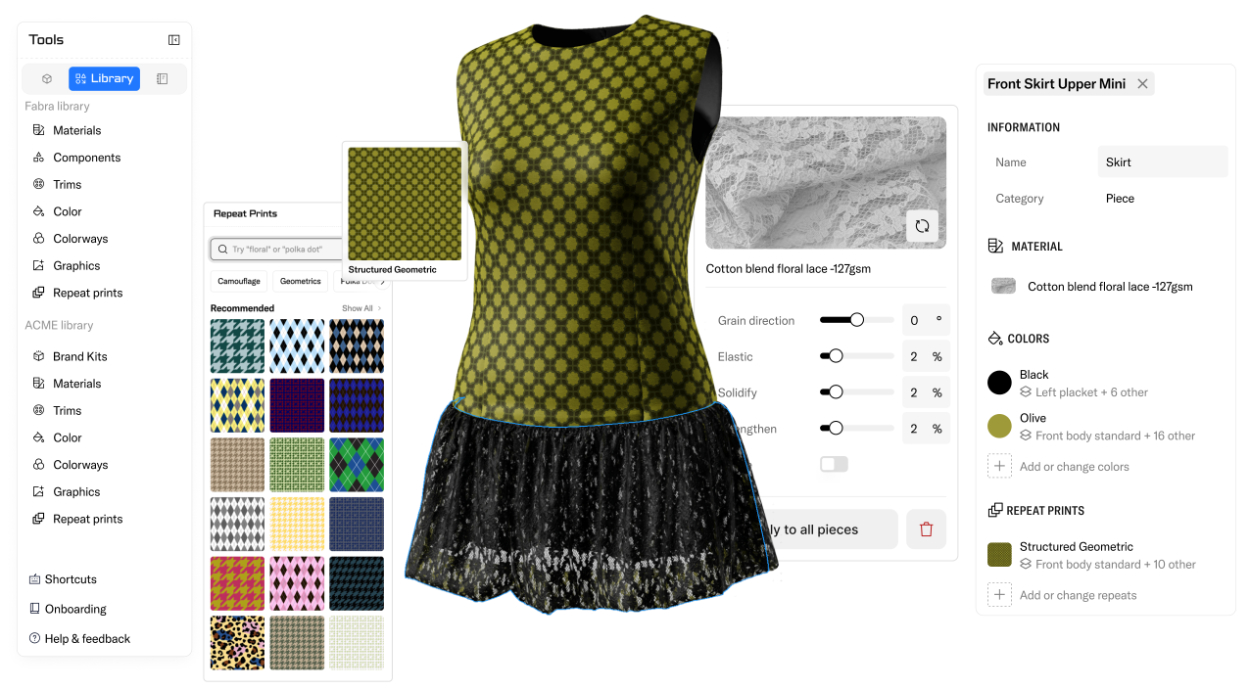
So you can do 2D pattern making in there. You can choose a base product and edit the pattern. You can do material simulation and soft-body physics, and it really moves Fabra from a modular design tool to a genuinely custom product design tool. And we have been building with WebGPU. So if your laptop, for example, has a WebGPU-capable card, then it will actually be able to use that. And the performance is night and day. It’s really amazing, the v2 browsers that have WebGPU enabled.
Good. So let’s talk about that distribution question, because this is the part I find most interesting. The browser is now the application environment for an enormous amount of the work that most people do. It’s a massively expanded market. Are you following the same playbook? Do you see Fabra as really expanding the audience for product design beyond that existing cohort of designers?
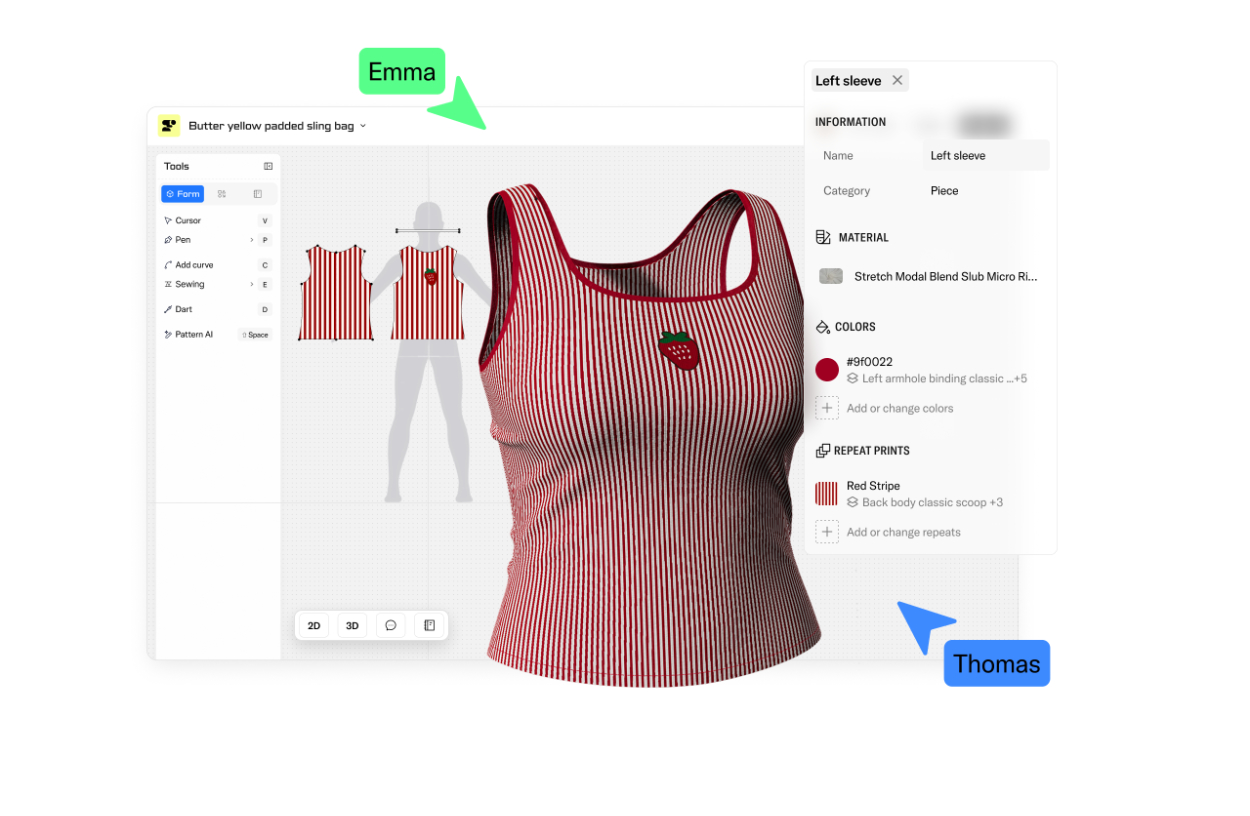
Gloria Yu: Absolutely. I think we get a lot of inspiration out of the software you mentioned, such as Figma, Miro or Canva. We really appreciate how they have expanded who gets access to the design process — not necessarily doing the actual design work, but at least collaborating, in the sense of commenting, giving feedback, and really keeping track of the changes without the designer having to export something and take it outside of the platform. So we really think what we’re doing is expanding who gets to access the design process.
Luke Grana: Yeah, just to add to that: if you look at Canva or Figma or Miro and you look at how they operate, there are similar elements. So they’re web based. There are templates, so there are easy jumping-off points. They’re very easy to use, so nobody needs training on how to use them, and they’re very collaborative.
So you can invite your whole team and collaborate together. We obviously take a lot of inspiration from that business model. However, the key thing to say is that designing a physical product with tech packs and grading rules and bills of materials and all the details that a manufacturer will need is a lot more complicated. But I think that still allows us to standardise a lot. We’re definitely taking the playbook, and our vision is really to always have a free version of Fabra available, so anyone can just come in there and design.
The goal has always been to make it as frictionless as possible, and that’s definitely learning from Canva a lot there.
Gloria Yu: I also think another thing we take from the playbook of the few references we mentioned — Figma, Miro, Canva — is their user experience and the intuitive nature of how they have designed their software. So, as Luke mentioned, creating products that are ripe for production is in some ways a much harder technical challenge, and you need complex tools to get to the fine-grained details of these designs and specs. But the challenge on our side is to still keep that experience intuitive and not intimidating to someone who is less technically trained.
Yeah, I think that’s right. So let’s be a little bit more specific and granular if we can. Which roles do you think have been locked out of the design and development process under the traditional single-player desktop application paradigm? And what do you think are the benefits of letting them in?
You talked about collaboration. Tell me what that collaboration actually delivers, what the net output of it is. Because the downside I would maybe point to with your Figma and your Canva and Miro is that a lot of companies will say, we’ve got hundreds of licences for this and I don’t know if we actually need 70 of them. I don’t know what the value of this person being in this space is. So tell me how you feel about that.
Luke Grana: Yeah. We definitely see unlocking users into DPC on the web in two different aspects. The first one is brands that are currently operating, that have teams of 10 to 200, and then as well as this new breed of brand, which we call a new modern brand or a new SME brand, that didn’t have access to product design before. So I’ll start with the bigger brands. Usually, what we’ve seen, especially in my experience, is that there’s a garment tech, there’s a pattern maker, and they have the ability to use these powerful tools and do the design.
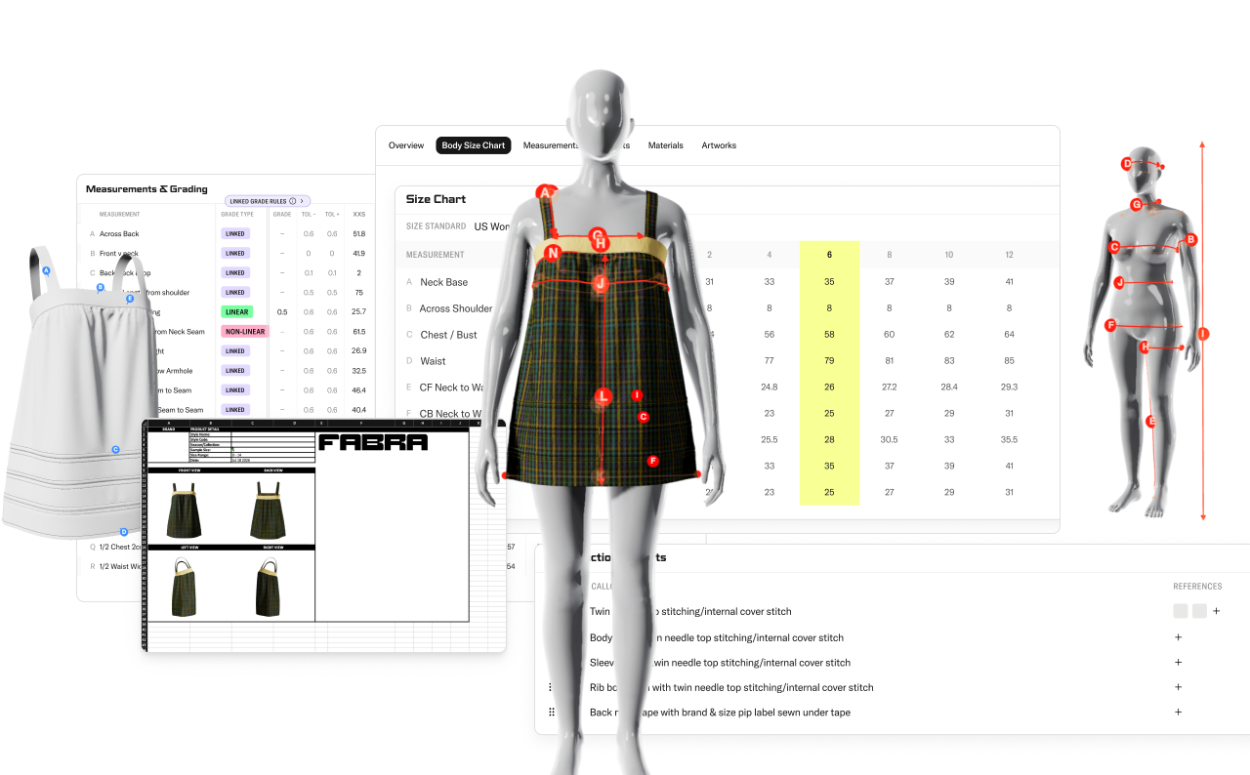
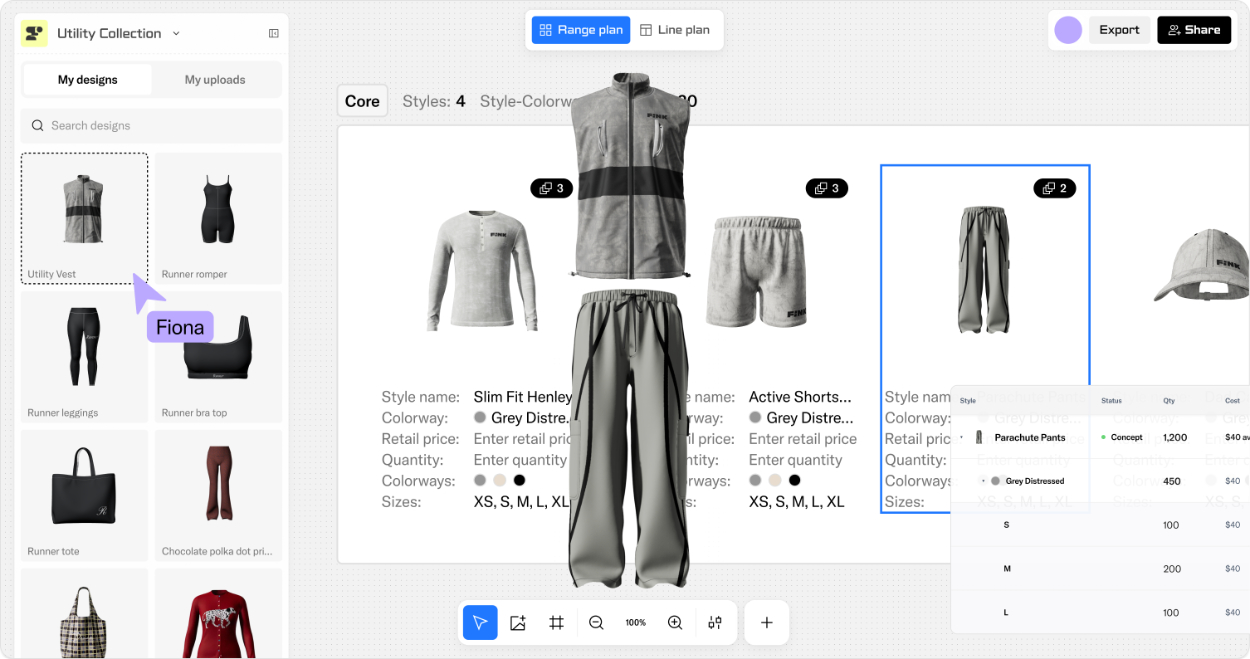
But when it comes to collaborating with your team, it’s hard to actually share that out and get comments and get alignment and get other team members excited. It also seemed like a very slow process: a lot of meetings needed to be set up, there were different tools, and people didn’t have access to the tools. What DPC on the web opens up is that, for these bigger brand teams, everyone can just come into the same workspace and work off the same workflow. So the planners, the buyers, the merchandisers, the creative directors, the marketing team members — even the whole company can really come in there and actually collaborate. And whether someone’s working on a 2D pattern or the 3D design or the tech pack, or building out a range plan and doing costing and pricing, doing quantity planning, developing the purchase order, that whole workflow can now be integrated and be very collaborative.
So that’s who we really think it’s opening it up for at bigger brands. But we’re also very excited about this market of small brands coming online. There’s a massive democratisation of commerce. It’s very easy now to build a community online, for example on Instagram. It’s easy to create a storefront on Shopify.
And we’ve seen this whole new breed of entrepreneur being started. If you look at their journey in the past, they would come up with designs, but they would always have to find a technical designer on Upwork, for example, or search on Google and pay $500, or up to $3,000 or $4,000, for a tech pack or for a range of tech packs. That was my journey building Grana, for example. And now, with this new design capability on the web and making it easy to use, they don’t have to.
Okay, let me play devil’s advocate for a second. Because democratising everything you just talked about, for smaller companies, for people with ideas who have been locked out of the tools to realise those ideas — I think that’s right. I think that’s something the market needs. I think fashion has closed a lot of doors that it shouldn’t have done.
But if we think about the big companies, if we think about the kinds of places where design and garment engineering and so on have been quite ring-fenced disciplines, done by a specific set of people — when you start to democratise that, and you get more people in there and more people collaborating and more feedback and so on, I wonder if there’s a cohort of designers listening to this who maybe don’t vocalise it, but who might think: God, I liked product design better, and we got better results, when not everybody in the company was throwing their two cents in. What do you think about that? Are there instances where maybe the gatekeepers had the keys for a reason?
Gloria Yu: I like that question, because I studied with probably some of these people that you mentioned. I do think that that is more of a governance problem, or a governance question, inside a company rather than a software problem. What I mean by that is that right now in our company, at Fabra, we’re building software. We use Figma a lot. For some files, we invite a lot of collaborators in for feedback, comments, different stakeholders throughout the company.
But for some files, we have a certain vision for a certain department and that is really contained within that department. So ultimately, we’re building a tool to allow that capability — to invite in collaborators if the user wants — but they could also keep it very close and just stick to their vision, and not invite collaborators or feedback in if they want.
Luke Grana: Yeah, I’ll just add to that briefly as well. I think we want to see more creativity in the world, and collaboration enables that, but it also enables more people to be creative and bring their ideas to market. I think that’s a really exciting proposition.
And I think there’ll always be big brands out there. No one’s saying that they’re ever going to go anywhere. But there’s going to be this new breed of brands that come in, and there’s going to be a lot more creativity and a lot more new types of products. I think that’s a really exciting thing, and we want to really empower and champion that.
Fine. That’s a good answer. I like the governance side of things there. I’m going to pull out the comparison to Canva and Figma for one more question, I think, and run something else by you. Like a lot of people in the design and tech space, I watched some of Figma Config, Figma’s conference, this year, and one of the big product shifts they brought about there was the introduction of what they refer to as code layers, which bring coding into the design space.
And that’s happening right about the same time that AI is giving anyone, designers included, the ability to generate code. There’s a whole different stream of democratisation going on here. Now for me, I think that only works because those two pieces go hand in hand, and they only go hand in hand if you scaffold them with some kind of structure and reusable components. So let me just quickly explain that. You can pair a design system with a code framework to iterate and execute faster by removing the gap between those things. But I don’t think it’s a good idea to give a designer an open-ended free-text box to create whatever code they feel like, any more than I think it’s a good idea to give anybody in a brand the ability to mess around with patterns and blocks and so on.
So, basically, I think that you need some kind of data standardisation to make this democratisation work. And I think I see that expressed already in Fabra, because you’re leaning into templates and base products and so on. Now, I know that’s a bigger fixture of your v1 than it is of your v2, but am I on the right track here? How do you think about this need to componentise pieces so that you can do democratisation the right way?
Gloria Yu: Yeah. I think products and templates are still going to be a huge part of v2, except that we did restructure a lot. But we still see a lot of people starting from products and templates and adjusting from there — like how a lot of brands have a library of silhouettes within their library blocks, you could say, that they start from and then adjust seasonal designs from. In terms of the data structure side, that’s something we think about a lot. So each design file, you can see it in a few ways, from the 2D side to the 3D side to the tech pack specs, and all of them are synced to the same data.
So we have thought about that structurally a lot, technically, to make sure that whatever someone has designed will be producible and that the specs would be correct.
Luke Grana: Yeah, just to add to that: in my experience building a fashion brand, I was quite annoyed with the process. Every time we would create a new product, it would just be from scratch. We’d build a new pattern, we’d build a new block, and then there’d be a whole new sizing chart that we’d need to develop. And there was a lot of inconsistency between products.
And then, as a company, we created all the blocks and the libraries, and componentised the trims, the designs, and the sizing as well, with Alvanon. They obviously set sizing standards. I think for someone creating a new brand, or even brands now, they don’t have a lot of that standardisation. So that’s been something that we’ve really put a lot of emphasis on in the last year. We’ve got a team of garment techs and pattern makers trying to standardise a lot, to really make it easy and take out the technical side as much as possible, and give users the ability to design but within guardrails — to make sure it is production ready.
Yeah, I think that’s the right way to express it, those guardrails. Every brand listening to this will be familiar with the idea that there are only so many blocks for a T-shirt, only so many patterns for a T-shirt. Realistically, having to redo that every time is quite often redundant work, unless you’re really experimenting with silhouette and pushing it in a really interesting direction.
Now, to be clear, and I think you mentioned this as part of your v2, which should be out by the time people are listening to this: that v2 does allow you to create new patterns from scratch if you want to, because the website at the minute kind of says you can go with the base product or you can do your own thing. What we’ve talked about there is what I would describe as the skill floor. What’s the skill ceiling?
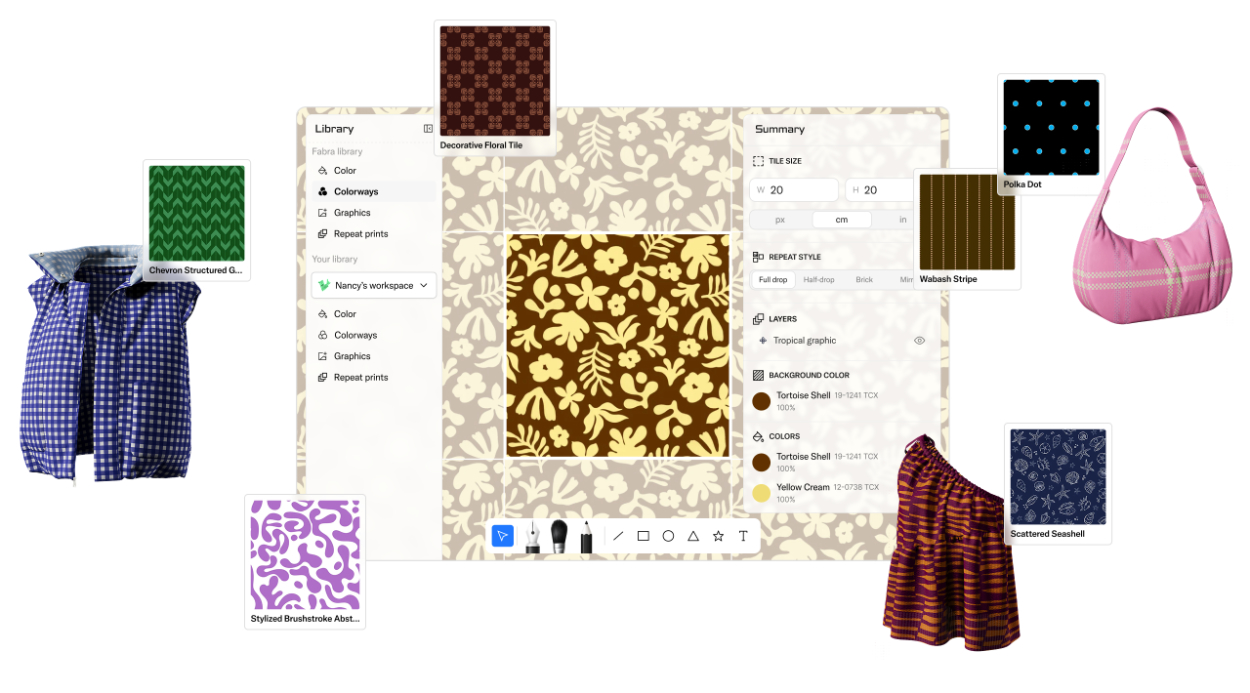
Gloria Yu: That’s a great question. So by a base product, we mean someone could select a template that is created by our professional team of designers as a starting point for design. But from there on, they can adjust the pattern as they like and, obviously, adjust the surface side of design — colours, materials, trims, prints, all of that. In terms of starting from scratch, in Fabra v2 we do have pattern-making tools, so that someone could draft a pattern from scratch or even import a DXF pattern. We are looking at some AI capability to prompt a pattern from scratch, and that’s something that will be launched in due time.
Luke Grana: Yeah, just to add there: we’ve been live in our public beta for six months, and it’s a great initial product because users can choose a base product. It’s a jumping-off point. They can’t really damage it in any way in a production sense — it’s all there.
But a lot of users have been asking for more customisability. They want to change the pattern. They want to see the product material drape as it would. And so we’ve spent six months now really building into v2, like Gloria said, so that you can build a pattern from scratch.
You can simulate it. And it really takes us from just a modular design tool to a genuinely custom design tool. You can really do anything you want in it. You can really expand your skills. And someone who’s a trained pattern maker could really get a lot out of Fabra now, with our v2 launch.
Okay, excellent. I like “launched in due time”. I’m going to start using that one myself when somebody asks me when something’s coming. Beyond design development — so we’ve talked a bunch about creative design here, and technical design — one of the biggest use cases for 3D has also been high-fidelity visualisation.
So the promise of what people refer to as scaling DPC quite often means taking assets that were intended, in their first instantiation, for in-house use, and pressing them into service in marketing and e-commerce, in image or 3D viewer creation and so on. Companies build garments in 3D for internal audiences, but then they still end up rendering them out as the way of telling the product’s visual story out of house to partners and downstream to end consumers. How far do you see Fabra going in that direction? Because there’s a difference between what internal colleagues and collaborators would be willing to look at and go, okay, I can make a choice based on that and what is suitable and ready for e-commerce, for marketing, and so on.
Gloria Yu: I think Luke and I both still really enjoy real products being filmed and photographed on real humans for final marketing purposes. But what Fabra enables is really realistic rendering for, as you mentioned, internal stakeholder communication. We will also have generation tools to allow you, as a designer, to quickly prompt an image so that you can communicate your vision of how an outfit would look. We don’t think that would be used in the final campaign, but it just helps to communicate to different stakeholders what the final vision is. We also see the use case of some solo entrepreneurs and brand owners using marketing images generated from their accurate 3D designs to maybe test with their audience — to communicate a final vision and say, do you prefer this or that?
And teasing what’s coming. But we still think there’s a huge place for taking photos and videos of products on real people.
Good. I think you would maybe be surprised at how far a lot of brands are willing to take generative AI outputs towards the final consumer.
Okay. So from a visual presentation point of view, that’s the AI question answered, I think. How about from a design and pattern-making perspective? I think you hinted before, Gloria, at the idea of allowing generative tools into some of the earlier stages of the product life cycle. What’s your perspective on how far you want to bring AI as an interface element, as a design collaborator, rather than just creating finished images?
Gloria Yu: Yeah. We think the most powerful potential of AI in Fabra is simplifying the technical process that is involved between intention and final output. So, as you probably know, right now, if you have an idea in mind of what you want to design, technically getting there in 3D and pattern making could be incredibly complicated, depending on what product you want to make. So we think if we could simplify that using AI and technology, that would open up a large market of people who could make products, but also just make the process of designing more efficient for existing designers. Ultimately our tool, unlike some of the existing AI design solutions out there, enables fine-grained control.
So, like how I’m sure we’re all using AI tools, we use AI to get us to a certain stage, and then we manually edit and refine until we’re happy with the final output. So we see that as a very powerful use of AI in our case.
Okay, perfect. Now I want to ask two commercial questions, business plan questions, to bring us to a close. And the biggest one, I guess, is this. Do you see your proposition surviving if one of the big desktop 3D companies launches a browser-native, WebGPU version of what they have?
Now, Luke, you mentioned before that you think this is where 3D in general is going, so I guess I’m asking what the differentiation is, what the moat is for Fabra in this space. And there’s a reference frame from way outside our industry that I like in this, which is FL Studio, one of the foremost digital audio workstations used by producers, which you as younger people than me probably know. The company behind that said for years that they would only make desktop applications, and that the web was a dead-end layer for the kind of serious work that people do in a digital audio workstation. But then they saw the wind changing. They launched a web-native version that has full compatibility with desktop projects, a free version, and basically drastically expanded their user base, and they were able to replicate all the necessary functionality in a browser. So that path exists, and we’ve seen a lot of companies in different spaces follow it. I wonder, if Browzwear or CLO follow that trajectory, what do you think happens to Fabra?
Luke Grana: Yeah. I think it’s a good question as well. And I think that there’s the potential to have both the desktop and web-based version for players in the space. I think it makes a lot of sense. But my thoughts there are that the fashion market is already massive. It’s $1.8 trillion. It’s a really big market. It’s growing. And I think DPC on the web opens up the market in a bigger way for more players to grow and have different niches. And I think our current focus is more on the solo entrepreneur, the small brand, the community creating products, and that’s definitely our lane.
And that’s where we’re doubling down and focusing, and building the best tool that we can. And I’m sure that other tools will move into the web, and they’ll have their lanes as well. And I think there could be a lot of players, actually, because the market is bigger and it’s growing. But, just to answer your question, we very much build with our users. And what our users are saying is that they want more flexibility. They want more design. They want help planning out a range. So our v2 launch now includes range planning, costing, pricing, quantity planning and purchase orders. And that’s all moving towards production, which is our big goal: getting that design directly into the right producer anywhere in the world.
And that’s definitely how we’re thinking about things — to try and standardise production outputs and product specs, integrating that into production. And I think that’s definitely the vision and the pathway that we believe in.
Fine. And that does bring me to my last question. So when I look at the fundraising that you’ve done so far, you have, amongst others, LFX on your cap table. For listeners, LFX originated from the Li & Fung ecosystem — the big manufacturing coordinator — but it is a separate investment entity. Now, despite that little footnote, this still suggests to me that there is some confidence in the manufacturing space in the idea that you just expressed: that across a vast network of manufacturers and suppliers, and that whole design-to-production connection, there’s a role for web-native 3D in there that can directly feed into it. So tell me, what happens right now when a factory receives a package from Fabra today, under v1?
And Luke, I think this is probably a question for you, because you spent, as you said, a long time in Hong Kong brand building and working with manufacturers. What do you think needs to happen to make what you’ve just described reality — to get to where there is this proper integration layer between web-native design and production?
Luke Grana: Yeah. It’s a great question. We work very closely with producers. We have producers on the cap table, like you mentioned with LFX. And since the beginning of Fabra, we’ve worked closely with them to make sure that the tech packs that are generated in Fabra are production ready.
They have all the information to go straight into production. And, obviously, we look at satisfaction and product-market fit with tech pack downloads, and how production ready the tech packs are. So that’s currently with version one of Fabra. And version two is just making that more collaborative, making producers have the ability to collaborate and have different version control of that tech pack. And that’s obviously live now with version two.
But where we see the future is that, as you know, there’s a lot happening in the DPC space, and we think that even more will happen when it opens up on the web with accessibility. But there’s also a lot happening in the supply chain space. I think bigger, major producers are moving from huge MOQs to retooling their factories, and a lot of them now are doing small-batch productions and testing quantities and fast replenishment. And then, obviously, everyone’s talking about on-demand production, and that’s something that we believe is coming. And that really gels very well with 3D product design.
Because if you have a user creating a design on Fabra, or on any 3D design tool, then that becomes machine-readable product specs that could be implemented directly into a producer that can very quickly determine whether they’re the right producer, whether they’ve got the right stock fabric, the right pricing, the right capacity. And it could really fast-track design to production in a really big way. I think that’s a very exciting future. And that also opens up 3D design tools to a bigger, broader market. So we’re working closely with a number of producers, especially bigger ones in Hong Kong, but also all around the world. And I think they are getting very excited by integrating with 3D design, and they’re also realising that they need to set up their production processes in a new way, to adapt to this faster-moving world.
So it’s a really exciting time.
Yeah. And I think you hinted at something there which I don’t think I properly got into earlier. The democratisation, the expansion of the user base and so on — we talked about it from the brand level, or from the entrepreneur, the small business owner launching a brand. Getting into 3D for manufacturers and suppliers has always been more threatening, in a way, because that overhead is bigger for them: they have to have specialist skills, they have to have specialist software. Building up those DPC capabilities in the supply chain is quite a big ask. And there are companies that have come a long way there — massive manufacturers like MAS Holdings and so on. But for your smaller ones, the more agile ones, the ones that are retooling their production in that way, there’s a difference between saying hire one or two or five or ten people to go and learn CLO or Browzwear, and get us to where we can communicate with companies that are doing the same, and the slightly, or potentially significantly, easier on-ramp that they would have with something like Fabra.
Luke Grana: Yep, absolutely. And I think the big challenge that we see with producers that are now moving towards small-batch production is the human interaction, and how slow it is to negotiate and to discuss with potential brands. So if that can be automated, if that can move quicker, that would help them a lot as well. And if it is a web-based tool, it just makes it easy for anyone to log in, including the manufacturers.
So the whole industry, we think, is going to benefit from DPC on the web.
Yep. I think that’s a good reminder that DPC in general is not just for 3D design and simulation. It is that whole ecosystem that we talked about at the top.
Gloria, Luke, I’m keen to see how all this turns out. I’ll be watching what you launch with v2. I’ll be keeping tabs on Fabra as this all grows. Maybe we’ll have you back on the show at some point to talk about how things develop over the next couple of years.
For now, thanks for your time. I appreciate it.
Luke Grana: Thanks so much, Ben.
Gloria Yu: Thanks, Ben.
And that’s the end of my chat with Gloria and Luke. There’s a fair bit to go away and think about, and I think there’s also a very big remit that they’ve carved out for themselves here. I’m going to be keen to see how realistic that ends up being. Whatever happens, though, I do think we’re entering a new turn for 3D and digital product creation.
Whether Fabra itself takes off or not, I don’t think we’re going to end up stuck with this idea that AI is easy to use, AI is everywhere and anyone can use AI, whereas 3D is stuck on the desktop, has a high skill floor and is for a niche audience. I think those two things are going to move much closer to one another over the next couple of years, and I’ve obviously got a vested interest in watching that happen very closely, so you’ll probably hear me talk about this again in the near future.
For now, though, thanks for listening, and I’ll talk to you again really soon.