What will it take for fashion to make the leap from adopting 3D and AI as isolated disciplines, to making them part of a connected ecosystem that bridges digital and physical in a tangible way, supported by the latest academic research and ongoing technology development?
Together, The Interline and Style3D evaluate whether that near-future ecosystem, properly grounded in industry knowledge and expertise, could then be able to deliver on the original promise of digital product creation by meaningfully shortening time to market – and might even begin to approach an entirely new, end-to-end promise under the umbrella of ‘physical AI’.
In spite of a gloomy economic outlook, fashion hasn’t stopped scaling its investments in frontier technology. According to the industry-specific data we captured through The Interline’s 2026 survey, more than 80% of AI initiatives have accelerated in the last twelve months, and close to 70% of industry professionals expect to spend even more on AI in the coming year, across new projects and continued license and token provisions for existing ones.
And AI might be the most visible category, but it’s by no means the only technology area where fashion brands are continuing to invest in the promise of digital transformation. Many of the same leading companies have also made large-scale, multi-year bets on the extended ecosystem of digital product creation.
That spend has, in many cases, delivered value in a series of standalone disciplines. Thanks to 3D, designers and developers can visualise and simulate products, and extend the utility of the digital assets that represent them, to a range of other use cases downstream. And while three quarters of companies are broadly struggling to establish a rubric for judging the return on their investments in AI overall, the returns at the beginning and end of the product journey (in analytical use cases and in downstream visualisation) are widely expected to be significant, which is why some of the biggest retailers on the planet are already planning for AI exerting a much greater influence over the future of both forecasting and visual content creation.
But beyond the scope of those early and late-stage activities, investing in 3D and AI separately has not made the existing fashion business model appreciably faster on aggregate, because those investment have left the heart of the product journey (where 3D and AI would connect with the real mechanics of technical design, sourcing, and production) relatively untouched. Despite having the ability to generate concepts in minutes, and to build extremely accurate digital representations of products for a range of different in-house and partner use cases, the industry’s aggregate calendar has stayed stubbornly fixed. It takes just as long today to bring a new product to market as it did pre-DPC.
And although retailers can generate visual content for product pages and campaigns more quickly and effectively than ever, buying lateral coverage and unique campaigns at a fraction of the cost of traditional photography, the speed with which the products featured in those images transition from design to the point transaction hasn’t meaningfully shrunk. They may be more AI-generated than ever, but those campaigns are still built at the extreme end of a product journey that’s as long after deep commitments to generative imaging as it was before those commitments were made.
For all the expenditure, time, and effort fashion has applied to technology under the umbrella of digital product creation, the overall trajectory of a given garment hasn’t become any faster. Or, in other words, digital transformation has not transformed the product calendar.
This is, at least in part, because the value of 3D and AI as standalone initiatives can be quickly and easily eroded away by the sequential processes that make up the more complex middle of the product journey. Each of those processes can have a cost that can be measured in terms of time, and each potentially represents a step that on one side or another of innovation that serves to slow the complete cycle down.
The original promise of digital product creation was, as we’ve documented many times here on The Interline, to create a single, comprehensive, digital representation of a physical garment that can serve any and every purpose – including, and especially, the ones in the centre of the product lifecycle. If that promise had been fully realised today, brands would be able to make style and material commitments earlier, to eliminate samples and reach approvals faster, and to anchor the processes of design, development and commercialisation to a single source of truth that allowed all of those processes to be accelerated.
This promise has largely not been realised. As it stands today, a product conceived and developed faster in 3D can still then spend weeks waiting for approval, or can wind up stalled behind material, colour, or fit approvals that need to be conducted physically. Similarly, an AI-generated product concept can get tacit approval in a fraction of the time it would have traditionally taken to put together moodboards, sketches, and early-stage visualisations, but will then still require one or more specialist garment engineers, patternmakers, or material developers (people whose time and skills are already in short supply) to reverse engineer the idea and determine how it can be made to meet a price point, a sustainability target, a margin target, or one of many other important product metrics.
This gap between the potential of creating, developing, and marketing digitally and the reality of calendars dragged down by process inertia has been a problem for a long time. But in the final third of 2026, when market conditions, economic factors, and consumer expectations can change so rapidly, these gaps, practically speaking, mean decreasing the chance that the product that makes it to market will meet its original targets, however they are measured.
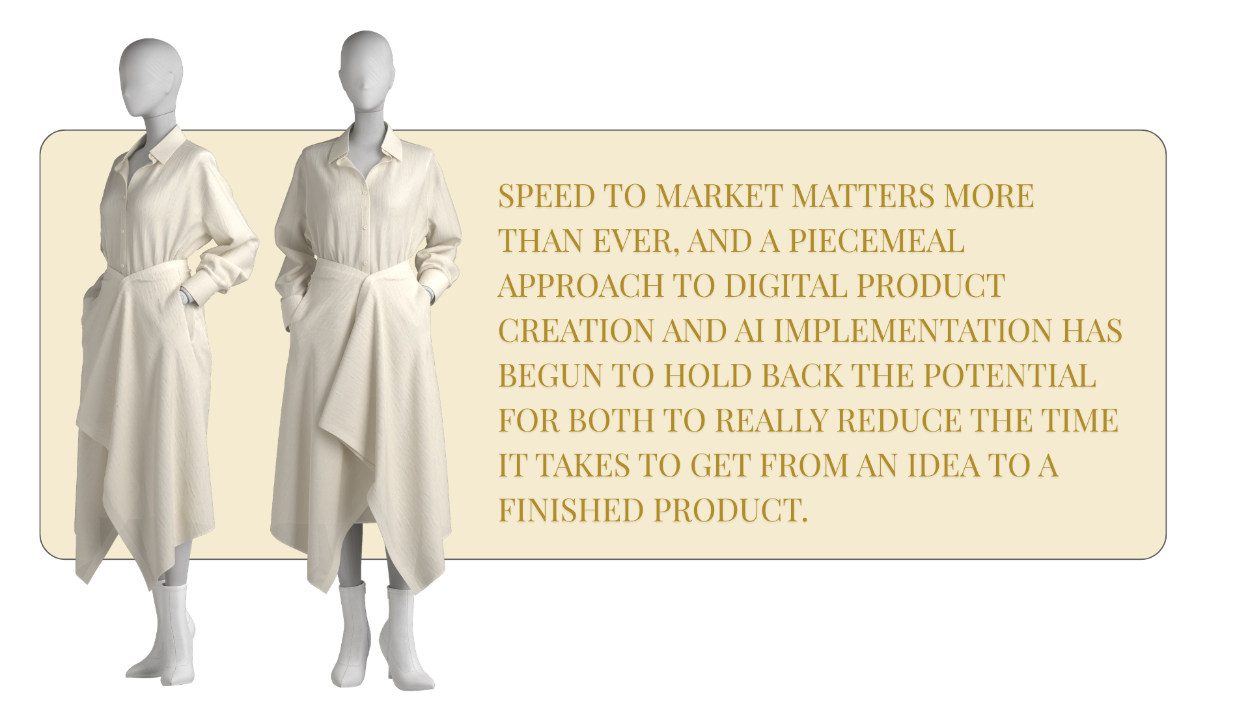
Or, to put it another way, speed to market matters more than ever, and a piecemeal approach to digital product creation and AI implementation has begun to hold back the potential for both to really reduce the time it takes to get from an idea to a finished product, on a shelf or featured in an eCommerce storefront.
But this doesn’t mean that digital product creation strategies themselves have reached a dead end – far from it. And neither does it mean that the value of AI will forever be ‘just around the corner,’ given that the returns being measured in specific areas are already indicative of a serious trend. These are both technologies with considerable runway left, even if that runway is relatively unexplored.
Rather than being anything directly to do with the technologies themselves, the persistent gap between investing in 3D and AI, and the practical reality of moving up milestones and delivery dates comes, at an industry-aggregate level, from the way those tools and process have been implemented: as largely standalone projects with narrow, ringfenced objectives, whose benefits do not cross over with one another.
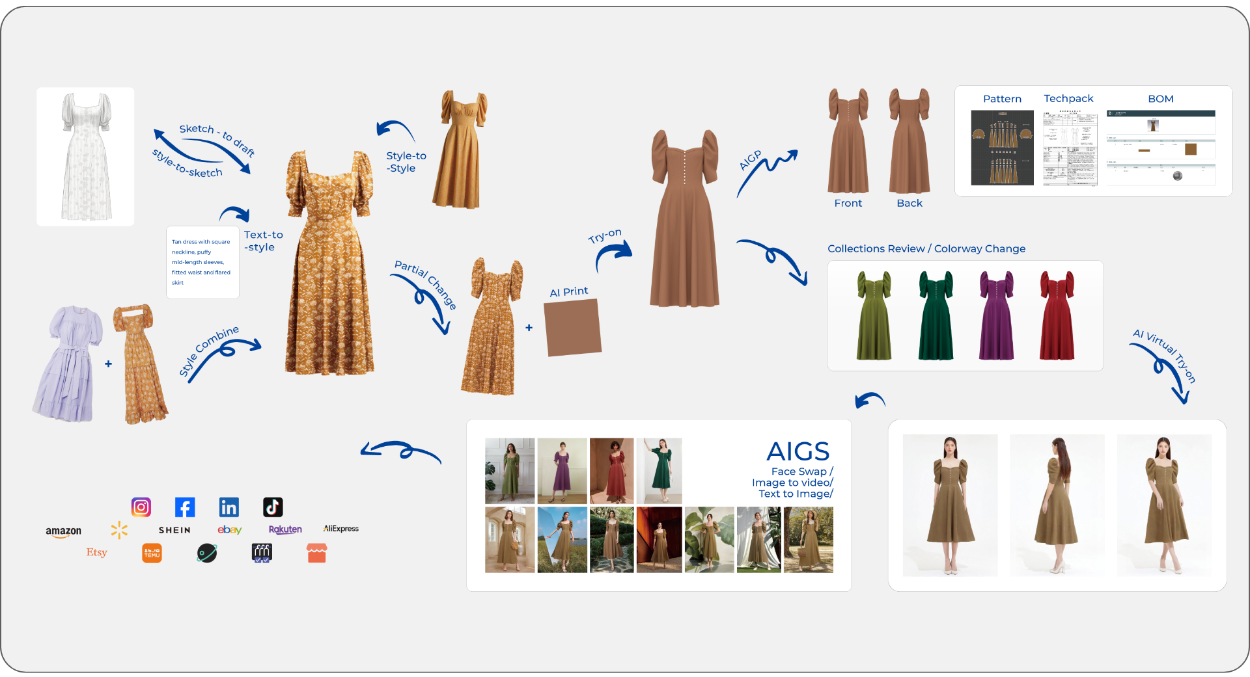
As a case in point: our readers will already be very familiar with the idea that a generated image is not functionally equivalent to a simulation, and that a simulated garment is a more complex object to build. But those two elements can also directly support and enhance one another if the teams creating and deploying them take the opportunity to transcend the way they’ve historically been implemented, and instead prioritise opportunities to combine the two.
Rather than existing in two separate lanes, patterns, material properties, measurements, construction details, artwork, and more – all originally defined in 3D but available to reference across the extended lifecycle – can become the essential foundations for AI that’s grounded in real physics and measurable proportions, connecting otherwise purely aesthetic output to the science of materials and fit simulation, and bridging visualisation the demands of real production workflows.
That connectivity can also work in both directions. As well as serving as a way to explode creativity in the early stages of the product journey, by either creating fresh ideas or remixing and combining existing material inventory and prior season concepts, AI can also take on final presentation work once a garment has been simulated and rendered, replacing the need for extensive, manual, staging and CG workflows.
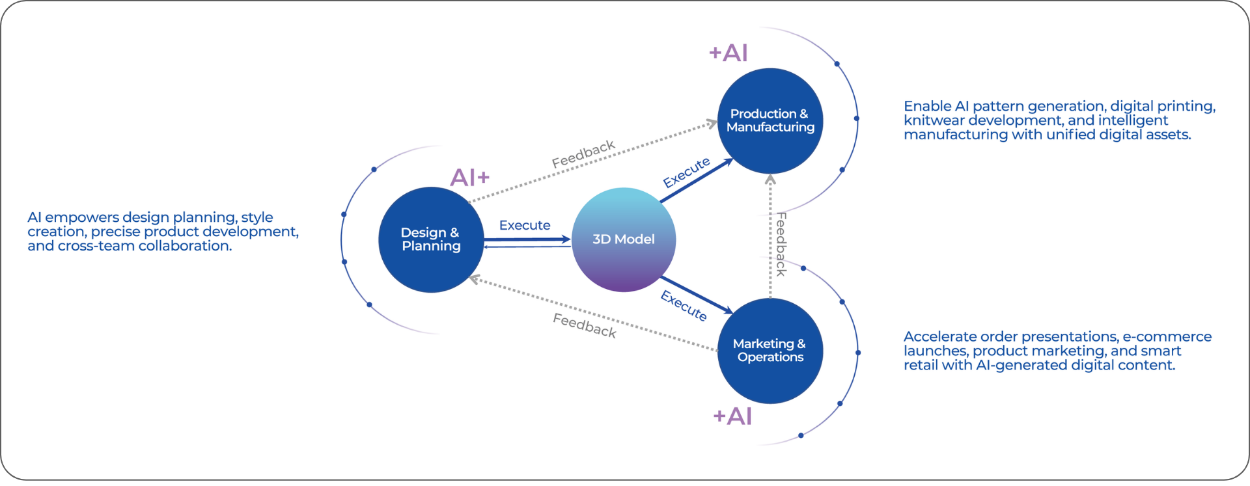
This connectivity flywheel between 3D and AI is something that the team at Style3D (who have been working on the problems of digitally transforming textile and apparel creation since 2015) are acutely aware of, and have made the foundation of their approach. As an early mover to the idea of combining AI, 3D, and then additional AI to create a connected workflow that can operate at speed without compromising on quality, the company has now spent more than a decade undertaking extensive, dedicated research and development to build an architecture where generative tools, 3D simulation, product data, patterns, and other essential attributes all operate on a unified data model, and are all pointed at the same challenge of turning ideas into reality more rapidly than ever.
That challenge can be seen addressed in public case studies like the one provided by Wolf Lingerie, who reported being able to generate 10-15 new colourway variations immediately, as well as creating product visuals with the combination of 3D and AI – a combination that it says has “improved communication between design, marketing, and sales teams.”
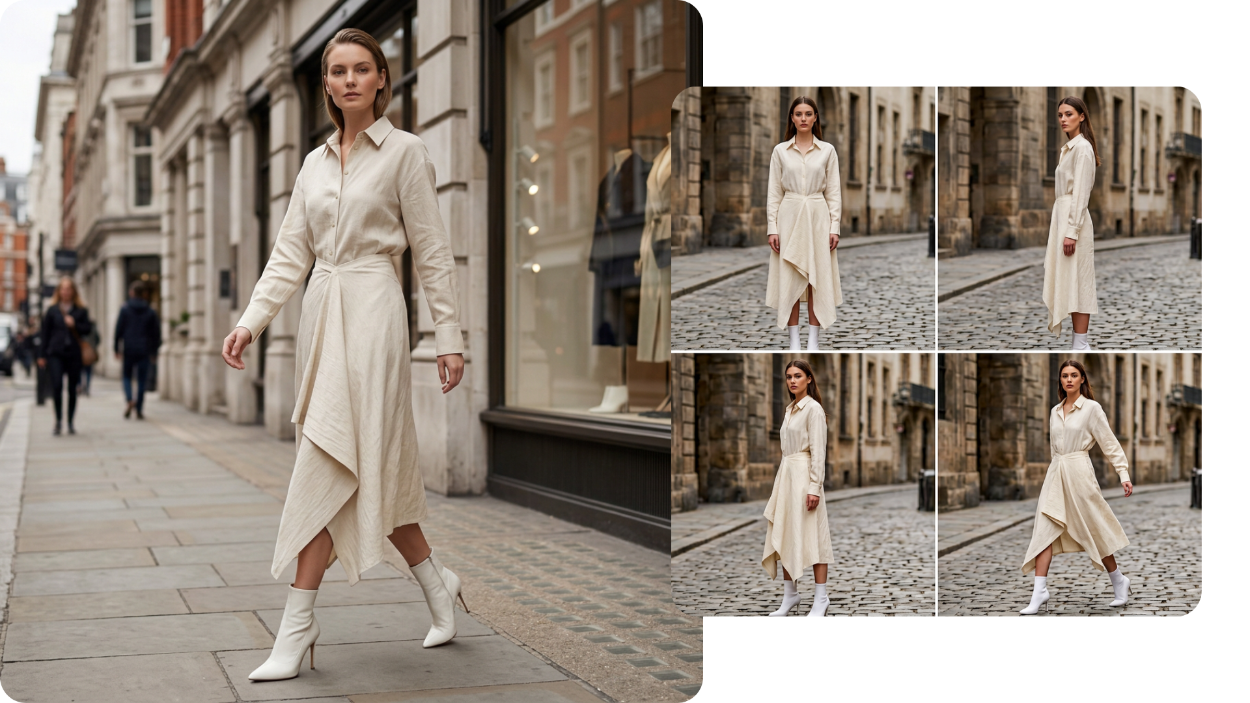
It’s important to note, though, that the AI tools that form one half of that duopoly are not the off-the-shelf, commercially available commodity models you may be thinking of. Instead, the team at Style3D believe (and it’s a belief that The Interline’s market data suggests brands and retailers share) that AI can only enhance 3D (and vice versa) if that AI has been properly trained on garment construction, grounded in product data, material physics, best practices, and much more from the physical realm of real product creation.
Put into practice, this contextual grounding is how generated images can be linked to generated technical specifications, since the two share a common grounding in standardised production processes, costing methods, and specialist skills like patternmaking and marker-making. When they’re linked in this way, the benefits of 3D and AI can combine to improve the efficiency of product development and production (as well as pre-existing benefits to visualisation) which, as a direct consequence, also improves speed.
And that speed difference can be substantial, with a public case study from menswear brand OLYMP including a testament that the company had, by using that combination of grounded AI and technical 3D, “digitally develop new styles in just days,” as opposed to weeks.
Our readers have recently heard the team at The Interline refer to this as vertical AI, and the conclusion from our analysis was that the process of allowing AI to learn from, and adapt to, specialist disciplines within fashion (across design, development, manufacture, marketing and more) will be what distinguishes industry-focused platforms and solutions from the general-purpose AI tools that have started to dominate the discourse. Put as bluntly as possible: industry-agnostic AI is able to generate believable-looking pictures of garments, footwear, and accessories, but verticalised AI (especially where it’s paired with similarly verticalised 3D, and where it benefits from specialised algorithms and simulation engines tailored to fabrics, for example) can create actual products.
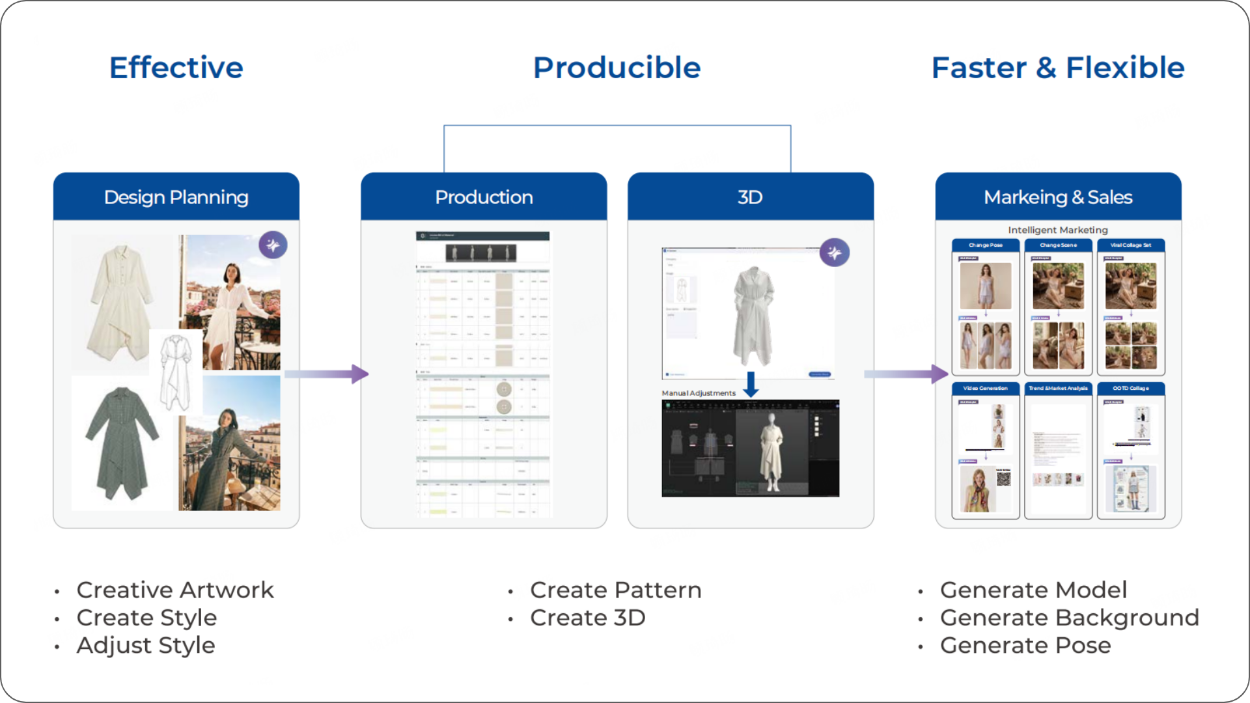
That verticalisation process, by definition, is not something that any company can just approach. It requires extensive knowledge of skills, techniques, machinery, materials, and more – as well as robust research and development that’s been specifically pointed at solving the challenges that are unique to soft material and soft body simulation. This, too, has been a focus area for Style3D; founder Eric Liu’s background is in textiles and garment manufacturing, and, as of 28 July 2026, the company reported having applied for 162 patents, as well as having already been granted 106, all based on the fruits of in-house research and investment in the ongoing development of digital tools dedicated to the needs of fashion.
This R&D frontier is also at the root of the kind of emerging ideas and pilots that are likely to distinguish verticalised 3D, AI, and DPC strategies from more general applications of those technologies. For example: Style3D’s Design2GarmentCode paper, published at CVPR 2025, explores generating sewing patterns from design inputs through program synthesis.
Translating proposed advances like these into solutions that fashion professionals can implement, adopt, and use to deliver quantifiable returns in speed, quality, fit, and other product outcomes requires industry-specific expertise and extensive experience on the part of the technology vendor. But it will also, by necessity, be a multi-party project to realise – especially if fashion is aiming to turn its investments in AI and 3D into tangible improvements in the efficiency and velocity of its routes to market. Technology developers can advance the underlying capabilities of their tools, and pursue industry and academic research, but brands and manufacturers will then play an essential role in determining how those innovations are put into practice.
A connected workflow that maximises the benefits of 3D and AI, in other words, must account for the inputs of not just the creators of AI and 3D tools, but the subject matter experts who deal in fit, materials, sourcing, garment construction and more, day in and day out. For companies like Style3D, this means making sure that its tools meet the needs of existing professionals, but it also requires continuous engagement with the next generation of fashion talent, who will be the ones defining the AI-native, end-to-end digital workflows of the future.
Through partnerships with educational institutions like MODART International, Style3D has pursued a strategy of making sure these benefits are available to anyone in education, and that opportunities for skills development also extend to the skilled professionals who already work for major brands. Rather than proposing a future where AI replaces human capabilities, technology vendors like Style3D are instead working to ensure that everyone involved in the typical product journey understands the technical foundations of pattern simulation, as well as where the frontier will sit between automated output and expert human judgment.
Whether these professionals are already in-role, or they’re working their way through education, their ability to change the pace of product design, development, and production will, to a large extent, hinge on how well-connected the tools available to them are, rather than just how attractive they seem as standalone disciplines to learn. For companies like Style3D, the future is going to be shaped by research, development, education, and effective commercialisation of tools, but the real measure of progress will be how much closer those tools can bring design to production, without compromising the product along the way.
And while the definition of further-off ideas like ‘physical AI’ is still being written, it does seem as though the new combination of 3D and AI (properly grounded, backed by research, and deployed by people with the right industry expertise) could, finally, dramatically change the time it takes to make something physical by advancing the use of digital tools.
Learn more about Style3D’s AI and 3D product development workflows at Style3D.com.