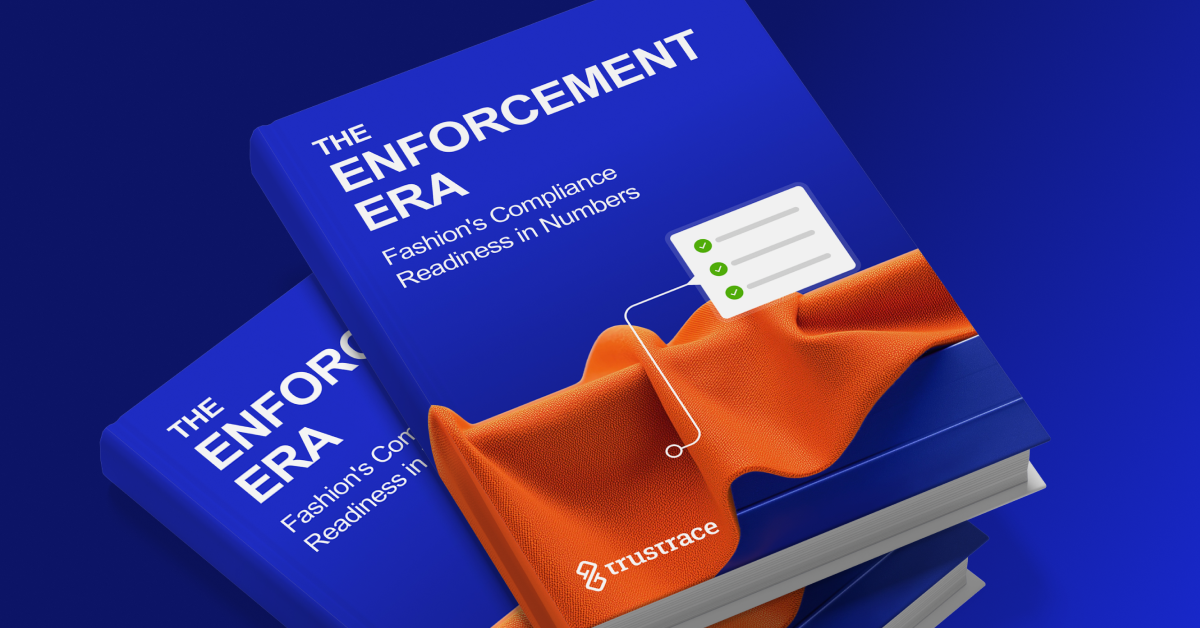
STOCKHOLM, Sweden, October 13, 2026 — TrusTrace, a global leader in supply chain traceability and compliance, today released The Enforcement Era: Fashion’s Compliance Readiness in Numbers, the latest in its annual industry research series. The report finds that 21% of surveyed brands selling into the U/S/ have experienced shipment detention, while 75% are not fully ready to prove material origin on demand.
Launching at the Textile Exchange Conference in Vancouver, where this year’s theme, The Implementation Era, puts the focus on turning commitments into action, the report draws on primary data from 57 sustainability, compliance and supply chain leaders across 24 countries to examine brands’ current compliance practices and preparedness.
Supply chain traceability used to be a sustainability initiative. In 2026, it is a trading condition. With the EUDR and PPWR coming into effect this year, the EU Forced Labor Regulation following in 2027, and Digital Product Passport (DPP) requirements on the way, the report finds that the gap between regulatory awareness and operational readiness is already having commercial consequences.
KEY FINDINGS
- Enforcement is already here: 21% of brands selling into the U.S. have had a shipment detained by U.S. Customs and Border Protection (CBP). Of those that have not, more than half (58%) consider it a realistic near-term risk.
- Visibility drops sharply below Tier 1: 75% of brands hold trusted data on their Tier 1 factories, falling to 33% at Tier 3 (yarn and fiber) and just 20% at Tier 4 (raw material and farm level); the layer enforcement agencies look for proof of origin.
- DPP is a high priority with low data confidence: 69% of brands are actively preparing for the DPP, yet the same group rates its supply chain data accuracy at a median of 3 out of 5.
- Basic due diligence is lagging: only 21% run continuous, automated compliance across their suppliers, 17% still rely on spreadsheets and email, and nearly half (48%) of U.S.- selling respondents have not yet screened suppliers against U.S. government forced labor entity lists.
- Coordination is the biggest accelerator: supplier resistance or limited capability is the top barrier (60%), and 63% named industry-wide supplier data standards as an accelerator, the most-cited option.

The report is authored by sustainable fashion journalist Megan Doyle and edited by Pauline God, Industry and Policy Expert at TrusTrace. It features in-depth interviews with TrusTrace customer Brooks Running and U.S. apparel group Komar, alongside perspectives from Christian Hudson of the UN Centre for Trade Facilitation (UNECE) and Julie Robertson of PIP Global Safety.
“Enforcement is no longer on the horizon. It is here. Border officials look at evidence to decide which goods move and which goods they hold. The industry has made real progress at Tier 1. But regulators ask for evidence that sits much deeper in the supply chain. The brands pulling ahead built compliance into how they operate. They did not treat it as a single project. Brands that start now can still meet every deadline,” said Shameek Ghosh, CEO and Co-Founder of TrusTrace.
“The hardest part is that there is no single right answer for what a complete document set looks like at each level of the supply chain, which makes it genuinely difficult for suppliers to know how much is enough. Our guidance to them is simple: provide as much as you can to show how the raw material was produced, processed, transported, and paid for to make the final product,” said Tahagod Mohamed, Senior Traceability Analyst at Brooks Running.
A PATH FORWARD
The report closes with a five-stage readiness framework drawn from the brands furthest ahead: know your supply chain, extend visibility to raw material, connect data across functions, automate compliance monitoring, and build documentation readiness.
It also sets out a 90-day compliance agenda, including an honest baseline of tier visibility, entity list screening, and a documentation stress test modelled on a CBP inquiry.
Download the full report at: https://trustrace.com/downloads/the-enforcement-era-trustrace
For more information, visit www.trustrace.com.

ABOUT THE RESEARCH
The survey was distributed to fashion, apparel, and footwear brands globally in the first half of 2026, receiving 57 responses across 24 countries, of which 40 were fully completed. Percentages are calculated on respondents who answered each question, so base sizes vary (n=24 to 55). Respondents include sustainability directors, compliance leads, supply chain heads and C-suite executives. The sample also includes a small number of manufacturers, mills and industry bodies.
ABOUT TRUSTRACE
TrusTrace is a global leader in supply chain traceability and compliance, helping brands turn supply chain data into decisions at scale. Its AI-powered platform goes beyond collecting and managing data: it tells brands what’s required, where they stand, and what to do next, then runs the programs needed to close the gaps, from assessment through to action, so brands can focus on decisions rather than manual execution.
TrusTrace is trusted by many of the world’s largest and most ambitious brands and has been recognized by the World Economic Forum as a Top Innovator supporting the UN Sustainable Development Goals. The company is headquartered in Stockholm, Sweden, with offices in India and the US. Learn more at www.trustrace.com.