

Hey, welcome back to The Interline Podcast. We started a couple of shows this season already with a bit of a thought exercise, but hopefully you’ll humour me if we do it again. I want you to think about the last thing you bought online that wasn’t quite what you expected when it arrived. Maybe the colour was different in the daylight. Maybe the fabric was thinner than it looked in the photos. I’m sure they shipped you the right size, in the sense that you ordered a small and you got a small, but maybe that meant something different on your body to what it meant in the size guide.
There’s a spectrum of outcomes that can spin off from those kinds of potential mismatches between the product promise and the product reality. On one end, it’s a minor thing. You’ll live with it, either because you decided it just wasn’t a big deal versus how much you like the product, or because the friction of returning it outweighed the impact of the issue. On the other, it’s a whole brand-loyalty-breaching crisis. Not only did the product go back, it went back with a stern note and a lot of anger around it, and it coloured all your future interactions with that company.
The severity of the reaction you had is kind of beside the point, weirdly, because both of those extremes have the same root cause: the information you were given to make your buying decision on top of was either inaccurate or incomplete in some way. High stakes, low stakes, the issue is the same. The only solution to that problem as it exists today is to manage the availability, the quality and the overall lifecycle of product data.
Of course, the problem isn’t just going to remain fixed in form the way it is today. Fashion brands, their infrastructure partners and the big AI labs are all right now putting in place the frameworks, the protocols and the behaviours that are supposed to govern a new hard turn into agentic commerce. And you know what AI agents like? Information, data, lots of it. It needs to be unimpeachably complete, accurate and deep, because it’s going to inform not just machine recommendations made to people, but the interactions that machines have with one another in agent-to-agent setups.
As you know, if you’ve been listening to this show for a while or you’ve been a reader of The Interline, I’ve been in this game for a long time now: sixteen-plus years. I cut my teeth on PLM analysis, as some of our even older listeners probably know. So I’m used to thinking about a garment as something that moves through a lifecycle. That garment gets planned, it gets designed, it gets developed, it gets sampled, it gets made, it gets sold, and lots of different teams and lots of different people all contribute to that journey.
I’m not really used to thinking of product data as having its own independent lifecycle. I tend to think of it as just a part of the product lifecycle. When you take a step back, obviously it does. But managing the lifecycle of information, even when that information is tied directly to a product, is a different discipline with different aims and different outcomes. And as we’re going to get into today, there’s also a chance that, in a weird way, the data might end up being more important than the product itself in the very near future.
To explore all of this, my guest today is Romain Fouache, who is CEO of Akeneo, a company that aims to help brands, retailers and manufacturers organise, govern and put their product information to work. Akeneo is now also building AI agents into that process, with the aim of having them take on more of the work of maintaining and improving product data, as well as having agents on the receiving end of it.
Alongside agents that help manage the data, though, Akeneo is introducing generative tools that can alter both written information and product visuals. I personally think that’s a very different thing, and it might be kind of emblematic of a wider convergence of AI being used to manage data, but also being used to tweak it without much distinction between the two. That’s a grey area that I really want to explore.
So you’re going to hear me and Romain have a bit of a debate that starts with the lifecycle of the information attached to a product, follows it out into a world where more of the entities reading it, changing it and acting on it might be AI agents, and explores why that information is more important now than it’s ever been. So let’s get going.
NB. The transcript below has been lightly edited.
Never miss an episode
Get notifications for new podcast episodes, plus our weekly news analysis, events, and more, delivered straight to your inbox.
Okay, Romain Fouache, welcome to The Interline Podcast.
Thanks a lot for having me today, Ben.
Looking forward to this conversation. Should be a good one. We do a couple of things the same in every one of these interviews. People who are familiar with this show will be familiar with these: we ask about the guest’s day-to-day, and we ask them to define something. We’ll start with your day-to-day. There’s a lot we want to get into, so we’ll try and fly through it.
Before we get into agents and the future of eCommerce, let’s start with the day-to-day in the present. You lead a company where the essential currency isn’t the product itself. We’re not here to talk about product lifecycle management, but the information that describes and depicts that product. When you’re first listening to this show, that might sound like a bit of a pointless definition or distinction, but as I think we’re going to discover over the next hour or so, that’s actually a fairly consequential difference between the two.
Before we get too deep, tell me what it looks like to run a data-focused company that makes solutions for brands, retailers and manufacturers whose expertise is the product, and who might see data as secondary, whereas data for you is primary. How’s the company set up? How do you allocate your time between talking to the market about that distinction and overseeing the development of the tools?
That’s a great question, Ben. I think it’s a pretty important distinction to make: the product as a physical element or a service, and the information that goes along with it. The way I like to spend my day is to focus on the highest-leverage activities that can create the most success for our customers. For that, you need to understand exactly what it is we do as a company, and then I can walk you through the potential activities on which I spend my day.
You mentioned product data or product information. One thing that I like to highlight is that, in the vast majority of cases, your products only exist as data for your consumer until way after the purchasing decision has actually been made, and even the transaction has been completed. For many organisations, many companies today, the product only exists in its data form until very late in the final process.
What we want to make sure at Akeneo is that whatever time and energy you’ve spent to develop, acquire or set up your portfolio or catalogue, you can get the best value out of it, because you can present the best data possible to your consumers. In a nutshell, I do believe that the foundation of commerce is actually product information. This is what consumers and buyers will base their buying decision on. As it’s the foundation, it means it is a huge area of potential optimisation. Discoverability, transactions, return rates: all of these things are first and foremost influenced by the data that you have put in front of your consumers.
Now, what does that mean on a day-to-day basis? Well, that’s the great thing about it. It’s such a broad topic that I have the opportunity and the chance to be talking to a large number of people, not just as a CEO. As a CEO, yes, I’m going to be spending time with the product teams, reading behaviours of customers on our own software platforms, spending time with the GTM teams to make sure that we have the right strategies in place to deliver. But most importantly, I try to spend as much time as possible with our customers and our partners.
We are blessed to be in a position that is relevant to almost all organisations. At Akeneo, we have 1,100, 1,200 customers that go from B2B to B2C, from distribution to manufacturing. It’s as much high-end luxury brands as commodity tooling. It’s really all across the map. So I’ve had the opportunity and the chance to talk with people that work on all dimensions of commerce and that are exposed to all of the challenges that they can meet.
Ultimately, the great thing about being able to cover everything is to have the ability to understand the challenges on one side, find solutions on the other, and vice versa. That’s the part of the job I love the most: interacting with the ecosystem to learn, to understand the pain, but also to be a trusted adviser to the ecosystem.
That takes me to the second most exciting part of the work of a CEO at a company like Akeneo. The world is changing. Software is changing. Commerce is changing, and we are at the heart of all three of these changes. Today, being able to manage product information is completely different from what it was five years ago, in the stakes that it manages to address with the rise of agentic commerce, as well as the way you want to do it with the rise of AI as a way to process data. I have the absolute privilege and chance to be at the heart of all of that transformation.
Perfect. You’ve just given everybody a brief for a whole bunch of the things that we’re going to be talking about today, so some slight spoilers for the discussion baked into that one. One thing I do want to pick apart is the definition, though. You’ve done a good job of explaining the fact that, in a lot of companies, products exist as digital representations until the very last minute, until they become physical things. That’s fine. I agree with that and I understand that.
What I want to get into is how the product data lifecycle differs from the product lifecycle itself, maybe where they diverge, where they converge and so on. I cut my teeth on PLM analysis. That’s my background, fifteen, sixteen years ago, so I’m familiar with what the lifecycle of a garment in flight looks like. It gets planned, designed, engineered, you get samples, it gets produced, distributed and sold. Along the way, different teams with different sets of skills all contribute to moving the lifecycle forwards. Every one of them is working on, contributing to and extracting information out of the same fundamental thing: the digital representation of something that’s going to physically exist at the end of it all.
The lifecycle of information is a bit weirder. I can see that it corresponds with the product lifecycle in some areas; in some places it doesn’t. Just give me a definition for what you think the product data lifecycle is. What stages of that product story or journey are you responsible for? Where does it end?
I think the easiest way to look at it is to look at what it is you’re trying to solve for. Ultimately, the whole lifecycle aims at providing the potential buyer with the most relevant and accurate information to inform their purchasing decision. Where that differs from the traditional PLM lifecycle of the physical product is that the physical lifecycle of a product is a very inward-facing process management, to some extent. Whereas the whole purpose of the product data lifecycle is to make sure that you can have things that are relevant and appropriate to the vast variety of potential buyers and markets on which you’re going to be.
Often, it starts with the PLM system, where you’re going to get a high-level description or the specific description of the product that you’re going to be talking about. If you’re a manufacturer, PLM is usually the starting point of the lifecycle. If you’re a distributor, it will be information coming from your supplier.
Then the first element is to collect all of this information from all of the various systems. You’re going to have many distributors, several PLMs, ERPs and the rest. The first step of that lifecycle is to collect all of that information and centralise it in a place where you can have a complete view of all of the information related to all of your products.
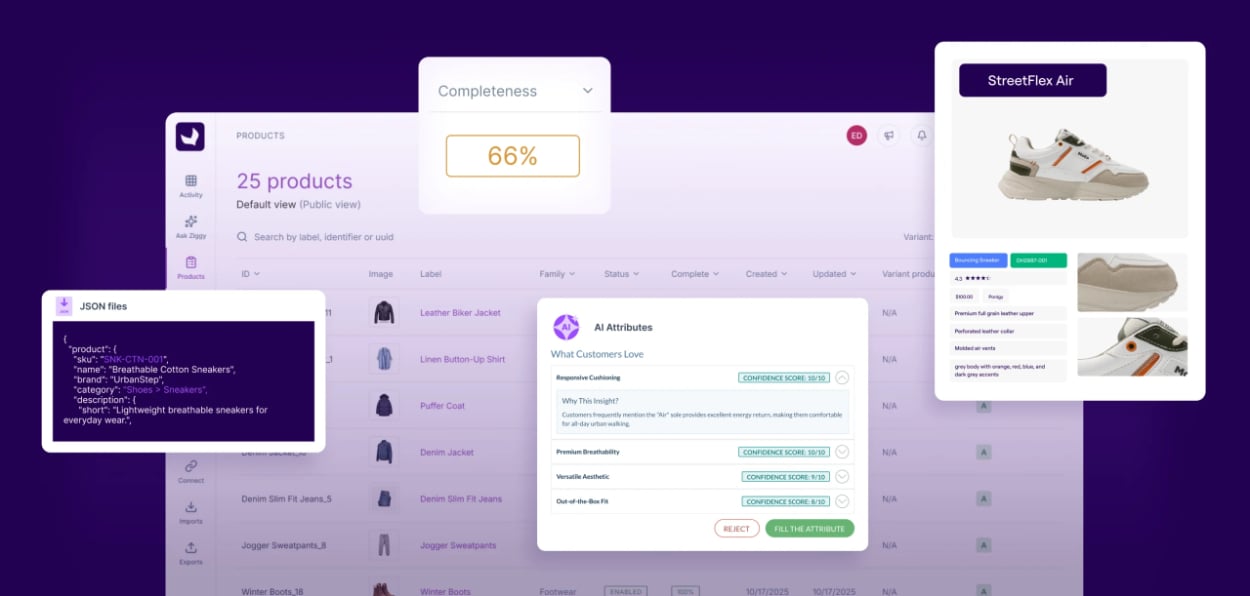
Generally, the second step is actually to enrich. What does it mean? You might have the various materials being used in the fabrication of your garments, but your garment is more than the sum of its materials. You’re going to want to add descriptions. You’re going to want to add pictures. You’re going to want to have titles. You’re going to want to have descriptions that are potentially specific to each country in which you’re selling, or each store. You’re going to want to have attributes that are properly governed and controlled.
You’re going to want to be able to show the same product in a consistent but differentiated manner, potentially on all of your various markets, or all of your various channels, or on your eCommerce and your Insta, or your buying portal for B2B customers. This is going to be at the heart of your enrichment strategy. Where are the places you want to push that information to, so that your product information is relevant to all of these elements? Then, yes, of course, distributing that information to all of the channels is a key component of the lifecycle.
Last but not least, even once it’s there and it has been consumed by the consumer and has ideally led to a sale, there’s a last fundamental element, which is the optimisation. It’s not a lifecycle as a one-way street from source to consumer. Since the data you’re going to have is influencing your business performance, you can use signals from the business performance to inform whether you have the right data to begin with. If you have high return rates, potentially the product information was not the right one. If you have low discoverability, potentially you’re missing some information on your products to get them discovered. These are the things that we work on in that lifecycle of collecting, centralising, enriching, distributing and optimising.

Fine. I think the key to that is the idea that data is something we think of as abstract, but it’s something quite concrete, with a lot of influence over concrete outcomes. That’s a key piece of it.
The other bit about data that is distinct from product is that there are separate processes, structures, frameworks and governance around it. When I was doing my research for this episode, I came across the word governance about ten times more than I came across anything else, I think. I’m not going to ask you to define it. We all understand that governance refers to custody, ownership, effective control over something, in this case data. What I do want to ask you to explain is a two-pronged thing.
The first is why you think AI represents a step change in brands’ and retailers’ ability to practise effective institutionalised data governance, and I want to know what it means to give AI the right starting point to build from. So first, tell me why, in an ideal world, AI is better at governance than humans. And second, since we don’t live in an ideal world, if companies have had years of bad or absent human-centric governance, is AI a solution out of the box, or does it run the risk of just inheriting and ingesting a bunch of disorder that will work against it long term?
These are two extremely interesting questions, and I’ll start with a controversial statement: I don’t think AI is better at governance.
To take it from the top, why governance when it comes to product data and product information? It’s because you cannot afford to be wrong on your products. It’s actually better to be wrong on customer data than on product data. My last name is spelled wrong one time out of two, and that gives me comfort because I feel like I’m not being spied on. Sometimes they get something wrong about me, but I don’t want them to know everything accurately about me. However, when you buy products from someone, you expect them to be 100% correct on all that they’ve provided.
There used to be a time where, if you had wrong information about a product, you would lose one customer. Then there were social networks. You’re wrong about one product, you might lose a bunch of customers. And then there are agents. If you’re wrong about a product and the agents capture the discrepancies, you might become invisible to all of your consumers. So governance and trust in the product information that you provide is paramount in the domain of product data.
Now, what role does AI play in that? I think that it’s actually the other way around. Governance is what allows the scale of the use of AI, not AI allows the use of governance. AI is required to be able to scale to the level of depth and velocity that is required for product data today. There is no way to do things at the scale that is required without the use of AI. But to use AI, you need to be able to trust its outcome. Governance is a significant part of the agentic harness to make sure that you can trust what your agentic workforce is going to be doing on your data.
So, yes, AI helps with the workflow of governance, but it’s always humans who have to be at the helm, define the governance rules, make sure that they are brought in whenever there is a doubt about what is being done, either through sampling or one-to-one verification or just greenlighting your process. This is how you can actually feel confidence about governance in the world of AI.
There again, human at the helm, AI to accelerate processes, but more importantly, governance as the warrantor of the trust that you can have in your product information.
Fine. I think that’s a good answer, and there’s a couple of bits I want to tease out in this question. When it comes to the data that represents a product, as you said, you don’t want to get that wrong. It seems to me that there’s two metrics for getting it right. One would be completeness of information: is the data that we part with fully representative of the product? Then the second would be accuracy of the information: is it not incorrect? You want as much coverage of what makes up the product as you can possibly get, but you want that coverage to be the truth for it to be considered useful and accurate.
Thinking about my product lifecycle days, and the regulatory environment at the moment, fashion has a tricky relationship with the truth of products, especially in consumer-facing situations. I don’t think it’s unfair to say that very few, if any, brands have a true end-to-end digital twin of every product in flight. A lot of brands don’t have full visibility into their multi-tier supply chain behind their products, so at some point it feels like there’s a level of governance that involves holding your hands up and saying, “I don’t know what I don’t know.”
But a lot of downstream actors, consumers, regulators and so on are very interested in knowing that what they’re seeing and being told is correct and complete. You can apply that to anything. You could say, “I make a written claim that this garment is made up of 100% regenerative cotton,” and that makes its way into my digital product passport. You can do that, but you have to be able to back it up with information architecture.
How do you think about this in the world of legislation and AI? In the EU, certainly, you can’t just say things you can’t prove, so it’s kind of hard, in a way, to put out information about your product that’s wrong. But at the same time, generative models, generative content, have made it easier than ever to just say things at speed and volume. Tell me what you think is going on with that promise of completeness and accuracy for the product data to the product itself.
I think you’re raising a point on one of the biggest challenges when it comes to product information for the coming years: product slop. It used to be that generating content was a high-cost activity, so content in itself was valuable. Now generating content is basically free. You can give the title of a product and get ten pages of content generated by ChatGPT, but it’s going to be slop, in the sense that it’s either going to be inaccurate, or it’s just going to be accurate information diluted in pages and pages and pages of words. So AI is not the solution to generating large volumes of high-quality, trusted content in that manner.
What I do think is, first and foremost, every piece of content you produce on your product needs to be accurate. One way you do that is capturing more information upstream. That’s something on which we provide many solutions at Akeneo, facilitating acquisition of data from your suppliers, for instance, as you say. Sometimes suppliers don’t provide information, but most often they do. It’s just not the right format, not the right typology, not the right files, and as a consequence, it ends up sitting in an online disk drive or PDFs or emails, and never finds its way to the product data repository that you have.
So facilitate that, and facilitate that with the use of AI. AI is fantastic to grab all of these sources of information that are accurate, that are scattered and not structured the right way, then structure it, put it in your system so that, in your system, you can have atomic information that is of added value, each and all, and trusted.
Once you have that large amount of atomic information, you can generate content with AI. You can generate content that is relevant to the volume of actual added-value information you have related to this content. It’s not about generating lots of pages of description from very limited information, because, as you say, it’s going to lead to false or uninteresting content. It’s about using AI to make sure that you can capture the most atomic, trusted information, and from there turn that into potentially a text or whatever else you want to have using AI.
One thing you have not mentioned, which I think is very interesting, is that the requirement for depth of information is ever growing. It used to be that information was searched by keyword, so you only had to have information that mapped those keywords. Thanks to AI, information is searched through by conversation, by intent, so it means there are as many different reasons to buy your product as there are consumers, and you need to be able to match all of these reasons. The level of depth required to understand your product is orders of magnitude bigger than it was before.
I think that’s interesting, and I have had conversations about that. My fault for not putting that one in there. I think completeness, accuracy and depth are probably the right three pillars of this.
I want to pick up on something you said there. I can understand, and I’ve seen and used the technology to know, that it’s a fairly straight shot from having, as you described, a lot of accurate product data, and then being able to generate your own written content, alphanumeric content, marketing copy, product composition details and things like that, without being concerned that they’re hallucinated. Akeneo has also recently got into the business of allowing people to generate visual content as well, or at the very least to edit visual content. That, to me, seems fuzzier, and less of a straight shot just because of the way image-generation models work.
I interviewed the CEO of Photoroom earlier this year on the show. I had the head of imaging on stage in Paris a few weeks ago. We’ve got a similar interview with the CEO of Botika very recently. These guys all disagree on the percentage figures about the accuracy of generated images to the underlying product, but they all agree that no one’s generating images that are 100% faithful every time.
Your material mentions recolours as one use case, for instance: taking an existing product photo and swapping out the material to an approved seasonal colour palette or what have you. It’s easy for me to see how that can go astray in maybe some subtle ways that aren’t picked up on right away, but then compound and start to threaten that promise of completeness and accuracy. Tell me about that. Tell me how you decided to go beyond some of the agentic capabilities and start to get into these in-platform interventions, where people would say, “I’m going to generate content, and it’s not just going to be written content pulled by retrieval from my existing systems and data stores. It’s going to start to be this fuzzier visual content as well.”
That’s a good question, and I don’t think it’s actually that different on the visual side than it is on the text side. Both can have inaccuracies. But also, I don’t think it’s just about AI. Even if you get someone to do the work, you can have inaccuracies. The only big difference is that you have someone that is held accountable for reviewing it. The fact that you do it with AI does not prevent you from having someone that can be held accountable for reviewing it.
In Akeneo, we have workflows for validations, we have governance capabilities to make sure that you can put the cursor of validation at the level at which you want, whether it’s for images or it is for text. Some companies will put the cursor low; some companies will put the cursor very high. Historically, at Akeneo, we started working with high-end luxury brands. We work with seventeen of the top twenty luxury brands in the world. These are companies where there is absolutely zero right for error when you work on an image. So they are going to be looking extremely carefully at every image generated, but still, it’s actually way faster and more efficient than regenerating the image manually, and not necessarily with a much higher error rate than if it had been done by a third party.
So overall, just having the right governance in place, not forgetting that it’s not because AI is doing the editing that there does not need to be a review, depending on what you want. But more importantly, AI allows you to do way more, so that you can better serve your consumers than if you were doing without it.
I can see that on a whole-workflow level. I can see that you can get faster, lower overheads and what have you, especially if you scale up your review function. I think the fundamental difference for me, when you’re talking about accuracy of data to the underlying product, is: sure, you can stage things with lighting that makes them look wrong colour-wise compared to what they would look like in lighting in the real world, if you’re shooting things physically. If you point a lens, a sensor and a shutter at a product, it’s right to that product 100% of the time. It is within the margin of error, let’s just say, for computational photography or what have you, but it’s not wrong 30% or 40% of the time, for instance, which might be the case with AI generation.
That’s the thing I’m getting at. I understand overall that the workflow can be faster, and the workflow can allow you to do more and can better serve your customers. I just think there’s something in the fundamental architecture of generative image models that is different from photography, and that, to me, is the bit that seems like a little bit of maybe a fault line in the project.
That’s a very relevant point. First, if the error rate was at the 30% or 40% level, I do agree with you, there’s no point. The fix takes more time than the solution, so that would not make sense.
Then, on a traditional workflow, don’t underestimate all of the complexities. Getting the shoots, getting all of that right, and getting the right image. The number of products for which it’s the right image that is attached to the product, or there’s just no image attached to it. Then again, the question is: what serves the best customer decision?
With the right validation and workflow, you can have images that provide a good understanding to the consumer of what the product actually is. Typically, you don’t have an image of your product in a setting where it’s easy to understand the size of it. Generating an image with it can make a whole ton of a difference for your consumers.
If it’s the choice between not having the image that will allow a consumer to make the right decision, who ultimately might make the wrong purchase because of that, or generating an image and then putting the level of control that you want on top of it, I think the choice is fairly easily made. That being said, I agree with you, Ben. There are probably cases where going through the full physical process actually makes more sense because of the specificity of the product and the specific type of rendering that you want from it.
Yep, I would agree. If you imagine two physical sliders as you’re listening to this episode, one is exacting accuracy to the underlying product, and the other is gallery completeness and full representation: shots from every angle, shots of every colourway, videography for every type. Things that are impractical to do with traditional photography. I am willing to bet there is probably a balance to be struck between those that lands on the side of generative being the better option. So, yeah, I’m with you on that one.
That does, I think, give us a good pivot to talking about the consumer promise and the consumer conversation, and a bit more of the agentic commerce side of things. I think the biggest argument for using AI to help populate product detail pages and so on is that more complete listings lead to more conversions. That seems to be the main statistic that the AI companies, brands and retailers will lean on: the more content we can append to a product, the better it converts.
What I haven’t, at least so far, seen is a lot of indicators of the longer tail to that. More content pushing bigger baskets through the funnel is a good near-term metric, but then there’s the longer-term metric of returns and customer satisfaction and loyalty, and all that sort of stuff that I don’t know that I’ve seen a lot about just yet. What are you seeing from that point of view?
Well, I do think that the statement “more product information gives more conversion” is a statement that needs to be taken apart a bit. If it’s just to have a product page that is fifty pages long, it’s actually not going to help that much. I think the first part is more relevant information that is usable by the consumer is what might lead to better conversion.
I do think the big change in paradigm is the fact that, in many cases now, and probably soon in almost all cases, it is an agent that is doing the first trade. If it didn’t make much sense to have a product page that was fifty pages long before, it does make a lot of sense to have it when you have agents looking at the data. Agents can look at the full information to identify and select what is relevant to the consumer in their specific context.
So, yes, there might be only a long tail of customers that are interested in that 127th attribute that is there, which is the width of the screws you need to use to put the support in your wall. But there might be a few customers that are, and the agent is going to be able to make sure that it matches the right intent with the right data to make the right decision. I think this is what completely changes the depth of the information that is required to be able to capture the sale itself.
Okay. I think that brings us to the depth thing that you talked about before. That’s a key component to this. I’ve seen you argue recently on LinkedIn that businesses need to be making their products discoverable by agents, as you just said, as the foremost priority, as the primary visitor, because you think the whole buying journey is changing. You’re definitely not alone in feeling that way. I’ve got an interview coming up with somebody from Stripe, and they, along with other economic infrastructure companies like Shopify, clearly believe the same thing.
You, Akeneo, I think call this work of pressing product information into use “activation”. Tell me, what does the typical retailer or brand need to do to achieve that sort of activation for that non-human agentic audience? I think people listening to this will have heard a lot about GEO and AEO and LLM citations. But I don’t think the difference between traditional keywords you mentioned before, and new vocabulary, taxonomic signals, completeness, that kind of stuff, is clear to everybody. Tell me what you need to do differently, if anything, from traditional SEO to new GEO, AEO, whatever you want to call it, to turn your product data into something you can activate for agents.
Yeah, that makes sense. Stripe, Shopify, we’re partners with them, because product data becomes the foundation of such a commerce decision. How do you get on these platforms? Ultimately, it’s mostly Gemini, ChatGPT, Claude, Perplexity. You usually have two ways of being present on the platform. I’m not talking about optimisation yet, but just existence. The first one is that all of them do standard web crawling. So if you have a product page that is properly structured, you will at least have a shot at being present in these systems.
Then quite a few of them also directly have feeds to populate them. OpenAI has a feed approach. Google, you have Google Shopping feed that can allow you to be present in Google AI Mode and Gemini. So these are ways to just be present.
Now the big question that everybody is going after is: how do you get ranked better than others? If you look at the overall economy of SEO, there is a chance that it just pivots to the economy of GEO, because this becomes the first step in the funnel. We are already seeing that, talking to customers: they have drops of traffic coming from search engines of 30%, 35% already, because the first filter is being done by agents.
Now, how do you actually get better position in GEO? It’s interesting because it’s a battlefield. It’s a battlefield because, as the stakes rise on the amount of commerce that goes through LLMs, the overall means dedicated to altering ranking are evolving accordingly. A year ago, everybody was saying, “To be well ranked in ChatGPT, you need to be present on Reddit.” Interestingly, millions or hundreds of millions of dollars have been spent by brands over the past year to be more present on Reddit. As a consequence, Reddit is not really a trusted source any more. Now that content can be generated for free, every piece of content that can influence the ranking on an LLM is going to be generated a thousandfold more than the original organic content to be able to influence it.
My bet is that, as of today, there are a few niche areas of optimisation through third-party content, but that we will see third-party content have a lower and lower place in the ranking of products, because it will become less trusted than it is. There was a study this summer showing that Perplexity puts 50% of the weight of product assessments on websites beyond the 10,000 websites, which means that they were subject to long-tail websites and potentially untrusted websites. We are seeing that trend move around. We are seeing ChatGPT move most of the weight of its ranking towards product feeds as opposed to web-scraped content.
In my view, that demonstrates that the thing on which we can bet with the highest potential return in the long term is going to be your product information, because the product is going to be the only piece of data that can be trusted.
I think that’s the correct read. Brands are very interested in having a single source of truth for the product itself. I think that’s a strong argument for having a single source of truth for the product data. What do you think that does for advertising? When we think about that agentic model where the buyer’s agent is the one going out and doing the first pass on the retailer stores, there’s programmatic advertising and things in the middle. There’s a lot of competing incentives for that data.
I guess it’s just an argument for making that first-party data as accurate as it can be to serve as many interests as you can. But as an old-school website owner who is very familiar with how online advertising works, the advertising in this agentic space seems more complicated and more arcane to me than anything.
We can talk about that for hours, but I can share a high-level perspective of what I see there. I think that advertising is fundamentally at odds with the model of agentic commerce. To have a purchasing decision driven by an agent, you need to trust that the agent has your interest in mind, and not the interest of someone who has just paid more than the others to be present.
When you’re just in discovery mode, yes, you can have ads that are indicated as such, but to be honest, ads blend not as well in conversational AI as they do in classical web search. In classical web search, you have them look a bit like the rest and just say “sponsored”, whereas on conversational AI, it’s going to jump at your eyes like an ad, which it actually is. But I think, as we move past discovery towards transaction, I don’t see a way in which you can have agents making automated purchasing decisions that are biased by ads.
I would agree.
That being said, I think it’s okay. If the agents do the transaction, then companies, the owners of the agents, can earn their money not on the ad, but on the transaction itself, which actually aligns…
Yeah. That’s the model that Meta is taking with Muse. It feels weird to point to Meta as an exemplar of maybe a healthy business model long term, but that is the thing there. On that basis, why do you think some retailers would want… Sorry, go ahead.
Actually, just to follow on your thought there. If agents get paid on the transaction, then what is the only thing companies can invest in? To be the ones that have the highest conversion rate, so that agents will favour them as part of that model. It means agents will favour higher transaction rates, because this is what they’re going to be paid on. So not ads, but conversion. The only lever that companies will have is their product information. It means that the whole of the energy that the world is currently putting both in SEO and in ad search might actually move to product information management.
I think there’s an argument for that. I think your product data and the relative seamlessness of your agentic checkout experience, the transactional side of things, would be the two: the transaction stack and that.
There’s another angle when you think about the sort of trust that people put in AI. We’ve talked about AI content. We’ve talked about the trust that people have in the LLMs and the agents that are acting on their behalf. The other one is how much people are going to continue to just use software as it’s given to them, so ChatGPT or what have you, versus the number of people who are going to want to modify it. This has been a tension in general software for a long time, especially in the enterprise, but customisation usually means service contracts, in-house developers and so on. That’s all changed super quickly.
This is going to sound like a crazy digression, but I grew up playing video games. I’m still pretty immersed in that world, and there’s an explosion of amateur developers at the moment using AI to decompile old games that required either original hardware or power-hungry emulators, and then recompile them for the web or for native Windows or Mac executables. You don’t have to play or care about games to feel something there. People have problems and they want software to solve them. So far, the ability to solve that has been confined to people with specialist skills and scarce time and so on. Now somebody can just buy a few hundred dollars’ worth of credits on OpenRouter or with one of the big labs and just ask for the solution.
I’ve seen you describe AI this way for retail as well: AI is a kind of raw material that people are going to work with to get the results they want. It also shows up pretty explicitly in your offer. You encourage people to develop their own extensions, including through vibe coding. What do you see this meaning for you as a platform owner, and for product data as a whole? You clearly don’t see it as an industry-destroying SaaSpocalypse kind of risk. What do you see it as?
You raise a very good point on this. As we talked about agentic commerce disintermediating eCommerce websites so that users can go directly from intent to product, I think the same shift is happening in software. You want users to go directly between their intent and the results.
Software is flawed at its heart, because you need to become an expert in the software. The software is just a path to managing an outcome, and today you need to be an expert in the how to be able to achieve what is the heart of your business: the what and the why. I don’t want the job description of someone to be, “I’m an Akeneo user, and the only thing I know how to do is to use Akeneo.” What I want is, “I’m leading brand development, and I’m there to make sure that we sell it the right way to the right people in the best fashion possible.”
I think AI provides the ability to make software invisible, but in the right way. Invisible in the sense that we allow users to directly go to their outcome. They don’t have to learn how to do it any more. They can say what they want, and then it gets there. Now, to do that, it’s not just unleashing an LLM on the database, because if you do it that way, it doesn’t have the context, it doesn’t have the control. You discussed earlier hallucination and trust: you don’t know what’s going to happen there. On top of that, you have potentially several people in your company doing it, so it’s all a mess.
In my view, the aim of the next generation of software is providing the best harness possible in terms of governance, validation, context, portfolio of agents, so that software can become invisible for business people to achieve their outcome. In my view, users will become CEOs of an agentic workforce. Akeneo becomes a distributor of an agentic workforce that is specialised in all of the specific things that need to happen on product data: from structuring data, to building the workflows, to distributing it, to enriching it, and the rest.
The user becomes the CEO of that team, is the warrantor of the quality of the work being done, accountable for the overall output, is at the helm of the agentic workforce that is driving the results. So, yes, software itself, the software as a UX, kind of disappears, but software as instantiating the technology to reach a business goal is the heart of what it will be.
How do you think that changes deployment? I’ll hop back to PLM one final time. Your typical product lifecycle management implementation or deployment took months, if not years, and involved a whole bunch of service days, expert advisers, consultants and what have you to get from what the business wanted, which was a way to centralise and manage the data that pertains to its real products, to the actual outcome. How do you see that changing? You see AI labs now investing a lot of money in forward deployment and in advisory. What do you think the transformation that you’ve just described does for the way that technology is actually put into practice?
I think the rise of the forward-deployed engineer shows the need for verticalisation of the AI technology and the development of specific harnesses, which is what I discussed before and what we’re working on. The integration itself will shift for two reasons. The first one is that, in the medium to long term, I think how systems interact is going to radically change. You’re going to have agents talking to agents instead of having APIs talking to APIs. So the way you connect systems is going to evolve.
But even before then, integration work can now be done in a much more efficient fashion thanks to AI. You can integrate much faster, clean data much faster, build structure much faster. For instance, at Akeneo, we used to work in a very waterfall approach to deploying customer projects. Now, as soon as the presales cycle, we start to deliver some value, because using AI we’ve been able to do a first assessment of the data of the customer, make sure that there is a clear path towards how they’re going to be able to deliver value, and potentially provide them, as soon as the presales cycle, a fully functional Akeneo instance with the data loaded in it.
So, yes, I do think software is going to be completely transformed in the way we think about it, as well as integration is going to be completely transformed. Then there’s going to be a bar to which we need to rise. With vibe coding, LLMs allowing the quick development of software, we need to make sure, as software vendors, that it will always be more complicated and more costly to rebuild the software from scratch than it will be to integrate it.
That is going to be the interesting thing. The burden of integration can be accelerated, but it’s still massive, and the burden of development reduces. You want to make sure that your software, which can be very feature complete, but the more complete it is, the more integration can be a burden, can be adjusted to the need of a specific customer and integrated into infrastructure faster and more efficiently than trying to rebuild it from scratch.
Yes. Rebuilding from scratch is du jour at the moment we’re recording this. Homegrown replacements for the Adobe Creative Suite, Microsoft Office and so on are big news across the technology industry. Reverse engineering things that have become de facto standards is big news. So I agree with you on that one.
Final question: what is your prediction for the timeline for your users specifically? You said the Akeneo user base is very broad. What’s the timeline that you give on them really becoming that CEO or orchestrator of an agentic workforce, where they feel like they can delegate work to agents that right now they feel they can’t, that right now feels uniquely human?
I’ve seen this personally. I don’t use AI to write content. I do use it for a lot of research, I use it for discrete tasks and all kinds of that stuff, and I’ve seen a big shift in the way I behave now. Literally this weekend, I set Codex loose on a task that took nine hours end to end, with an objective. It cost me a lot of money, but it was something that needed to be done. That’s a very different way of thinking: take something that you would previously have had full responsibility for as a human, you’re willing to go, “Do this end to end, come back to me with finished work and let’s see how we go.” Where do you think that goes in the world of product data and in the world of agentic commerce?
I think it will come faster than we think, but most importantly, it’s already partially there. We released our agentic workforce three-some months ago, and we already have 60% of our customers using it. It’s not using it in the full-blown scale of what we can do by 100% of customers, but it is already quite a wide adoption.
I think most people are ready. If you give them trust and confidence in the way it’s done and allow them to check what they want to check. ChatGPT, Claude, there are already things that they’re using mostly on a daily basis, especially with Google AI Mode now being the standard way to search. I don’t see that much of a distance due to the people not wanting to do it, as soon as we make sure that they have the guardrails, they have the control, that they feel like they are at the helm of what the agentic workforce is doing.
Do you see that as a multiplicative thing, where each individual person is then doing extra work? You give somebody an agentic workforce, you suddenly multiply their capabilities. Or do you look at it from the business’s colder commercial angle, where a business would go, “I have a real human workforce of ten. What if I only need a human workforce of one and an agentic workforce of nine to get these things done?”
That’s a good point. That being said, I think as of today, the race companies are on is: you need to have ten times more depth on your product, probably five times more products that are going to change five times more rapidly than they were before, and be 90% more certain of the information that is there. What we are seeing today is a huge increase on the product teams in terms of expectations of execution, and not a linear growth of their capabilities to do that.
So I don’t think this is how things are going to be shaping. I don’t think it’s going to be about reducing the workforce. I think it’s going to be about drastically increasing their accountability. Ultimately, as we said, if product data is what replaces SEO, ad search, and drives your overall commerce performance, then the people that are working on the product data become the first line of business performance of your organisation. The equation is not going to be, “Do I actually reduce this team?” It’s, “Is there a way for me to scale that team that is nonlinear with the exponential amount of additional work that I have to get them to do?” This is where we will provide a solution.
Perfect. Good answer. Romain, it’s been a pleasure having you on. I’ve enjoyed this conversation a lot. Thank you.
It was great. Thank you very much, Ben.
That’s the end of my conversation with Romain. If there’s one thing I think I’m going to end up dwelling on from this episode, it’s that the massive promise of agentic commerce depends on getting some pretty old and deeply unsexy problems solved. Conflicting, partial or inaccurate product information, unclear governance, claims a company can’t substantiate: these are all issues today, but they’re going to get compounded and become way more important in the agentic future. And the agentic future, we’re told, is close.
Like a lot of things in technology for fashion, then, the idea of what’s coming is glossy, but the groundwork required to deliver on it is comparatively pretty boring, even if I hope it did make for an interesting episode today. Grace and I will be back next Tuesday with the next edition of The Edit, and I’m going to be here next Thursday with another one-to-one interview as we barrel towards the end of the 2026 series. For now, thanks for listening. I’ll talk to you again really soon.