
Originally released in The Interline’s AI Report 2026, this executive interview with Made2Flow is one of a 17-part series that sees The Interline quiz executives from companies who have either introduced new AI solutions or added meaningful new AI capabilities into their existing platforms.
For more exclusive interviews, stories and opinions from different industry perspectives, and real survey feedback from voices from every level of fashion, download The AI Report 2026.
We’re observing a big disconnect (in both our own fashion-only data and in wider benchmarks from other sources) between the increasing capability and reliability of AI, in both a general sense and in discrete applications, and the lack of trust that end users place in its outputs. What do you think trust in AI looks like, and what’s the right rubric for measuring it?
For most fashion brands, sustainability data has always been in two places at once: everywhere and nowhere. Scattered across PLMs, ERPs, supplier portals, factory floor spreadsheets, and a mix of formal and informal channels, that data exists in abundance, but it’s sufficiently complex (covering Bill of Materials and Bill of Process) that it’s almost impossible to assemble into something actionable at the speed and scale that modern regulation now demands, or into something that teams can properly trust.
Brands either need to accept that this deeply confused dataset is something they’re stuck with – in which case a lot of their AI strategies will struggle, not just the sustainability ones – or they find a way to make AI part of the solution, and to embrace the kinds of new tools we’re working to create, which use AI to standardise sustainability data and then allow users to interact with it using natural language.
For us, trust comes from users having confidence in the method as much as it does from the auditability of the output. There is a difference between looking at the results of a process that incorporates AI, and understanding the specifics of how those results were arrived at – and the role that AI played in translating complicated and highly technical information into comprehensive impact data that a wide spectrum of roles can interact with.
We’re also operating at the most tightly-regulated frontier of fashion, where getting the right result from an opaque, inscrutable process won’t be sufficient to form the basis of disclosure, due diligence, and compliance. We see a lot of technology companies promising novel insights from applying AI on top of existing supply chain data, without acrually interrogating what that data looks like. That feels like the wrong foundation for building the kind of trust the industry needs in this class of technology.
We started building an AI-native data infrastructure in 2020, because we knew we needed to directly address the way data is captured and used – not just make it faster to generate reports and roll-ups from the patchy and incomplete data that already existed. We have also undertaken, in partnership with academia, extensive research on the role that AI can play in establishing the right foundations for the sort of trust that non-technical users now need to be able to place in the new tools we are building.
Another key consideration, when we’re talking about applying AI to an area as all-encompassing as sustainability, is who the end user should be. The kind of trust you’re talking about building is obviously relevant right now for dedicated sustainability and supply chain professionals, and for anyone preparing outward-facing reports and commitments, but it’s already becoming increasingly important decision-making context for people who work in marketing, or in design.
To put it simply: if sustainability is a whole-business initiative, then using AI to enhance sustainability and traceability tools for a narrow cohort of users feels like missing an opportunity. Do you see this as a chance to make insights and actions more accessible to a wider in-house user community?
You’re correct that one of the most persistent structural problems in corporate sustainability has been the disconnect between the teams that generate environmental data and the teams that need to act on it. Sustainability managers have historically been the only people in an organisation with both the access and the training to interpret lifecycle impact assessment (LCA) outputs. Everyone else — product developers, sourcing managers, material specialists — has been effectively locked out of data that is directly relevant to their daily decisions.
Made2Flow’s AI addresses this through conversational access, combined with the research-led underpinnings we talked about earlier. Rather than a fixed set of reports, users across an organisation can query the same underlying dataset, standardised and optimised with AI, using plain language, each from the perspective of their own role and priorities.
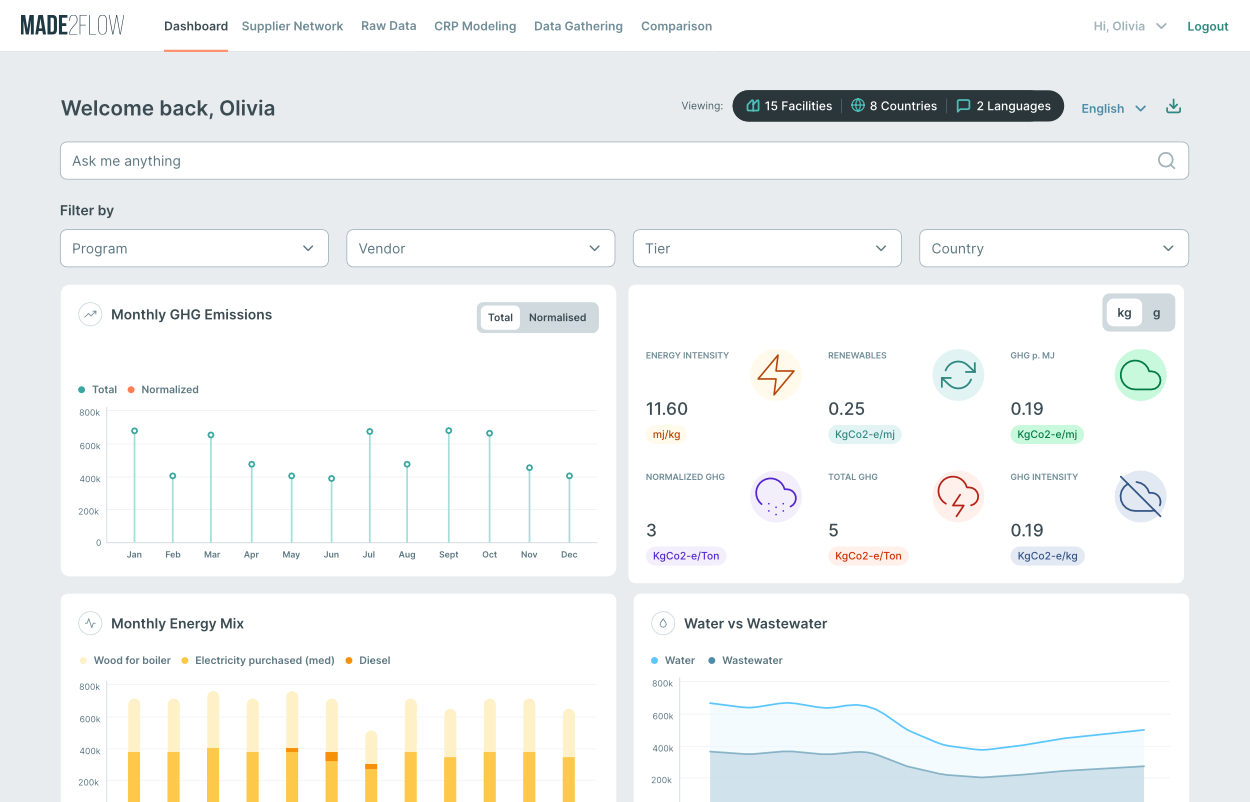
This does not mean that everyone needs to become an expert in the language, the method, or the mathematics of LCAs! The opposite is true: it gives non-experts a way to benefit from the work that specialists have done.
A product developer, for instance, can ask which styles in their range share the same dye-house, identify patterns in material consumption or waste, or surface the energy costs embedded in the products in their department – all without needing to sit down and learn new tools.
A sourcing manager can model the financial risk implications of a shift in production allocation — understanding not just which countries carry environmental exposure, but which facility types in which regions face the greatest upward pressure on energy and water costs, and therefore on FOB pricing.
By the same logic, planning can become more nuanced than country-level heuristics allow: a decision that looks identical at the geography level can carry very different cost and risk profiles depending on facility type, energy mix, and water infrastructure.
A sustainability lead can dig into the specifics of a single impact indicator, explore the relationship between cotton certification standards and land use scores, or understand the precise causes of an anomaly in freshwater eutrophication results.
There’s also a marked shift here in what sustainability feels like, and how internal users perceive it. Within most organisations today, sustainability functions as a constraint. It’s a set of thresholds that complicate decisions rather than inform them, and that put the brakes on creative and commercial ideas.
When the same underlying data supports both environmental scoring and financial risk modelling, that dynamic can be inverted. Scoring systems built on product, sustainability, and cost data can give sourcing and sustainability teams a shared language — one where sustainability becomes productive input, and a prism for understanding the impact of choices, rather than a blocker.
In the conversations we’ve had over the last few years in particular, there’s been a feeling that sustainability is simply too big to properly engage with. Some companies treat that pragmatically, by breaking apart the eventual goals and finding success in the steps along the way. Others get a kind of perfection paralysis, and stop wanting to engage beyond the level required for basic compliance.
You’re positioning Made2Flow as holding a lot of keys – from initial product-level impact assessment right through to full-blown, company-level decarbonisation. Do you see AI playing a role in making those progressive stages feel achievable?
It’s important for fashion brands to realise that every sustainability initiative has the same foundation: faster, cleaner data ingestion. No matter how far you want to take your actions, they still need to be based on the most accurate and contemporaneous information that’s available to you, and that information needs to be refreshed as quickly as possible. There really is no substitute for getting this essential component correct, and our entire philosophy is to employ AI to ensure that every choice is based on accurate, accountable, up-to-date data.
Once you have that foundation, then it’s entirely logical to approach sustainability as a multi-stage initiative, and for each of those individual stages to have its own value return that makes the next one worthwhile.
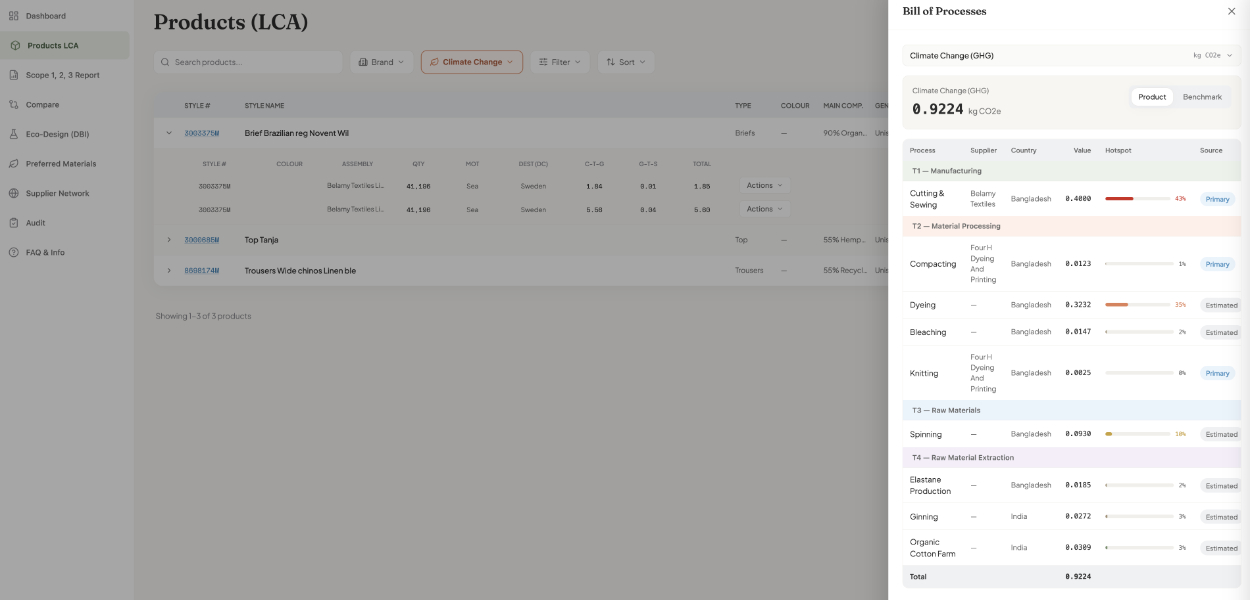
The natural starting point is a Life Cycle Assessment itself: a precise, granular picture of a product’s environmental footprint across climate change, water use, land use, ecotoxicity, and the full suite of EF 3.1 impact categories. That level of visibility and understanding is something most companies can build towards.
But an LCA is not the endpoint. It’s the first layer of a structured intelligence stack that sequentially leads to a much deeper understanding of the brand, rather than just the individual product.
From the LCA, Made2Flow provides a clear and actionable pathway for brands to move into Scope 1, 2, and 3 emissions accounting — translating product-level environmental data into the corporate carbon reporting framework that CSRD and investor disclosure requirements demand. The same underlying data, and the same AI-native foundation, that powers the LCA feeds directly into Scope 3 calculations, eliminating the double-handling and reconciliation work that typically makes this step so labour-intensive.
For companies that want to go further, that emissions picture can then become the basis for a Climate Transition Plan: a structured, evidence-based roadmap that identifies the biggest material impacts, which levers are available to reduce them, and what timelines are realistic given the brand’s current supply chain configuration.
This is where the cross-referencing capability of the AI becomes particularly powerful — connecting product data with facility information to surface financial, operational, and risk dimensions alongside the environmental ones
The final layer is the Decarbonization Framework, which is the operational implementation part of the transition plan, built around the specific supplier relationships, sourcing decisions, and process changes that will actually move the numbers. Because Made2Flow’s AI has continuous access to updated data, the framework is not a static document. It improves and evolves as the underlying data improves over time.
For us, environmental reporting has always been a multi-step process, and one of our big ambitions with AI, as well as expanding the userbase, is to make those steps feel like part of one cohesive journey, rather than being a series of independent roadblocks to try and overcome. This complete vision has been one of the driving forces behind the work we’ve done, and continue to do, to translate research into compelling commercial solutions.
We’re talking about a technology-enabled change here, but we can’t ignore the outward context, and especially the legislative progress that’s been behind a lot of brands’ sudden need to take more quantifiable action on sustainability. How much of the action you’re seeing, from your customers and from the wider industry, is coming about because technology has made it possible? And how much is being directly driven by looming regulatory deadlines?
The arrival of the EU Digital Product Passport, the CSRD, and the CSDDD has fundamentally changed what sustainability reporting means for fashion companies, and that has happened at almost exactly the same time that AI has been rising. For us, the two go hand-in-hand, but it’s important to also be able to examine them independently, to see where each serves the other.
Life Cycle Assessments are no longer a sporadic, project-based exercise commissioned once every few years. They are now a continuous, company-wide operation — one that depends on live, structured, high-quality data flowing in from dozens of sources simultaneously. Something that was “optional” is now firmly mandated.
But direct regulation has also triggered an indirect race to lower impact in a way that can stand up the scrutiny of external stakeholders. Disclosure alone is no longer a defensible position; brands are under growing pressure from investors, customers, and legislators to demonstrate credible, measurable progress on decarbonization.
That requires the full picture — not just a single product LCA, but an end-to-end view spanning Scope 1, 2, and 3 emissions, grounded in primary data from the supply chain rather than industry averages.
That’s where most organisations hit a wall, and no amount of political will alone will help exceed the scope of compliance and turn environmental progress into a differentiator. You need a fundamentally different approach to data to unlock that.
The conventional answer to the data challenge has been API integration: connecting PLMs to LCA platforms, linking ERPs to transport data, pulling supplier information into a unified system. It’s the right idea in theory. In practice, it means months of scoping, multiple internal teams, coordination with every external service provider involved, and still no guarantee of clean data at the end of it. Projects that should take weeks stretch to twelve or eighteen months.
Faced with that timeline and cost, many brands make a pragmatic calculation: reduce scope, do the bare minimum required, and return to the problem later. This is how we arrive at a state where the industry is largely making progress towards a baseline (because legislation has removed the option for inaction) but where the pre-existing technology wasn’t enough to enable companies at large to move further.
You’ve talked a lot about the role of AI in data capture and accountability. What does that look like, practically speaking?
Since 2020, Made2Flow has been systematically gathering data across the fashion value chain. That’s included facility-level information such as machinery inventories and energy consumption, but also huge volumes of product-level data including Bills of Materials and Bills of Processes, metering records, and in some cases recipe-level input data from dyehouses and finishing units.
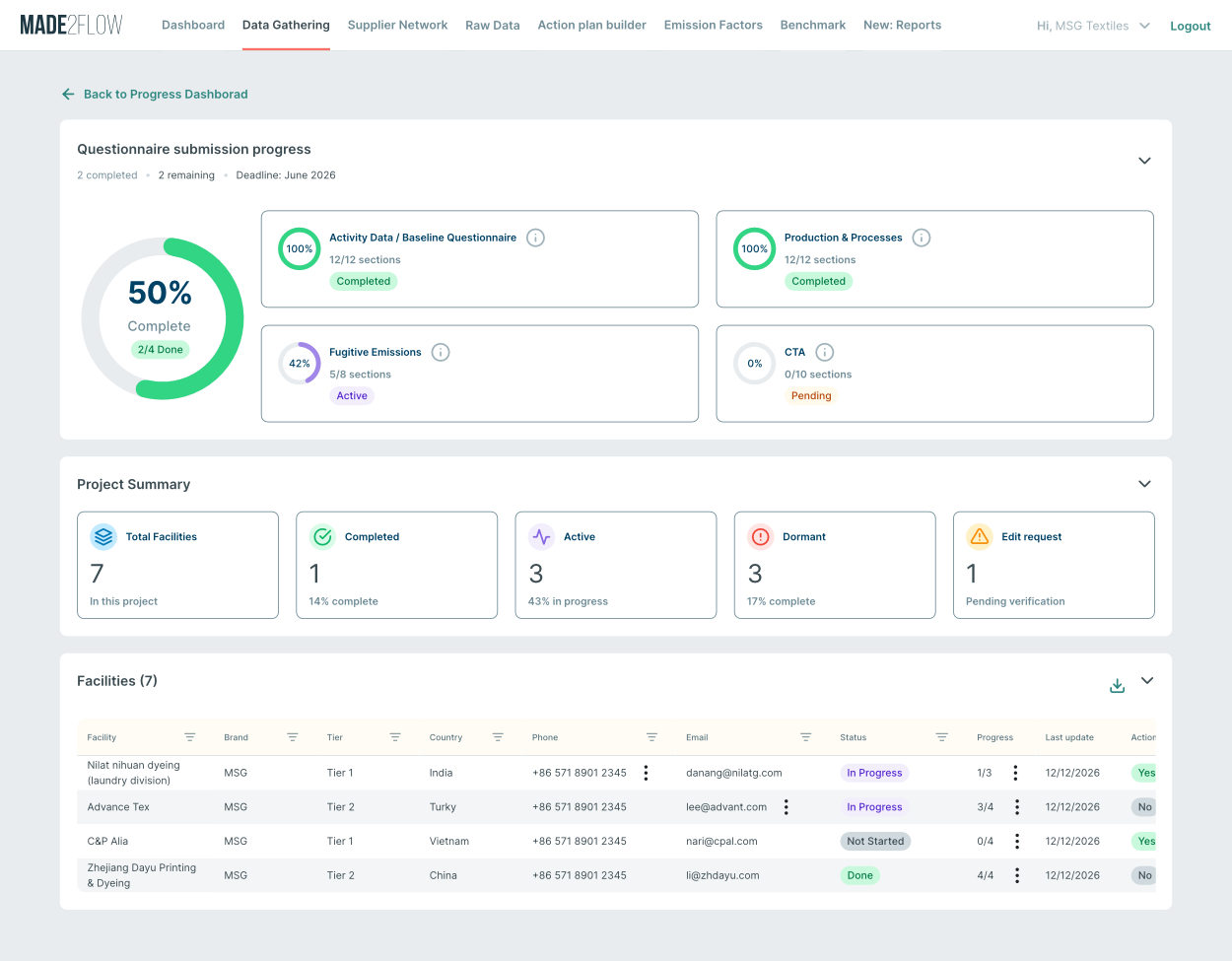
The sheer variety of that data is precisely what makes it difficult to work with at scale. This is information that single brands have found hard to wrestle with, and we’re looking at it industry-wide!
Every dataset is also structured differently. There is no unified taxonomy across suppliers, factories, or software platforms. The depth of product data varies enormously from one style to the next, and from one brand to the next.
But what was once an insurmountable barrier (the impossibility of normalising this volume of non-uniform information into an LCA-ready format) is now the foundation of Made2Flow’s AI capability.
By training on millions of data points drawn from hundreds of different data structures, Made2Flow’s AI has learned to recognise patterns across disparate sources and map them into a consistent format automatically. Raw data — transferred in whatever form it arrives, from structured exports to unstructured files — can now be ingested, interpreted, and prepared for calculation in a fraction of the time that manual data processing would require. Projects that previously required year-long set-up phases can now be initiated within weeks.
The AI is also a more reliable data quality auditor than any human team could be at scale, and this is something we’re not just assuming, but have tested and researched through our academic partnerships. Data collected for product development purposes — where the priority is getting the right product to the right point of sale on time — often contains inconsistencies and errors that carry no operational consequence but have serious implications for environmental reporting. Made2Flow’s AI detects those inconsistencies systematically and flags possible resolutions, protecting the integrity of every calculation downstream.
Last year, we asked technology executives whether they predicted AI would become more obvious, as a primary interface paradigm, or whether it would disappear into the background in the way that vital but invisible platforms like AWS and Azure have done. This year’s data suggests that the answer is both: fashion professionals that use AI interact with it as both the engine and the steering wheel. But we also see that, for a lot of companies, both kinds of applications are still largely in the scoping or refined-pilot stage. What do you see being the trigger for deeper adoption and wider roll-out?
Brands have historically faced a binary choice when it comes to technology in general: work with specialist consultancies that offer depth, best practices, and help with configuration, but at significant cost and lead time… or adopt turnkey, low-configuration SaaS platforms that offer scale and efficiency but limited analytical support or extensibility.
The same is true for AI. This is why we’re now seeing the major AI labs start advisory practices – because they recognise that, despite being a significant technology shift in its own right, AI is still expressed as software implementation and change management.
I believe the right way to look at this is to recognise that AI itself can change the implementation and adoption paradigm, so you can get the engine and the steering wheel at the same time, but also to remain aware that we are still dealing with technology-enabled cultural transformation, and that requires the same considerations as any other technology project.
Made2Flow’s approach to AI is designed to make the depth of interpretation that previously required trained consultants accessible to anyone in the organisation, at any point in the process, without waiting for a reporting cycle to close. It’s designed to make sustainability operations faster to set up, broader in scope, more accurate and accountable,and genuinely viable to interact with for non-expert teams, whether we’re talking about an initial LCA or full-on operational decarbonisation.
So I think deeper adoption comes from finding a methodology you can trust, but also taking advantage of the opportunity for AI itself to contribute to the onboarding process.
