Hey, welcome back to The Interline Podcast.
I’ve been meaning to do an episode dedicated to beauty for a while now. If you’ve been a reader or a listener this year, you’ll have heard me and Grace talk about the unique market opportunity beauty has to ship consumer devices, and to use hardware to get closer, literally and figuratively, to shoppers. Fashion doesn’t have anything close to that outside of wearables.
We haven’t, at least not head-on, talked about the fact that beauty also seems to be further ahead than fashion when it comes to AI-led personalisation and AI-enabled or AI-adjacent experiences like virtual try-on. To be clear, VTO in fashion is having a moment thanks to AI. But broad consumer adoption is still very much a work in progress, which is not the case in beauty.
Every fashion brand will tell you that personalisation is the key to increasing basket sizes and customer lifetime values. But the actual levers available for brands to pull if they’re trying to build a personalised look are fairly minimal. You can recommend tops, bottoms, shoes, accessories and outerwear in various permutations and different subjective fits to align with people’s tastes as they stand today.
That pales in comparison to how individual everyone’s skin is. It pales in comparison to the huge range of features, needs, biomarkers and other variables a beauty brand can use to build an extremely detailed profile of its customers. And it pales in comparison to its ability to tailor products and routines to those customers, then track their response over time. That gives you a very interesting substrate to start building AI experiences on top of.
Beauty is also, as you no doubt know, an extremely tightly regulated industry compared to fashion. That adds its own complexities and opportunities when it comes to building, refining and scaling those kinds of AI experiences.
In one sense, requiring testing for every claim, implied or explicit, means the right foundation is there to build trust in AI answers in beauty. Not wanting to harp on too much, but fashion isn’t exactly known for being able to substantiate everything about its products and everything it claims. On the other hand, you don’t just quickly roll a probabilistic, fuzzy technology out in an industry that has guardrails as strict as the ones that exist in beauty.
So, as you might expect, I’m interested in how much of this is destined to stay unique to the beauty industry, and how much can be ported over to fashion’s ambitions for AI, or even just learnt from. Fashion brands might not be about to start shipping 3D knitting machines to everyone’s homes, or even putting them in every major city just yet. But they are very much trying to apply AI to the challenges of personalisation and product innovation. On both counts, I think there’s a fair amount they could learn from beauty.
Today’s guest is someone who’s been applying AI to both of those things for a while, as both a scientist and the CEO of a beauty tech company. Anastasia Georgievskaya is the CEO of Haut.AI. If you’ve been listening to the show long enough, you know I enjoy the opportunity to talk to CEOs from any background. But technical and scientific founders who run companies and stay close to the nuts and bolts are probably my favourite guests.
As you’ll hear, Anastasia is both a bona fide scientist and a real operator, with some well-formulated perspectives on where AI for beauty is going and how much might end up being applicable to fashion. So let’s hear what she had to say.
NB. The transcript below has been lightly edited.
Never miss an episode
Get notifications for new podcast episodes, plus our weekly news analysis, events, and more, delivered straight to your inbox.
Anastasia Georgievskaya, welcome to The Interline Podcast.
Hello, Ben. It’s my pleasure to be on the podcast. Thank you for having me.
Not at all. Looking forward to this one. It’s in a space we don’t talk about nearly as much as we should, so I’m going to ask you a pretty broad spectrum of questions. I appreciate you being game for me quizzing you about quite a few different things at once.
We always start these shows with a look at what our guests’ day-to-day jobs actually entail. Yours is an interesting prospect because CEO jobs are pretty variable when it comes to how people balance their understanding and hands-on immersion in the product with the everyday demands of running a company.
You’re also a technical, or more accurately scientific, founder. I’m interested to see how close you still are to the science and technology compared to how much of your time is dedicated to CEO tasks. Walk me through what an average day looks like for you.
I really love staying close to the science. Maybe I’m not focused as much on the development side, but I focus on applying it to real business problems. As a CEO, there’s a shift for me from just, ‘Can we build it?’ Typically, that question will be answered by our R&D and data science team. I try to focus more on questions such as, ‘Does it solve a real problem?’ The second question is, ‘How scalable is it?’ How many times can we solve this problem again and again? Can we turn it into repeatable problem-solving?
I love staying actively involved in the product and product strategy: how this technology will be rolled out, who it will be marketed to, who is in that ICP. Since I’m a scientist by training, with a degree in biophysics, I also like to stay engaged in validation and scientific work. Our team is actively publishing our research, and I like to contribute. I still review some of the research papers we’re bringing to life.
It’s important to tell a little of the story because I’ve been interested in biology from a very young age. I begged my parents to buy me a microscope. Then I graduated with a degree in biophysics and bioengineering. In the first years of my career, I worked in drug discovery. Then I shifted to skincare, primarily R&D and validation. I founded Haut with a mission to measure skin.
In my typical day-to-day, I’ll wake up and start by setting an intention: what am I trying to achieve in this day? How will it move Haut’s mission to be at the frontier of skincare measurement technology forward? Then I’ll do some emails using AI tools. The majority of my day will be calls.
I like talking with customers. I spend about 30% of my time interacting with them, understanding where they want to be and how we can help them get there with our technology. About 30% of the time will be focused on the product and technology: what’s new, and how we can bring it to market.
That gives us a good idea. The second thing we do with each guest is ask them to define a word. For you, I’ve picked personalisation, because that’s one of the two central promises you’re making with Haut.
Personalisation also means something fundamentally different in beauty to what it means in fashion. In both cases, you need to know as much as you can about the person you’re trying to personalise for. But styling, fit and price are the only variables you really have to play with when you’re personalising a fashion offer: something made up of garments, footwear and accessories.
In beauty, you’ve got a complex, completely individualised, idiosyncratic set of dials you can turn to provide a customer with a personalised experience or a custom formulation. You have to track things like efficacy over time, and do all of that within regulations that govern both explicit and implicit claims.
We’ll get to the regulations in a bit. For now, I want to know how you define what you refer to as ‘hyper-personalisation’. Tell me what it takes to deliver that.
For me, personalisation in beauty means putting consumers into increasingly specific demographic buckets. That goes into understanding what someone needs now, not just what they’ve bought before.
When I think about consumer shopping, there’s a place for emotional shopping and rational shopping. Emotional shopping is: you go on TikTok, find a product and engage with it. You think this brand and product are culturally relevant for you, and you want to buy it.
But what if you’re interested in buying a moisturiser and have identified, let’s say, nine products and brands? You’ve built this emotional relevance and affinity with nine of them. How do you narrow it down to one product?
This is exactly where hyper-personalisation steps in. It’s the ability to combine the consumer context and what brands we consider culturally relevant for them. We also apply product intelligence: what is the product supposed to do? What are the claims? What is the intended use? We combine their historical behaviour: what have you bought in the past?
But now we add something fundamentally different: objective measurement. I don’t believe personalisation can improve something that’s not measured. There’s a saying: you don’t know what you don’t measure. For me, personalisation is the ability to combine the consumer context with objective measurements that we’re using AI to perform.
When you think about putting people in those increasingly granular, small buckets, how far down does that go? Do you get down to true personalisation, true one-to-one? Or is this more a case of getting progressively finer brushes to paint groups of people with?
That’s a brilliant question because quite often personalisation is identifying some demographics, and everyone within those demographics gets exactly the same product. What we’re doing at Haut is much more granular.
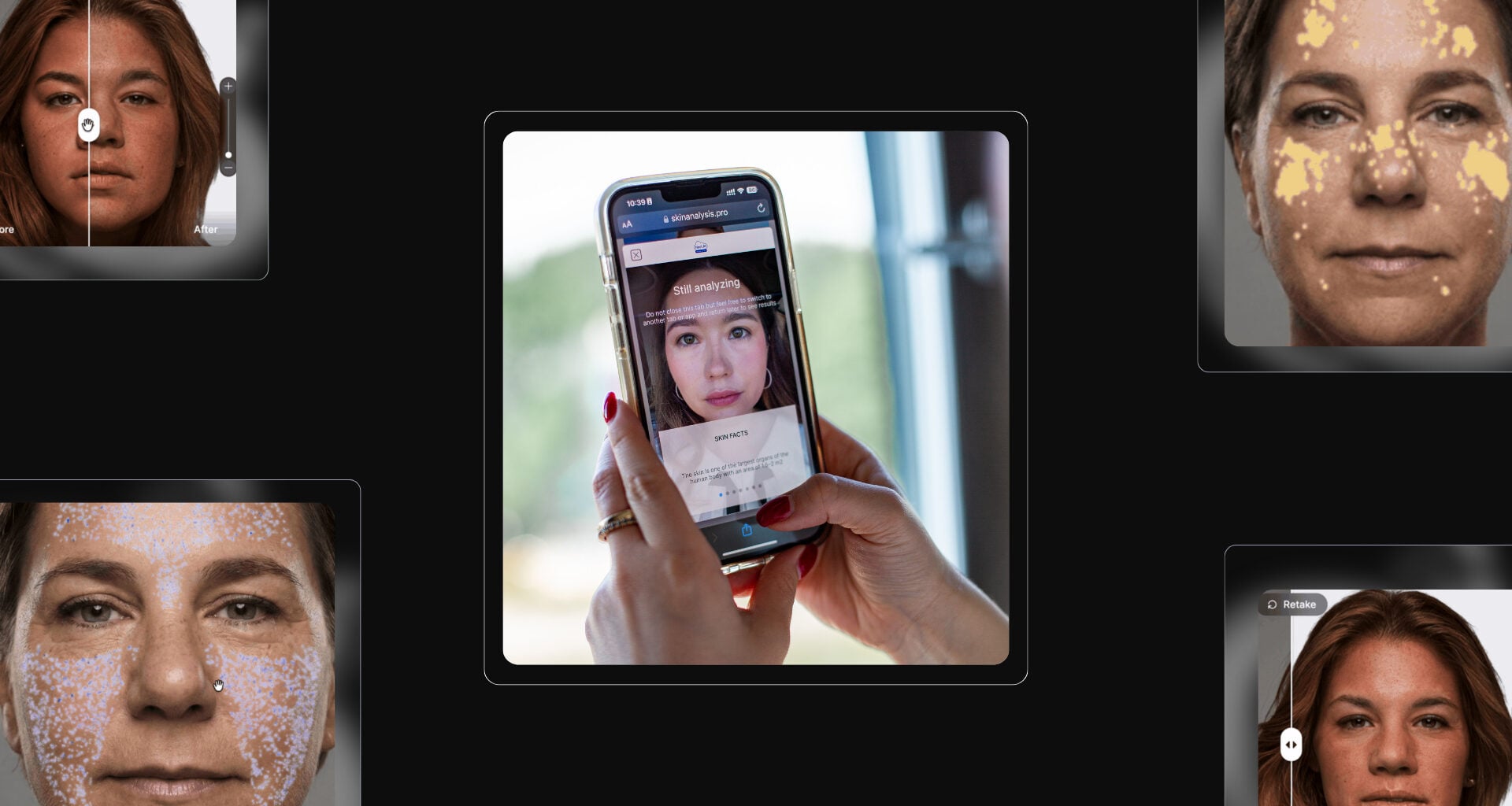
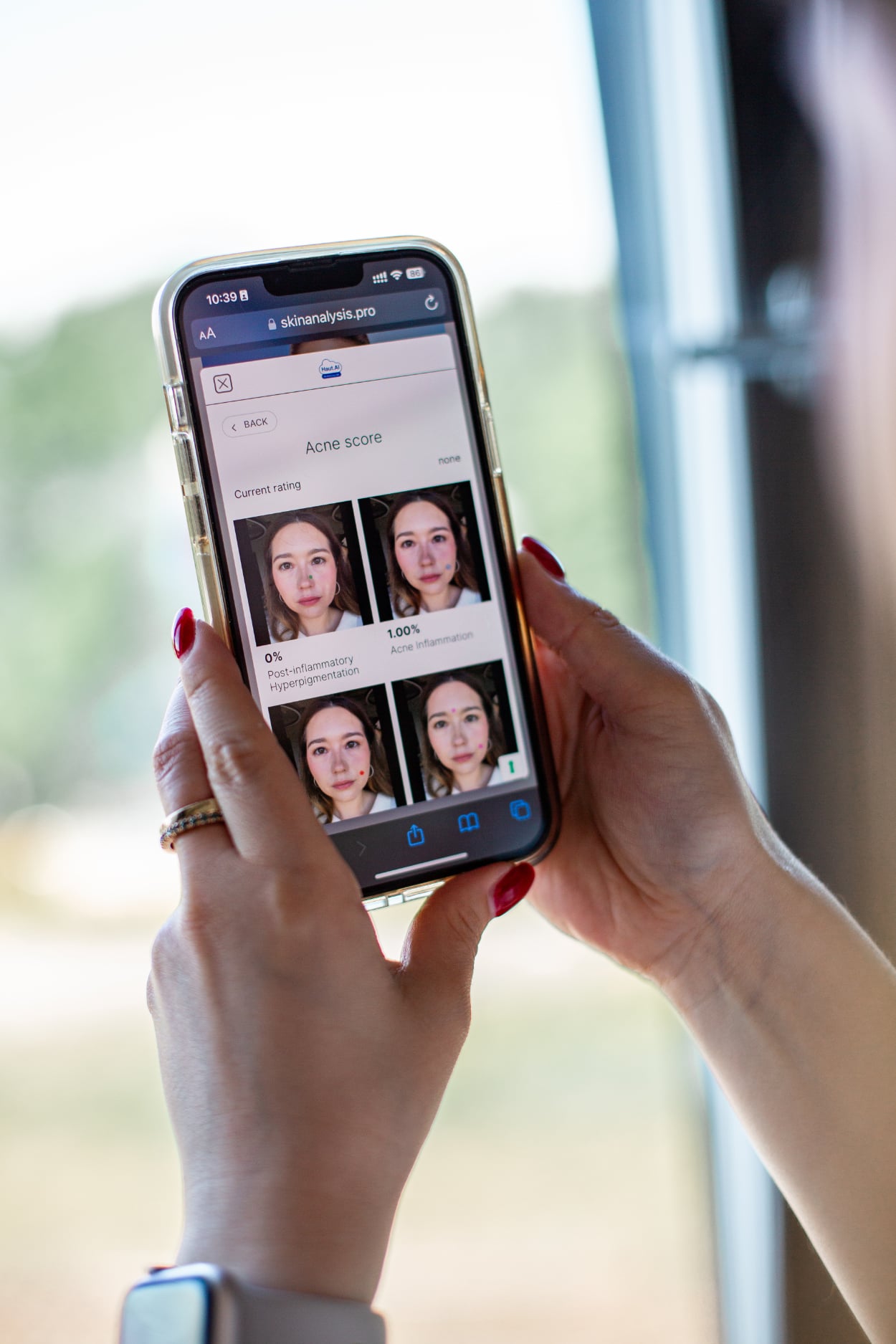
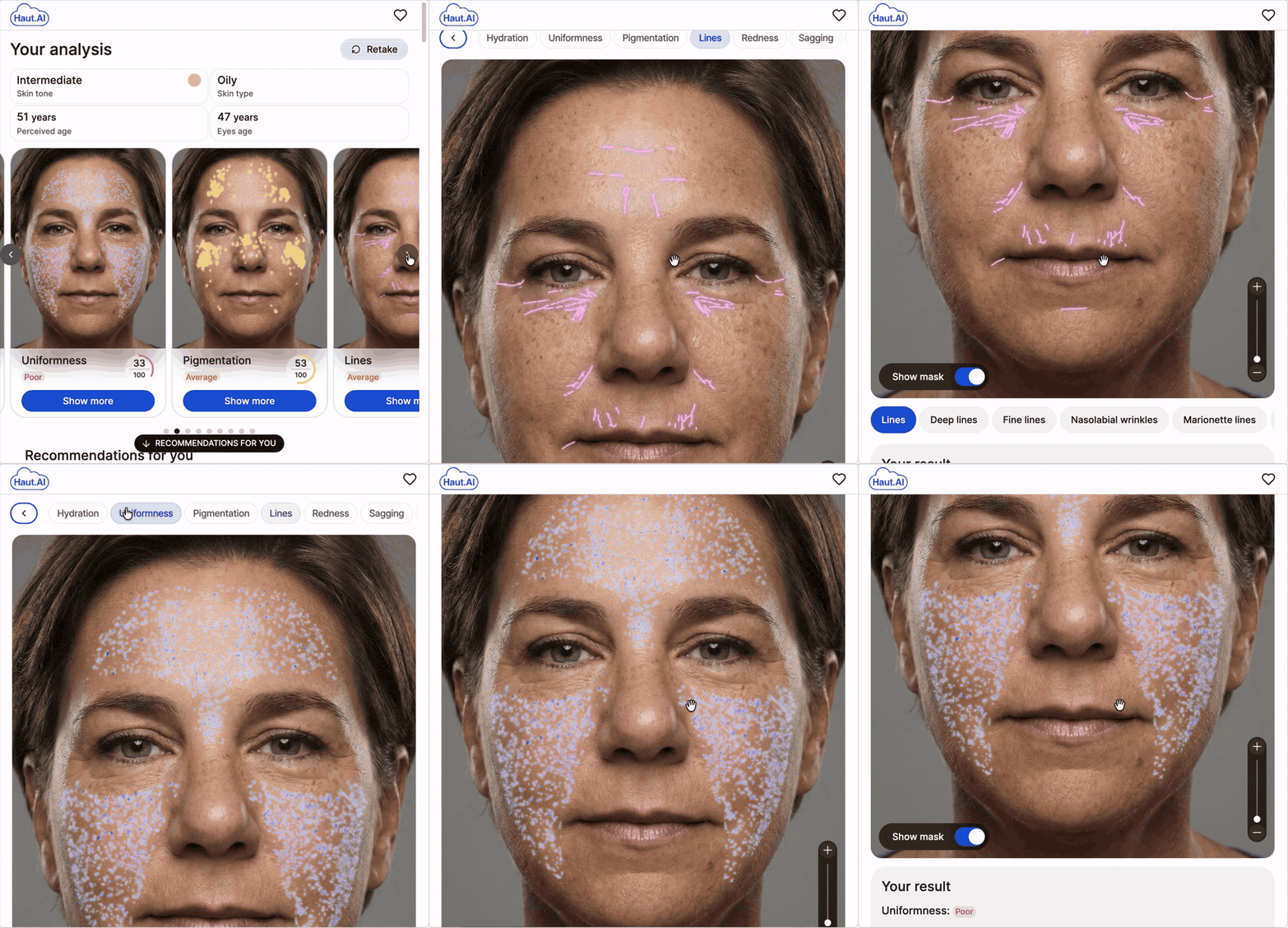
Right now, we can identify 30 high-level skin features and 250 skin biomarkers. By doing that, the product recommendations and routines are extremely refined to address these 30 high-level metrics and 250 biomarkers. We go beyond having buckets where everyone gets exactly the same product recommendations, by really doing it one-to-one.
If you think about 30 features and 250 biomarkers, there’s an enormous number of permutations. Unlike fashion, and I’m going to generalise slightly, no one’s fit is quite as individual as that, I don’t think. Garment fit, length, compression: none of that gets to the same level of individualisation that exists in beauty when you think about all the different combinations.
If you combine the things you’ve just talked about, you have individualised demand. That’s the way I would think about it, in a way that doesn’t have a direct analogue in fashion.
That’s right. There’s individualised demand, but there’s an additional layer of personalisation: measuring the outcomes and performance of individual products. We add a dimension of time, which is quite often neglected.
The question is: I’ve identified candidate products that will benefit these consumers. But I also need to understand which products will actually have an impact and how they’ll change the skin parameters. In beauty, we have this additional dimension of measuring over time and knowing what the outcome was.
I want to ask you a couple of questions about the time element later on. I’ve zeroed in on the difference between fashion and beauty because my impression is that the beauty industry is further ahead in some important ways.
Some of those leads are things fashion can’t replicate. There’s no fashion equivalent to mixing foundation in someone’s home with a dedicated device. The whole category of devices and hardware is something fashion can only really touch with wearables, whereas skincare and beauty have a huge spectrum of at-home and consumer devices the industry can sell.
Some of the other stuff, with virtual try-on as the primary example, is a matter of beauty perhaps having an early-mover advantage. But beauty also has a consumer who’s more accustomed to being an active participant in the process you’ve just described: personalisation, then evaluation over time.
The simplest way I can put it is that virtual try-on in beauty seems like a mature category, whereas fashion still seems to be finding the right combination of technology and user experience. Am I reading that correctly, or is there something else going on?
I think that’s a brilliant observation. In my view, consumers in beauty are interacting with products more directly.
To give you an example of mixing products in the comfort of your home, a consumer can mix two foundation shades and get the perfect one. They can do it daily, and maybe the next day mix different products and get a different foundation shade. Or, if we’re talking about care cosmetics, I can take my foundation, mix it with a serum and get a new product: foundation with skincare benefits. Consumers can do this more directly, at home, daily.
Another difference between fashion and beauty is that skin and hair can be measured and tracked over time, using devices or just your mobile phone. In that sense, there’s a shorter, more straightforward feedback loop. I can measure my skin, get a recommendation, use a product, then measure again to understand its benefit.
To compare it with fashion, let’s say I’ve thrown on an outfit and go out. Maybe friends or family will give me feedback on whether they like it, but that won’t necessarily happen. With all the technology and devices in beauty, I have a more straightforward feedback loop about products enhancing or improving skin conditions.
That’s why technology is perhaps more established in beauty. The feedback is more straightforward, more direct, and it’s measurable.
That’s a good way of putting it. It captures the feedback loop side of things neatly. The other major difference between fashion and beauty, aside from that feedback loop, is regulation.
In the EU, cosmetic claims need supporting evidence and scientific rigour. You can’t just say things. There’s an unbreakable link between the product promise, as made in marketing copy, images and tools like the ones you’re offering, and the testable reality. You have to be able to back up what you’re claiming you can do.
What I can’t figure out is whether that’s a restriction or a boon, a good thing or a bad thing for AI experiences. On the one hand, I can see companies being nervous to touch anything probabilistic and fuzzy when they’re trading in products that either do what they say within a well-codified framework, or don’t and get removed from the shelves.
On the other hand, there’s a lot of uncertainty in clothing that’s still present by the time the product reaches the market. That’s not really the case in beauty. An LLM can retrieve data for a given beauty product. As long as the citation is there and the data is accurate, the brand, retailer and consumer can all be confident this is an accurate claim because of the regulatory environment it exists within.
That’s not the case for fashion. Outside of the pieces that make it into digital product passports, fashion doesn’t have a regulated chain of accountability. Even those things are an inexact science in some ways when it comes to lifecycle impact assessment and so on. You can’t query fashion in the same way because it’s not so tightly regulated.
This is a roundabout way of asking: do you think beauty being a regulated industry helps or hinders the rollout of AI? That’s the other difference I see between the two.
Regulation definitely raises the bar for evidence and transparency. If we think about AI in this context, what it can measure in clinical studies is visual data: how appearance changes over time. But we can also use AI to measure differences in skin structure and even chemical reactions happening in skin.
In the context of regulation, we can use AI to understand the changes, but also the mechanisms behind them and the fundamental changes in skin biology. Once we have this information, based on consumers’ skin profiles we can identify which products they could benefit from most. We can make the claims match the skin profiles and product usage.
What’s valuable is that the industry has requirements and regulation to test the product. Based on clinical data, we can also project the magnitude of effects. Those effects have to be measured before a product is put on the shelf and before you can put the claim on the package.
AI doesn’t replace clinical and regulatory reviews, but it can support them in a meaningful way. It supports product development on many levels, such as helping run studies in a more scalable way. You can go from running studies on 40 participants to collecting data on thousands. This is partially what we’re doing at Haut with our clinical software: helping brands scale studies.
But you still have to run the studies on real participants. There are techniques where you can use AI to run studies on virtual participants. But mostly this is rooted in real clinical data from real participants.
When we’re talking about regulations and claims, AI can help you prepare claims that are ‘claims-ready’. What does that mean? It doesn’t mean you’ve used an AI tool to analyse your clinical data and now those claims will automatically be approved. That’s not the case. AI can help you prepare data in a way that’s ready to be audited and inspected.
Stronger evidence in the beauty industry is moving AI beyond being a novel tool. By collecting more information about product performance, we’re also able to collect more meaningful signals from clinical studies. That’s where the core value of AI in the regulation of beauty is: stronger signals and more holistic data for product testing.
I see the value of that for brands, labs and from a scientific point of view. I also see the value for a consumer base that wants to ask fuzzy, natural-language questions about a complex scientific category of products, and have confidence in the answers it gets back. Right?
Indeed. The consumer wants to understand: how was it tested? Was it tested on consumers like myself? What were the claims? What did they measure? The ability to collect more data allows claims to be more holistic for consumers, and a variety of consumers.
Based on the results of the AI survey we ran this summer, which, full disclosure, was a fashion survey rather than a beauty survey, around nine in ten professionals tell us they’re using AI day-to-day at work. Only about a quarter trust its output enough to support decision-making in critical areas.
We see the same shortfall of trust in B2C scenarios. You don’t have to go searching for surveys about how people feel about generative content, tools and advertising. Those are now subject to labelling requirements in the EU.
What do you see in both audiences when it comes to the level of trust people put in AI in beauty? What you’ve just described puts AI close to the science. As you mentioned, it’s not a straight shot from ‘I’m using AI’ to everything getting instantly approved, but it exists close to the real work.
How do brands feel about AI in your experience? Do they trust it? How do beauty consumers feel about it? Same question: do they trust it?
I think the introduction of different LLMs into our daily lives improves consumers’ perception of AI. About 45 million consumers are asking ChatGPT questions related to healthcare monthly. When Haut.AI surveyed consumers in the US, about 70% said they were already using LLMs to ask for skincare advice, or were considering using these tools for skincare advice. There’s already an established trust in different AI tools.
When it comes to specifics and claims related to products, the question still goes back to what’s been measured and how. How were these measurements validated? What demographics were they tested on?
Consumers have trust in AI, but they’re increasingly interested in the diversity and inclusivity of AI measurements, or measurements done by their brands generally. There’s also a question of not only data validation, but making sure there’s ongoing monitoring of AI systems. These systems aren’t just doing what they want by themselves. There are specific guardrails applied to them.
Consumers are becoming more educated in AI. They’re inspecting claims because they don’t want overclaims. They want to see data rooted in real measurements, and the validation of that data.
I think that’s right. Anecdotally, from observing how people interact with AI in fashion, trust grows through emotion and experience. That seems to be a pretty universal truth.
One of the weird parts about how people interact with AI in specific industries is the gap between how consumers talk about what they want from a product and how the people creating it talk about it.
I had a series of chats about the natural-language frontier of eCommerce at the start of this year. One big theme was that when you let people talk to software, whether they’re typing or using voice, they use a very different vocabulary to the people who designed the software, and a different one to the people who created the products.
In fashion, somebody might ask ChatGPT or Claude to help them find a comfortable outfit or a boxy-fit T-shirt. Or they might pull in words and concepts from outside fashion, from media and wider culture. I spoke to the CTO of Daydream, and she gave me an example of somebody asking for a ‘revenge dress’.
Revenge isn’t a concept that exists inside traditional product design and development. No one is sitting down and using that as a tag. It might exist in marketing, but there’s no real crossover. You have people using fuzzy language to describe something with a bunch of objective criteria.
That feels like an even bigger challenge in beauty. People have preconceived ideas about what ingredients do. I might believe something about retinol or peptides, then you have the actual literature and science behind it.
You also have people describing their skin in very personal ways. Those 30 features, those 250 biomarkers: I don’t know if I have the right words to describe even half of them. If I do, does the way I think about my skin align with how science thinks about it? People are using a lexicon that isn’t the same as the people developing the products.
As an AI company, how do you approach that translation? How do you approach the vocabulary shift between what the consumer thinks they’re talking about and asking for, and what the objective science says, without pushing them in a different direction, and certainly without overclaiming?
We need to understand that a consumer concern, in their own words, doesn’t mean it was the clinical endpoint when the product was evaluated. How consumers talk about their concerns doesn’t mean a product necessarily has a claim for that concern, even though it may improve its appearance. It may not be something that was claimed.
In my view, it’s AI’s task to translate between those three worlds: the consumer, what’s been clinically measured, and what’s been claimed.
There’s a problem in the beauty and aesthetics industry: it’s never agreed on its own vocabulary. It’s not only a problem in fashion. It’s not just me speculating. Allergan Aesthetics published a research paper earlier this year in Dermatologic Surgery. They analysed more than 900 papers published over about the last 20 years, and surveyed about 200 aesthetic providers and about 1,000 patients.
What was interesting was that when consumers talked about their concerns, they were quite consistent with each other. But when they started talking to providers, the language fell apart. A provider wouldn’t understand what the consumer was saying.
AI takes its knowledge from the open context. We also know LLMs will search for confirmation on sources like Reddit, where consumers speak about their concerns in their own words. Allergan built a shared vocabulary with 15 agreed terms, called the Skin Quality Index.
This is exactly where we need ongoing work to build specialised AI: for beauty, dermatology and aesthetics. We can’t get away with general-purpose LLMs because we need to infuse this domain knowledge into the specific use case.
For example, at Haut we have a product called Skin.Chat. Its goal is to help consumers navigate product choice and match it to their concerns in natural language.
When it comes to identifying how consumers shop, we now have a powerful weapon: AI skin analysis. We can capture this additional context, these visual biomarkers. That’s important because consumers don’t always know what the camera knows.
There are two use cases. Sometimes consumers see concerns on their face but don’t know what those concerns are. They may use terminology that doesn’t reflect the skin concern, causing confusion with product recommendations. Or a consumer may not even see some biomarkers on their face because they’re so subtle, or because they’re not trained to do it.
In beauty, we can use not only the context and consumers’ own words, but also enhance and enrich that data by objectively measuring biomarkers to form the skin profile and refine product recommendations and choices. There’s ongoing work to build specialised AI to translate consumers’ own words into how they connect to clinical endpoints and product claims.
That gives me a ton of insight. We talked about time earlier, and this feels like a good point to get back into it. It’s not something fashion has to deal with outside of colour fastness and product durability. You buy clothes, wear them and hopefully they last.
One of the biggest pushes with generative AI in beauty seems to be showing people predicted results over time, then closing the feedback loop through objective measurements. You capture real results, then use any delta between predicted and real results to get deeper into personalisation.
This feels like the highest possible stakes for AI. You’re talking about predictions made based on tested claims, then being demonstrated and attested to, or not, over time within an individual, potentially within the same personalisation engine. If the product performs as expected or better, that’s an incredible flywheel for securing customer loyalty.
If you show me my skin before a product, show me predicted results, then we see observed results over time that are as good as or better than expected, I’m going to be very loyal to that experience and product. If it underperforms, you undermine confidence in either the product or the AI, depending on how we frame it.
Tell me how you see this playing out and what you think is next. If your product and experience are great, this is a miraculous experience for customers. If either piece is missing, it’s potentially a detrimental experience.
First of all, beauty is inherently longitudinal. A typical study for skincare products is usually at least eight weeks. The reason is that the skin cycle is between 45 and 60 days. You’ll see the first results after about this period.
On top of that, we have this established category in beauty: anti-ageing, recently also called prejuvenation or longevity. It’s all about maintaining your skin health, improving its resilience and reverting the signs of skin quality deterioration.
Because of this longitudinal nature of beauty, everyone wants to build towards results. The flow is: we start from a baseline, recommend a product, use it, then follow up and compare with the predictions.
However, a prediction is usually derived from a clinical study, which is an objective measurement. It’s important to understand that a predicted result is not a guaranteed result. There are different reasons for that.
Skin changes are quite individual. You’ll see in clinical studies that not every cohort benefits from a product in the same way. There’s always a group of good responders who really benefit, and even non-responders who won’t respond to the product.
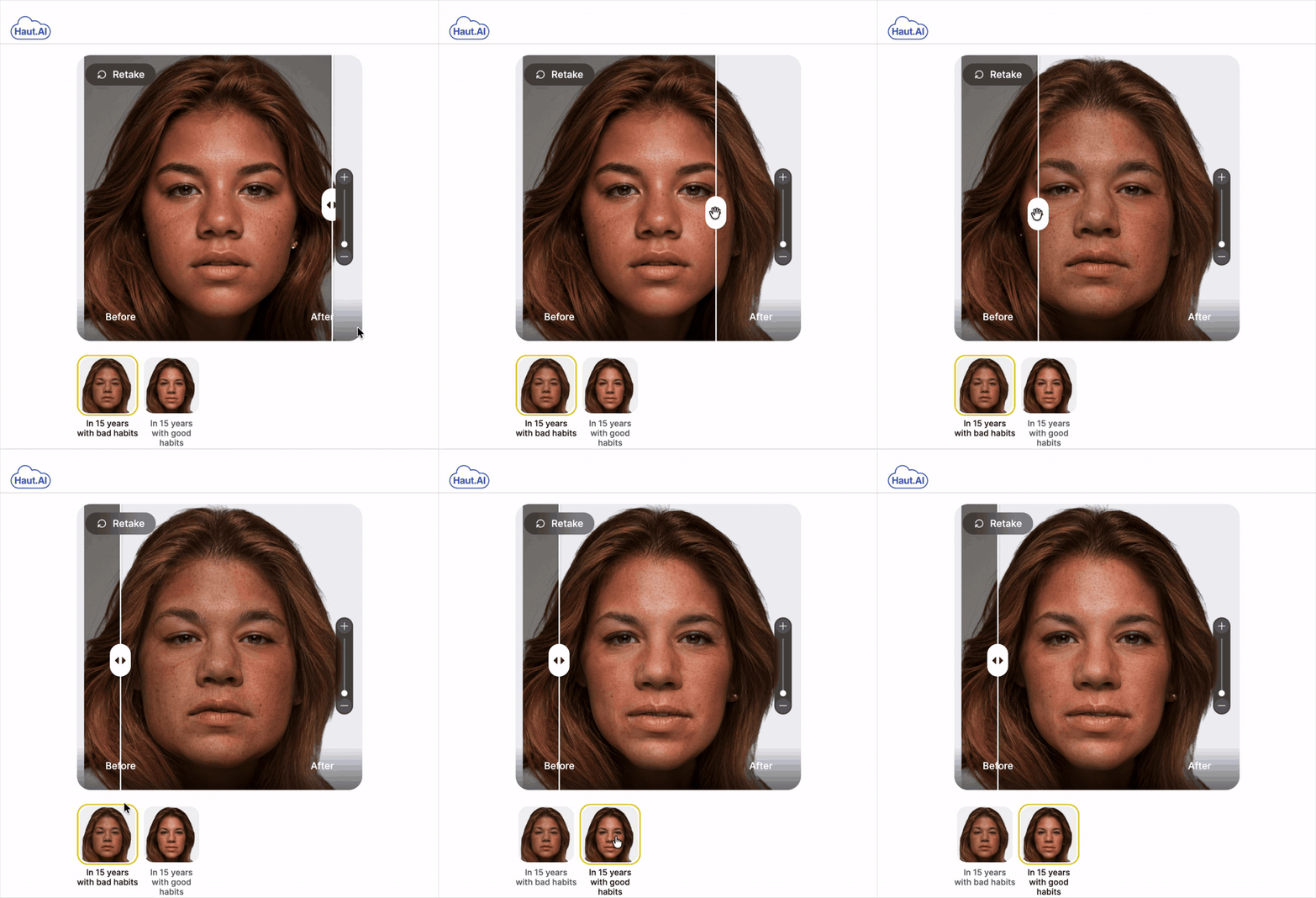
By using clinical studies, we can objectively measure how a product performs at a population level. Then we can make a visualisation of that product effect. But we always make the disclaimer that the simulation is a projection, not a promise.
In that sense, we need to trust the measurement and objective data from the study over the prediction. Objective measurement for a population is historical and real. The prediction is, in a way, an approximation of what effect can be achieved.
The thing we can additionally do nowadays is objective measurement on an individualised basis, rather than an unstructured, ad hoc population or cohort based on products sold and experiences had, or a tightly controlled study. You could do it on a personal basis.
Rather than saying, ‘I can see an end-to-end study that measured efficacy, response and so on,’ someone can say, ‘This was my skin before, this is my skin after.’ That seems like a big part of the personalisation feedback loop you talked about.
That’s correct. We can now make a projection at an individual level of how a face could change after using a product.
Another benefit of AI is that before, we had claims in the format of numbers. I would say, ‘Ben, if you use this product, your wrinkles will improve by 21%.’ But you might ask, ‘How would 25% be different from 21%?’ It’s hard for a consumer to envision that change.
If we use generative AI and SkinGPT technology developed by Haut, we can visualise it. This is much more comprehensible for the consumer. It sets up the right expectation, and expectation builds motivation.
It also sets up expectation management. You can project a realistic result so you don’t feel frustrated and disappointed if you don’t see a dramatic change, because that doesn’t mean your skin isn’t improving. Beauty is longitudinal, so you need to use a product long enough. SkinGPT sets up the expectation of what results you could achieve based on clinical data.
If we think slightly longer term about that personalisation, I’m keen to see how it plays out and who the beneficiary is. I’m paraphrasing, but in fashion at least, the current growth environment, according to Business of Fashion research and data, is close to a zero-sum game. You can grow your market share as a brand by securing it from someone else, but you can’t grow the overall pie. There’s not absolute market growth.
At the same time, fashion shoppers are more fickle than ever when it comes to brand affinity. People judge individual products on their own merits and have relatively little brand loyalty over time.
If we think about everything we’ve described, the short feedback loop and hyper-personalisation, let’s assume we build that trust in what AI can do. Is the long-term beneficiary the brand, or the consumer independent of the brand ecosystem?
I can picture a world where every beauty consumer has their own shopper passport or ID, with a detailed skin profile: all those features and biomarkers, and the time dimension you talked about. That passport is portable. They can take it across different brands’ storefronts or retailers’ selections and not lose that history, that time element.
Maybe the passport is informed by intent and memory from their LLM of choice. Maybe it’s provided by a third party. I don’t know. But I can see a different world where hyper-personalisation exists within the walls of a single brand. I buy my skincare or cosmetics from a particular brand and get personalisation within its walls, but not beyond. If I move away, I lose that personalisation, that visibility and that distinction between 21% and 25%.
I can see lock-in here. The idea of lock-in in beauty is strong because of that longitudinal element: people want the positive results they’ve had to continue. What’s your bet? Is the consumer the primary beneficiary, the brand, or somewhere in the middle?
First, I’d like to talk about the modern consumer and how they shop for skincare. The modern consumer wants to see claims, but also results. The sentiment is that consumers don’t trust brands or brand marketing. I’ll give you a statistic from Capstone: only about 2% of consumers see brand marketing as their most trustworthy source of information.
By using AI and skin measurement on an ongoing, longitudinal basis, the consumer benefits by getting an increasingly useful understanding of themselves. What are their skin parameters? How does their skin respond to different products and lifestyle changes? They can understand what ingredients they respond to best and which product categories they should target to see the most effect.
For brands, they win by understanding which channels they need to be in. AI technology can be deployed in multiple channels. Consumers are increasingly shopping on TikTok. They use websites as a source of information and additional insights about products. Then they go to YouTube to look for dermatologists’ reviews. Brands need to be in multiple channels, and a way to capture information about all those channels where consumers are is by using AI.
I’d say it’s somewhere in the middle. Consumers benefit by getting an increasingly better understanding of themselves and what works for them. Brands get more insights and information about where they need to be to meet their consumers.
If we think about AI as an intermediary, you mentioned that people spend more time interacting with ChatGPT and so on. That seems like an additional channel. What does it take as a brand to show up in an AI conversation?
Let’s say I’m sitting down and, completely de novo, asking ChatGPT about my skin concerns. How much of that eventually gets handed over as intent to a brand? How much is a brand marketing opportunity?
Fashion is spending a lot of time on what you’d refer to as generative engine optimisation or answer engine optimisation. I’m keen to hear your experience of how beauty is approaching that.
A lot of what we’re discussing in the general conversation about LLMs and beauty will be hypotheses, and to an extent speculation. Time will show what was right and wrong.
The practical takeaway for brands is that you can’t just do nothing. You don’t know exactly what to do. There’s no playbook and no rules. But doing nothing is the worst strategy at the moment.
We see different approaches to LLM partnerships. There was a big announcement between L’Oréal and OpenAI in June this year about a strategic partnership. An interesting piece of news recently is the partnership between Estée Lauder and Profound.
Brands are definitely treating LLMs as a new channel, and a strong one. Perhaps agentic shopping isn’t as popular right now, but this is where the future is. Consumers will use LLMs to shop in increasingly bigger volumes.
So far, we’ve talked about AI interactions and use cases with a couple of parties: the brand, the consumer and the AI itself. There’s an additional person here. I know you still see a role for human advisers and clinicians in these interactions.
What is the human adviser’s role now, and how do you think that will change over the next few years?
Humans’ role in beauty, aesthetics and wellness is extremely important. They bring context, judgement, empathy and a relationship with customers. Consumers trust professionals over LLMs and AI. We don’t know how long that will last. I think it will stay because we want that emotional connection.
I see AI giving scale to beauty professionals. You can’t deploy dermatology expertise digitally because there’s a limited number of dermatologists. But you can provide and democratise access to skincare for those who perhaps can’t see a dermatologist, or don’t have the time or resources.
AI will augment that human expertise. It will take away routine work, as it does in other industries such as legal or logistics. That leaves more time for human connection and direction. Consumers aren’t necessarily only shopping functionally. They may want to shop for beauty to unwind their mind and have a moment of peace. That’s exactly where the human relationship steps in.
Beauty professionals are adopting AI pretty fast. If you go to a clinic, you’ll quite often find some type of face scan to help explain skin concerns to consumers. There’s ongoing demand for tools to upskill and educate beauty associates in retail stores, spas and boutiques.
AI will give advisers better information to act on. If you think about research, one of the biggest benefits is again objective measurement and the scale AI can give professionals.
There’s a justified place for people in there. Sometimes those answers are a little unclear about the role of people, but beauty has a clear one.
Final question. When we run the idea of personalisation sufficiently far, there are two pieces to it. Fashion has learnt this the hard way: you can optimise selling things by personalising. You can optimise conversions without meaningfully doing anything for the final product experience, or, in fashion’s case, for returns.
There’s a difference between creating new experiences and ways to be sold things downstream, and using that data to change the next cycle of product development. To make better products that fit consumers’ individualised or broader bucket profiles.
Your other pillar, aside from hyper-personalisation, is AI for product innovation. Walk me through an ideal example where a brand has learnt something from consumer interactions and personalisation, then taken those findings into optimising existing product mixes or researching and introducing new ones. That seems like the bit we haven’t touched on yet, and where things head afterwards.
At Haut, we have two loops: the consumer loop and the R&D loop. They’re interconnected. Our customers typically use learnings from consumers in R&D, and vice versa.
In the consumer loop, we measure, scan, understand and recommend. If there’s a follow-up measurement, we also learn what the outcome was. But by making one single measurement, we’re already learning about the audience, skin profiles and market demand for different types of products.
The R&D loop also measures the population, analyses and learns what the product effect is. You can use that data to improve the product. By combining clinical data about product performance and demand from consumers based on their skin profiles, you can identify new niches to target with your products.
What are these unique skin profiles that haven’t been addressed? You can then run a new study targeted at that consumer profile and generate data.
What’s valuable about clinical data is that you can also use it to target new channels such as LLMs. In beauty, it looks like LLMs are favouring brands with clinical evidence and clinical backing. By providing clinical data about product performance, you can potentially show up better in LLMs.
You’re not only using AI to improve existing product catalogues. You can identify which new products need to enter product development. Your NPD department will probably be very happy to get that intel. In a way, we’re learning from both consumers and R&D, hopefully creating better products for an audience that has demand for them.
Very final question. We’ll be doing an AI Report again in spring or summer 2027. Without putting too fine a timeline on it, if I wanted to pay attention to something happening with AI for beauty that isn’t earning the headlines it should, or hasn’t percolated to the top of people’s attention, what should I look at? What will be a significant force in AI for beauty by next summer?
On the consumer side, longitudinal measurement is still undervalued. There’s nothing like Oura for skin, where you can track your skin changes daily, weekly and annually. I think we’ll see a breakthrough in beauty that starts collecting much more evidence that’s longitudinal in nature. We’ll use AI to track those changes over time.
And from the brand side? That’s a good answer for the consumer. Is there anything happening with AI from the brand perspective that we should pay attention to?
AI is driving new ingredient development. There’ll be ongoing releases of new ingredients with new claims and performance. The whole industry is moving towards products that not only have an emotional connection with consumers, but also very strong clinicals.
This will be one of the bigger transformations: consumers will increasingly expect more performance, more claims and new ingredients. AI will play a big role by helping discover those ingredients, measuring their performance for different audiences and improving marketing: who to target with those new products.
There’s AI embedded in a much bigger loop there. It’s fascinating to see how that plays out. Anastasia, thanks for letting me quiz you on so many different things today. It’s been a pleasure talking to you.
Thank you so much, Ben.
That’s the end of my conversation with Anastasia. Like I promised upfront, she has a real scientist’s perspective on things. I don’t just mean where AI is being incorporated into scientific discovery and development, but where it crosses over with some of the biggest things the beauty industry wants to accomplish in its relationship with consumers. Many of those are things fashion wants to accomplish in its relationship with consumers as well.
I hope you’ve enjoyed this one. I certainly did. We have a very different topic next week, and Grace and I will be back on Tuesday with The Edit as well. I’ll talk to you again really soon.