The Interline has been on-record for a long time about the difference between visualising something and being able to actually make it. For a long time, the route between these two disciplines has been for technology companies experienced in product design and development to grow their visualisation capabilities. Now, the opposite trajectory is in effect, as evidenced by Fermat’s announcement of “Techpacks”.
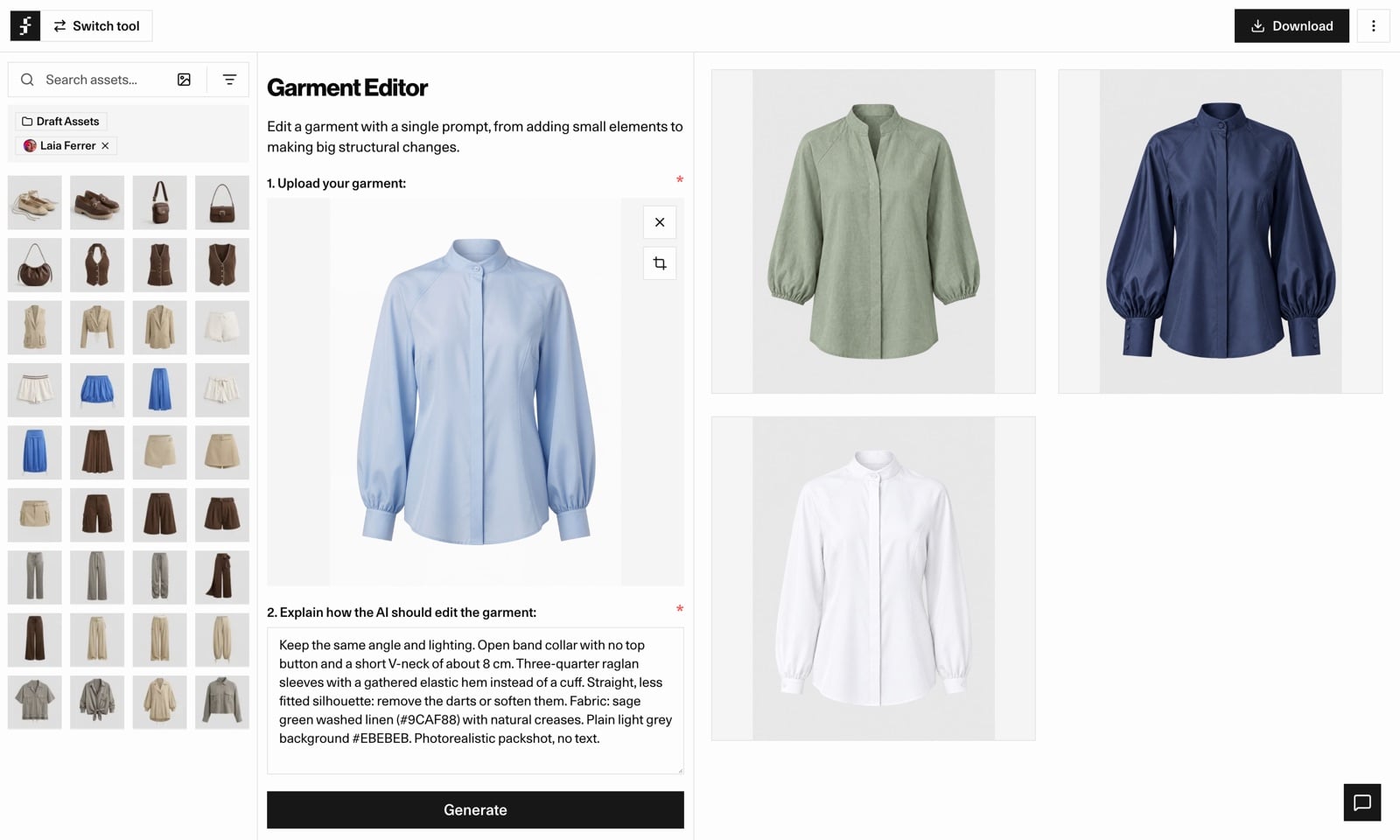
Today, the Barcelona company announced that it has raised $8 million in a seed round led by Kibo Ventures and Lunar Ventures, with participation from PROfounders Capital. It says the funding will support a New York office, but also expansion of the platform footprint from design and into garment production.
That expansion already seems to be underway with the launch of Techpacks, which Fermat says generates technical flats, measurements, construction details, bills of materials and colourways – most of the constituent parts of a technical specification, in other words.
The company also says its revenue has tripled since the start of 2026, and that it now has more than 350 customers, including ASOS, J. Crew Group, and New Look. Which, given the demand for AI tools that our team is observing, all seems feasible.
This news is also another major push for AI-native workflows into areas that fashion professionals have, so far, perceived the technology to be least mature. But it also represents a potentially new frontier where creative tools operate much closer to development systems. As Ben discussed in our interview with FLORA, styles were historically designed in Illustrator, but they became producible in 3D and PLM.
Pol Baladas, CEO and Co-founder of Fermat, is quoted in the release as saying: “Fashion is an industry starving for good software tools, and generative AI is the first technology that can match its need for speed. In five years, no brand will work without it. We’re building Fermat to be the tool designers use from first sketch to production. It feels like the right time to open an office in the US as a third of our revenue already comes from there, without a single person being on the ground–until now.”
The Interline will need to evaluate these new tools in earnest, but if the promise plays out, then having the ability to generate both a visual representation and a producible garment in a single workspace could be the start of a different way of working.
Nick Eley, Head of Digital Product Creation at ASOS, who wrote for The Interline’s DPC Report last year, is also quoted in the release as saying: “Fermat transforms our sampling process from weeks to minutes. Designers communicate vision to suppliers without physical samples. This isn’t just time saved – it’s a fundamental change in how we develop products.”