

Made2Flow is a sustainability technology company helping fashion brands transform fragmented supply-chain data into actionable Life Cycle Assessment (LCA) and decarbonization intelligence. Founded in Germany in 2020, the company has developed one of the industry’s most advanced proprietary environmental datasets, covering more than 16,000 suppliers across tiers 1–4 and over 10 million primary data points, including energy mix, production processes, chemistry, and fugitive emissions data across 53 countries.
This unique data foundation has been used to train machine-learning models capable of delivering credible, audit-ready environmental calculations at both product and facility level. By combining AI, supply-chain expertise, and environmental modelling and intelligence, Made2Flow enables brands and suppliers to move beyond static, single-solution sustainability reporting toward continuous, data-driven decision-making at the point of action – accelerating emissions reductions, supporting regulatory compliance and disclosure, and unlocking native product transparency.
Services
Fashion supply chains generate vast amounts of inconsistent and incomplete sustainability data, for which there is no agreed system of record. That data has become more critical, but it remains spread across ERP systems, PLMs, spreadsheets, supplier documents, certifications, PDFs, and manual reporting processes. Made2Flow removes this operational complexity by automating the collection, standardization, enrichment, and validation of environmental data across multi-tier supply chains – providing brands with a single source of environmental sustainability data.
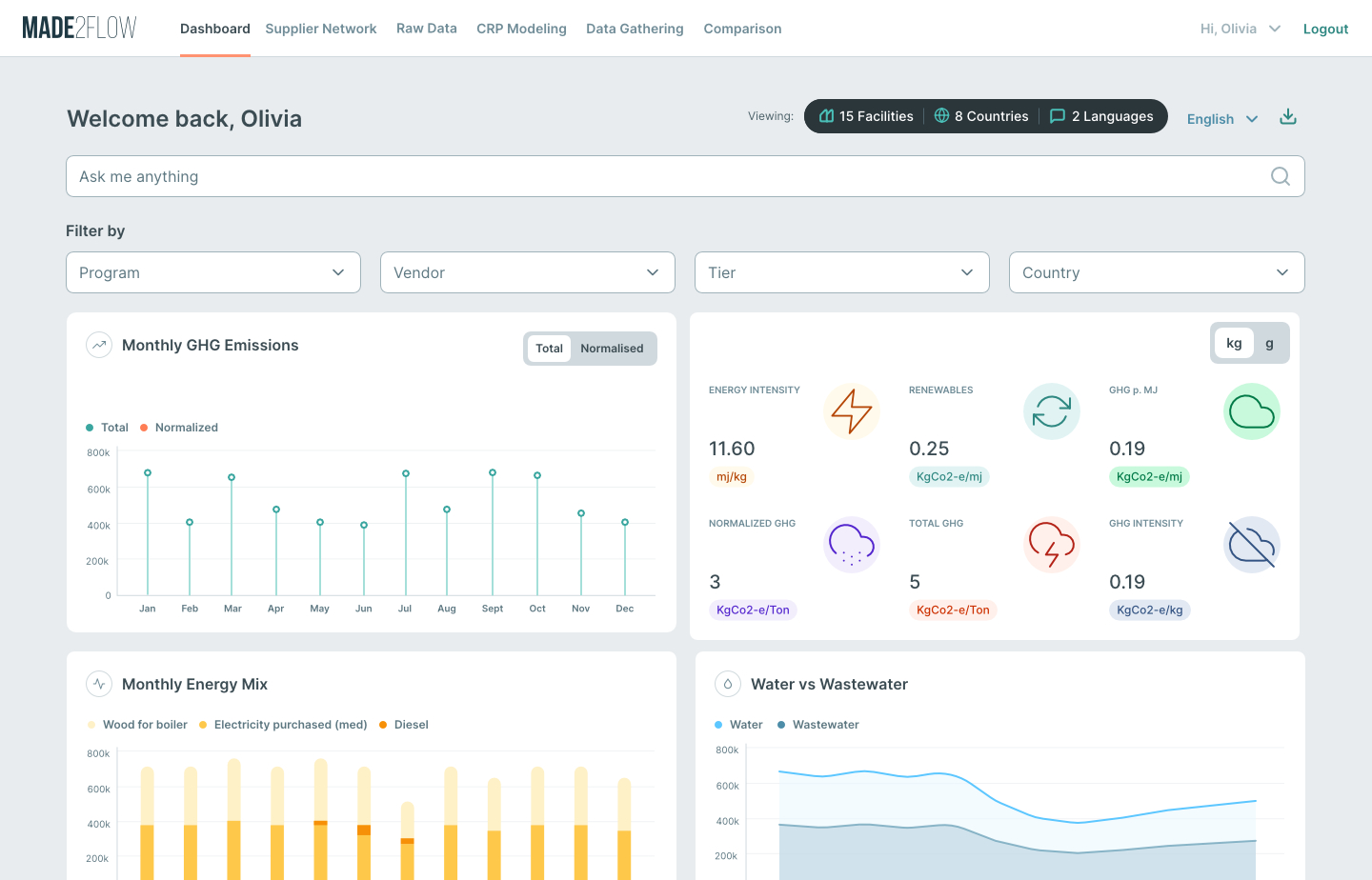
The platform enables brands and suppliers to:
- Standardize data from multiple systems and formats into one unified environmental data layer
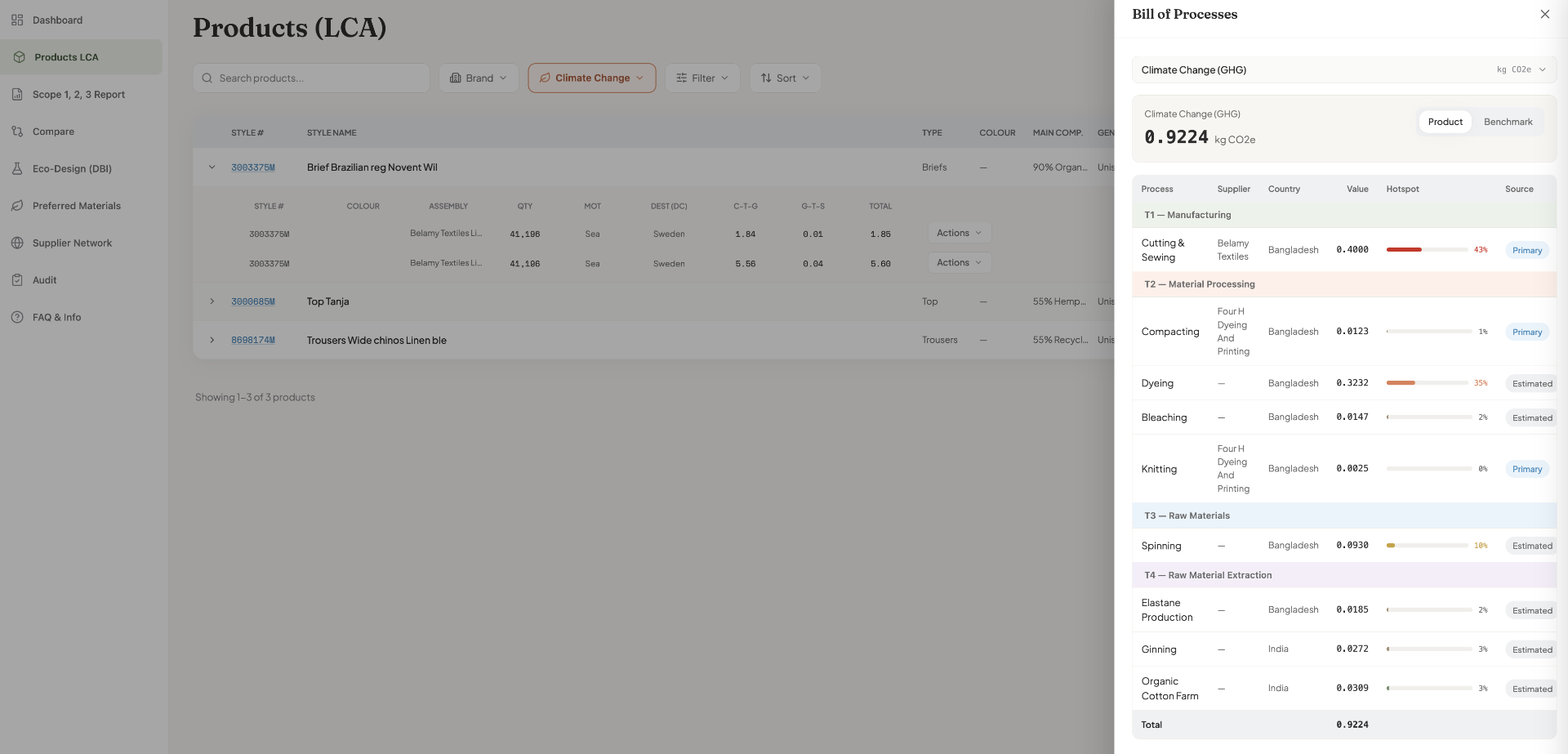
- Implement data-backed due diligence, disclosure, and reporting at scale, by measuring all their products (20k +) with automated LCA calculations, using verified primary and secondary datasets
- Validate supplier submissions through AI-based anomaly detection, benchmarking, and quality checks
- Extract and structure information from existing documents and paper-based records using automated document intelligence
- Shine a light on Scope 3. Made2Flow provides automated conversion of LCA generated data into multiple scope 3 categories such as category 1, 4, 11, 12 and more.
- Deliver on the demand for Digital Product Passports (DPP), by shipping with a phase 3 ready DPP data model.
- Generate audit-ready outputs aligned with leading frameworks including PEFCR, CSRD, CSDDD, SBTi.
- Share reliable sustainability data seamlessly with suppliers, sourcing teams, and downstream stakeholders
- Make transparency part of their technology estate, with a bidirectional API that allows for transmission and retrieval of data from PLM, ERP, and other enterprise platforms.
By reducing manual work while significantly improving data quality and credibility, Made2Flow helps organizations strengthen supply-chain resilience, accelerate decarbonization efforts, and lower operational and reporting costs, helping to shift sustainability from a cost center to a competitive edge.
Clients
Made2Flow works with leading fashion brands, manufacturers, and global suppliers seeking scalable product transparency and decarbonization capabilities. One example is its collaboration with Promocean (Li & Fung Group), where Made2Flow transformed fragmented ERP and supplier data into validated Digital Product Passport-ready datasets.
The implementation generated more than 2,000 Bills of Materials across 672 product categories, identified over 400 suppliers, and achieved 78% automated data validation accuracy. The project improved supply-chain transparency, accelerated compliance readiness, and strengthened supplier engagement in sustainability and decarbonization initiatives.
Philosophy
Many sustainability platforms still rely heavily on generalized assumptions, closed-book methodologies, disconnected spreadsheets, manual supplier questionnaires, and ways to roll up data that do not translate into real insight and intelligence. The result is often slow reporting cycles, low supplier participation, and environmental calculations that are difficult to verify, stand by, or operationalize. Made2Flow was built on the belief that credible sustainability decisions require credible data infrastructure, and that building that infrastructure does not need to become a never-ending project by itself.
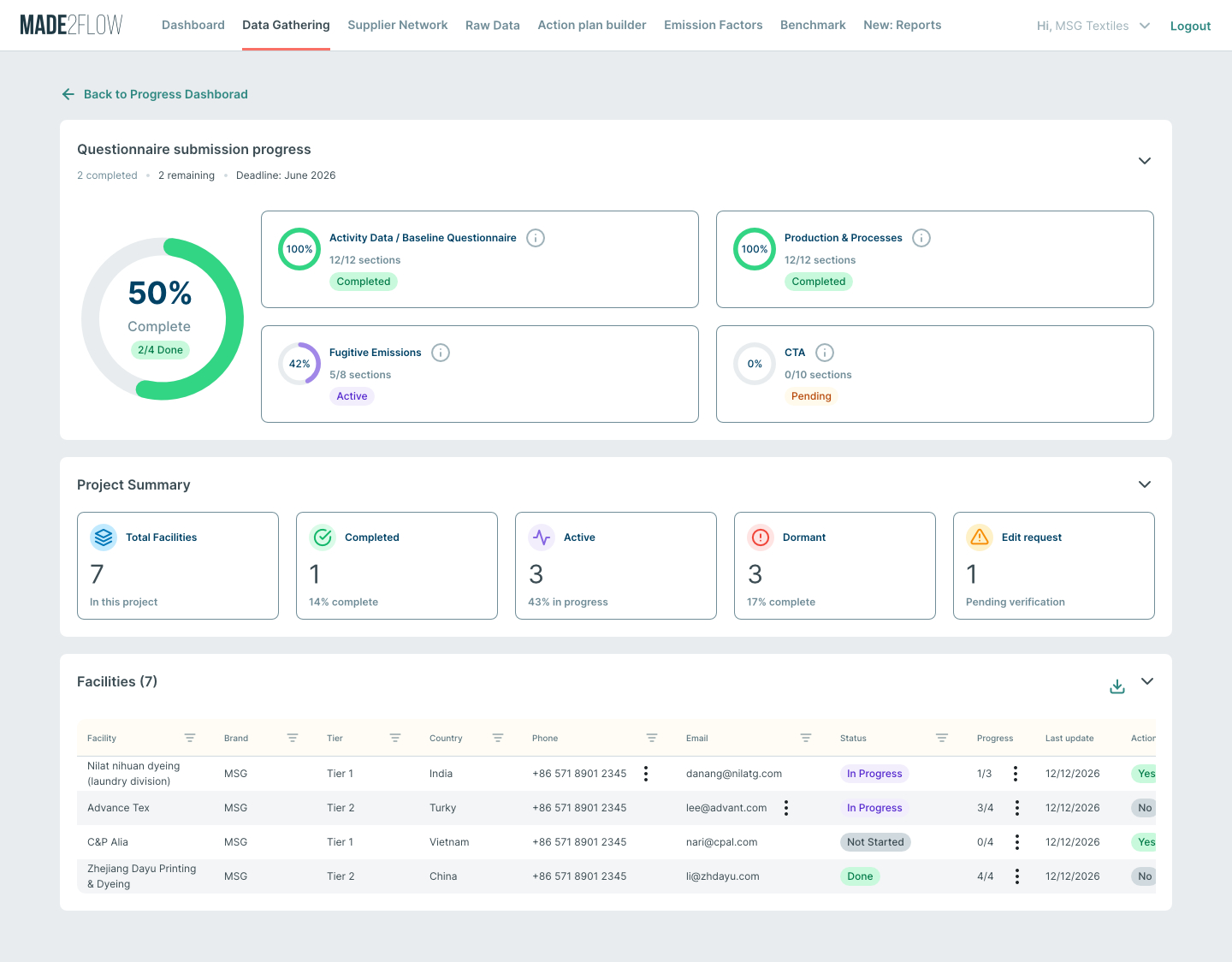
Our approach combines automation, artificial intelligence, and deep supply-chain expertise to bridge the gap between fragmented operational systems and trustworthy environmental intelligence. Rather than forcing suppliers into entirely new workflows, Made2Flow works with existing data structures, enriches missing information using validated secondary datasets, and continuously improves data quality through AI-driven verification and benchmarking.
This approach is increasingly important as the fashion industry moves toward stricter transparency regulations and product-level accountability. Sustainability data is no longer needed only for annual reporting – brands require dynamic, decision-ready insights embedded directly into sourcing, product development, procurement, and supplier engagement processes.
Made2Flow’s mission is to help brands and suppliers move beyond compliance-driven reporting toward scalable, cost-effective decarbonization action. By transforming fragmented supply-chain information into transparent, validated, and shareable environmental intelligence, the platform enables organizations to reduce emissions faster, improve supplier collaboration, and build greater trust with regulators, business partners, and consumers.
Key Features
AI-Driven Data Standardization
Automatically harmonizes fragmented sustainability data from PLMs, ERPs, supplier spreadsheets, certifications, and traceability systems into one structured, analysis-ready environmental data layer, which can then be called upon by other enterprise platforms and, starting September 2026, AI agents.
Parses and makes sense of documentation disarray, ingesting and normalising thousands of documents and millions of data points across multiple data lakes (PLM, ERP, Traceability platforms) and countless spreadsheets & certifications into one structured unified taxonomy, which then populates an analysis-ready environmental data platform.
Through an extensive R&D project and collaboration with the Alan Turing research institute, at Manchester University (supported by The Interline) Made2Flow has driven down reliance on costly APIs, and made significant improvements in the ability to directly ingest raw data. This has a marked impact on the platform’s ability to consolidate information from different sources, and it has also unlocked an industry first: giving brands the tools to have a natural language conversation with their supply chain data. With AI properly grounded in auditable intelligence, users can simply talk to grasp environmental impacts in different scenarios, to dive deeper into their LCA results, to run what-if scenarios to find alternative inputs and sourcing partnerships, and to make sustainability intelligence that was previously locked to small teams available across the extended organization.
Credible LCA Calculations
Combines supplier-specific primary data with a rich proprietary secondary-data database covering thousands of suppliers, materials, industrial processes, and regional production conditions to improve calculation accuracy, completeness, and credibility.
AI-Based Data Validation
Machine-learning models continuously benchmark and validate incoming supplier data, identify anomalies, close data gaps, and improve transparency across complex multi-tier supply chains.
Automated Document Intelligence
Reads and extracts information from PDFs, certifications, invoices, Bills of Materials (BOMs), and other supplier documents, significantly reducing manual data-entry requirements and accelerating reporting readiness.
Supplier-Friendly Collaboration
Enables suppliers to leverage existing operational and production data rather than creating entirely new reporting workflows, simplifying data sharing for Digital Product Passports, Scope 3 accounting, and regulatory compliance initiatives.