This article was originally released in The Interline’s AI Report 2026.
Including profiles and exclusive interviews with 17 AI companies, stories and opinions from 12 different industry perspectives, and real survey feedback from around 100 voices from every level of fashion, bottled and analysed, The AI Report 2026 is essential reading for anyone interested in AI for fashion.
For as long as fashion has been taught, people have always been the sole participants in both the educational process and in the industry’s operations. I studied Fashion Marketing, where originality and visual identity are top priorities – both things that humans have historically had the sole claim to being able to create and own. My peers in other courses would, until very recently, have had the same assumption.
Now, artificial intelligence has started to co-opt that role. In my interactions with academics, fellow students, and industry professionals, I’ve seen how AI has rapidly gone from having a fairly minor role in how fashion thinks about and uses technology, to being put at the centre of how the business works – and to being placed at the core of how the next generation are taught to create.
Initially, AI helped forecast trends and improved production and cutting room efficiency. Now, as I and the students I studied with, are going into the workforce, it generates images for in-house teams and external audiences, writes copy, constructs moodboards, and supports design development.
Without trying to sound dramatic, this raises a big question for me and my generation, that no previous generation has had to ask in quite the same way. What does human creativity mean when machines are active participants in processes that were previously owned exclusively by people, and that people went to university to learn how to do?
I’m sure brands and their supply chain partners are asking that same question right now; this is not an issue that’s exclusive to people navigating the transition from learning to practicing. But this also feels like a vital moment to try and document how emerging creatives, across different fashion disciplines, are adapting to the rise of AI in their fields. Because there’s a difference between having a job you’ve performed for years change underneath you, and going into an entirely new role, straight from education, and finding it has a very different shape to what you might have expected when you began your course.
To assess some of that sentiment, our student-led agency, Westminster Fashion, surveyed students and recent graduates across the University of Westminster’s fashion courses, from design, marketing, and business backgrounds.
The result is a small dataset, confined to one part of the UK. But although we would love to see how it compares to the feelings of other students in other parts of the country, or further afield, I think it’s a meaningful one. And it will come as no surprise to anyone who’s seen the survey in this report, or the wider cohort studies that have made mainstream headlines, that AI is viewed as a tool, as a threat, and as an unavoidable part of the industry’s future.
In our specific, narrow, study of new and aspiring graduates, attitudes towards AI in fashion were deeply divided. 59% of us said it would mostly threaten opportunities, against just 12% who saw it as mostly an opportunity itself. The qualitative sentiment behind that finding also tilted away from optimism: nearly half said they felt worried, and only one respondent admitted to being excited. The rest landed somewhere in between: mixed, wary or cautiously optimistic.
We often hear that AI is inevitable, which may be true. But this doesn’t sound like a generation that has made its peace with that idea today.
Interestingly, though, this caution does not stop us from using the tools. Around seven in ten of us reach for AI at least occasionally, though most only rarely, And just 12% use it regularly. Where we use it is the giveaway: writing and copy came first, then admin and research. Image creation, idea generation and design development trailed behind.
In brief, students right now are using AI to support the work they want to do, not to create it. Although I will note that, had we surveyed students on research and writing-centric tracks [I studied classical literature at university! – Editor’s note] then the gap between the work and the acceptable use of AI would be much tighter.
This is a complicated idea, and it cuts to the heart of why this generation’s attitudes towards AI, and the way they interact with it, can feel so confused from the outside. The students who raised concerns were not outright rejecting AI, but they were reluctant to let it do anything they saw as fundamental to the creative process. Idea
generation, image-making, and design development are probably the most potent examples of tasks that had always been reserved for humans, so it stands to reason that they will be the hardest to let go of.
And that kind of letting-go (if indeed it ends being accepted as necessary) will be where the strongest resistance comes from. One student we talked to argued that AI has no place in fashion design at all, because it recycles existing material rather than making anything new. Another asked why a creative industry would adopt tools that risk pushing out the writers, designers and illustrators it depends on to differentiate one brand from the next.
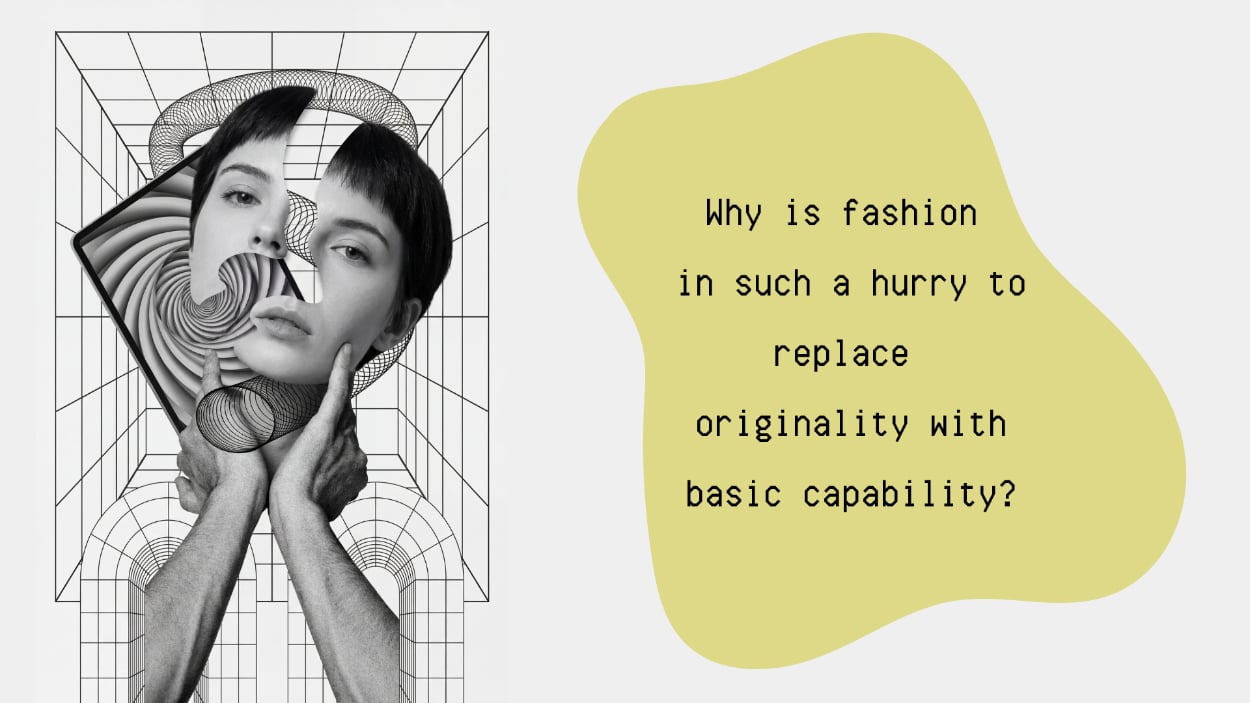
In other words: why is fashion in such a hurry to replace originality with basic capability?
Fashion education, after all, is built around experimentation and refinement, and key to that practice is allowing ideas to develop gradually. Several of us questioned the impact of technologies that prioritise quick results, because speed, we’re taught, can be antithetical to creativity.
So while AI can speed up production, there is concern amongst students that that convenience could come at the expense of exploration, risking ideas becoming derivative or too reliant on algorithmic suggestions – all of which undermines the need for the skills we have spent years acquiring, and are now ready to practice.
So it won’t come as a shock to know that the survey also exposed how unprepared many of us feel to enter a workforce that now seems to think very differently about what work really is. Only around a quarter of students felt their course was actually getting them ready to use AI in a creative field. A similar share felt poorly prepared, and the largest group, 41%, simply were not sure what parts of what they’d learned were really applicable to employment.
Some saw an opportunity for new courses to help them catch up. Others worried that AI is arriving in our education with no real conversation about its ethics, or its effect on how we learn to create. And I cannot help but think that, if generative AI is taught as a basic technology the way Adobe Illustrator or Excel are, for designers and merchandisers respectively, then this generation will miss an opportunity.
So at the risk of falling back on nuance as an excuse, the reality is that, at least in education, students are neither accepting nor outright rejecting AI. Instead, they are negotiating with it, with the industry that’s implementing it, and with the educational institutions that are finding the right ways to teach it.
The one place this nuance doesn’t really exist is in the ethics of AI. Students expressed some deep concerns – particularly regarding consent, authorship, and the use of existing creative work to train these systems, as well as the environmental costs of the infrastructure supporting them.
These concerns are relevant to fashion, because a lot of my generation has been preparing to enter the industry with a mandate for change. Lots of the people learning to work in fashion intend – maybe idealistically – to enter the industry and then tackle its legacy of overproduction, rapid trend cycles, and its significant environmental impact. Because we’re told that AI is a tool for efficiency and optimisation, we worry that, rather than resolving existing issues, rolling AI out could reinforce the very systems that contribute to waste.
This same feeling manifests in how students want to talk about, explore, and challenge AI in education – because many of us worry that AI is being introduced into both industry workflows and curriculums without discussion of its ethical and creative implications.
The final thing to take away from our study is a feeling of resignation. You’ll often hear that this generation feels as though it is being handed a shrinking possibility horizon compared to previous generations. In my experience that feeling isn’t universal, and many students believe they can accomplish what they aim to. But it’s also true that many young people believe that resisting AI is not realistic when it is already built into the industry we are about to enter, and that refusing to engage with it could narrow our own options. One described it as a tool “we’re learning to question, shape and integrate into creative practice,” which feels closer to where most of us actually are than outright opposition. Another pointed out that our generation tends to be more cynical about AI precisely because our careers are on the line, while those already established use it more freely and worry less. Again: I do not know this first-hand, but I suspect that feeling your job change around you is less immediately scary than feeling as though the job you thought you could have might not exist by the time you’re qualified to do it.
Students and graduates like me will not be the ones who get to decide whether or not AI belongs in fashion. But we do hope we get to help determine what kind of creative culture gets built around it, what guardrails end up being set up to govern it, and what we should be asked to sacrifice to make it work.