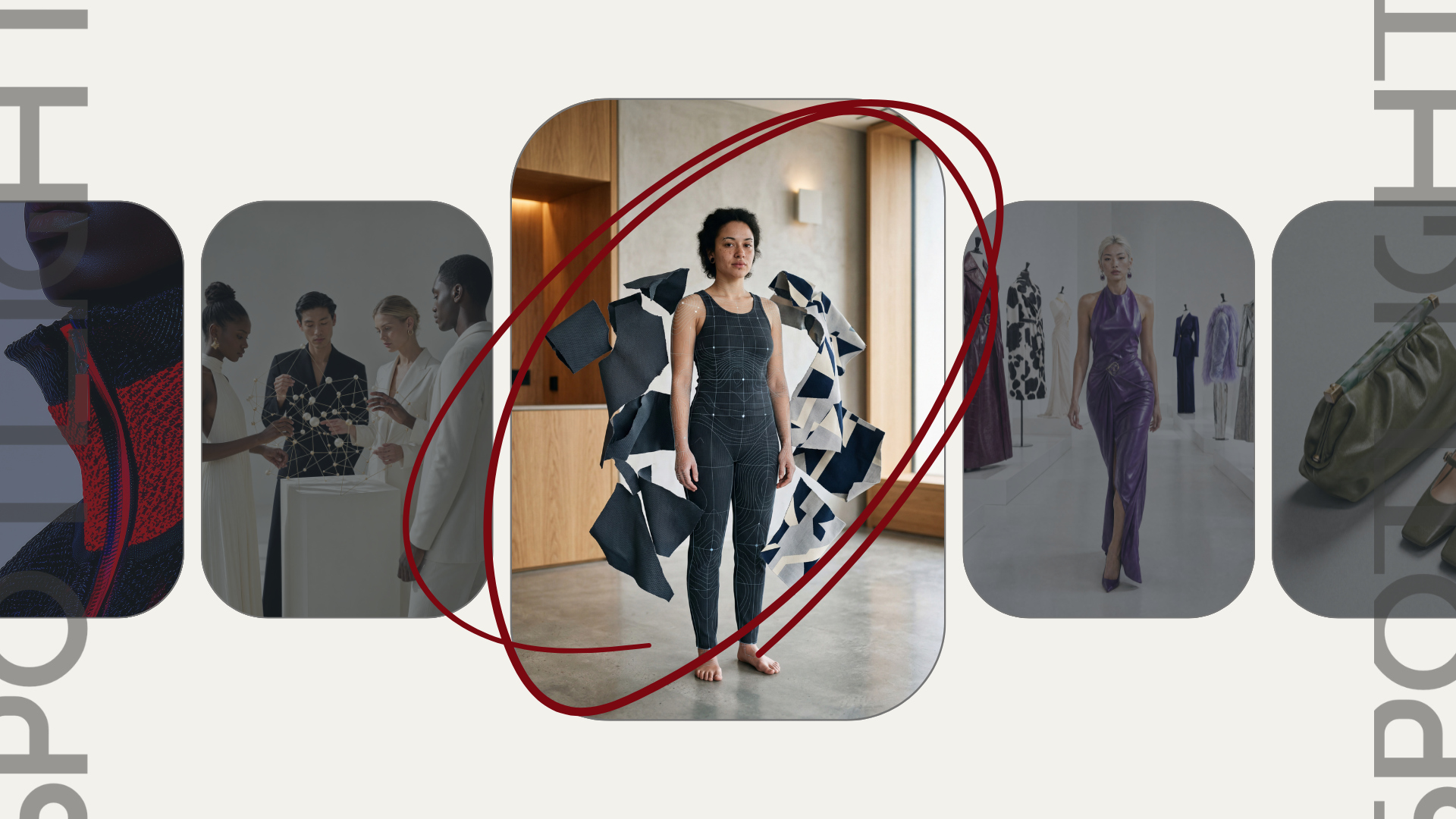
Released in The Interline’s new Solution Spotlight, this is the third in a 13-part series examining where fashion is looking to invest in technology, process by process, and the maturity level each stage has reached.
Download the full Solution Spotlight for a deep-dive on SAIZ, our sponsor for this instalment, and to discover other technology vendors who are supporting one or more vital fashion functions in 2026-27.
As important as technology has become to the moving goalposts of fit, solving the industry’s sizing crisis is not, at least not any more, a technology problem.
Before understanding why, though, it’s essential to reckon with the scale of that crisis.
Returns cost US retail alone an estimated $890 billion in 2024, according to statistics from the National Retail Federation and Statista, and depending on market segment and geography, eCommerce apparel return rates sit anywhere between 10% and 50% of every product sold.
While there are other contributing factors to these stratospheric figures (inaccurate product images, perceive and actual quality, colour and so on) the largest influence on whether a product purchased remotely is kept or sent back is how well it fits. And as digital commerce has exploded in volume – with mobile now accounting for more than half of all online commerce, according to holiday 2025 statistics from Adobe – more and more products are sold this way, sight-unseen, with significant amounts of trust being placed in how a garment looks in photography, and how its fit is conveyed, through measurements, suggestions, and descriptions, to consumers.
Taken together with business models built around free shipping and free returns (some of which, we should note, are now being walked back), these statistics are behind the phenomenon of “wardrobing,” whereby consumers purchase multiple sizes of a style that appeals to them, and then return the ones that they consider not to fit. For shoppers who can’t or won’t visit a physical store, the easiest fitting room has become their own living rooms.

Implicit in that trend, though, is a deeper idea: that, just as brands struggle to effectively communicate whether or not a garment or a shoe will fit a prospective shopper, the shopper themselves has no mechanism to convey what they consider to be “good fit”.
And in between those two avenues of misunderstanding and miscommunication, fashion has spent at least the last five years attempting to apply technology to a set of nested problems that only partly have technology solutions.
Body scanning, for instance, would, at first glance, seem like an ideal way to address this challenge. If shoppers are looking at product images and arcane charts in the privacy of their own homes, would it not be logical to capture their measurements (through direct input in the crudest sense, or through photographic measurement and machine learning in the most modern) and then directly map one set of datapoints – points of measure, specifically – onto the other? And wouldn’t being able to pair those things in a 3D simulation be the ultimate foil?
Theoretically, yes, but in practice both approaches crash up against several considerations.
The first is behavioural: even in their bedrooms, people do not always feel like stripping down to their underwear and taking front and profile photos, then having those synthesised into a finite model of a body that they have very personal feelings about, even if we park the discomfort that they might have about data privacy. As a brand or retailer, presenting a buyer with an objective, uncompromising look at their own body is not usually desirable – and putting an uncomfortable technology barrier between the act of browsing and the output of a sizing visualisation often leads right back to wardrobing.
The second is founded in data, or the lack thereof: while brands design to fit models and then extrapolate grading rules and size ranges from that centre, the information behind those tools is often out of date or based on assumptions. Those assumptions can be commercial (speaking on The Interline Podcast earlier this year, Style Arcade’s Michaela Wessels explained how distorted data coming from retail channels leads to companies misunderstanding what sizes to stock, when to replenish them, and how much of an impact sizing really has on their bottom line) or they can be foundational, based on the fact that brands operate from broad-brush sizing surveys taken years, or even decades ago, or from limited snapshots of their current customer base – or stemming from the reality that many brands do not own their blocks, and instead work with suppliers who become the gatekeepers of fit, despite operating at several removes from the party, the shopper, who dictates whether or not something actually “fits”.
Third: the way the shopper thinks about that air-quote definition, “fit,” can be very different to how the brand sees it, and while this challenge is anchored, to some extent, in limitations of demographic sizing data, it has far deeper roots in social, cultural, and personal considerations. While there is no disputing whether or not a 1:1, millimetre-accurate body scan is objectively “correct,” there are only a few select scenarios where that scientific correctness is actually something the consumer wants to be exposed to, or considers to be useful.


Fit, as a broader concept, is built on those objective measurements, but it is expressed as a subjective preference. The simplified version of this fit preference lumped into buckets: one shopper might prefer a boxy fit t-shirt, while another wants something that’s more closely-fitted. The more complex version is that, within those broad categories, there are people whose bodies do not conform to historic rules: the rise of GLP-1s (Ozempic, Mounjaro etc) have become the common touchstones for the idea that bodies can change more quickly than linear guidelines account for, but the same trend has been percolating for much longer, with everything from the uptick of strength training in women to cosmetic surgery separating traditional assumptions from market reality.
And as much as The Interline believes in the value of 3D simulation, and applauds the progress in areas like soft body avatars, these represent a technology-first approach that assumes its inputs are both technically correct and have undergone a process of cultural auditing that few brands have performed.
In reality, then, the solution to fit is not – and is not likely to ever be – a single product or a discrete technology solution. The answer will be based on body data and consumer preferences that are both scientific and deeply subjective. It will draw on digital avatars and eCommerce-storefront widgets alike. It will pull in both the direction of merchandising spreadsheets and downstream, as well as creating a loop between the two.
As it stands today, companies like SAIZ have done arguably the best job of weaving together these different components into what they refer to as a “Fit Intelligence” platform. As the name suggests, this kind of platform is based on body data not just as a standalone artifact, but as a living, connected layer that can then drive decision-making (both brand and consumer) across all the different surfaces where fit, and fit preference can be expressed.
Technology for fit, then, will manifest itself in very visible places (size charts, recommendation engines, cross-brand methods of weighting and paralleling fit, customer avatars and more) but brands and retailers should not be looking to buy a monolithic solution to a multi-faceted problem. Instead, the return on investment in fit technology will be measured as much in the stories that brands and their shoppers collectively tell as it will in reductions in returns.
