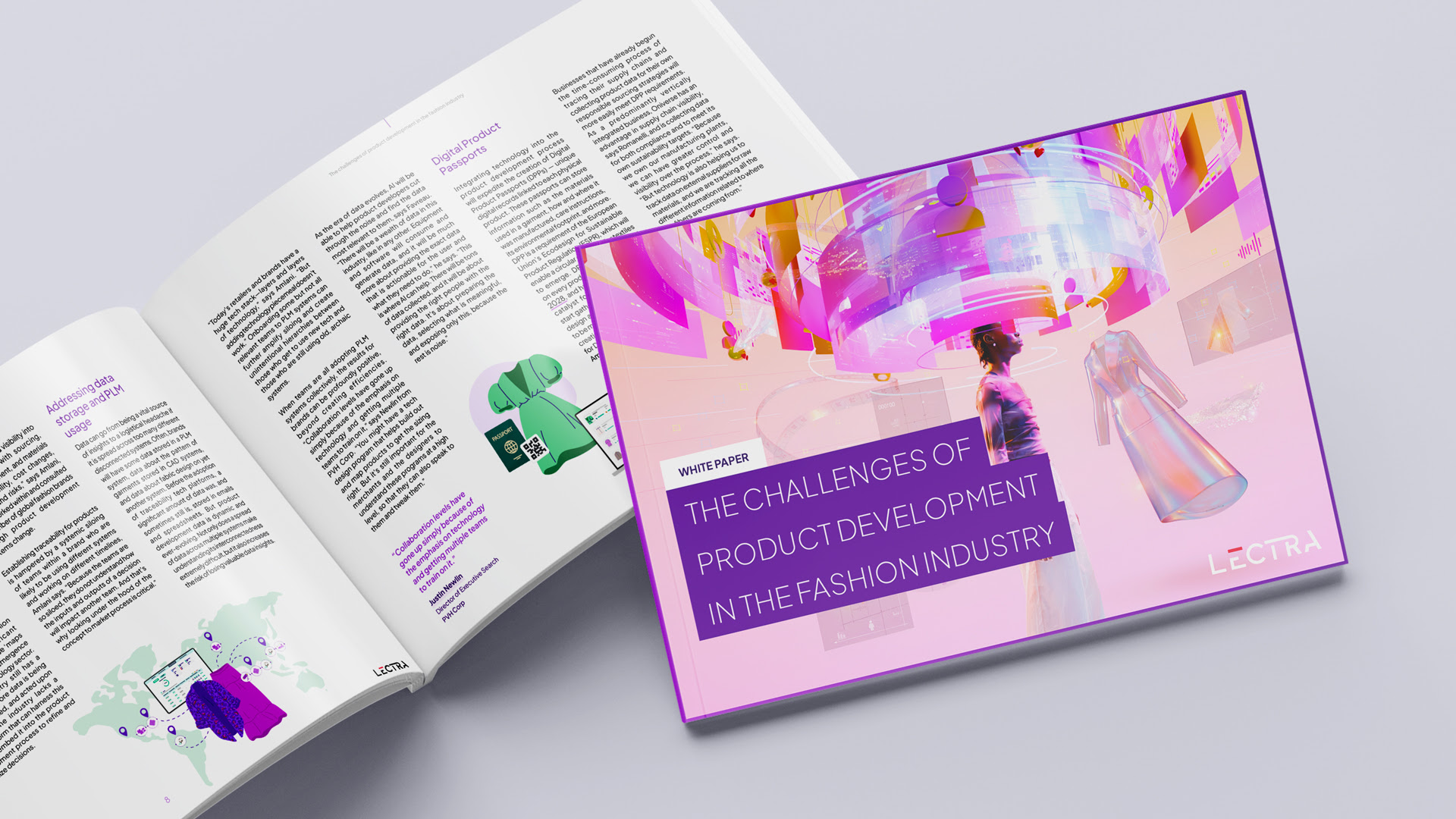

Paris, March 4th 2026–The Lectra Observatory which studies innovation and change in the fashion, furniture, and automotive markets, has published a new white paper entitled “The challenges of product development in the fashion industry”. The report deep dives into three decisive factors – talent and knowledge transfer, data-driven decision-making, and the connection between design and production – as essential drivers for accelerating innovation and operational excellence.
Product development in fashion is the complex process of transforming creative concepts into manufacturable items, involving everything from fit and fabric choices to technical specifications and prototypes. Despite the industry’s reputation for innovation, when it comes to product development, methods have barely evolved. Amid persistent disruption – from the pandemic to geopolitical instability, supply chain volatility, and rising material costs – brands face mounting pressure to improve efficiency, resilience, and regulatory transparency.
Modernizing product development offers one of the sector’s strongest levers for transformation, with emerging technologies such as advanced 2D/3D solutions and AI – poised to accelerate timelines, reduce administrative work, and strengthen data capture. Unlocking this potential, however, requires rethinking roles, workflows, and the connection between design and production – an opportunity explored in this white paper through the lenses of talent, data, and process integration.
Contribution of experts from the fashion industry
In this white paper, the Lectra Observatory appealed to a wide array of players from the fashion industry, including: Liza Amlani, Principal and Co-Founder at Retail Strategy Group, Matteo Secoli, President of Istituto Secoli, Justin Newlin, Director of Executive Search, PVH Corp, Giulio Romanelli, Technical Engineering Project Coordinator at Oniverse, Joanna Tripp Ortiz, Design Operations Director at Wacoal America, and Nicolas Favreau, Vice President Offer Strategy at Lectra
“With the Lectra Observatory, we bring together leading experts to uncover the industry’s key challenges and opportunities, and to spotlight the technologies and innovations that will help fashion players drive their transformation,” explains Maria Modrono, Chief Marketing and Communications officer at Lectra. “This white paper, dedicated to product development in the fashion industry, highlights the need for fashion players to adopt technology in ways that support both new and experienced teams, preserving craftsmanship while making workflows more intuitive. Companies that integrate AI thoughtfully with existing tools are already building more resilient, future-ready organizations.”
This white paper is the fourth dedicated to the fashion industry, following the one dedicated to Sustainable fashion, Better create, manufacture and market, and Mapping worldwide traceability and transparency regulations for sustainable fashion.” To read our latest white paper dedicated to product development in the fashion industry, click here. All Lectra Observatory white papers are available here.
Get a glimpse on the three decisive factors developed in the white paper – talent and knowledge transfer, data-driven decision-making, and the connection between design and production – as essential drivers for accelerating innovation and operational excellence.
- Design–production link: Design and production remain poorly connected, causing avoidable rework. Limited access to manufacturing constraints and inconsistent tools slow teams down. Although 3D helps, adoption is uneven. The future lies in solutions unifying 2D, 3D, AI, and manufacturing data to make products “manufacturable by design” from the start.
- Human resources & knowledge transfer: Fashion development is digitizing, but many brands still rely on manual, expert-driven processes. Teams face fragmented tools, uneven digital skills, and fear of tech replacing craftsmanship. To move forward, brands must balance human expertise with technology, digitize know-how to preserve brand DNA, and use AI to remove repetitive tasks and support better decisions.
- Role of data: Data is critical but remains scattered across systems, limiting visibility and traceability. Integrated platforms and AI can streamline collaboration and highlight key insights. With regulations like Digital Product Passports approaching, brands that structure their supply chain data now will be better prepared and more sustainable. Centralizing material data improves forecasting and reduces waste.
About Lectra:
At the forefront of innovation since its founding in 1973, Lectra provides industrial intelligence technology solutions – combining software in SaaS mode, cutting equipment, data, and associated services – to players in the fashion, automotive and furniture industries. Lectra accelerates the transformation and success of its customers in a world in perpetual motion thanks to the key technologies of Industry 4.0: AI, big data, cloud and the Internet of Things.
The Group is present in more than one hundred countries. The production sites for its cutting equipment are located in France, China and the United States. Lectra’s 2,800 employees are driven by three core values: being open-minded thinkers, trusted partners and passionate innovators. They all share the same concern for social responsibility, which is one of the pillars of Lectra’s strategy to ensure its sustainable growth and that of its customers.
Lectra reported revenues of €507 million in 2025, including €89 million in SaaS revenues. The Company is listed on Euronext, and is included in the CAC All Shares, CAC Technology, EN Tech Leaders and ENT PEA-PME 150 indices.
For more information, please visit lectra.com.
