
Key Takeaways:
- Fashion’s push for AI-driven personalisation faces consumer resistance, with 78% of UK shoppers uncomfortable with AI accessing personal data and 73% calling for stricter regulation of AI-driven advertising.
- Retailers attempting to operate like tech companies must prioritise rigorous data governance, as evidenced by the severe regulatory penalties now targeting illegal data practices.
- Amazon is bypassing traditional stock limitations by leveraging generative AI and on-demand manufacturing to deliver custom-designed apparel directly to consumers. But not every company is Amazon, and this model is locked behind heady investments in infrastructure.
Summarise and debate with AI:
Take the content and context of this article into a new, private debate with your AI chatbot of choice, as a prompt for your own thinking. (Requires an active account for ChatGPT or Claude. The Interline has no visibility into your conversations. AI can make mistakes.)
To put it mildly, fashion is very keen on personalisation.
Not necessarily of the products it sells, mind you, because that’s only feasible to deliver by rearchitecting backend sourcing, manufacturing and fulfillment, and re-baking the entire production cycle. But personalisation of the experience, automatically or algorithmically determining what existing styles and ideas to put in front of people to progressively make assortment presentation and, eventually, product mixes themselves, more attuned to what smaller and smaller cohorts of people want.
That drive to make the storefront you see different from the one presented to your nearest neighbour is behind heavy investments in AI, data capture, aggregation and analysis, and content creation – both human curated and programmatic. Personalisation is a technology lever, in other words, as much as it’s a strategic ambition conceived of and executed by human beings.
It might be taking a back seat this week, as World Cup fever gets underway, and people across all the football-playing nations rally around a common and condensed aesthetic identity. Business of Fashion has an excellent analysis of this blending of sports, culture, and advertising this week, and the AI-only Willy Chavarria X Adidas World Cup collection being sold using Swap is another interesting case where technology is facilitating soccer mania.
But once the unity of everyone staring at the same pitches on the world stage fades into the background, fashion will be back to wanting to meet people where they are, with a salesperson’s sample case full of styles picked just for them – or at least for the smallest practical demographic slice they can fit into.
To put it similarly mildly, though, shoppers are very much not keen on personalisation of their experiences. Or rather they might value the outcome, but they have a deep distrust of the data that needs to go into delivering it.

This week the Chartered Institute of Marketing here in the UK released a research study, sent to The Interline, under the banner of “Marketing Leadership in the Age of AI,” which gathers up survey results from outreach to more than 2,000 shoppers here in the UK, along with insights from 500 of what they refer to as “marketing decision-makers”. A lot of the findings are relevant to marketing as a content-creation exercise rather than as a personalisation engine, but two in particular leap out to The Interline as being important to consider on the opposite side of the scale to fashion’s desire to engage every consumer on their own terms.
The first: 78% of those consumers are uncomfortable with AI having access to their personal data. This is difficult to square with the trends we actually see, with users of chatbot applications like ChatGPT, Claude, and Gemini being anecdotally very willing to turn on memory and allow the parent companies of those apps to capture and hold very intimate indicators that then go on to form part of the picture of “intent” that at least two of them now want to use in hand-offs to brands and retailers.
And as we’ve already pointed out, AI is one of the engines that brands are using to not only make sense of the identifiable data they hold, but also to design new use cases for it. So whether or not an individual shares their deepest thoughts with AI on their personal device, their interactions with it on storefronts and across adjacent channels and surfaces is certainly forming part of a picture or profile.
Before you read on...
Our weekly news analysis will always be available to read here at The Interline, but you can get it (along with notifications for new podcast episodes, events, and more) in your inbox by signing up to our mailing list.
The second: 73% of shoppers believe that AI-driven advertising should be more tightly regulated. Now, it’s tempting to read too much into this statistic when it’s paired with the one above, but in all likelihood it relates more to the use of generative images in marketing than it does to AI for personalisation purposes.

It remains interesting to observe just how ubiquitous AI content has become in promotional campaigns and on product detail pages, and how little of it is labeled as such. This is something we’ll be analysing in more detail in the upcoming AI Report 2026, but suffice it to say that there does seem to be a delta looming between how heavily generative tools are used in image-creation workflows, and how much of that usage is visible to consumers – a delta that will almost certainly be subject to disclosure requirements in the future.
In the here and now, though, the picture is clear: brands want to engage shoppers in an individualised way, but shoppers only have a patchy understanding of what the value exchange would actually entail – and when you parcel those pieces out, people have strong objections to them in isolation.
And, perhaps unsurprisingly, regulators feel similarly. South Korea’s largest eCommerce company, Coupang (actually headquartered in the USA, which is relevant to the story) was fined more than $400 million USD this week as a consequence of two things: a long-running data breach, which is the part that made the news, and an illegal data capture exercise that was presumably used to assist with targeted marketing – i.e. the cousin to personalisation.
According to Reuters: “Separately, the regulator found the company’s marketing program illegally collected information on online activities of around 11 million customers without their agreement.”
So personalisation of experience, then, is something fashion retailers and brands need to approach with caution. As we’ve put it here at The Interline before, if fashion companies want to act like technology companies, then they need to have the data governance, trust and safety, and similar structures in place to meet the kind of scrutiny that tech companies face.
But if personalisation of experience is a minefield, and personalisation of product is out of the reach of traditional business models, what does that leave the retailer or brand that wants to capitalise on the trend for consumers wanting tailored offers and products that express their individuality?
As it turns out this week, there’s a third mode of personalisation that’s available on-tap… if you happen to be the West’s biggest online retailer.
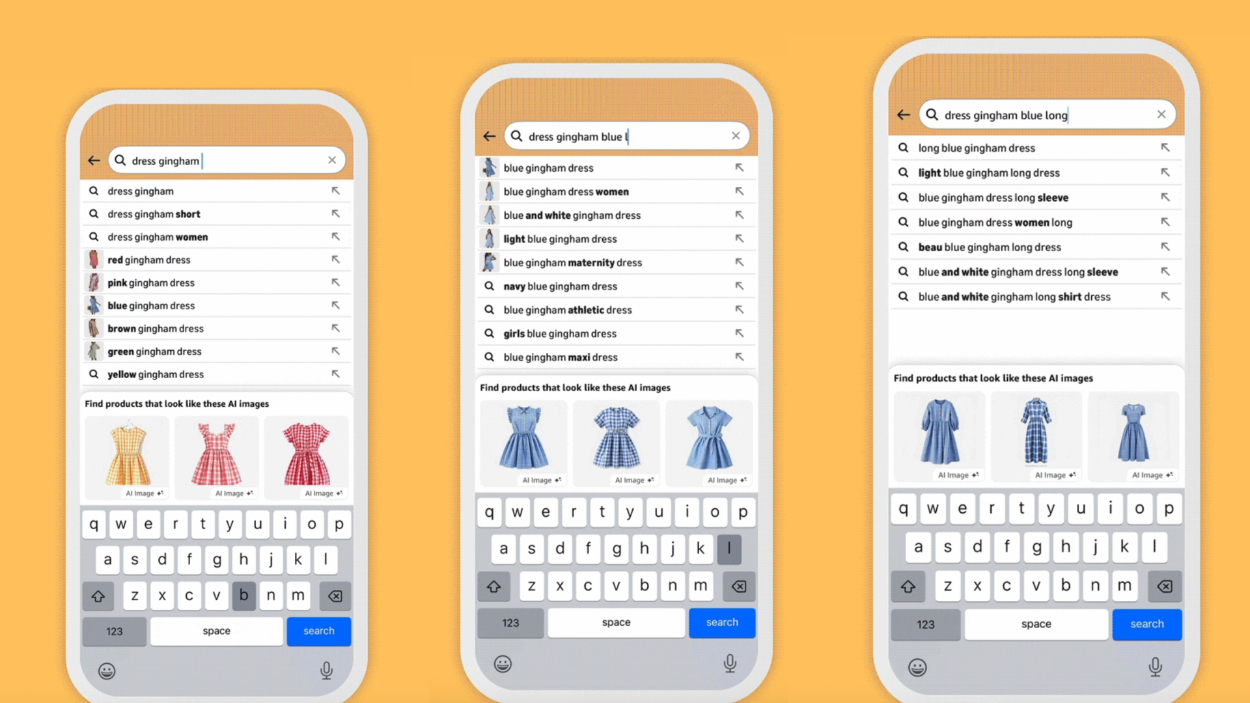
Last week we saw the eCommerce giant testing the waters of generative images in a strange way, by allowing users to undertaken meandering natural-language searches and conversations, while a small, fast image-generation model created examples of what the user’s ideal product might look like.
These were not, critically, products that actually existed in Amazon’s catalogues. They were idealised representations of what the model believed the user wanted, translated into more technical vocabulary on the backend, and assembled into semi-believable-looking generated lay-flat images that Amazon then attempted to closest-match to items it did have in stock.
Wider media coverage of this strategy was universally negative, with publications wondering what, exactly, the point was.
The Interline understood it straight away, though: what better way for a company that’s received heady criticism in the past for taking heavy “inspiration” from third party brands it stocks, and coming out with its own private label versions, to get ahead of that curve and obtain a direct line into what customers are shopping for, even if the product doesn’t exist yet?
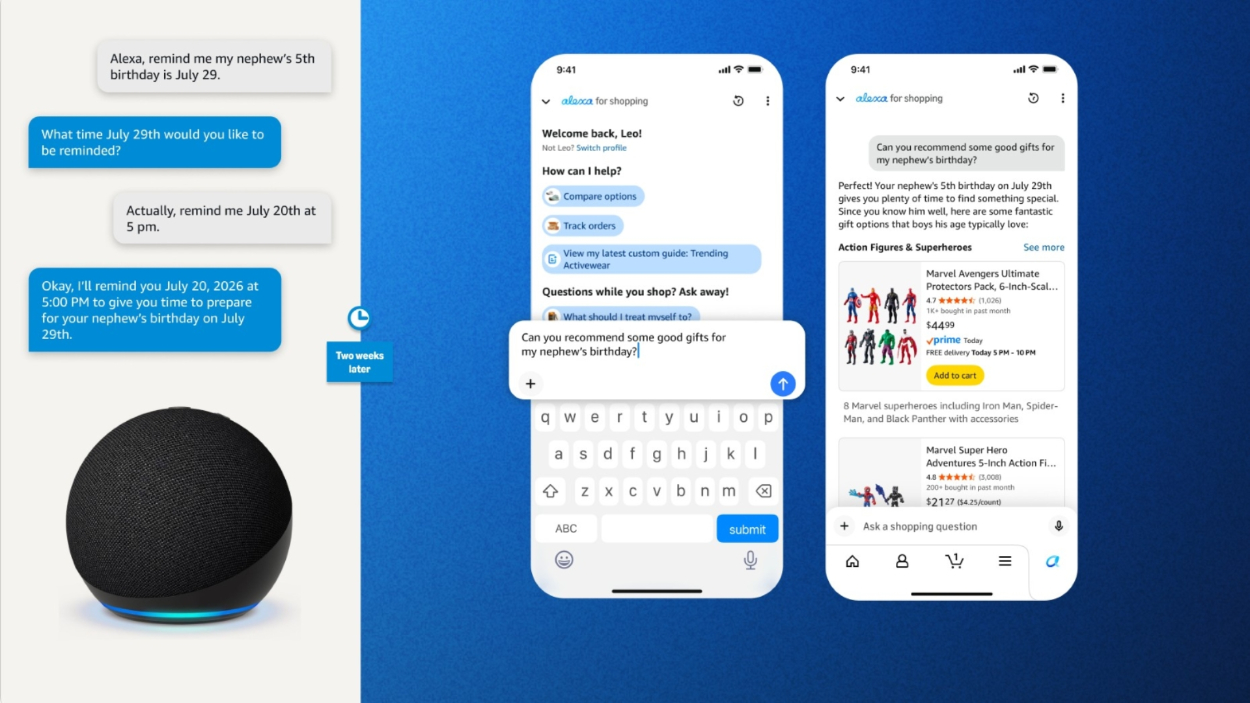
And who better to make that product, assuming something like it can be put together from a high-quality blank garment and digital artwork / printing, than the company that’s surreptitiously been one of the world’s biggest buyers of unit-of-one, direct-to-garment printing hardware?
And wouldn’t you know it? This week Amazon announced that Alexa For Shopping will allow users to generate artwork, print it on blank t-shirts and hoodies, and then the Prime delivery network will get it to their door in a day or two.
When it comes to AI-centric personalisation, as is the case with a lot of things, there’s a rule for the biggest companies and one for everybody else. So while the wider industry absolutely does need to be cautious about how it personalises, and what its data collection puts it on the hook for, we’ll see just how far Amazon can turn its significant AI and hardware investments into a new operational model.
