
Key Takeaways:
- A recent Duke University study highlights a growing cultural tension in the workplace, revealing that employees using AI are often viewed as less competent and trustworthy by their peers. This sentiment is particularly salient in fashion’s creative sectors, where embracing AI too eagerly can lead to perceptions of diluted artistry, while hesitating risks appearing outdated.
- In manufacturing hubs like Bangladesh, AI-powered surveillance is being implemented to monitor garment worker performance in real-time, driven by economic pressures and policy shifts. Unlike the cultural debates in creative teams, these workers often lack the agency to choose engagement with these technologies, facing potential job insecurity if they fail to meet AI-set standards amidst limited union power.
- The integration of AI across fashion’s value chain presents starkly different realities for creative professionals and manufacturing workers. While designers grapple with cultural acceptance and redefined artistry, garment workers face structural impacts on job security and labour rights. Respectful AI adoption necessitates understanding these diverse human dynamics, providing cultural support, and redefining excellence in hybrid human-machine workflows to ensure a truly human-led future for the industry.
Whitepaper: Why fashion’s long-term future relies on finding a better way to create, manufacture, market, and more – starting today
Today’s analysis from The Interline team asks some deep questions about how automation, AI, and other technology roll-outs are likely to influence the way fashion’s culture evolves in the near future. But this mindset shift is just one part of a much broader, deeper, and more lasting transformation that fashion is undergoing – one that’s documented in a new whitepaper from Lectra, available to download from today.

Featuring quotes from senior figures at luxury jewellery brand Boucheron, London’s renowned Fashion Innovation Agency, the American Apparel & Footwear Association (AAFA), storied full-service supply chain partner MAS Holdings, the Fédération Française du Prêt à Porter Féminin, sustainable business publication The Good Goods, Lectra itself, and The Interline, the full report examines a unique period of deep challenges and historic opportunities for fashion – as well as the importance of technology to a complete digital transformation that transcends traditional domains to cover creation manufacturing, marketing, and more.
Analysis: How attitudes towards AI – and the people who use it – are evolving across the product journey
This week a study from Duke University gave us a fresh look at the knife edge of AI deployment in the workplace. The key finding: employees who use AI tools at work are often seen by their peers as less competent and untrustworthy. Not because the technology fails, but because using it sends a message – one that can’t be misinterpreted, and one that runs counter to any notion of solidarity in the labour market. To some, according to the data, finding out that a colleague is using AI as part of their everyday work signals laziness. To others, it might suggest a lack of skill. Or maybe, rather simply, it just feels impersonal.
The latter is a sentiment we’re sure at least some of The Interline’s readers share. As much as the firehose of email is a disruptive force, interpersonal correspondence should still feel, well, personal. And there’s unquestionably an element of “if this person couldn’t be bothered to write an email to me, why should I care enough to read it?”.
This, though, is incredibly low-stakes compared to the much deeper, down-to-the-society-bone considerations of what impact AI will have on the labour force at large – not just in white collar office jobs, but across the extended value chain of people who contribute a wide spectrum of skills to the journey of each individual product or service.

And in the fashion and beauty industries in particular, where creativity, craft, and individual vision are valued higher than many other sectors, the kind of quiet (or overt) judgement carries real weight. Here, the reputation of the person doing the work – and the brand heritage they frequently act as at least partial custodians of – is often just as important as the work itself. So when a designer uses generative AI to develop a concept, or a planning team asks a generative model to fill some slots, or someone with oversight of supplier management leans on AI to surface risks at scale, are they being innovative, efficient, or cutting corners in a way that undermines their counterparts who are doing the same work the ”honest” way?
This dilemma highlights a growing cultural tension. AI is advancing quickly, but the social understanding of how it should fit into creative and labour intensive environments is lagging behind. In principle at least, most people tend to agree that AI should take on drudgery and free us up to focus on the things we think matter more. Where everyone likely differs is where the line between busywork, which is considered fair game to automate, and ‘real’ work, which the survey data suggests people judge others for trying to automate, gets drawn.
It’s also important to remember that employees are, right now, being encouraged or outright asked to use these tools, often without clear guidelines or agreements on what “good” or “authentic” work looks like in this new context. The consideration from the top down is not how AI fits the evolving cultural narrative, but how it can increase efficiency, throughput, productivity, and other metrics.
Or to pare that idea back even further: as AI changes workflows, it also changes the dynamics of workplace status and trust. And those dynamics are shifting as we speak in a lot of different workplaces – from the ones fashion places in domestic markets, to the ones it books capabilities and capacity with overseas.

In creative spaces like design studios and marketing teams, AI tools present something of a paradox. Embracing them too eagerly might lead colleagues to see you as abandoning traditional methods or worse still diluting the art. Hesitate for too long however, and you risk looking outdated or resistant to change. It’s not just a matter of mastering new software, it’s navigating a new social terrain.
Fashion may be a forward thinking industry, but it’s also deeply rooted in legacy and reverence for human artistry. So what happens when part of the creative process is handed over to a machine? How do we redefine originality when design is increasingly a collaboration between human instinct and algorithmic suggestion?
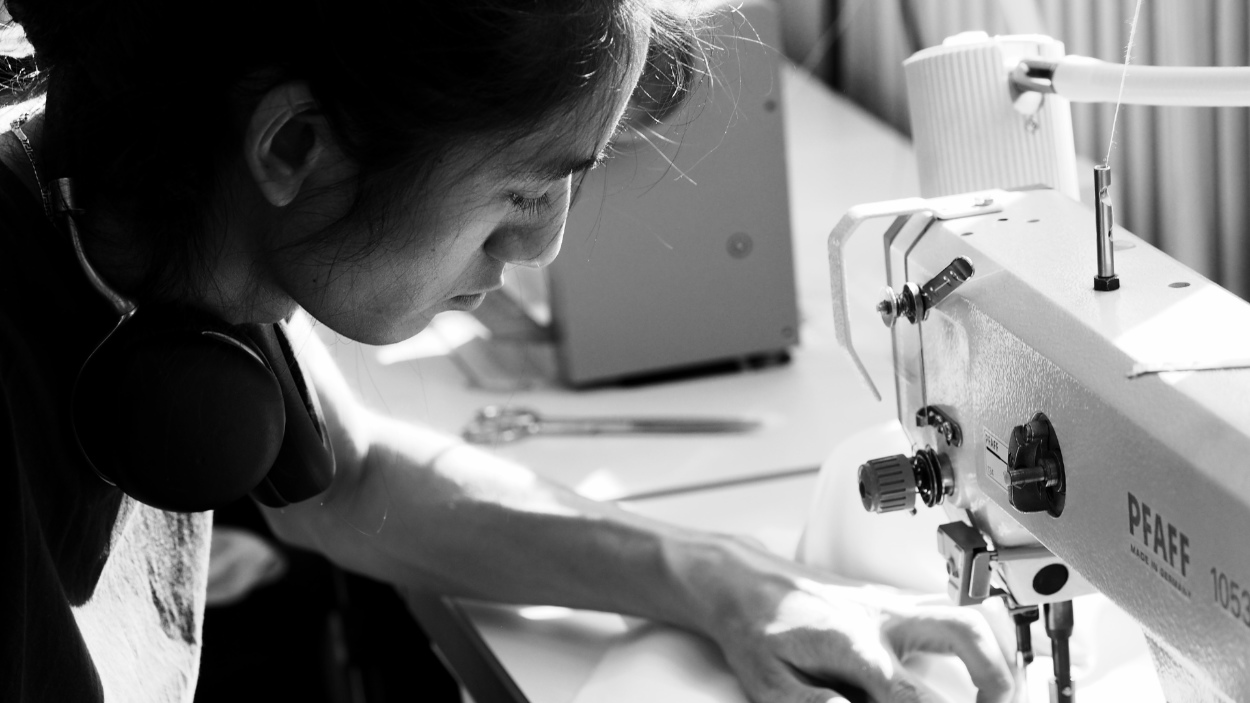
A very different – but related – story is playing out in the manufacturing centres that power fashions supply chains. In Bangladesh, automation is growing rapidly, driven by global economic pressures and shifting trade policies. According to a report published in March, factories are implementing AI-powered surveillance systems to track worker performance in real-time, measuring output by the minute, much like the tone-deaf scenario we covered at the start of the year when this technology first presented itself.
Unlike the cultural debates happening in creative teams, garment workers are rarely afforded the luxury of choosing whether or not to engage with new technologies. Just as there was with mechanical automation, there will be few conversations about whether AI threatens the “authenticity” of their labour. The machines are installed, the software is layered on the top, the standards are set, and those who fail to meet them are marked down.
At the same time, union efforts to advocate for worker rights and resist exploitative processes have faced strong pushback in those production markets. As Business & Human Rights reports, protests have erupted in response to new U.S. tariffs, which many believe are accelerating the push for automation. The equation for many workers is brutally simple: adapt to the machine’s demands, or risk unemployment.
One industry, two very stark realities, and while these two settings -a designers studio and a factory floor – might seem worlds apart, they reflect two ends of the same continuum. AI is transforming fashion work, and that transformation is reshaping the value and agency of the people involved, as well as deeply colouring how they look at one another. And while The Interline is hardly a socialist publication, there’s at least some truth to the idea that when big capital has workers looking over one another’s shoulders, a key ledge of power has been well and truly eroded.
In creative environments, the impact of automation, right now, is going to stay cultural as much as it is technological. Whether or not people use AI to speed up their tasks will affect how people are perceived, how teams function, and how creative labour is judged. In industrial environments, the impact is more structural. It affects job security, working conditions, and basic labour rights – none of which have been particularly well enshrined at the industry level to begin with.

In both cases, though, the story is not just about machines. It’s about power, control, and identity. It’s about who gets to shape the terms of technological change, and who must adapt without input. If fashion wants to respectfully embrace AI, it needs to go deeper than productivity metrics and software demos. It needs to understand how these tools are changing the human dynamics of work. That means recognising that people don’t just need training or new tools – they need cultural support. They need new definitions of excellence that reflect hybrid human/machine workflows, and new opportunities to align their values with one another instead of giving the person at the next desk, or the next station, the side-eye.
It also means understanding that AI’s impact will look very different depending on geography, job role, and institutional power. A designer in London and a machinist in Dhaka may be separated by continents, but they are both facing a future where the value of their labour is being recalculated.
To be truly human-led, fashion’s AI adoption must focus not only on what technology can do, but on how it makes people feel, what it demands of them, and whether it honours their contribution. The future of this industry won’t be defined by what AI enables, it will be defined by how we treat the people we expect to use it.
