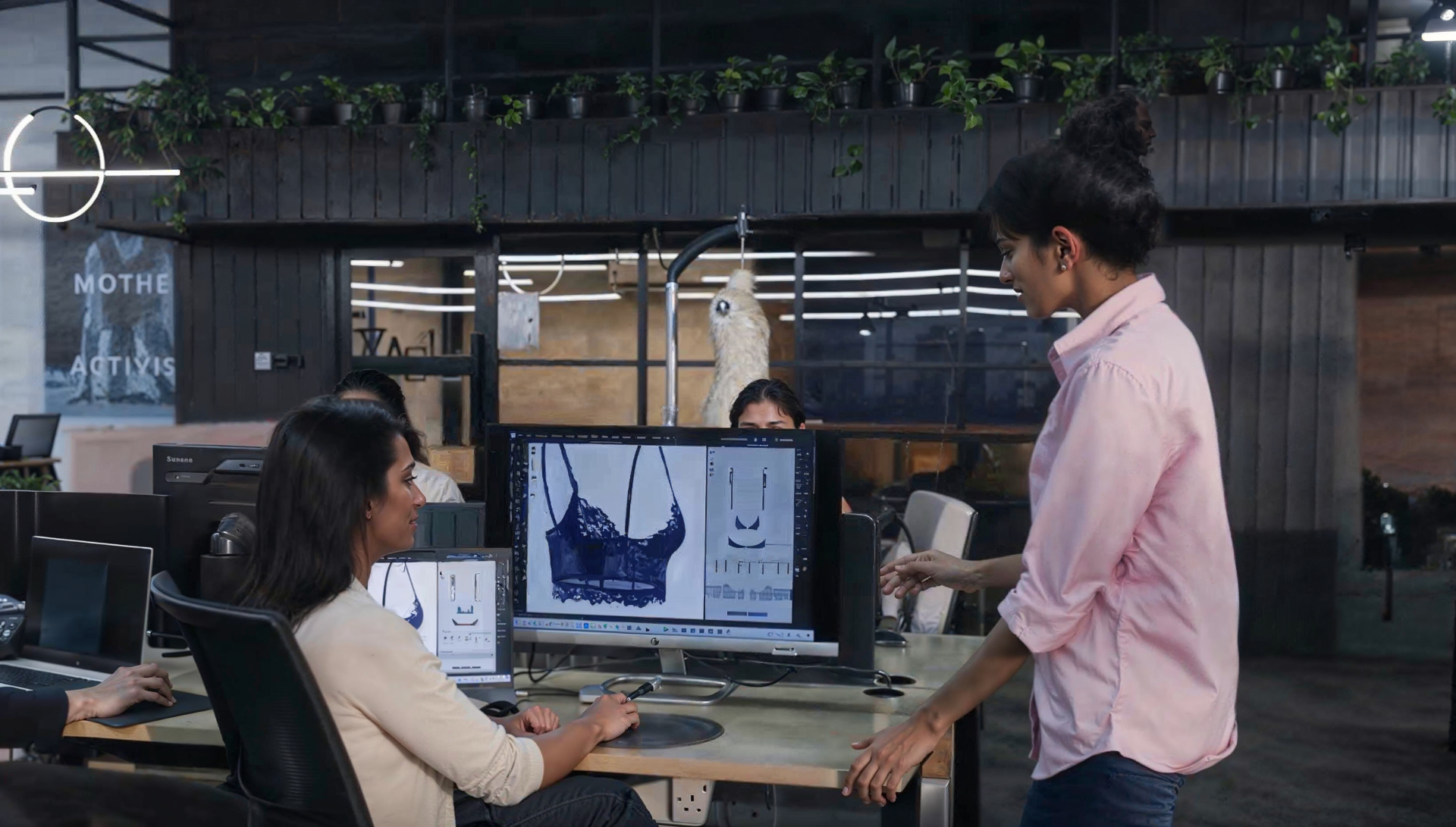
Hey, and welcome back to the Interline Podcast. I’m going to try and keep today’s introduction short, partly because I’m recording this during the first event season of the year, and there’s a lot of calendar wrangling to be done between figuring out where I’m headed and when, and also the logistics of having a young baby in the house, but mostly I’m shortening it because today’s guest and I ran a fair bit over in our conversation, but in a way that I think was really justified.
Now, I know a lot of brands listen to the show and a lot of brands read our content, download our reports. And the upshot of that is that we pretty often talk about technology and transformation exclusively or predominantly through the brand lens. But you don’t need to pull back very far to recognise that any successful change in the way fashion operates is going to hinge on the digital maturity that exists upstream at the needle point in manufacturing and beyond. Now that’s a perspective we’ve always tried to roll into our reports and into our reporting. We’ve had some great op-eds from people in the supply chain over the last few years, but it’s also a perspective that I recognise we don’t do enough of, which is why I wanted to bring on Steve Dodd.

Weekly discussions, debates, and technology insights for fashion and beauty professionals, hosted by The Interline’s Editor-in-Chief, Ben Hanson.
Find daily editorials, reports, analysis, and stories at The Interline.
From building repeatable systems to constantly updating their pipelines, seasoned and incoming designers are both working at the bleeding edge. What are they finding there? And what does it mean for the future of hybrid skills, and the balance between 3D and AI?
To answer those questions and more, Ben talks to Andrea Doering.

Steve’s currently the Chief Digital Officer at Sri Lankan Apparel Tech conglomerate and leading manufacturer, MAS. But Steve has also held similar senior roles in IT upstream for major brands like Ralph Lauren and for Li & Fung. Steve has a terrific on the ground perspective on what innovation and industrialised digitisation really looks like in the supply chain. And I enjoyed hearing that perspective a lot. So let’s go.
Never miss an episode
Get notifications for new podcast episodes, plus our weekly news analysis, events, and more, delivered straight to your inbox.
NB. The transcript below has been lightly edited.
Okay, Steve Dodd, welcome to The Interline Podcast.
Great, and thank you for having me on today. I’m looking forward to the conversation.
No, not at all. The pleasure’s on this side of the table. So the reason I think that we have you on is when we talk about digital transformation in a broad sense in fashion, a lot of the time we’re talking from the brand’s perspective just as our default mode without realising it. And that’s just because so many technology initiatives get framed that way. We’re as guilty of that as any other publication, any other outlet. Are you seeing more recognition of just how much transformation work happens upstream? Are you seeing more acknowledgement of the expertise and the pivotal role that’s played by people in the supply chain? Are you seeing a shift in what brands expect or entrust to their manufacturing partners where technology is concerned? Because there are multiple parties in any successful digital transformation initiative, and I feel like we overindex in talking about just one of them.
Yeah, yeah, I think that’s probably true. First of all, I would say that I think it really depends on the brand. I think we see more of the heritage brands or the more established brands are a little bit slower in that transformation. They tend to be very consumer focused transformation around digital particularly, less so in the supply chain. But we deal with lots of different brands. Generally, the real transformation ones that we see tend to be more with the digital savvy brands, so the new startup brands who don’t have that baggage of building an apparel business or a fashion business per se and go natively digital out of the box. Some of the brands are kind of in the middle. They’re trying to migrate into that more digital world, but generally they’re kind of legacy processes, their legacy supply chain models and distribution models kind of pull them back, I would say.
I think the answer is, really it depends on who the brand is and what their background is. The technology is certainly there. It’s quite surprising. Again, we see on the other side, we see the PR on the brand saying, we’re digital savvy and we’re doing all this stuff. And then we see how they engage with us that is still on Excel sheets and emails.

So there’s a discrepancy then, I guess, between the consumer facing and the outward facing ambitions and then the back end. We could simplify this and we can say there’s front end innovation and then back end innovation and the latter is the one that’s in shorter supply.
Absolutely. Yeah, I would agree.
Okay, cool. So how do you think about, from MAS’s point of view, the difference between innovation and transformation that is intended to serve suppliers, brand customers, or give that supplier a competitive edge against alternative suppliers and initiatives that are measured according to internal metrics? Because, again, when we frame digital transformation as a brand first initiative, when we extrapolate that into upwards into the supply chain, we’re looking at it through a lens of, how can a supplier better serve its partners and its brand customers. But actually, there’s a huge amount of digital transformation that’s going on within the walls of particularly forward thinking companies like MAS that are designed to serve their own growth and efficiency strategies, designed to serve their own objectives.
How do you frame those two? Do you reconcile those two? Are they different things? Is it a case that becoming a more digitally savvy and more digitally capable supplier improves things within your own walls and then makes you more competitive? Are those two things separate tracks?
No, don’t think they’re separate. I think they’re very much intertwined. I think with any company, you know, digitalisation is really about driving efficiency through the process and people and bringing technology to that conversation to improve it. The drivers generally don’t come from the brands per se.
You know, to internalise digitalisation is very much driven by us as an organisation wanting to ensure that we’re keeping ahead, we’re delivering, or we’re creating an environment where we can deliver the right product at the right price at the right time on quality. And do that in a way that reduces as much friction that there possibly can be with brands in that supply chain. I think when I look at everything that we do internally, we’re doing it, and we make those investments for our own benefits, but clearly there is a driver as well that it’s delivering a benefit to anybody who wants to come to us as a customer.
Yeah, I think that’s the right way to frame it. And it’s good to get that perspective on what it actually means and what the strategic framing is for upstream transformation. When you think beyond your remit here, so if you think about the extended multi-tier global supply chain, and we look at that broader ecosystem, how digitally prepared is the average supplier upstream of you? Do you ever find yourselves needing to play the role of digital enablers and trying to raise the maturity of partners who are a tier or two up the value chain?
Absolutely. I think particularly, in the less mature supply chain markets, a lot of our suppliers still deal with us in phone calls and paper. You know the digital maturity – I think it’s a conversation about scale of the operation. We have a lot of suppliers who only maybe deliver us one product and they just could be delivering us that one product. As long as we get that product on cost, on time, there’s not a lot of incentive for them to digitalise. But because our presence is so large and we’re buying from so many different places, I think part of our drive is to ultimately digitalise that supply chain to really unleash more capabilities, not just for our customers, but also for those suppliers as well. Particularly here in Sri Lanka, we are somewhat of an anomaly within the business because of our size. And so there is a huge supply chain base that we also want to grow with us as we grow as a business as well. And I think the only way that we can really do that is to help them improve their digital capability.
One thing that we started 12 months ago was, even at a simple layer, de-risking supply chain disruption through cybersecurity. So elevating our suppliers’ awareness around cyber security and how it can impact them. Ultimately, it means that it impacts us if it impacts them. And so we do a lot of work, and we’re starting to do more work to elevate them. Having stability in the supply chain is key for us. So anything around cyber security is important, but starting to give them tools and platforms to improve that interaction with us, create more transparency, help us better plan with them and ultimately with our customers as well upstream. I think it’s a maturity thing. I worked in Hong Kong for a long time, and you know, Chinese supply chains are extremely mature, very transparent, lots of data, very heavily data driven, and as you come into Asia maturity kind of starts to roll off, but it’s more of a case of a focus on doing it rather than a desire not to do it.
Yeah, and if I could just maybe try and tease out one specific example I’m thinking of. So if you think of a brand customer from your point of view who is, let’s say they’re doing a lot of 3D work and they turn to MAS as a partner who is capable of collaborating with them on that basis. And let’s assume that you have a material supplier further upstream. The mandate is kind of passed down there from the brand customer to you, to the material supplier to have a fit for purpose digital representation of that fabric in order for that whole process to work.
Yeah. So we have a very mature digital product creation capability. You know, again, I’ve been in this business for quite a while without a doubt. I think the team here have an amazing capability to turn a sketch into a moving lifelike video of a model walking down a beach in minutes. It is absolutely amazing, that capability. And the key in that, of course, is material. And so for us to be close to the supply chain enables us to sample that material digitally into the platform and put that in so that we can actually reflect that very, very quickly.
And would you do that yourself in that instance? Just walk me through the workflow – would that be something?
In some of them. If it’s a smaller supplier we do, but some of the larger suppliers we do, do that for us as part of their process. So they will give us that, they make the investment to do the digital scanning of all the materials so that they can get the composition, the stretch capability, all of that into the metadata, they provide that to us and then we use that in a library to create products with the brands. So again it’s a maturity, it’s a scale thing. Technically all of that is possible and all of those tools are widely available. What’s really really interesting is still the lack of digital adoption within the brands.
I was going to say this is probably one of the prime examples where you will find there are brands who do a lot of, I’ll call it CG work, marketing-facing, selling and partnering, consumer-facing 3D, and a lot less in the way of actual producible side of things. And I actually have a specific question about that later on, so don’t want to steal the march on that one. But I think you’re right. I think that’s one of those areas where your ability to receive, process, and create digital fabrics yourself starts to set a baseline for what the extended supply chain is incentivised to produce, but also over time hopefully helps to create more incentives for brands to take advantage of those capabilities as well.
Yeah, and I think one of the other things, as an organisation, we do a lot of work on material development as well. And a lot of our customers come to us because of that capability. In those conversations around product development, often when we come to a point where we can’t quite find the right fabric, we have a team here who essentially all they do constantly is creating those new materials and those new capabilities. And we have a lot of products that have come out through that process into the marketplace that are differentiators for our customers because nobody else can replicate that. It’s very difficult to replicate some of these capabilities unless you know the actual process. It’s like chemical engineering to a large degree, right? Unless you can get the exact composite and the exact same materials, it’s very difficult to replicate some of these things. But we have a great internal capability in our innovation team that supplement that where we don’t have something in the library already.
Yeah. For our Digital Product Creation Report that came out ahead of the holidays, we had a different manufacturing company who was talking about their role as essentially being a filter for the wider funnel of innovation ideas that the market has and one of their roles being to help determine which of those are ready to be industrialised, ready to be operationalised. I’m guessing that’s something you see as well because you will have, as we’ve established, your own technology initiatives, but you’ll also be exposed to wider market forces and ideas and people saying, we have this that we want to do with software, this we want to do with hardware, this we want to do with process. And I’m guessing it falls to you to some extent to separate the wilder ideas or the kind of earlier stage ideas from things that are actually ready for industrialisation. How do you approach that kind of decision making?
Yeah, I think that some of those ideas are very, very, very early ideas. The technology just might not yet be there to be able to create that. So again, I worked in the beauty industry as well as in fashion. And the ability to actually create a new beauty product in a beaker is relatively simple. So quite easy to do. Trying to then replicate that at scale is extremely difficult to do. And I think we don’t have that problem necessarily in creating a product that the difficulty in scale simply becomes from an efficiency perspective when it comes to actually manufacturing the product more than from the, I would say the material. I think we try to obviously guide our customers to follow specific manufacturing approaches that can help drive efficiency. I think it’s difficult.
Some of our brands are extremely innovative, and really, really push the boundaries of innovation on finished product as much as the materials that go into those products. And on the innovation team, I spend a lot of time working with them, and a lot of projects just never make it because they just can’t get to that right thing. For us with the technology, how close we can get to replicating that digitally, you know, it essentially allows us to eliminate a lot of wasted time to rapidly prototype products and say, that looks great. But then making that jump from that fantastic 3D image onto the shop floor is very, very complicated. And sometimes it just doesn’t work financially either.
Yeah, I think that’s where a lot of the brand audience does get stuck. And I would do the same in a lot of shoes, is to pursue technology lanes that seem like they would have a marked impact on time to market or margin or a bunch of different material, whatever it might be, only to then the difficulty, I think, comes in having the willingness to interrogate yourself and say, has this actually meaningfully increased my velocity to market? Has this actually meaningfully increased the variety I can offer consumers? Has this meaningfully increased my profitability per style? Has this been just all of those harder metrics? And I think that’s where the rubber meets the road when suppliers like yourselves are talking with…
Yeah, yeah, I think the other thing that we’re really pushing is a little bit more data in that decision process as well. There’s a lot of data out there that we collect around products, categories, material types, sentiment analytics that we scrape from multiple sources to try and create a little bit more of a focus around what products are trending, what materials are trending, and with our customers go back to them and say, look, these are gaps that you have in your catalog right now. If we have the material, here’s 20 digital designs that we think look great. We have capacity in the factory. We’re ready to go right now. So our more digitally savvy brands are a little bit more receptive to that more proactive approach to product creation. But, you know, a lot of our customers are still stuck in these seasonal cycles, that are very, very long cycles. And a lot of that time there is back and forth on product design. A lot of the brands talk about wanting to compress that speed to market, but the reality is their internal processes and the way that they operate really don’t help drive that at all. There’s still those seasonal calendars, they’re still there. I think it’s four in the UK, it’s five in the US. And they seem to have a real difficulty in moving away from that process and maybe having something that’s a little bit more agile. I mean, lots of people talk about Shein, and I know I have quite a few friends in the team in Shein and they don’t have any calendars. They don’t even have any products. You know, everything you see on the website is digitally created, when they get enough orders, they cut the PO with a supplier and it’s done. Talk about reaction to market, you know. As much as all the negative publicity around their market approach, but as a business model, it’s the extreme of what we would say is the more heritage grounds that we deal with as well.
No, I agree with that and I think a lot of calendars are set up around planning and pre-booking capacity, months out, months and months out. But in a way that has to conform to a product vision that is also being determined by factors that are months out or is being determined by forecasts that are kind of outdated by the time they arrive there.
There’s an interesting thing you said which is that there’s the potential to become more capacity driven, to be able to say, well, this is something we could make now. And does it 100% correspond with what we might plan if we were planning six months out, if we were planning nine months out? Maybe not. Does it 90% correspond with something that we would create and it’s available to get to market in a much more meaningful timeframe? It’s shifting, I think, from the realities of sourcing and production, what it actually involves and how long it takes. Maybe more of a platonic ideal of what it looks like.
Yeah, you know, that same model, the reality is that most brands still work on that seasonal calendar. They’re designing product now that they’re going to put in the shops in 2027. Historically, we all know the stories, you put it into a store, you put it on markdown, what’s left you put into a factory outlet. Then somebody realised that factory outlets were actually profitable. So we’ll make product for factory out there and fill them in. But despite all of the technology and all of the capabilities, the reality is that most brands in order to solve that excess problem, simply just bought less stuff, made less stuff. They simplified the buys. And that meant that they had less inventory to deal with at the end of the process and actually starved the sales channels in some respects to compromise on that. But still doing that with 18 month design cycles on seasonality. The newer brands – a lot of it’s interesting when we see startups, they’re very hands-on, they’re involved in the whole process, they don’t want to do all the hard work, they’re just interested, they have an idea, have a brand, they have a design, they want to just make it. And they rely on us to do all of the work for them, which is great. As soon as they start to scale, they’ll then start hiring in people from other brands. So we see this constantly, people coming in from these other brands. As soon as they do that, what generally we start to see is they start to revert to those other brand approaches to buy and design and go backwards in some cases. We’ve seen some of our customers change their teams because they said, no, this is not what we were all about. It’s difficult, I think, for startup brands to scale without unfortunately having to revert to the old ways of working.
I think one of the things you said is absolutely right. Capacity, locking in factory capacity is key for sourcing teams because they don’t know what they need to make. They just know that they’re going to make something. And so, as long as they’ve got capacity locked into a factory, then they can get something made and then they can get it delivered on time. What is it they’re going to make?
The biggest disruption that we see in the supply chain is the reality between the brand deciding what it wants and giving us the purchase order – it’s literally down to the wire. And we just had this just before Christmas. The brands were going, okay, we’re confirming all of these orders and you need to give us a purchase all this tomorrow. It’s a 24-hour turnaround. And then all this stuff that’s going to get made in the factories in January, right? So 18 month development cycles. And ultimately the supply chain piece, the real supply chain piece for us comes down to essentially three or four weeks in that 18 months. And so we have the same problem that we are also making sure that our mills have got capacity, that we can get the yarn in on time. It’s still amazingly a really, really inefficient, inefficient process despite the technology.
It’s just, feels, and again, full transparency, everybody listening knows that I’ve never worked directly for a brand or manufacturer. So 15-16 years in the industry, but I’ve never been on the shop floor from that point of view. It looks, you don’t need to invite me twice to Sri Lanka
You should come out and visit and we can take you around the factory.
It sounds like fun. But it seems like a very weirdly elastic sort of exercise. There’s a huge amount of slack in it until there isn’t. It just seems like if you could take up that slack in a way that was driven by visibility into, like you said, capacity, materials, into trauma, if you can take more data-driven decisions in there and just reduce some of that multi-month cycle ahead of the three to four week compressed cycle, all of sudden you have a fundamentally different go to market calendar and it doesn’t it doesn’t seem unrealistic.
Yeah, very much so.
And certainly the technology is there and we can do it and we do do it. But what’s interesting is despite us doing that, we’re still reacting at the last minute to ultimately what the brand decides that they want to focus on. And I think that’s also part of the problem as well is that, again, it’s an 18-month cycle if you think about it. You commit now to what you want to do in 18 months. You want to leave that decision to the last moment as well, right? You’re also looking at your in season product. You’re looking at how that’s selling through, you know, what’s working, what’s not working. Do I need to calibrate? That process is ongoing and I’ve worked in brands on the brand but in that area, I understand really, really well and of course they don’t want to make a decision until the last minute and that then has a knock-on effect.
And I understand that we write stories week by week. If you ask me what we were going to write about in 18 months, I have no idea. But if I had to commit to resourcing, which I do as somebody who owns a business, it’s a way of framing things.
Now, one thing I wanted to ask you about was how you think about the technology adoption side of things and what drives it in that sort of context.
So I think it’s equally challenging for the brand.
I think you’re on record as putting out a view that we definitely share, that technology should be an answer to an identified business problem. Technology initiatives shouldn’t be dowsing rods you use to try and find problems in the first place. I’m keen to get your take on what it looks like to actually identify business challenges in an operating environment that’s as complex but also as compressed as the one you’ve just described. In that three to four week window, once it’s finished, how do you go, these are the problems that we had and I can map those to technology initiatives that we can then roll into the next cycle?
The approach that we have is firstly, I think, we need to be very tightly connected with the business. And so we have teams embedded within our business units, who are ultimately always in the front line. So on one side you have the, I would say the more incident-driven or problem-driven investment or innovation where we may see a consistent, some kind of a problem that’s happening and say, well, actually, you know what? I think we need to build some new capability or add something in.
I think the other thing, certainly for me, is actually about bringing the technology into the business and certainly what we’ve done a lot recently is actually going onto the shop floor and looking at what’s actually happening in the shop floor. So I started in manufacturing many, many years ago in the UK and so I was lucky that I was taken through that whole Japanese manufacturing approach – all of the tools, all of the training, all the capability. So when I walk onto a shop floor, I can understand what’s happening. I can see things that sometimes, if you’re on the shop floor, you can’t necessarily see. I think then it’s a case of understanding if that’s a problem or if it’s not a problem. Because many times, you might see something in the business that’s not really a problem: it happens once a week, there’s not a big cost to it. But often it’s a case of, when we go on the shop floor and we say, yeah, that’s a real problem. We spend hours and hours and hours doing that, but they don’t necessarily know how to solve that problem. And that’s really, I think, where, this close connectivity between the technology teams and the operational teams really, really, deliver some real benefit. Because, you know, they may have a problem that they bring to us, say, you know, we don’t know what to do about this. We may have a technology that we don’t know an application for. And sometimes, it’s just that walking the floor and spending time in the factories. I mean, I just love walking around in factories anyway, I’m a big machine engineering freak. So for me it’s great, go and I’m not going to say, you know what, I think we’ve got a problem there that we can solve.
It’s quite interactive. I think I’ve always felt the same way about technology. You can’t sit in an office and deliver technology strategy. You certainly can’t sit in an office and deliver digital transformation. The reality is a digital transformation for us happens at the needle point. And the closer you are to the needle operation, the more important that digital transformation is to the business. And the further away from that, that you are, the less important actually, and the less benefits can actually be driven.
So we talk about innovation at the needle point, as opposed to backends, your finance and supply chain systems. For me, the needle point is where the magic is. Core systems are important, but not as important as that transformation at the needle point. And in retail, I used to say the same thing. Digital transformation needs to happen at the customer interaction, not in the offices. There is a degree that can happen in the office…
Yeah, it’s not its own standalone initiative. It’s in service of delivering either the retail context, better customer experience, from the manufacturing context, better product outcomes, however those are judged, fit performance, timeliness, whatever it might be.
I’m just gonna fly through this one, because we’ve talked about 3D a bit already, but I’m keen to get your take, because we’ve just come off creating The Interline’s Digital Product Creation Report for 25/26. And I like to ask this question of people who are in the position to give a concrete answer, which is, do you think the industry at large has actually successfully reoriented itself to take advantage of the potential for 3D to be a genuine, producible digital twin rather than just a visual asset? Because I think the ongoing tension with a lot of 3D work is, pretty pictures versus something you can actually make at the needle point.
Okay, I think there’s a couple of layers in that question. So first of all, technically, is it possible? Yes. Technology – and every day there’s some new tool coming out that makes it even more seamless. I mean, we do prompt-driven product creation that we can say, can type in, design me a t-shirt with this design, blah blah blah, and very realistic. I think the reality is, while we have a very, very strong capability and we have brands who come and visit us and they’re constantly amazed by the capabilities that we have and the quality of that, adoption within the brands is low, single digit. So they still will come back and say, here’s 24 tech packs, give me a quote or, here’s our designs, the patterns, make the product.
Again, digital savvy brands, new startups, very, very digital savvy, love the digital stuff, don’t want to create 3000 samples. They’re happy with, you know, a few hours playing around with a digital image and they say, okay, let’s do two samples of that. Done, very quick, nice and efficient, great for us as well. And we have sample rooms that are the size of factories because a lot of our customers still demand in that 18 month cycle, hundreds of samples, just constant, constant churning of samples. So I think the reality is, yes, and we’re then able to turn that into a product.
The models that we’ve built are built around our product creation capability as well. So we bring those two together and say, this product, if you do it like this, we can make it. But if you do it like that, we’ve never done it that way before. We’re going to have to do some work to essentially get that ready.
Yeah, you’re going to have to reinterpret it for want of a better word, in which case the digital asset is not serving as the product definition. It’s not serving as the same operation.
Yeah, reinterpreted, correct. It’s funny because I’ve seen it here as much as I was doing exactly the same in the beauty industry is that in the brand, so you say, we’re gonna do digital product creation, great, fantastic. Don’t want 800 samples, let’s just do digital product iteration, create a couple of samples and then go. The reality is, unfortunately, what happens, and I think it’s human nature, is as soon as it becomes digital and you can tweak it, you start tweaking it. And so the actual amount of time that you spend tweaking the digital samples becomes equal to the amount of time that it would have taken you to create the physical samples.
That’s a really interesting way of framing it, that when you reduce or eliminate the overhead of creating physical samples, that doesn’t automatically remove the behavioural trigger that pushes people to want to experiment with things.
Yeah, and so we can create 500 digital samples in about an hour. The problem is then people are going to look at all 500 of them, and that takes time and they’re like, yeah, we like this and we like that. So it still takes a lot of time, which is the process. That’s the design process.
Mm-hmm. I can see that.
Similar question, but through an AI lens, because I think it’s no secret that the whole industry is expecting a lot from AI at the moment, and I think across a pretty vast surface. More than any other kind of technology category, there’s a huge kind of heterogeneity into the makeup of what companies expect AI to do for them. It does seem like if you want to put it into chunks, it seems like a lot of the value potential that gets headlines at least is brands that are focused on exploding the beginning of the product funnel – so using generative models, generative image models to create a lot of inspiration. Or it’s focused at the end – putting the finishing touches on final pixels intended for partners or consumers. The middle is harder to figure out.
So where and how do you think AI is going to deliver value from, in that middle within MAS? And do you think the technology is ready for it?
I think I would say, already at the front end of that whole product creation process, we already use a lot of AI in that space. We’re doing that, you know, in production with our customers today, the ones who adopt it. As I said, we’re doing prompt-driven product creation, taking that through to very, very realistic video as well as obviously flat screen images for them to put on their websites etc so that’s great.
I think to your point there’s suddenly a big hole, one of the big ones that we’re spending a lot of time at the moment is pattern making. So turning that design into a physical product still requires somebody to make a pattern. And digital pattern creation is an area where there’s a lot of people doing a lot of work at the moment. And we’re working with a couple of different partners in this space. Because the problem is that pattern making is a very, very, very unique task. It takes a long time to learn. And you get it wrong, thousands of dollars of impact. And people don’t want to do pattern making anymore. Unfortunately, you know, it’s just another one of those manual tasks that people don’t want to do anymore. So it’s still a lot of things going on in that space.
I would just say in general, in our whole manufacturing process, we’ve implemented a lot of AI capabilities to provide insights in supply chain, into productivity, into efficiency and problem solving, real-time problem solving within our process as well. These are, I think, tools that we built ourselves to a large degree, but I think now what we’re starting to see is more in the, what I call the enterprise technologies that the AI is embedded into those sectors. So I always look at AI in two different perspectives, right? The AI that most people talk about is the ChatGPT or the prompt stuff, which is very consumer focused technology. You’re not going to run a company on a ChatGPT. So the other side of that is enterprise AI. We were using AI capabilities within enterprise level platforms to help us either be more efficient, more effective, or to help our decision making process, identifying problems, et cetera, et cetera. I think now what we’re starting to see is a lot of that AI capability coming into those tools. And we very specifically, when we’re looking for new tools, we spend a lot of time looking at their AI capabilities because it is going to be important for organisations going forward. And the maturity of those capabilities within the platform will help organisations become more efficient and stay ahead.
Yeah, 100%. One of our big predictions/themes for this year that we published at the tail end of last week was the kind of footprint blurring between different technologies thanks to AI, but also the integration of AI into big enterprise systems, your PLM, your ERP, and so on. That definitely seems like the next step.
One more question before I get to our final one, and this one is something you’ve actually just said, which is people don’t want to patternmake anymore, i.e. there’s a lot of skills and capabilities that fall under the roof of an organisation like MAS, which are scarce elsewhere. There’s a lot of the patternmaking expertise there. There is precious little patternmaking expertise in consumption markets, in the major consumption markets of the US and Europe and so on.
How do you see that balance between those kind of scarce protected resources and something like AI playing out? Do you think of AI as a lever that you can pull to start to unlock more in the way of embodied AI and robotics and things like that? Or do you see that kind of stepping stones of fuller automation? Or are you aiming for a smarter collaboration between that kind of scarce human expertise and knowledge and machine learning?
Yeah, historically we haven’t had a problem with those kinds of resources. And we have a very long and strong collaboration with the universities here. And within those courses, there’s a lot of focus put on the traditional side of apparel manufacturing. So they teach them everything from sketching through to patternmaking, everything. And in talking with the universities, they’re already noticing a trend that the students don’t want to learn how to patternmake anymore. They say, no, I can just do it digitally. I’ll do it digitally and then that’s good. It’s good enough.
What you talked about is that lack of that skill in the consumption market. Again, 50-60 years ago, Manchester and the surrounding areas were full of people like that, right? That same thing is happening here, but the driver is different. So it’s no longer a conversation around cost; it’s a conversation simply around not needing to do that anymore because there is a technology capability that can do it.
Now that said, we do a lot with automation, we do a lot of work with physical technology. When we start talking about robotics replacing people on the shop floor, the reality is that making any apparel product today is still a very tactile activity and the sensitivity that’s required to consistently make a product that may be slightly different every time it comes to you is still very difficult to replicate.
The one that we often talk about is if you have a stack of pieces, it’s still very difficult for robots to pick up just one piece. So if you use suction, it’ll pick up 20 pieces, which is useless. But that human finger tactile piece is still very difficult to replicate. I’m sure it’ll get there. But I think then at the needle point, obviously there’s a lot of conversation around now bonding as an alternative to stitching. And certainly we see a lot of that. Huge capabilities there and already providing that for our customers. So again, these are technology drivers and technology changes that are taking away a need for specific processes within that apparel manufacturing chain. But the external factors on them are very, very different to the traditional factors that we’ve seen over the last 50-60 years.
Yeah, I think that’s right. I think that’s the right way to think about it.
Final question. When you look ahead a couple of years from now, what roles and skills and mindsets do you think are going to matter the most? And how do you think companies like MAS construct themselves so that you’re finding the right members of the workforce or upskilling the right members of the workforce to grow alongside the way the market is evolving and the way the technology is evolving?
I think ability to solve problems, to be inquisitive about things and to not just accept that, yeah, that’s the way to do it, because that’s the way that the person told me before. I’ve always found that when you start to ask questions, you start to see opportunity. And so I think that that ability to look at something and see opportunity and to then be able to go through the process of actually creating a solution to that problem is a key skill that I don’t, I mean, to some degree that can be replaced with technology.
So we talk a lot about computer vision, using computer vision as a means to capture an activity and say, ah, you just did it slightly differently, but it’s not going to solve the problem, right? It’s just going to tell you that something happened differently to the way that it happened the previous 100 times, but it’s then not going to fix it. And it’s not going to be able to tell you why without some other external factors. I think the reality is that power manufacturing hasn’t really changed for a long time. Bonding technologies have been around for a while. I think there’s always, it’s one of those industries. We’re always going to need clothes – unless we all go very Northern European, we’re always going to need clothes. And I think it’s an industry that will evolve. And of course, design is a driving factor of that to a large degree, but turning something into a yarn that you then turn into a product is always going to be a need. I don’t think we’re going to be able to start printing, although actually there are printing capabilities, right, to create great things.
But, I think it’s just an industry that will continue to evolve with time and technology. I think historically it was economics that were a driver of that transformation. Now it’s technology that’s a driver of that transformation. I think that’s the show.
Sure, yeah. I think that’s a great way to put it. And I think it’s what you’re right to zero in on: people having the knowledge and the grounding and the taste and things to ask questions. The closest analogy I can think of is something like building software where historically I would have needed to go and learn to code. That’s your sole option. If I want to make an application, that is it. There’s no other pathway. Now, if you put all that leveling in place –
Yeah, not anymore. Not anymore.
– that doesn’t mean that if I set out to create software, I have a good idea. I can have a bad idea and go execute it, then the market is still going to determine what works well and what doesn’t.
Yeah, it’s just easier to do it, right?
Yeah, I think that’s one of the levers that technology gives people is ease and it gives them some measure of being able to say, that thing that used to require a lot of effort is now something I can turn a key to get, but that is not synonymous with being a good brand, being a good designer, being a good manufacturer.
Okay. Well, an operating principle to take forward into the year, I think. Steve, no more questions from me. You have been very gracious with your time and I’ve enjoyed this conversation a lot.
Yeah, that’s right.
It’s been great to come on and talk about what we’re doing and talk a little bit more about the broader apparel sector. I say I’m always very happy to talk about what’s going on. I think it’s good to give people insights. I think a lot of people don’t understand how some of these things that they buy get made.
It’s always been fascinating for me walking onto a shop floor and seeing what we talk about: the hum of the floor. You can tell if a factory is running and on full tilt based on the hum that comes out of the factory. It’s a fantastic experience. And as I said, more than welcome to come.
I was going to say, think that’s something I need to come and listen to myself. So let’s try and make that happen at some point this year. That would be wonderful.
I think you need to do a video cast rather than just a podcast.
We’ll build out those capabilities this year, I think. Steve, thank you so much for joining. I very much appreciate your time.
No problem, thank you very much.
And that’s the end of my conversation with Steve. I found this one really interesting in a way that’s often the case but not always guaranteed when you talk to upstream experts. Hopefully it’s left you with some incentive to think about what successful full-spectrum digital transformation really involves and some incentive to really interrogate the kinds of partnerships that are going to be pivotal for delivering on it. For now though, thanks for listening and I’ll talk to you again soon.
