From exposing holes in essential data, to revealing missing links between personalised, consumer-facing experiences and backend systems, an initial wave of AI adoption in beauty has highlighted both how far the core technology has come and the distance retailers and brands still need to travel if they want to be able to take full advantage of the possibilities and to connect AI applications to their tech estate.
To explore the shift from experimentation to more structural change, and to examine case studies of retailers who’ve successfully capitalised on the deeper opportunities, and who’ve emerged ahead of the ways AI is reshaping the path to product discovery, The Interline has partnered with Inference Beauty – a boutique software company with clients at the head of digital retail strategies for brands and multi-brand retailers like Dermalogica Kiehl’s, Verso, and Justmylook, or FaceTheFuture Harrods.
The road from initial investigation to a beauty shopper having the right product, ready to check out, tailored to their exacting, individual needs, has undergone a radical inversion.
Historically, consumers started that journey with a brand already in mind, influenced by cross-channel storytelling, prior product exposure, or brand name loyalty. In that world, lifestyle marketing and the trusted word of a small panel of editorial sources – or passionate promotion from well-meaning friends – were the drivers behind most pathways to purchase, and specificity at the start of the funnel was in short supply.
Now, the brand and the local word-of-mouth are typically much further down the agenda, and traditional advertising and centralised curation have been pushed aside by a combination of social influencers, experts, and consumers’ own research, education, and self-advocacy.
Based on Euromonitor data from the pre-AI era, the share of online shoppers searching for loosely-defined terms like “natural skincare” had nearly halved in a five-year period, being replaced by focused, ingredient-led queries with direct links to the specific skin concerns of a new cohort of “skintellectuals”.
And according to contemporaneous analysis of traffic patterns at Net-a-Porter, searches for actives such as retinol, hyaluronic acid, vitamin C, and niacinamide had jumped close to 700% in just two years, with the online retailer’s Global Beauty Director saying that: “customers now prioritise tried and trusted ingredients over the big brand name”.
This devolution of authority over beauty buying was already underway before the meteor strike that was the launch of TikTok Shop in the USA, in late 2023. But in extremely short order, that platform has come to monopolise the social element of eCommerce, with the Vogue Business Beauty Index suggesting close to 70% of all purchases are now influenced by social video feeds – an explosion driven by algorithmically matching an educated consumer base with influencers who share their scientific rigour, or who curate solutions and products based on the proverbial “vibes”.
Of course, the same trends are also now carrying over into the next phase of the web, with shoppers who engage with ChatGPT, Perplexity, or Google’s AI mode rarely beginning their conversations by asking about a particular brand, and instead having natural language, back-and-forth discussions about their problems and concerns, and having their semantic intent progressively matched to ingredients and claims.
And this combined shift is not just something analysts observe. Beauty brands and retailers are seeing the paths to their product pages migrate from company-first to concern-first. Speaking to The Interline, Lars Fredriksson – CEO of VERSO Skincare, and a client of Inference Beauty – said: “we’re seeing a clear shift from brand-led discovery to ingredient- and problem-led search, accelerated by platforms like TikTok Shop and AI-driven channels.”
This same shift is also manifesting across channels, despite beauty having a persistently uneven online channel mix. As documented in the post-publication discussion of the McKinsey / Business Of Fashion “2025 State Of Fashion: Beauty Report”, only 15% of online beauty spending is directed towards brands’ own eCommerce storefronts, while close to 30% is directed at marketplaces, and especially towards Amazon.
Despite their different scales, though, both avenues are seeing the same behavioural changes. Established brands are seeing their historic cachet being eroded, while new entrants have a leapfrog opportunity to put their claims and ingredients front and centre. At the same time, retailers are facing a potential crisis when shoppers arrive at their extensive, multi-brand catalogues only to find missing information at the core ingredient level, or a lack of differentiation in their inventory.
However they frame their own opportunities and strategic priorities internally, though, both beauty retailers and brands are, according to McKinsey, being judged by the new cohort of beauty buyers against three main criteria:
- Convenience, or “a frictionless experience”.
- Assortment breadth and value for money.
- Discovery and innovation.
Unsurprisingly, the task of elevating each of these has fallen into the scope of beauty’s first wave of AI strategy roll-outs. But as we’ll discover, those initial deployments have really only scratched the surface, and a significant share of the real value of AI in aligning beauty business models with market expectations is still going untapped.
How AI initiatives have exposed the data chasm behind beauty retailers’ ambitions for variety and convenience
It’s hard to overstate just how extensively Amazon has recoloured consumer expectations for price, variety, and speed. This is true for many different categories, of course, but the marketplace giant’s impact on beauty has been especially pronounced; analysis by Morgan Stanley predicted that Amazon would overtake Walmart to become America’s biggest beauty retailer in 2025, and that position has been largely built on the company’s ability to ship next (or same) day, its hooks into replenishment through the “subscribe and save” scheme, and its app’s safe position on users’ homescreens.
For multi-brand retailers and alternative marketplaces, the rise of AI search and discovery represents the most meaningful chance to disrupt Amazon’s dominance and to supplant decades’ worth of default behaviours. Where traditional search engine optimisation and web advertising had become heavily monopolised by Amazon, there is evidence to suggest that AI search weights things differently, giving competitors a fresh chance to be cited in AI results if they can parlay community and influencer validation, media coverage, and other organic content into product authority.
For many beauty businesses, this reset opportunity has been one of the primary catalysts behind AI strategies, since success could have a democratising effect on an extremely entrenched market.
But those same AI strategies have also, in many cases, revealed another tool in Amazon’s chest: its status as a technology company with bold ambitions in beauty retail, rather than a beauty company, with department store heritage, attempting to shore up its backend systems.
The most visible area this limitation shows itself is in the data that beauty retailers hold and can make available to either human shoppers coming from AI sources, or to AI agents themselves. Where Amazon holds exhaustive ingredients, claims, and other structured datapoints about essentially all of the beauty products it sells, retailers will often find themselves with missing ingredient information for potentially thousands of products, a lack of documented benefits and claims for those products, reliable information about sun protection factor (SPF), and granular, product level certifications.

Without this data, retailers may be able to offer beauty shoppers convenience in the form of shipping velocity (provided they have inventory available) but converting visitors who arrived at product detail pages from an AI source to purchasers will hinge on those retailers significantly improving the data they can surface to answer customer queries, comply with regulations, and enable shoppers to filter, cross-reference, compare, and make properly informed purchases.
At the scale many multi-brand retailers operate, though, manually capturing or inputting this information is both time and cost-prohibitive. But just as AI has set the expectation for a new mode of search and discovery, it can provide the solution – as long as it’s intelligently scoped, deployed, and overseen by an experienced technology partner.
Working at this scale, Inference Beauty was able to implement its API solution at Harrods, giving the reputable beauty retailer a way to instantly enrich more than 20,000 individual product pages, across more than 600 beauty brands, with standardised, fully compliant International Nomenclature Cosmetic Ingredient (INCI) ingredient lists from Inference’s own exhaustive product and cosmetic ingredient database.
As well as ingredients, this same AI method can enrich product listings with missing olfactory / scent data for fragrances, granular skin tone information for cosmetics, and more. This wider dataset was used in Inference Beauty’s partnership with UK beauty retailer Justmylook, to provide shoppers – both AI-sourced, social-referred, and organic – with the ability to see accurate, detailed ingredient explanations, as well as carefully-cited “free from” claims.
And these projects are likely to be emblematic of a much wider push to address the data gaps exposed by AI initiatives, with McKinsey pointing to beauty as a growth driver for a range of new business models, including “grocers, hypermarkets, and discounters” – all of whom will need access to the same standard of data.
The challenge of connecting AI face scanning and skincare recommendations to customer loyalty and long-term systems.
Whether they arrive at a retailer’s storefront or a brand’s own, direct-to-consumer portal, informed, engaged shoppers are seeking differentiated experiences that help to reinforce their understanding of the products that suit them, and that recommend new ingredients based on a detailed skin analysis conducted at home, instead of in a clinical setting.
According to Salesforce’s fifth edition “State Of The Connected Customer” report, close to 90% of shoppers (across categories) believe that the experience a retailer provides is as important as the products it sells – and close to 75% expect the companies they engage with online to understand their unique needs and cater to them.
When we combine this with 2025 data from McKinsey, suggesting that “more and more people are actually looking to the online channel for discovery, not just the replenishment trip,” it’s little wonder that beauty retailers have jumped at the opportunity to use AI as a means to make that discovery process more personal and more interactive through personalised AI skincare recommendations.

Like a lot of AI applications, scanning and recommendation tools have the potential to be a reservoir of information and intent; shoppers who interact with them are more likely to purchase skincare (especially the 57% of buyers who say they will not buy cosmetic products without an in-person consultation) online, with the confidence that sensitivities, allergies, and a broad spectrum of attributes from age to skin tone, have been factored into those recommendations.
But for many beauty retailers, AI analysis and recommendations have been deployed in an effectively standalone way – integrated with underlying sources of product information as inputs, but not subsequently linked to CRM, loyalty, and other ongoing contact platforms as outputs. As a result, these deployments provide a novel touchpoint for consumers, but give the brand or retailer little insight into how to better target and engage that shopper in the future.
Without this connection, retailers are unable to conduct advertising segmentation (a discipline that, itself, is going through an AI transformation through personalised outreach and look-alike campaign photography), unable to connect real skin concerns to personalised recommendations in emails, SMS, or other channels, unable to enrich users’ profiles with personalised routines, and unable to insert relative analysis and skin match information into personalised product detail pages.
In partnership with Kiehl’s, Inference Beauty incorporated these learnings – and their own data-driven approach and solutions – into a project that led to a 30% increase in conversions for shoppers who interacted with the “skincare finder” quiz, and a double-digit uplift in consumers joining their CRM with high-intent information – an average of around 100 new, personalised contacts every day.
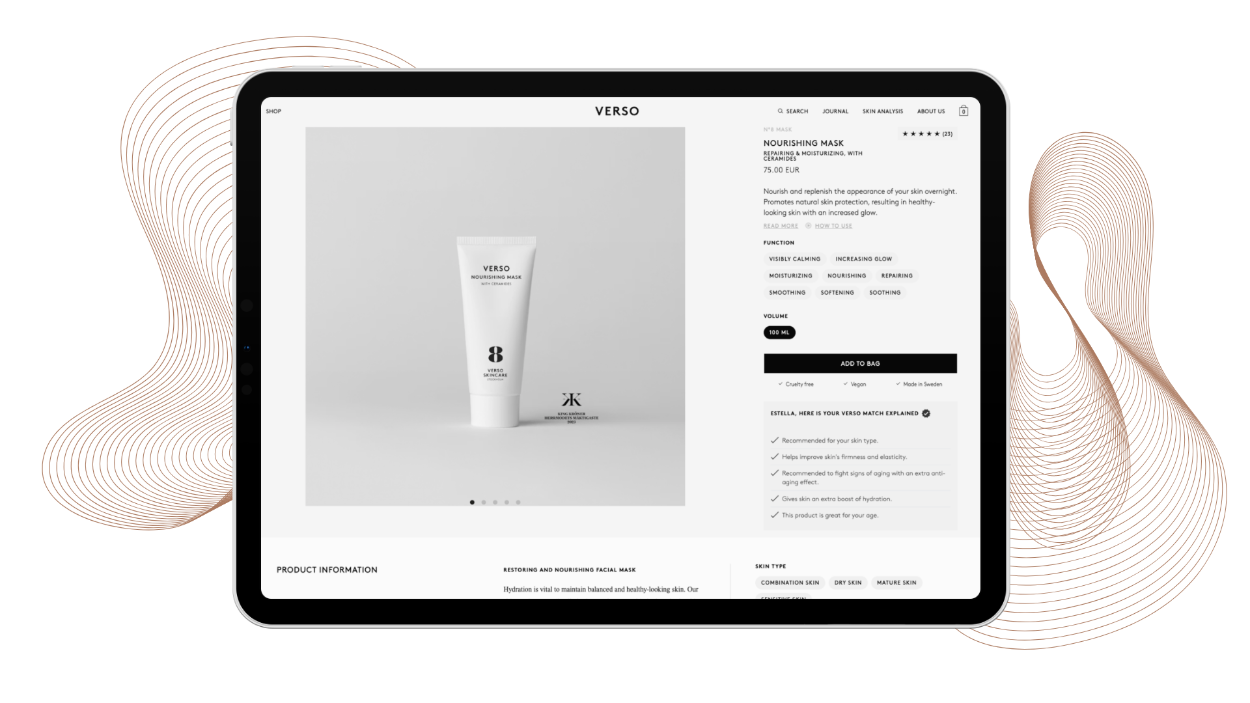
And Inference Beauty also worked with the team at VERSO on a similarly-integrated deployment of AI scanning and recommendations, combining the capture of behavioural data through a text-based quiz with a granular scan of biological markers, to allow the brand to match products to customers in real time, with percentage “Match Scores” displayed on product pages.
The future of AI-native beauty retail.
To be clear: for beauty retailers and brands, the first wave of AI deployment has delivered value. Companies that had found themselves languishing in the lower ends of online search have found an opportunity to reset the playing field for eCommerce, and to bring mature, educated shoppers to their storefronts, where AI scanning and recommendation apps have delivered a new touchpoint in an industry that’s historically needed to rely on in-person skin analysis to make data-driven recommendations.
Where that initial push has fallen short, though, is in vital areas where the drawbacks of a lack of data, or limitations in connectivity between experience and ongoing engagement, will compound over time. Beauty retailers and brands who know their customers and can exhaustively document their cosmetic assortments in real-time, will have a clear edge over their counterparts, because they have been able – with the help of partners like Inference Beauty – to build logically to overcome data gaps, to connect what would otherwise be novel but transient experiences to essential systems, and to make sure that AI initiatives become a meaningful part of their technology estate.
As Lars Fredriksson of VERSO summarises it: “For retailers, the pressure is no longer just about being present, but about owning high-quality, first-party data and translating skin analysis, education, and trust into the digital shopping journey. Those who adapt early will define the next phase of beauty retail.”
And that phase will be dominated by beauty retailers and brands who have captured all the potential missed opportunities of the first wave of AI deployment in eCommerce, and are now prepared with the right foundation for what’s next.
About our partner
Inference Beauty® (formerly Skin Match Technology) is a Switzerland-based AI and software company focused exclusively on the beauty industry. Its beauty-industry-focused AI empowers B2B clients to deliver tailored, interactive consumer experiences across every touchpoint. Inference Beauty helps beauty brands and retail turn complex product and ingredient data into transparent, personalized product discovery across skincare, haircare, makeup, fragrance, and body care.
Find out more at https://inferencebeauty.com