
Key Takeaways:
- The Interline attended “the world’s first AI-driven, immersive, shoppable catwalk,” and found muddled applications on the runway itself. But behind the scenes of one of the UK’s biggest fashion studios, generative AI pipelines are producing content at genuinely surprising speed and scale.
- With war now well underway in the Gulf, the military and commercial focus is on protecting shipping lanes for finished goods and fuel, but from synthetic fibres to distributed compute, the conflict could be having a greater impact in less visible places.
Summarise and debate with AI:
Take the content and context of this article into a new, private debate with your AI chatbot of choice, as a prompt for your own thinking. (Requires an active account for ChatGPT or Claude. The Interline has no visibility into your conversations. AI can make mistakes.)
We were there for an AI world record, but that actually wasn’t the interesting part.
Last week, The Interline attended a world record event put on by global consumer brands group THG, in our joint home city of Manchester.
Some context for our international readers: formerly known as The Hut Group, THG is one of the UK’s heftiest eCommerce businesses, doing in excess of £1 billion in revenue through its beauty vertical (stocking third party brands and its own private labels), and an additional half billion across its nutrition business – in particular MyProtein, which is billed as the world’s largest sports nutrition brand.
What does any of that have to do with fashion? This event – billed as “the world’s first AI-driven, immersive, shoppable catwalk” – was hosted in partnership with Topshop, the revitalised 00s high street brand, and it promised to demonstrate how far AI can transform the typical runway experience, as well as key ambitions around personalisation and engagement.
Topshop, as audiences of a particular age will remember, was essentially synonymous with UK mass market fashion in its heyday, before also expanding to 30+ other countries. And although the brand shut down, as part of the pandemic-catalysed-but-long-simmering collapse of the wider Arcadia Group in 2020, it was subsequently bought by ASOS (another UK-native eCommerce powerhouse) before having a majority stake acquired by the BESTSELLER group in 2024.
Before you read on...
Our weekly news analysis will always be available to read here at The Interline, but you can get it (along with notifications for new podcast episodes, events, and more) in your inbox by signing up to our mailing list.
That convoluted history lesson of how Topshop was shopped around actually does matter for the purposes of this analysis, though, because Topshop, after returning to retail channels very recently, has garnered a lot of attention. But it still has a lot of ground to regain when it comes to recapturing the mindshare of a generation that might have aged out of its offer, and a lot to gain for the first time amongst a new cohort whose expectations for speed, convenience, and price have been coloured by overseas disruptors like SHEIN who’ve majorly reshaped the business of selling affordable clothing while Topshop has been away.
And what better way to make that kind of cross-generational splash than to lean into AI, as we saw Gucci do in last week’s analysis?
Supported by PayPal, Google Cloud, and other sponsors, the AI catwalk show itself was billed as the primary reason for industry insiders and brand leaders to attend. And a headline-grabbing submission to the World Record Certification Agency in the self-created “AI-driven, immersive, shoppable catwalk” category also did a lot to get people talking about Topshop. So, mission accomplished there.
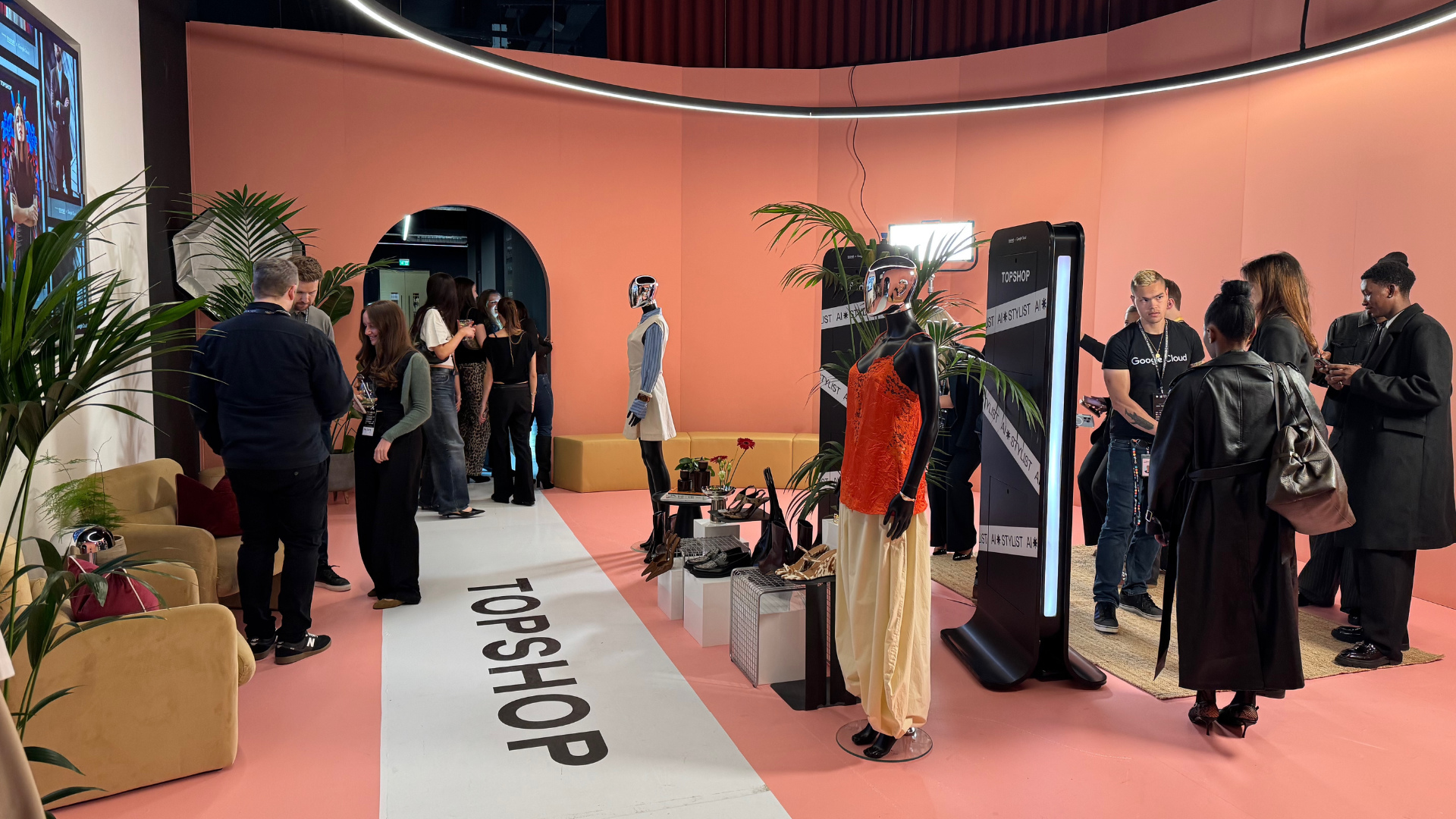
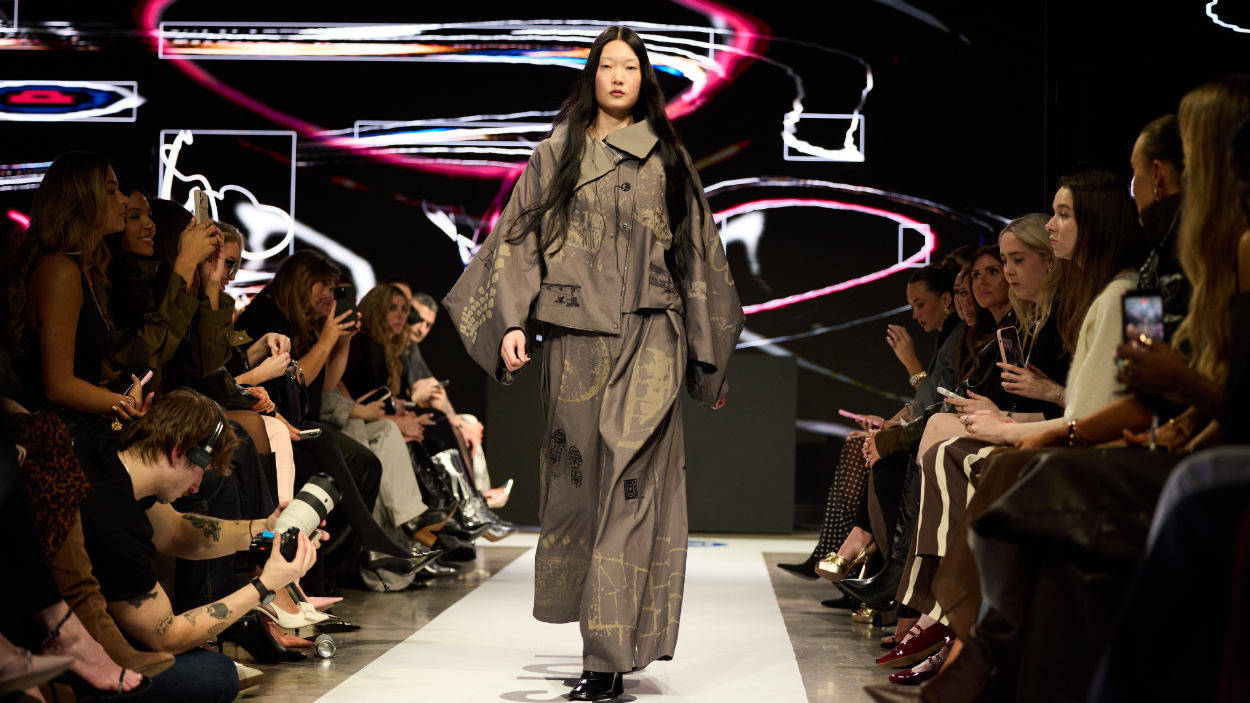
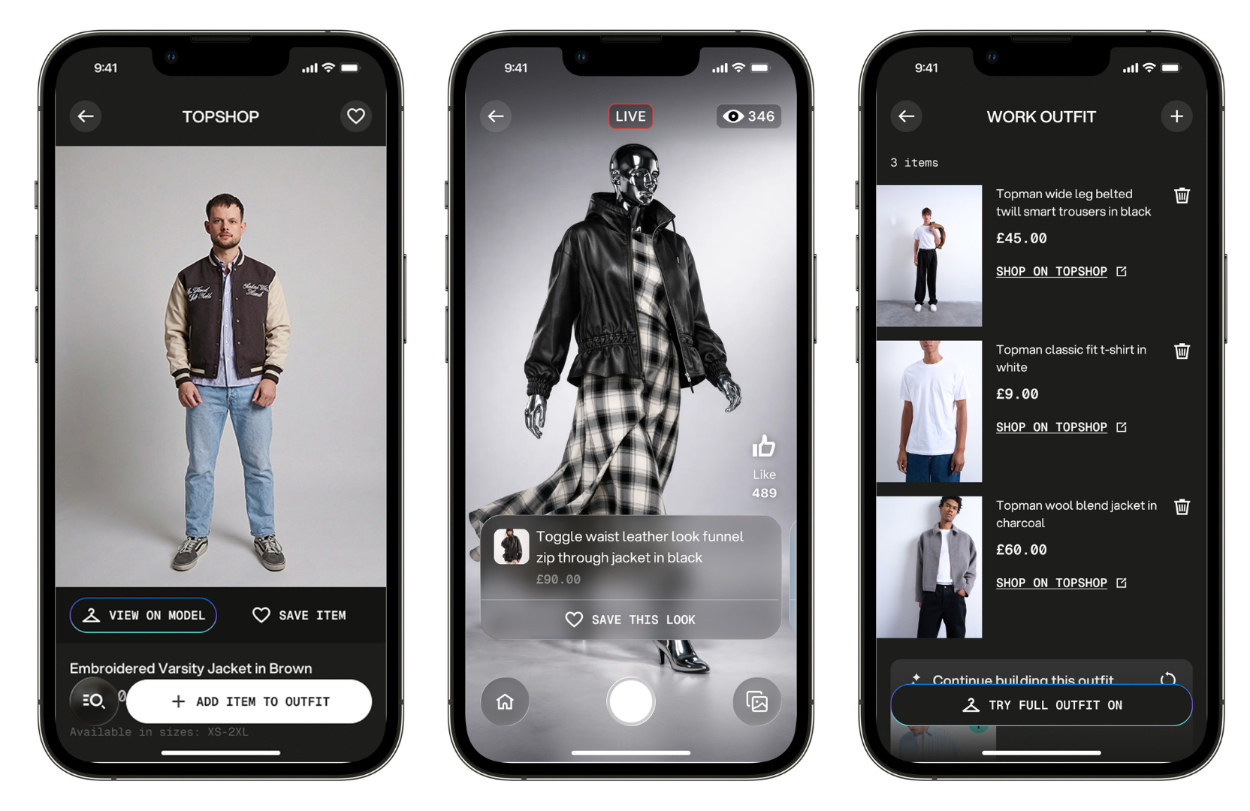
In practice, though, the runway show – despite being well-produced, with combined 3D / AI generated art and assets used alongside the physical looks – was a brief diversion, with some stumbling blocks where the vision for identifying looks, live, through users’ camera feeds with the help of AI was concerned. But the pre-runway tour that attendees were given of the massive THG Studios facilities revealed something much more profound: the extent to which generative image and video workflows have already taken over fashion’s visual communications, across web and social media, and how far those workflows have been operationalised and professionalised to become packaged agency services.
It’s something of an open secret, within fashion, that brands and retailers are making far more extensive use of AI in consumer-facing materials than they admit. For every visibly generated holiday ad, there are thousands of images and short video clips that pass us by, day in and day out, that are either enhanced by AI or created with it from scratch.
Right now, people still pride themselves on being able to tell AI content apart from traditional photography (or digital art, depending on the usage) when the two are placed side by side, and in fact one person on the THG Studios tour The Interline was given did successfully answer every blind A/B test. (We have to come clean and say that we did not.) But these kinds of tests are controlled and purposeful; people know that they’re looking for AI content, and this predisposes them to look harder.
For the average vertical video on TikTok Shop, or the typical Instagram reel, the audience is not scrutinising what appears in front of them, and as a result, an incredible amount of AI generated visual content already flies under the radar – and the volume is increasing rapidly.
This is not, however, the interesting part. Or at least it’s only part of the interesting part.
Like a lot of people, The Interline has instinctively known that AI content is now everywhere, but it wasn’t until we had the chance to see a cutting-edge studio workflow and AI pipeline that we realised just how far the technology had become operationalised. Generative visual content hasn’t just suffused the industry’s visual lexicon – it’s also already subbing in for a lot of traditional workflows to an extent that people don’t necessarily realise.
While this specific event was hosted by THG and Topshop, THG Studios actually does the bulk of its agency and studio work with other global brands, from Coca-Cola to L’Oreal, and from P Louise (the latest British social commerce success story) to smaller TikTok shop sellers. As well as virtual production and traditional photography studio setups, the THG tour also showcased a live, photography-to-finished-content workflow that ran almost entirely through a node-based setup of different generative image and video models from Google. (Google Cloud also had a showcase of its dedicated virtual try-on image model at the event, which The Interline had the opportunity to test.)
That setup may not sound like a big deal, but consider this: from a single photo taken of a garment on a mannequin, a team of fewer than three people was able to create full lifestyle photography and video content, ready for use across every conceivable channel, in very little time, with what looked like excellent adherence to the original garment.
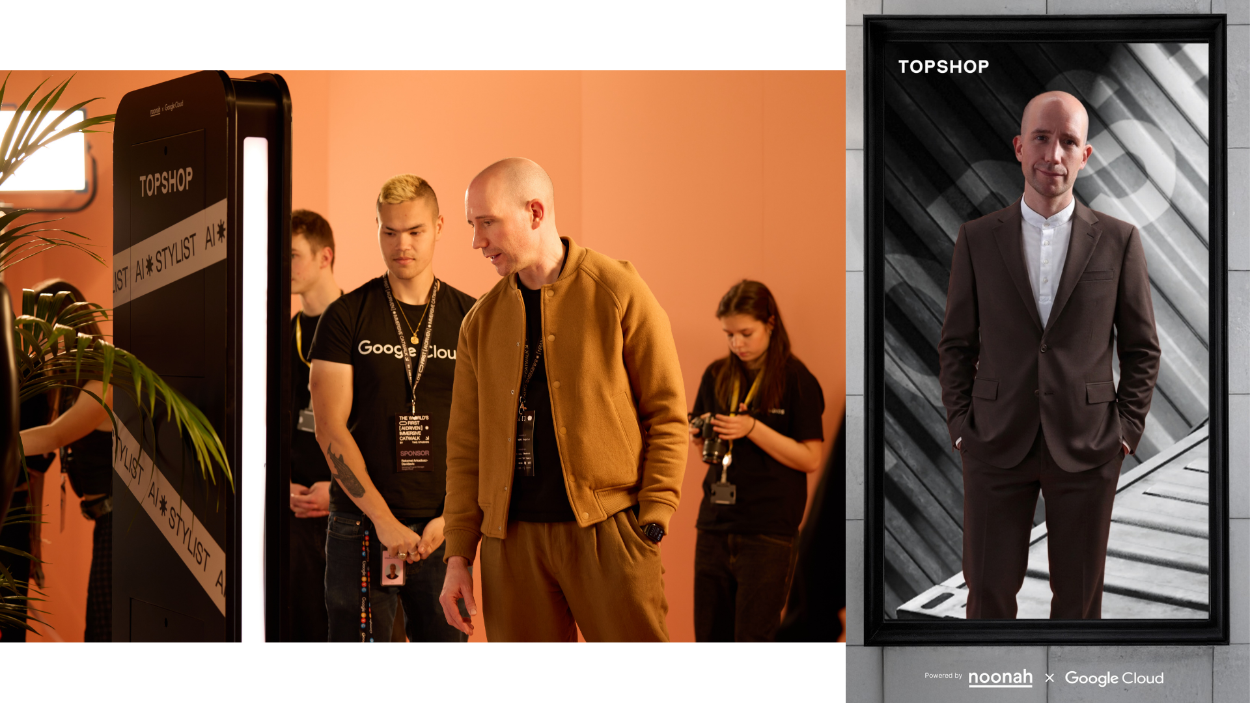
To put this into context: it’s entirely feasible, today, to ship a single production sample to a studio, and to get back something approaching a full marketing and social campaign, without anyone setting a foot outside with a camera. As Hannah Pym, Chief Brand and Marketing Officer, THG Ingenuity, puts it, “content is the new storefront,” and being able to automate the high-velocity buildout of that storefront definitely feels like a competitive advantage.
To be clear: THG is by no means the only company pursuing these kinds of workflows. It is, again, an open secret that some major European retailers are already putting primarily generative photography and video in front of consumers, with garments being photographed on fit models in-house, and then replaced with generative models and environments downstream.
The key difference is that, at least for the time being, a much smaller number of companies are offering these mature workflows as a service for other brands to take advantage of. And when the market for that service grows (which seems inevitable), it feels as though we’ll see an irreversible tipping point where generated images become the majority of social and marketing content.
The Interline will be analysing these workflows in more detail in our AI Report 2026, coming this spring.
Another wave of war spotlights fashion’s risk exposure – not to finished product sourcing or energy, but to the fibre inputs and the technical infrastructure that are becoming increasingly essential to bringing products to market.
One of our predictions for this year was that fashion would try to find a delicate balance between de-risking and upstream consolidation, with the most salient sentence from our start-of-the-year agenda being this one: “…spreading risk looks increasingly prudent, even necessary, as companies try to protect themselves against shocks that remain difficult to predict and harder to absorb.”
That principle still holds, but this week’s developments in Iran, and across the Gulf, are also evidence that there are some risks it’s simply not possible to spread, because fashion’s reliance on particular inputs and specific technology partners is so deep.
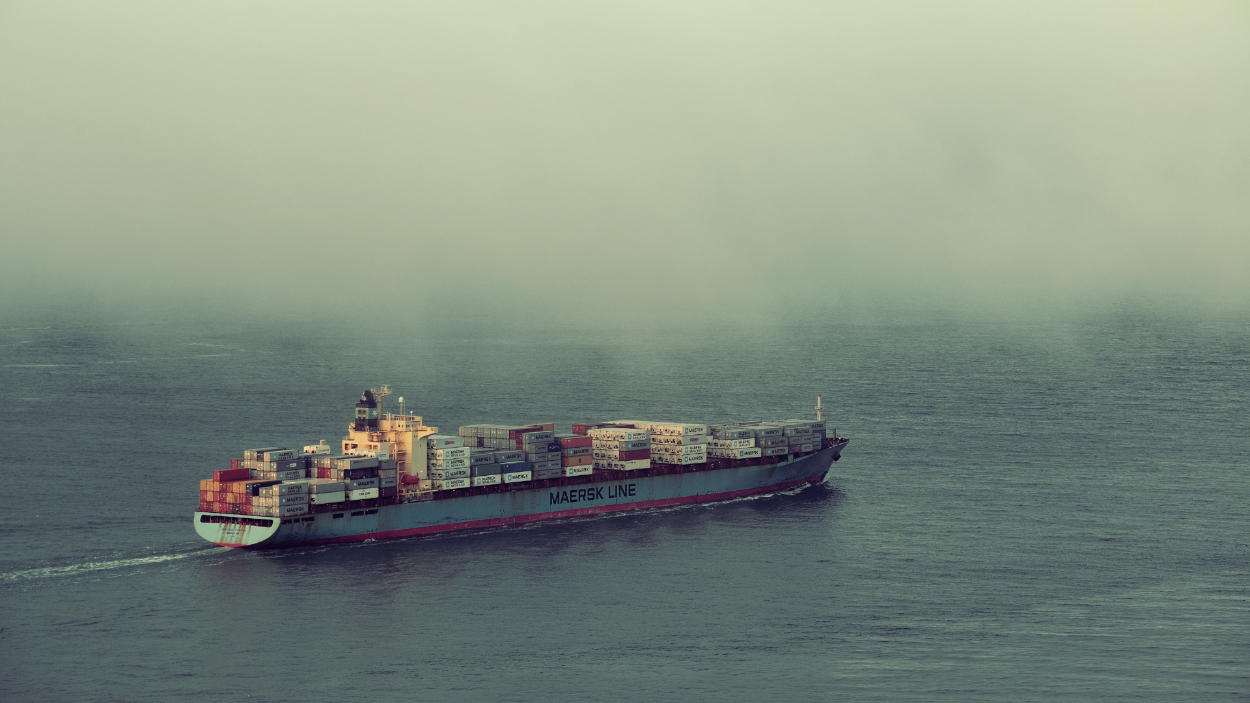
As usual, Sourcing Journal is a good reference point for understanding the impact of world events on the global fashion trade (especially the sourcing, production, and procurement parts), but the potential closure of the Strait of Hormuz – or at the very least a massive shortfall in shipping volumes moving through it, potentially with a military escort when they do – and the wider conflagration that threatens to erupt around it, represents a risk in a different way to the more well-worn pause on companies being able to move finished goods or components, or the established impact of energy crises.
As we’re already observing, shocks to the global trade in oil are manifesting themselves in increased consumer gasoline prices at the pumps in the USA as well as in inflated costs should the government decide to refill its strategic reserves. This, again, can sound like a shipping problem first and foremost, but we need to remind ourselves of just how reliant fashion has become on the same fossil fuels for its essential fibre inputs.
We recently ran an opinion piece about fashion’s energy mix, and the continued presence of coal in that mix, but the industry’s relationship to petroleum is felt at the fibre level as much as it is in fuel. If we look at the Textile Exchange Materials Market Report from the tail end of last year, it reveals that synthetics (particularly polyester) made up close to 60% of the world’s fibre production, and that close to 90% of that volume was derived from fossil fuels.

For companies looking to use those synthetics either exclusively or in blends – which, to be clear, is most brands in a market where consumers like stretch! – any enduring disruption to the movement or the price of fossil fuels represents a risk to replenishment of existing styles or the development of new ones. And, given how extensively synthetic fibres are used, and the limited scalability of alternatives, this is a kind of exposure that fashion cannot easily wriggle its way out of – even if the impacts aren’t felt for a little while.
But even this may not be the most profound “hidden” outcome of the expanding conflict. For one of the first times, data centres have become military targets. And these are not, themselves, purely military facilities; these are owned and operated by the likes of Amazon, as parts of its global AWS distributed compute / storage cloud, which handle workloads across enterprise and consumer segments.
Now, the entire point of infrastructure like AWS and Azure is redundancy and proximity to the end user through local distribution nodes, so knocking a regional data centre offline really only disrupts that particular region. But we do not need to look especially far back into 2025 to remind ourselves that an outage at just one major AWS hub – the famous US-East-1 – is enough to bring enterprise software systems the world over to their knees when they’re architected with a single point of failure.
Are we likely to see a scenario where fashion’s material development workflows and the software tools it uses to coordinate them (when end users of those tools are in the supply chain, and are served by the most proximate node) are both knocked off kilter by a regional conflict? That outcome now feels just as tangible as the more commonplace and easily-understood choking of shipping lanes or strangling of energy supplies, with the added wrinkle that, while ships can be diverted, over-reliance on a single input and on technology with common points of failure, can’t be as easily worked around.
