
Hey, and welcome back to The Interline Podcast.
Spreadsheets. Now I said that, you’ve had one of two reactions. You either perked up because you’re excited that we might be talking about formulas and pivot tables today, or your eyes glazed over because we might be talking about formulas and pivot tables today. Not to give anything away in the first 30 seconds, but those things are going to come up, although they’re not actually the focus of today’s show.
Spreadsheets themselves, though, are the tip of the spear for today’s conversation because for all of the enterprise system rollouts and all the digital transformation we talk about here, spreadsheets are still where a shocking amount of critical decisions get made. In a very real sense, product outcomes are determined by the choices someone took in a spreadsheet a year or so prior to that product actually reaching the market.
This makes it sound like I’m coming out against spreadsheets. I’m not. I’m personally really bad at using them, but there’s no denying that spreadsheets persist in fashion enterprise use cases because they’re as powerful as well as being ubiquitous in terms of individual use. Send someone a spreadsheet, they’re going to be able to open it and interact with it. Give an Excel expert a spreadsheet and they’re going to be able to do some pretty spectacular stuff with it.
What spreadsheets are not is a proper integrated part of the tech estate. They’re not a workflow platform to hang a complete product lifecycle off. And even when they are home to vital choices being made in areas like planning, merchandising, buying, or even in material development and marketing, those choices then have to go somewhere else if you want to collaborate on them or you want to reconcile them with other choices that ran in parallel and so on. All of that conspires against auditability, accountability, the ability to take the roots of decisions and interrogate them, and plenty of other factors.
Quite a few disciplines in the typical fashion product journey have at least partially reduced their reliance on spreadsheets for this reason. And a lot of them have taken a more systematised approach. Merchandising, buying and especially sizing have kind of stayed pretty stubbornly in Excel and Google Sheets.
So I wanted to pick this specific area up, not because I’m mounting a campaign against spreadsheets. I have enough personal and professional friends who love them and would divorce me if I did that, but because they represent a really neat case study for the disconnect between the everyday surfaces that people use to make product choices and the outcomes of those choices.
Someone who knows a fair bit about all of this is Michaela Wessels. Michaela is a former VP of Merchandising and she’s now CEO and Co-founder at Style Arcade, which is a planning and buying workspace that aims to help brands make smarter product decisions and to make those decisions a better integrated part of the product journey and the tech estate.
You’re going to hear me and Michaela talk about spreadsheets as we get into it, but this is also a much wider talk about not just how fashion decides what to make and buy, in what size ranges and ratios, but how to substantiate the money it might be leaving on the table by getting those things wrong, which is something that’s hard to capture in rows and columns and cells.
So let’s get rolling.
Never miss an episode
Get notifications for new podcast episodes, plus our weekly news analysis, events, and more, delivered straight to your inbox.
NB. The transcript below has been lightly edited.
Okay, Michaela Wessels, welcome to The Interline Podcast.
Thank you, Ben. So good to be here.
Not at all. It’s a pleasure to have you. You’re quite a bit ahead of me with my morning, your evening. So my day is just getting underway, yours is coming to an end. And I’m going to start by asking you to kind of run me through what a typical day of yours looks like. Doesn’t have to be today, but any typical day.
I’m always curious how CEOs in particular allocate their time. Sometimes we have guests whose roles are very, very clear cut. And sometimes you have somebody who has a much more wide open remit. And I want to quiz you a little bit about that because I want to find out what you do. Also, I’m pretty sure I’m bad at being a CEO sometimes. I’m pretty bad at delegating and distancing myself from things. How hands-on are you still with the product in a typical day? You used to be a VP of merchandising yourself, so I’m picturing it may be difficult for you to take a step back. Or maybe you’re better at delegating and distancing yourself from things than I am. Just run me through what your day looks like.
Goodness, Founders, there’s no way we’re good at distancing ourselves from anything – especially the things we love, right? So, for sure my days are topsy-turvy, as you say it’s 6 p.m. here but 9 a.m. for you and I split my time between New York and Sydney, so I’m always at the wrong end of my day for somebody and our EU team does our product and that’s my favourite part.
So if I had to describe my favourite day, it’s whenever it starts or ends with product. That’s when I’m my happiest. Everything in between is just to be able to get to do product to be honest. And then thinking about, why would I spend so much time on product? It’s a little bit like the fashion industry and having come from that industry, product is king. It’s everything. It’s like what makes it tick. And I think it’s the same for tech. You can’t get away from the fact that the product is everything for your customers, your users.
So, I spend a lot of my time in product, but of course juggle all the other billion things that you have to do as a business owner.
Yeah. That sounds familiar. And I’ll align. The part I like is writing and talking to people and being on stage. Everything else is in service of that. So I think we’re of a similar mind there.
Exactly. And then you know you’re winning by the numbers, right? It’s like who’s listening, how many, you know, and you just get a kick out of that. So the more I see people using the application, the more powered I am to work into the evenings and the mornings just to have all the fun stuff come alive for them.
I will say The Interline stated position is “don’t work nights”. But the reality of it is a bit more complicated than that for everybody. Generally speaking, I don’t advise it. As somebody with a business of my own, yes, it happens more often than I would care to admit.
Now, we’ve done the day-to-day. The other thing that we usually do at the top of these shows is we ask people to define something. The term I’m asking you to define is a slightly complex one, so I’m going to give it a bit of preamble because it comes from a conversation you and I have previously had. It’s new terminology to me, at the least in the way it’s framed, and I think it’s also going to be instructive for the rest of this chat. So the term is ‘sizing quantification’.
Now, if you take a step back, the primary success criteria for any brand or retailer are pretty simple. To win. As we’ve talked about, the product is everything, product is king. You either make or buy products that your target demographic are going to want. You allocate them to different channels in size, ranges, and size ratios that also correspond to your knowledge of your customers, which is hopefully pretty granular and pretty accurate. I think people say size curve these days rather than size ratios. I’m just slightly old fashioned in that regard, but the principle’s the same.
Now, I think people are maybe more familiar with what it looks like to get the first one of those things wrong than the second. If I’m making or buying products that shoppers don’t want, then I’ve got a pretty fundamental binary business problem and I need to go back to the drawing board. That’s pretty clear cut. If I’m getting my approach to sizing quantification wrong, it’s harder to sense and it’s messier because the net output of that is inventory distortion, overstocks, out of stocks, capital bound up in excess inventory, operating expenses that you lose trying to chase replenishment, compounding challenge when it comes to taking the data from one season and using it to build future forecasts and so on. You get the idea.
So, before we get any more specific about what you do at Style Arcade and with the wider industry context, help me draw the line from that messy spectrum of potential bad outcomes back to that one specific defined task.
Ben, you’ve picked the least sexy topic to talk about, but it’s my favourite. It’s my favorite, but it is boring for most and a problem that most are completely unaware of.
So sizing quantification is typically done for fashion retailers in spreadsheets. And we have done for decades. And no one would think that there was – well, I actually think that the teams know. The teams know it’s inherently incorrect. The execs and the CEOs, I don’t think they know that. I think they can see the downstream effects of that. But does anyone measure size accuracy? No, we don’t. But it’s super important because it’s two halves of the whole that you’ve just described, right? Buy the right product and quantify it perfectly. Get the right quantification, including size. And, you know, when you look at the performance of a product, you can easily see if you misalign that size ratio to it not performing, when you get that wrong, a brilliant product can be an absolute dog in just after launch, which is pretty sad.

So if you think about this, it’s a big, big problem. If we’ve got consumers saying, I can’t find my size as the biggest shopper complaint year after year, you know there’s a supply and demand issue. There’s definitely a math problem sitting under there. And I couldn’t believe when I was in the merchandise seat that we were allowing that to happen.
So the first thing that we ever built was a sizing tool at Style Arcade. And that was because it is so difficult to quantify this in spreadsheets. And I’ll explain why. The data is distorted, right? Because the math doesn’t math because we’re doing it in spreadsheets. But the bigger issue is the out of stocks by size, by store, can never tell us how much we could have sold. So we’re sitting with an empty bucket. How do we know this answer? And also when we discount products, we inflate the sell through on the sizes and then we get a distorted view as well. Now let’s layer complexity there. If you’re still following me after all of this talk about sizing.
I’m with you. I’m with you.
Layer on the complexity of we need to decide sizing by region, by country, by channel, store, category, colour, and even attribute. Because it matters. The same dress in white versus black will be sized and perform completely differently in different sizes. So you have to think about all these facets. And if you don’t use the sizing tool, you’re doing this in spreadsheets, who has the time to do all that? No one.
But I think we went and quantified it. And brands lose up to 23% of profit every single month from inaccurate buying by size. Just add one simple thing. It’s like, why would we do this in spreadsheets?
Yeah, I think the interesting part, as you said, is you can’t measure what you can never know if you don’t have that size.
And the other thing I wanted to ask is not kind of corollary to this would be, how are people’s expectations for sizing changing? So you mentioned the biggest consumer complaint being that they cannot find their size. Just walk me down the garden path a little bit as to what consumer expectations for sizing look like these days.
Well, I think it’s shifting as well, Ben, because the shapes and sizes of people are shifting. I mean, if I look back at my career, we used to resize every quarter. Let’s relook at the size ratios or the size curves, as you call them. That’s not enough. Not at all. You now need to size on the fly. Every single new product needs to be sized based on the most up to date data that you can get for all of those facets of the product that I’ve just described.
And so If you throw an image of a product into Style Arcade, it’ll then recommend based on similar products, how much to buy by product, by size, by store. If you give it the time of year you want to launch, and then obviously the price point. So that’s what good looks like: sizing in seconds versus sizing in 30 minutes per product.
And how about the degree of specificity from a brand point of view? Where does the average brand capture their sizing data from? Is it a mix of big size set surveys? Is it predominantly own channel, own audience sort of stuff? Just walk me through what the typical data mix looks like.
Ideally, it’s all first party data. So, you know, what your stores are selling, where they’re selling it. You’ve got your customer base that you’ll lean on and then you’ve got your demand signals being the traffic or the eyeballs that you’re getting, the out of stock notifications that you’ve got, the wish list. So you pull all these signals together to understand what your demand by product and size is.
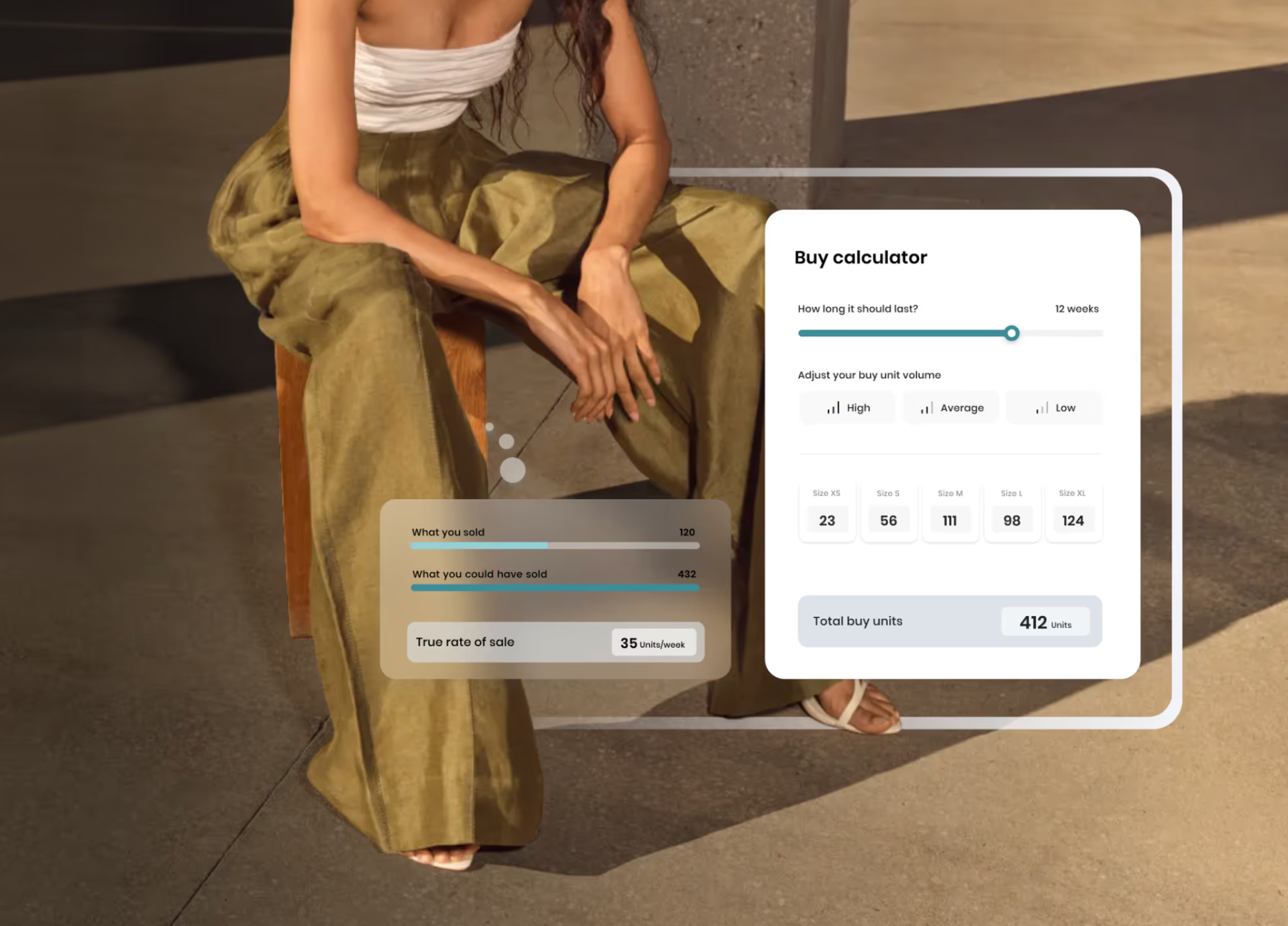
And also the one thing that you should be looking at is, hopefully you’ll follow this but when we say it to people in the industry they get it. The true rate of sale when in stock, what’s that? How much can you sell when you’re in stock by size? That’s the number you want. So when you’ve got that everything becomes a lot clearer.
Mm-hmm. That makes sense. And the final pull on the sizing thread would be from a brand point of view, thinking about tariffs and supply chain risk and all the general kind of precarity that comes with introducing products to market. Is there any drive within brands to kind of consolidate or rationalize sizing?
And you mean like sending sizes between stores? Do you know how often they do that? A lot.
I mean a bit of that. I think I also mean reducing complexity of size ratios and ranges because I think this is all part of the same puzzle, right? Which is you want to be making what actually sells. You want to be making what actually serves your audience. But from a brand point of view, you don’t want to be spending money on bringing size brackets to market that then don’t sell through.
Mm-hmm. Exactly. And Ben, you remember we had that push where all brands were thinking, let’s go plus size or let’s extend our size ratio on the far left and the far right of the curve. And they didn’t get the sell through. They didn’t get the ROI and they quit it. And then they went straight back to their old size ratios. And there is missed demand there. There is, we know it. That plus size market has been underserved for the longest time. But when you dip your toe in, it can become very expensive. And then you pull out really quickly without having the data. Like I said everyone’s using spreadsheets, they’re not using a sizing tool so they don’t know when it’s working and then so often brands just pull out which is sad.
Yeah. So everything we just talked about is also true beyond sizing, even if sizing gets wrapped up in it. And the reality is that fashion makes planning, merchandising decisions on a really long horizon, not like aircraft building long, but the products that make it to market have all their essential attributes and allocations and characteristics and things defined the best part of a year in advance, typically. That interim period between decisions that get made pretty fast, like there’s a lot of pressure as everybody, every brand listening to this will know. They’re high velocity decisions. And then they go through a very lengthy development, sourcing, production, distribution journey. That’s where the acuity, like the accurateness, and the future proofness, of those choices get tested.
What I want to understand is how you change that cycle. How you change that, like I am guessing or with some degree of blend of kind of intuition and analytics. I’m making a choice and then a year later we see how that choice plays out. ‘Cause I can point to a specific instance, one that you and I have previously talked about, which was adidas making use of Style Arcade midway through that famous global demand spike for their Samba platform and being able to then quantify opportunities in real time and working to adjust the size curves across regions and stores, right? I can point to that and I can say that’s an example of what it looks like when you have a hero product that lines up with a solution.
It’s harder for me right now to see how you close that gap between decision and market reality much later more systematically. No one’s going to fundamentally change product lead times, at least not right away. So tell me what you think it looks like practically, operationally, to make merchandising decisions, whether they’re for hero products or something bigger? Making decisions whose value doesn’t leak out in that year or so in between or whose fault lines don’t get exposed in that time period.
So many things to unpack there, Ben. Look, we were all trying to get our hands on Samba shoes, were we not? And you can never find your size. But thinking about in-season trading, it’s a top priority for so many big brands and Adidas was no exception. Actually quantifying how much we sold versus how much we could have sold becomes the biggest question on everyone’s mind, especially for the hero products. And you have long and short range product lead times, right? You’ve got a combination in your product architecture and sometimes you can react and sometimes you can’t, but you will see that a lot of these bigger businesses are investing in in-region production. You’re right where the customer is, you can produce in-region, you can do shorter runs. So people are getting quite clever with how they’re manufacturing. And I think that’s helping a lot of brands. Like I say, now you have a combo of lead times in amongst your product mix.
But, what’s the utopia? The utopia we all want is to be at the Zara model level where we deliver a product to store, 1-2 weeks of performance assessed, hey, we know exactly how much to reorder in exactly the right sizes, send it to exactly the right stores and you have less wastage, you know, and using your data to your advantage. No more guessing, no more unhappy customers. But practically, it’s not the case for everybody.
It’s like, why does that exist but not exist for everyone? And I think the longest lead time we have in our customer base is some products that have nine months. And you want to cut that down. There’s a lot of coordination in there, Ben, that doesn’t need to happen because we’re not all on the same system. Your supplier’s on one system, you’re on another, your internal marketing teams on a different system – that’s the biggest issue, is the coordination problem to reduce the lead times.
And then, yeah, quantifying it upfront is super important. I remember I was working at a 700-store multinational department store retailer. We had nine monthly times and we used to quarterly assess our size ratios. That was nowhere near enough. Hundreds and thousands of units you’re moving on a weekly basis and we’re basing it on last quarter’s data. That’s wild.
Yeah, and I think people get very hung up on the Zara advantage being a manufacturing advantage rather than it being just the degree of granularity and kind of newness, near-time, real-time information they have on what is shifting through each individual store. That’s always been their kind of key trading edge rather than just being able to make things first.
Yeah, yeah for sure. A lot of the time as well with the size ratios you do them once at the time of the buy, but quite often the factory hasn’t cut that until a certain time before production. So you can adjust size ratios. Actually every time we go live with a new brand I say have a look at what you can adjust today because I bet you can change a lot.
Yeah. Yeah. So you mentioned spreadsheets a lot. Let’s get into them. I’m not going to open one. Let’s talk about them.
So, what is it about the evolving roles of merchandisers, buyers, planning teams, and so on, the kinds of people who now have to balance the intuition side of things with this, what we’ve just talked about, that sort of near-term real-time analytics. What is it about their role that you think the existing enterprise tech stack hasn’t covered? If you could just try and conjure up an image in your mind of one of your power users, for example, tell me what kind of tools they were using beforehand to pull all of these different strands together.
Well, we had spreadsheets and we had our PowerPoints and we had our pinboards and then for inspiration we were using, you know, WGSN, Pinterest to pull the trend stuff, socials. But that’s it. Can you imagine? Just spreadsheets, PowerPoint and pinboards. That’s how we used to pull range reviews together and maybe we’d have some actual samples. But, ultimately, all we wanted was to get like – if you want to build on your intuition about which product is going to be a hero product for you and how to back it with confidence, you need to back your intuition with the knowledge and the experience in practice. And if you don’t have access to the data to help you make those decisions, every season becomes a guessing game.
And I think we were just operating between BI cubes and spreadsheets making million dollar decisions on what products to buy and how much to buy them.
I think there’s a lot of segments of fashion where that will resonate. The primary decision-making tool, the primary day-to-day environment is still Excel. In a very real sense, a lot of businesses run on Excel. So in a similar vein, I’ve spent long enough analysing tech for fashion to know that the footprint of different tools is open to change. Like what constitutes PLM today is slightly different from what constitutes a PLM a few years ago.
But it’s relatively rare for a completely new software segment to emerge or a completely new category. So, you frame Style Arcade as a “buying and planning workspace”. And I want to know if you see that as a fundamentally different product category to how we delimit existing planning, merchandising, forecasting platforms and so on. There’s a reason I ask this. It’s that software that’s built for existing well codified categories tends to fall under the umbrella of what we call push systems. Other people call it that and I’m borrowing it In the sense that it’s clear what they are, people buy them to fit a hole and they get bought and deployed by people who aren’t necessarily their end users. They fit budgets and boxes and they get pushed down onto people, hence push.
Software that’s genuinely newer, that is its own category and that has a specific market fit, that tends to inspire more in the way of passion and devotion from end users who then pull it towards them and make a business case to take it upwards. It’s a bit different to the traditional top down tech decision making versus bottom up because it’s not just about how software solves a problem. It’s about creating an environment that people actually want to exist in and operate in and that they see value in transforming their day to day.
So, taking account of everything you already told me about the historic kind of tech stack that people were using, the context of sizing and so on and about the criticality of the choices. How do you approach building software that is designed to be an everyday workspace that adds value for a particular type of user, but that also delivers some of these big bottom line benefits that we’re talking about that appeal to the higher ups who will then receive the business case for it?
No, you’re right. There was an undefined category for Style Arcade. I mean, we began as an analytics platform, had a lot of adoption and success there. We then built assortment planning on top of it, but we didn’t just build it on top. The key was to create a fully integrated experience of the past, present and future range. Right. So you can analyse how things perform. You can trade them in season and then you can plan them going forward.
We, in the industry, were desperate for that single connected system instead of an ERP over there and an e-com platform over there and a PLM back here and BI tool over there. We wanted to make decisions using all of these great platforms’ data in one place that wasn’t spreadsheets. And we wanted all that product data to help us do that and create seamless workflows.
So, I mean, I always said the product team, it’s like our product team at Style Arcade is like, if you guys want to get them out of spreadsheets, we have to be 10x better than Excel. We have to be 10x better. We can’t just be slightly better. We have to be a dream for them to want to leave Excel, because personally, I loved Excel. I was a pivot, we were all pivot table wizards and Excel geniuses. You pride yourself on it, but it’s not the way forward. Ben, you can’t be running billion dollar fashion brands on Excel spreadsheets anymore.
Style Arcade fundamentally became a very well connected platform between all of these tools. Doing one thing, the most important thing, is like how do we help them quantify how much to buy? Because if we can do that by product and by size, we’ve just helped that retailer immeasurably.
But you spoke earlier about push versus pull. I do remember being pushed many tools that we never adopted and what’s interesting about Style Arcade, I’d love it to be easy, just introduce Style Arcade to the CEO and they just put it straight in. It’s not the case for us. The users at the level, the buyers, the merchandisers, the e-commerce managers, they know what they want. They need Style Arcade and they have to take it up to the boardroom. That’s not an easy feat when that department doesn’t have budget. They’ve never had budget. And so they do an outstanding job of articulating the ROI. A lot comes down to automation for them, a lot around decision making and better KPIs.
A friend of mine was actually in a boardroom when Style Arcade was being decided for or against. He was another tech provider at the time. And he said, you know, I was in this boardroom listening very intently because I was going to give you the feedback after. And they tabled Style Arcade and said, so are we moving ahead or not? And the head of IT who’d put it forward said, look, I am not arguing with 80 buyers downstairs. We’re signing this off. There’s been enough noise about this platform. The ROI is clear. Can we just get a vote of yes here? So it is really the army of buyers and planners that help us get into the brands and retailers.
Okay, if you ever want to go in for the Excel Olympics, by the way, I will be there and I’ll cheer you on. I know it’s a real thing. There’s enough passion there. Is it called the Excel Olympics? There’s definitely some kind of big competitive Excel scene. I’ve got friends who are deep in spreadsheets as well for the same sort of thing.
Yeah? And you’re good. Ben, you rate your skills?
God, no, I’m terrible at Excel. I’ll be there as a cheerleader. I live in Google Docs. That’s where I live. Google Docs and a podcasting platform.
Okay. Yeah, you’re a communicator at heart.
That’s it. Yes, I was terrible at maths. There’s a whole different podcast about my high school maths incompetence.
Both of the angles we’ve just covered, the end user and the big budget holder, the people you’re talking about in that boardroom, they all want software that integrates with the rest of their tech estate. The end users want it because it makes their lives easier. Pursestring holders and IT wants it because it reduces tech debt and middleware and everything else.
Now, that sort of integration seems especially important when we’re talking about having that one platform where people make decisions that brings in a complex array of signals and data from elsewhere.
When I think about some of the solutions you can potentially integrate to, and we’ve hinted at a couple of them, it feels like the market signal side of things is fairly clean, it’s fairly clear cut. But there’s a lot of product choices, like sizing, stock allocation, assortment, line reviews, sourcing and things, where maybe you’re making those decisions at the moment in a few different places. Spreadsheets is part of it, maybe it’s not all of it.
Do you find any tension in practice and in implementation between people who want to make those choices in Style Arcade and people who prefer those choices to be made elsewhere for accountability reasons? Because you’re making really pivotal product outcome-based choices and I’m wondering if your experience is that those slot really cleanly into the existing tech ecosystem, or do you find yourself having to deal with some blurrier lines where you say, well, this choice is currently made over here, but it would be better made over here?
Hmm. Great point. Great point. And that’s our job, isn’t it? We have to have a platform that people want to work in.
One of the keys to that is, you know, buyers and merchandisers, we know the data that we want to get our hands on to make our decisions, and we know what good looks like. So when we recommend a buy quantity in Style Arcade, they don’t have a black box of how on earth did we get that… they can find out how we got to these answers, why we’re making the recommendations, and they can find out fast. It’s almost like they can answer their questions at the speed of thought. Well, that’s the goal that we have. So you get a buy recommendation, you have 10 questions following it, and you can follow your train of thought and get the answers.
Ultimately, you have to make them want to make the decision in Style Arcade because it’s so much better. Who wants to go and calculate true rate of sale when in stock by store, by size, by product and then go and put that into a spreadsheet to try and determine a rate of sale and a potential buy quantity by size? Way too hard. We want to focus on the commercial value of each of the products and decide the product tiering and all of the strategy behind the product, not the number crunching. So a lot of the grind, I would say, is taken out of the number crunching so that we can get to the answers faster.
We did a great case study once with a multi branded retailer, 300 users, and you could directly tie those high pattern usage of Style Arcade to departmental performance. Now I couldn’t say it was the reason that department performed, but across 300 data points, that’s pretty compelling. So when assisted by intelligent tools, buyers and merchandisers have superpowers, I believe.
And when those choices are made, so let’s say those decisions are made within Style Arcade, how do they travel afterwards? What does it look like to be part of the extended sort of tech estate ecosystem from there?
So they’ve got the quantification. Let’s just say we’re buying a pair of sneakers, we’ve got 300 units. That then gets made into a planned product and then everyone starts collaborating on it. Because you can imagine, Ben, pulling around, who’s communicating with the factory, how the market is planning, the campaigns around it, what about all of the product attributes? Everything that happens with a product is touched by hundreds of people at different times. And so we have a real-time collaboration that happens in our assortment plan.
So you’ve taken the buy quantification, put it into the assortment plan, and now everyone’s collaborating in the workflows to get the things done. And then it pushes into the purchase order system. Purchase order gets raised, factory gets their order. Then what happens is the product launches, it goes live, it starts trading, Style Arcade’s telling you how it’s performing. You’re doing in-season trading in there. And then the whole cycle starts again with a whole new product that you want to quantify.
Okay. All right, good picture.
So when we think about what constitutes a pull system, like we talked about earlier, things that people love using, at the time of recording right now, we’re in the early days of our 2026 AI Survey. It’s the first time we’ve done this, the results will be reported in our 2026 AI Report, which is due out in the June timeframe. Even with only some really early data to go from, it’s clear that people don’t have a whole sentiment when it comes to AI. Certainly not universally. It’s a divisive subject culturally, socially, and it’s one that people also have some deep reservations about technically in the sense that they don’t know if they need to know that it’s going to work and a lot of people don’t have the confidence that it will or that it’s accurate or that it’s trustworthy.
You’ve been on a journey, if I understand it correctly, when it comes to how, where and why you ended up adding AI in the contemporary sense, generative sense to Style Arcade. We’ve already established that your users are making high stakes choices and the upshot of that kind of pressure is that ‘good enough’, which is what a lot of AI content is, where go, okay, it’s fine. I can sign off on it. It’s not perfect, but it’s okay. ‘Good enough’ isn’t good enough when you’re making mission critical decisions that have a marked effect on product outcomes nine months later.
Walk me through how you arrived at the primary way you’re using AI right now, which I believe is attribution and tagging in images, and tell me the pushback you got along the way?
Yeah, I think we’re all divisive on AI. We have the pros and the cons.
So for Style Arcade, our AI journey began with, as you say, AI image tagging. We wanted to take the load off attributing, deep attributing products. You know, when we’re talking about sleeve length, neckline, hem length, colourway, print, pattern, fabric, all those things. Taking an image and then giving the user back all of these attributes to say, for example, this is a black notch lapel long sleeve blazer dress in velvet. That was great for them because it took a lot of heavy lifting away. But the accuracy on these tags was about 96% because it depends on how many images you fit the model and depends on, you know, perfect taxonomy – like, we don’t call it trousers, we call it pants.
So we had to quickly adapt to feedback of like, we don’t like 96% accuracy, we need 100% accuracy. We’re making investment decisions on this. If you tell me my investment in long sleeve blazer dresses is going to be, you know, X or Y, I need to make sure that that’s attributed properly. So we had to go back to the drawing board, improve the model so that we could get 98-99% accuracy and allow one key thing, fine iteration by the user. They want ultimate control on their own taxonomy and they do want to adjust tags that it hasn’t picked up and be able to make 100 % accuracy. That was key for us.
And, you know, once we’d made those two changes, it was big adoption and a huge weight of these teams, which is amazing. But I hear you on that divisive nature of AI, because we’ve all got prompting fatigue. And I feel like when I say the one key thing was we allowed the user fine iteration. When today we’re prompting, it feels like, you know, that I don’t know what the name of this game is, but you’ve got six dice in a cup and you shake them and you roll them. All six roll out and you want to reshake two of them, reroll two, you know, to try and get higher numbers. It’s like when you’re working with LLMs that you have to reroll six every time. Or if you’re doing generative AI, you’re rerolling six dice and you feel like you’re starting from scratch. That is the most fatiguing thing to do.
So I think focus on high value items where you’re allowed fine iteration instead of a full reroll makes a big difference.
Yeah, I think that’s a pretty accurate summary.
And I think when you look at generative AI and creative workflows and everything, you have the same challenge. All of the applications being built on top of the core models are all designed to try and resolve that. They’re all designed to try and give you some templating, some workflows, some elements, some things that are not starting from scratch every time.
Outside of the scope of how we talk about AI right now, which we say AI, I mean the current generative text, video, image models, and so on. I’m going to guess that under the hood of Style Arcade there’s plenty of traditional machine learning as well. You don’t deal with the kind of volume and variety of non-normalised data points and signals we’ve been talking about without that.
Tell me how that works because I find this disconnect a lot between what the market wants to be told is AI to help justify investment and the spread of things that have been algorithmically driven for a long time. My go-to example is cut plan optimisation, nesting material yield and so on. That’s been algorithmically driven, machine learning driven for a decade or more, easily. But nobody really talked about it as AI. Now we have a situation where every product claims to have some AI components to it. Some of that is earned, some of it’s not. And I’m keen to see what the kind of deeper machine learning parts of what you’ve done at Style Arcade look like?
Yeah, such a good question. Everyone wants a sticker, right? This AI sticker. Sometimes we walk into meetings and people will say, please tell me you have AI. We’re not going to get this approved if you don’t. So everyone’s looking for it. But like what? I think that’s the thing. It’s like in fashion retail, what are we actually looking to do with AI?
And so we’ve had a philosophy at Style Arcade at least: anything we build and of course, like you say, algorithmically driven from day one, true rate of sale, win and stock, the most amazing algorithm to use across so many facets, AI image tagging layered on top of that. But our philosophy is it must be of high value. It must have practical application to get a real job done and to help the user. And it must be accurate and auditable. And I think that’s a big difference between what’s out there is you could use, you could give full autonomous control to many things like even an LLM tell me how many units of a certain product to order. But if it’s not accurate, not measured and not auditable, then we’re all guessing, it’s as good as a guess then.
If we think of moving buyers and planners to full agents, I don’t know. We have to be able to audit the accuracy of it. When another product we developed in the AI space was, you’ll probably follow this, it’s AI stock art forecasting. How do we know when this product is going to sell down based on patterns we’ve seen in the past? And then how do we know that it’s any good at predicting this?
So we use almost like a retrospective look. You take a product, a full product that’s already sold down, sold out, and you put it into the model and you remove some of the data points and you say, tell me what units sold in that week and in which sizes and in which stores. And then you can actually test the accuracy. So, finally you have a model that you can measure the accuracy on versus just trust. I think this blind trust is where we all lose faith.
Yeah, and I think there are a lot of areas where accountability matters in the extended, you know, our nine-month product journey that we’re talking about. These early stages where so much of the product outcome gets set in stone, this is where you need accountability. You need to be able to trace back and say, well, what decision was made? What data was used in making that decision? And who made it? And if you’re going to hand off anything like that – it doesn’t have to be in buying or planning, you can be in anywhere – you need to trust that the data is there, that the inference was run on, but you also need to say, well, somebody needs to be accountable for this. I don’t think the buck is ever going to stop with a full agentic sign off for anything. It feels to me like there always has to be a human gatekeeper there, because otherwise I don’t see how that accountability works.
Yeah, for sure, for sure. I agree. But how much fun are our jobs going to be. What are we going to be like? Imagine a world where the agents are doing everything and we’re just supervising agents. Is that the future of work? It cannot be.
No. I would give it some of the stuff that gets in the way of, we talked about this at the top, the things that get in the way of me writing, interviewing, being on stage. I will delegate my accounting, I’ll delegate my, I don’t know, I’ll delegate my admin. I’m fine with that side of things. But again, only if I can trust it. And trust is a very complex continuum.
One of the concerns that our audience has raised time and again, doing what you do best, is that technology, especially if it incorporates AI, keeps raising the bar for talent. It keeps raising the entry point. And irrespective of what kind of discipline we look at, it’s getting harder to see where junior folks can get a foot in the door in fashion nowadays. So an extreme example of this might be in design where creatives who come out of university, you’ve studied creative design, you don’t have AI skills or you don’t have 3D skills because you weren’t taught them or you didn’t acquire them yourself outside of institutional education, you’ve got a hard time getting into the industry because those roles mandate one or both of those things. And there’s plenty of other everyday examples where people who are studying traditional disciplines like merchandising, they come out of education with a skill set and an idea of what the industry is going to be like that’s misaligned with what it’s really like because there’s so much technology adoption and diffusion.
So if I put you in a room full of people like that, younger folks who want to be retail buyers or planners on merchandisers, what direction would you point them in? What skills would you encourage them to develop to improve their employability?
The second one, if I did the same, but I put you in a room full of management, how would you work with that management? How would you talk to them to measure the influence that humans versus machines should have over decisions? That kind of accountability and things we talked about. Because the industry is definitely seeing technology as a foil for a lot of this and as a solution. I’m keen to see where that stops, and I’m keen to see what younger people should be thinking about how to build out their technology skill set to ensure that they fit with what the industry is actually expecting.
Yeah, for sure. I think actually, Ben, you know what’s nice to see is that a lot of educational institutions are catching on early and actually introducing technology into degrees. So, I mean, we work with a number of them and sponsor Style Arcade to help support the learning of, how do we merchandise, plan and buy and how do we use data to our advantage? So I think some of them will actually come out with technology skills and not have to learn it on the job like we all did. So that’s a very positive thing.
But I think in terms of advice, what do we need to do? We need to do what humans do best, make data and intuition become our superpower. It’s like, how do we use data to our advantage to make us better at what we do? And I think, Ben, you know, we’re also used to hearing this a bit actually in the early days of Style Arcade. People think, no, it’s going to replace my job. No, no, no. This is going to make you the best buyer on the planet. That’s what we’re here to do so that you can use your intuition skills and your knowledge of trend and further enrich the data that you already have from your experience, Ben. Because if you think about these buyers, they get better and better with the more that they’ve seen, right? They have a bank of IP building from every single brand that they’ve worked with. And so you hone your intuition through more data and through more knowledge about product.
And, this is a funny example, but some of our new brands that join Style Arcade come to us because someone has asked through the interview process if they have Style Arcade. They ring us up and said, I had eight candidates ask me if you have Style Arcade. Please explain to me what this platform is and why I need to know about it. But they’re asking because they’ve used it before and they know that their ramp time to be effective is faster. They know how to use technology to supercharge what they do. And that’s amazing. That makes me so proud that we could be helping in that way.
So I think educational institutions will catch up. We’ll learn this early. We will use tech to supercharge what we do and then we will be in the future measuring the accuracy of all these things, measuring the accuracy of the agents, measuring the accuracy of the humans and they’re not going to out beat us on picking a best seller. I can promise you once you’ve got knowledge and intuition and lots of IP in the industry, plus the right data, you are a supercharged human. So that would be my advice.
And then if you talk about CEOs and execs, yes, I often get asked, this is always a side whisper after a boardroom meeting, someone will say, you’re going to replace all the buyers and planners. I’m like, no, we are not. So, I think execs and CEOs are a bit delusional about what AI can do today and how risky it would be to just let an agent loose on your decision-making versus actually empowering your team and finding the A players.
Yeah, that’s definitely another thing that we’re seeing in the early survey data is a disconnect between what higher-ups expect AI to be able to take charge of versus what people on the ground recognise that it can do.
Finally, as we talked about, we’re in full production on our AI Report 2026, at the moment. This is going to be the third time we’ve done a deep dive into that topic, as we’ve already covered a bunch. I want to put you on the spot and ask if there’s anything in or around AI that you think isn’t being talked about enough, that we haven’t talked about today, or maybe isn’t being looked at the right way. If you could insert something into our editorial.
I think, to me, I mean AI is here to stay. So like I said to you, I don’t believe the future of our work is really supervising LLMs. It cannot be. So we have to keep things human and we have to keep things rewarding. And I believe that human creativity is boosted by technology, which I’ve, you know, stated a number of times. So I think the future of what we do is either we’re building things as humans or we’re interfacing and connecting as humans just like you’re a communicator. So we have to build skills. Either building things or we’re connecting with people. So I think new roles will develop in those areas and it requires a lot of critical thinking. And I don’t know, we all look at work and a lot of people hate what they do. So it’s like, wouldn’t we be happy with some of that being replaced and we could do something we love more.
True.
Very final question actually, because I forgot to ask it at the top. Why is it called Style Arcade?
Because, it should be fun. Retail was not fun. We wanted to bring the fun back to fashion retail. And product is fun. And it should be. But if you’re buried in spreadsheets, it’s not so much. So Style Arcade, a nod to the fun.
Good to know. All right, perfect.
So, Michaela, thank you so much for joining me. I’ve enjoyed this conversation. Let’s see. Maybe this is one we loop back to in a year or two and see how things have changed.
Sounds great Ben, thank you so much for having me on. Such a pleasure.
And that’s the end of my conversation with Michaela.
I liked her candid answers about how the user base of technology might respond to AI as it gets added to the products that they like. I think it’s fair to say there’s a lot about size curves that you can take away from this conversation and look at with fresh eyes when you get to your desk.
Something completely different coming next week. So thanks for listening, as always. And we’ll talk to you again really soon.