
Hey, and welcome back to The Interline Podcast.
Today’s show is going to be a tiny bit longer than usual, but that’s because I set myself and my guest a really tall order. We’re going to be debating not just unique practical applications of AI in creating a new generation of websites. We’re also going to be talking about philosophical considerations that need to be weighed when we’re evaluating the roles that we actually want AI to play versus the areas that we think should stay ineffably eternally human.
Now, if that sounds like a lot of university fluff, I want to assuage your fears a bit before we get underway. Today’s guest is Francesco Bottigliero. He has a dual role. He is Chief of Humanistic Technology at Brunello Cucinelli. And he is also Chief Executive Officer at Solomei AI, which is part of the same overarching Foro delle Arti.
Brunello Cucinelli is in no uncertain terms, the perfect brand to be talking about all of this with. But Francesco in particular has a unique perspective that brings together hands-on technology knowledge and implementation experience with a deep thinker’s point of view on what technology and in particular AI is really about.
The Solomei AI team was behind the recent AI native version of the Brunello Cucinelli e-commerce store, which now uses a multi-agent structure to compose its interface and its content in real time. So I wanted to quiz Francesco about how that platform works and how it fits with the company’s overall philosophy, and to talk to him about a prediction I think he and I both share for AI as a lever for building composable reactive software in general beyond websites in the near future.
As someone who did classical literature at university this episode got some very rusty parts of my brain turning over again. But you shouldn’t need to have your philosophers robes on to get a lot from our conversation about where technology and fashion actually intersect and where AI is really headed.
Never miss an episode
Get notifications for new podcast episodes, plus our weekly news analysis, events, and more, delivered straight to your inbox.
NB. The transcript below has been lightly edited.
Okay, Francesco Bottigliero, welcome to The Interline Podcast.
Thank you Ben, very happy to be together with you.
The pleasure is all mine. Now, let’s start with some fundamentals. And this one’s a really interesting one for me. So I think all of our listeners will know Brunello Cucinelli, the brand, but maybe won’t be familiar with some of the humanist philosophy and the history behind it. And I want to get into that because it might seem like it’s sort of sideways to the conversation, but the whole ethos and how it relates to the capitalist framework of running a fashion brand and then the philanthropic structure of operating a foundation and curating a historic village.
All of that’s fascinating in its own right. But it also actually kind of informs a bunch of the stuff we’re going to talk about today. There’s a real bridge in front of us between classical book learning and cutting edge technology. And I think maybe we get the classical book learning out of the way first before we get into that. So tell me a bit about the philosophy and the history.
Thank you, thank you, Ben.
Brunello, our Chairman, when he created the company, actually it was 46 years ago. And he always had this idea in mind of working for the dignity of human beings. So we always try to respect and apply this principle. Of course we are a public company, we are listed on the stock exchange. We need to grow. We need to be profitable. But we always try to remember that we also need to give back. We have to give back.
And so everything that we are doing is in some way inspired by this idea of balancing profit and gift. This is happening with our industrial activities, it is happening with our fashion brand, with our collections, with our manufacturing facilities, and also with the vision of the future that we have, because we are not here to create something that will disappear once we are gone, but we like to prolong the magic as much as possible.
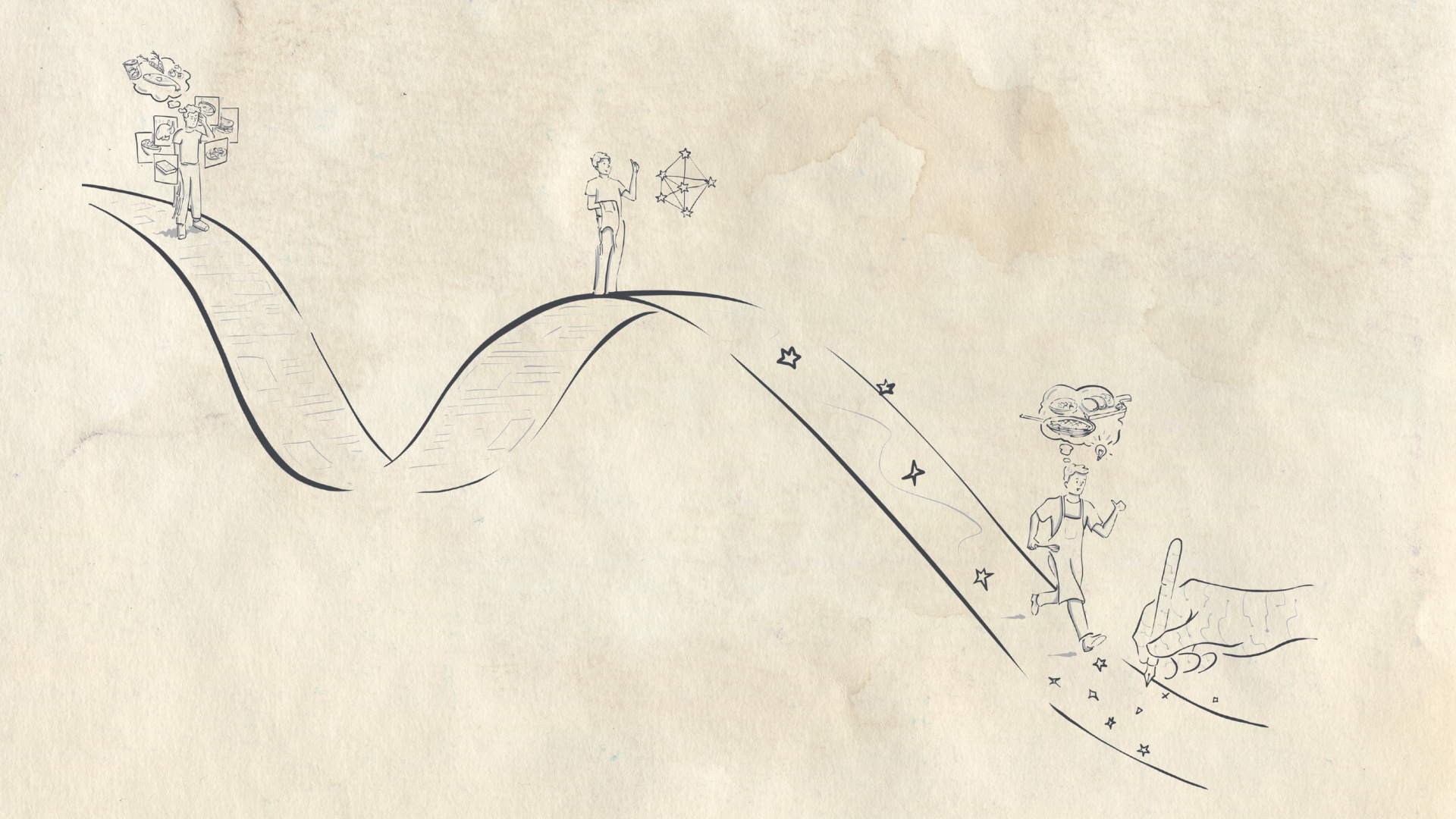
We consider ourselves like custodians of this company and also of the places where we live. So you mentioned before the small hamlet where the company is currently operating and where it was founded, which is Solomeo, this very beautiful village in Umbria. The care that Bunello paid when he really wanted to renew, to renovate everything there, is really proving this philosophy, this vision of being custodians and trying to prolong the magic of a place or a company as much as possible, leaving it to the future generations in better conditions.
And when we talk about technology, we are in a very technical world. If we make a comparison with the 19th century, with the 18th century, we are surrounded by technology. We always talk about technology each day, all of us from a car driver to a tailor, a teacher, someone working in fashion, in banks, in finance, all of us, we are always dealing with it each day – for personal use or for professional purposes. And we have to be contemporary also in the choices that we take as a company. And to be contemporary, we think that we have to start with a scouted market in order to understand what’s going on. And then we should try to pick up the technologies and to make choices which are very consistent with the values because we don’t want to jeopardise that value, that vision I was telling you before.
Okay, that’s a really good summary. Thank you.
Now, you kind of have dual roles. So you have your role within Brunello Cucinelli, brand itself, and then you have your role within Solemei AI. So walk us through the background behind the founding and the scaling up of Solemei AI, which it’s part of – I hope I pronounced this correctly – the Foro delle Arti.
What was the catalyst behind spinning up? Where did it come from? And how is its relationship to the outward facing brand changed over time as it’s become less of maybe a research and ethics initiative and it’s got more immersed in actually building solutions that are now making their way into backend systems and client facing touch points. Where did it start and how has it grown?
We started, we had this idea five years ago in 2021. A couple of years before, we received a visit from a very good friend of ours, Reid Hoffman, the Founder of LinkedIn. And he came to Solomeo in 2019 with Apollo. And actually, he had two Apollos. The first one was branded with the Stanford AI Center for Human Artificial Intelligence. And the second one was Apollo by OpenAI. And in 2019, he started telling us about what was going to happen with Gen AI. So seven years ago. And we were impressed. We understood that we had to develop our ideas, our vision.
So two years later, in 2021, we established this very, very small multidisciplinary team of researchers. We hired a mathematician, some AI engineers. We also tried to make it not only technical. So we also asked a philosopher to join the team, an artist as well, a UX designer, because we wanted to have a full view of what was going to happen, in order to understand all the different aspects of the revolution that we were going to face in a short time.
So this team, very young by age, we asked them to start investigating the possible applications of AI to our industrial processes. So of course it was common sense to understand what would have been the impact of AI to a factory, to the blue collars, to the employees. And we asked them to go beyond the boundaries of our industry and to think about possible applications other investments that we do, like for example, the very big library that we are building in Solomeo, which role we could have assigned to AI in the development of the library. And then we also thought about some investments that we made in biotech, in drug discovery.
And after some months of pure investigation, the team came out with this idea that we named Callimacus. Actually when we first started to understand the idea, it was three years ago, the beginning of 2023, we thought of a possible application to ourselves. So we were not really thinking about the market, but we were just analysing the data of our websites. We understood that of course our e-commerce, our corporate websites, were going great in terms of metrics, but something was going on in terms of the industry. So we said to ourselves, this is not going to last forever because it’s not balanced.
So basically, e-commerce websites are really becoming less attractive for users in terms of engagement, in terms of time spent, and so on. And so we realised that that idea could have been a good solution for ourselves. And we started from there. Then we kept growing. We grew the team. And of course, now it’s much bigger than at that time. It is bigger than what it was at the very beginning.
And I’m going to ask you some practical questions about Callimacus as we go as well. Before we get into the practical side of stuff, you mentioned philosophers and artists and I’m going to indulge myself and just stay in that philosophical territory a little bit longer because it’s not something I get to do too often in these shows.
Now, within some of AI, you talk about the idea of human artificial intelligence. That’s a direct quote, which feels at first kind of familiar. It feels like it’s part of the same philosophy of people saying, well, I don’t want AI to replace people. I want AI to augment people’s capabilities. But I think there’s actually something a bit deeper at work in that framing, which is the idea that AI shouldn’t be trying to imitate people at all. And that’s clearly going to be a point of contention broadly now, because I think there are obviously people who have fringe beliefs and think that large language models are generally intelligent or conscious or what have you. But even in everyday conversation, people are now thinking about these kinds of questions, about how they interact with AI, why they trust it, what it’s supposed to do, why so many people anthropomorphise it, try to turn it into something human.
There’s a weird divide coming, if it’s not already here, between people trying to develop models that feel more alive and more capable than people. And that’s one goal. And then the framing you have at Solemei AI, which is that we should be architecting human values into systems that are there to serve us rather than to supersede us. Just tell me what your perspective is on all that.
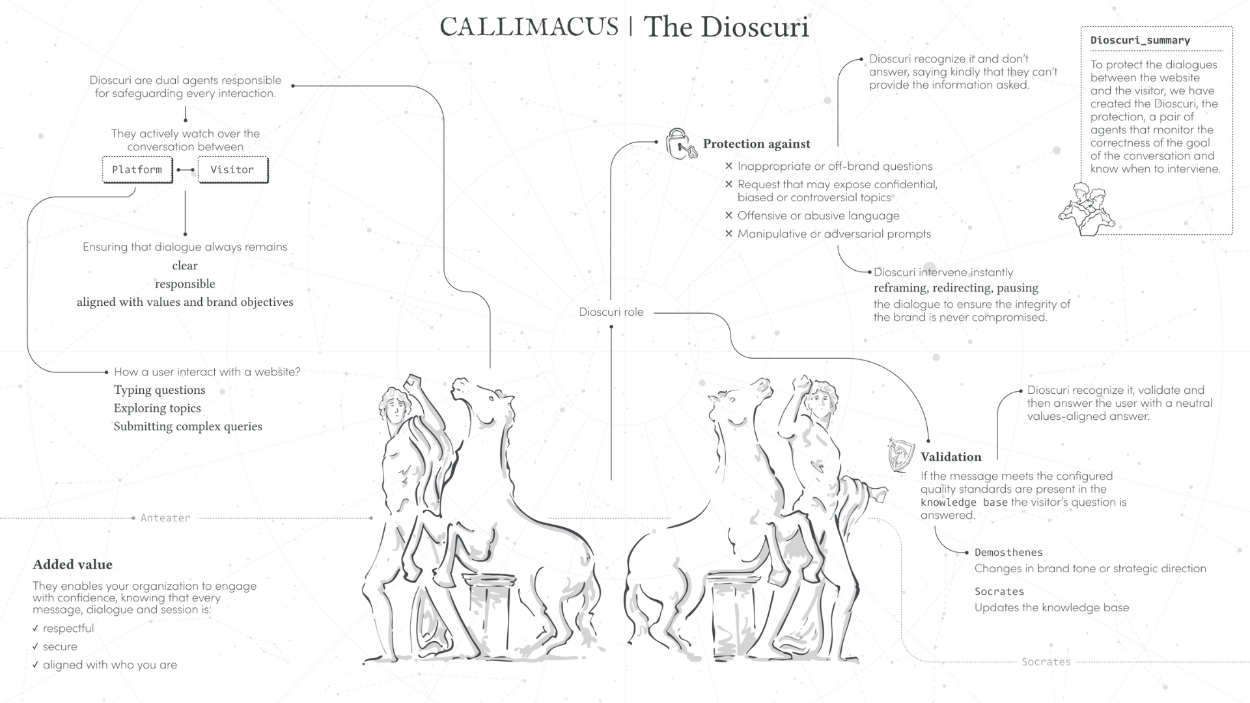
So our perspective is that we always see technology as a companion of humankind. So it’s a companion, it is beside us. We are “homo technicus”, as once said by Reid Hoffman. We shape tools that are shaping ourselves. But we love humans. We love nature. We love the organic things, as you say in English. We don’t want to get rid of humans. We don’t want to substitute humans. We do believe in the power of nature. We do believe in our brain. We do believe in our senses. And we received in the last five years many, many proposals from companies suggesting we substitute the customer care team with some chatbots, but we don’t want that. We really want to invest in the importance of that human feeling, the very human feeling that you have when you interact with a person which is helping you, listening to that voice. We don’t want to invest in things that can simulate those feelings or could generate those feelings because in some way they are mimicking human behaviours. So that’s why we try to invest in this vision.
We believe that human intelligence can do things that should always be appointed to humans. While artificial intelligence is very productive in doing things that would be more complicated or are extremely complicated for ourselves. If you go to our corporate website, you’ll see some key sentences for us. So artificial intelligence can analyse much better than what humans can do in a fraction of the time, for example. It can calculate, can synthesise. Of course, we can ask artificial intelligence to suggest, because through LLMs, can have access to billions of previous experiences in documentation. And we can also ask it to execute. But we would love to keep human intelligence focused on having feelings. We can dream, which is something that machines currently can’s do, or they could pretend to dream, but we are dreaming. And then we can desire, which is something extremely important because it is coming from a biological nature. We desire something, we want something, and it’s pure. It’s essential. We can sense, we have very, very well developed senses and we can get it. We have a special intelligence. Of course in Silicon Valley they are trying to recreate. We know professor Fei-Fei Li, she’s great and she’s trying to develop this special intelligence artificially. But currently, thanks to billions of evolutions, human beings have got this very important special intelligence.
So if I throw you a ball without telling you anything, without any alert, you will be able to catch it with your hand; that is special intelligence. And to recreate this with a robot is very, very complicated. And then of course we can really create. Like Mozart, creating something which does not exist, not re-inferencing the creativity. No, no, no. We are referring to the fact that we are not like we used to be during the Bronze Age or the Steel Age or the Iron Age.
We were able to go through a very important evolution of our species thanks to our creativity. And so we would like to consider the things that I said to you, having feelings, dreaming, desire, sensing and creating as something that we will always ask to human beings.
Yeah. And I think what you said about Fei-Fei Li and the world models and spatial models and things like that, I’m of the opinion that they do a very good job of mimicking the visual output of a full simulation, but they are not simulations themselves. And there’s a difference between, as you put it, doing a very convincing job of pretending to feel something or pretending to understand something and actually feeling it and understanding it.
Yeah, of course.
OK, cool. Let’s shift gears then from the philosophical to some of the practical stuff. When you’re thinking about your applications of AI in a broad sense, what does it look like from a technical point of view? Are you making use of models from the big cloud providers, your Anthropic, your OpenAI, your MiniMax, those kinds of things? Are you using open source? I know you have an inference and compute partnership with Groq (which is Groq with a Q, the inference provider, not the XAI model with a similar sounding name). And I know you’re serving from their LPU architecture and things. Tell me what it looks like from an architectural point of view and the choices you made?
Thank you.
So, with regards to the last, we think that we are seeing a race which is dominated by a very small handful of large players now. Of course we do believe in open source models and we already work with a lot of them. But instead of let’s say developing our own model that was not something feasible for us, we always try to use the best available models out there.
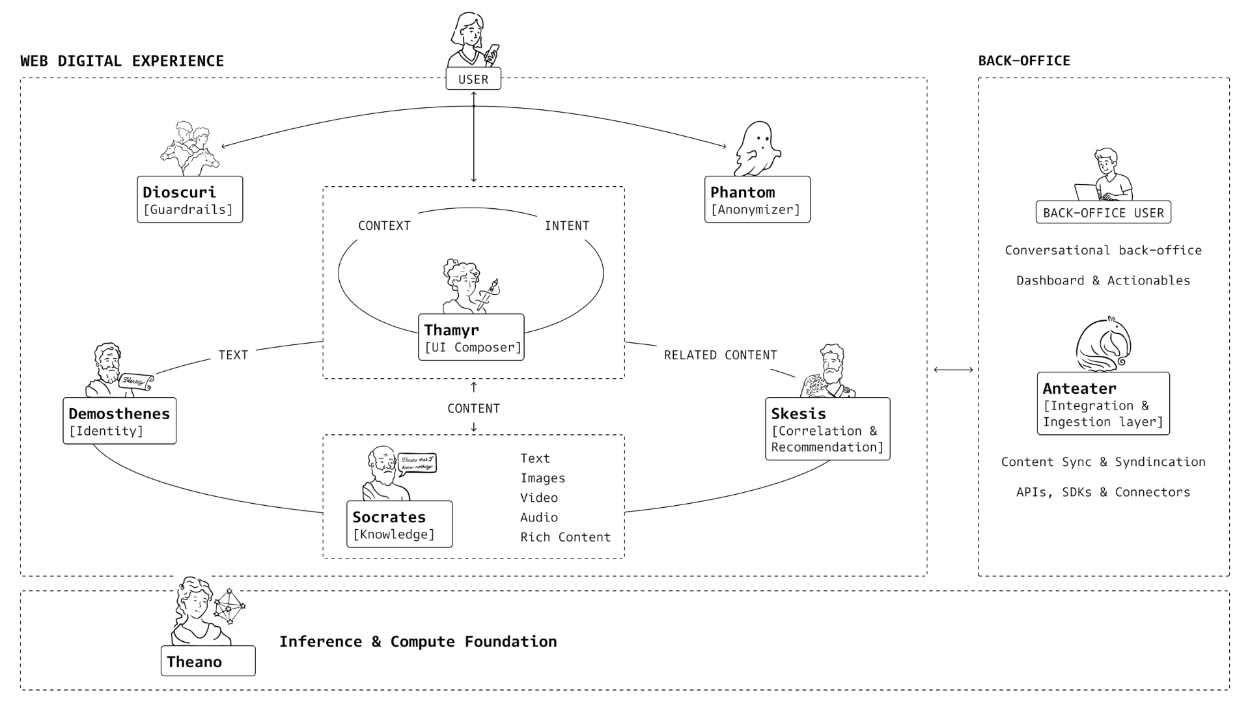
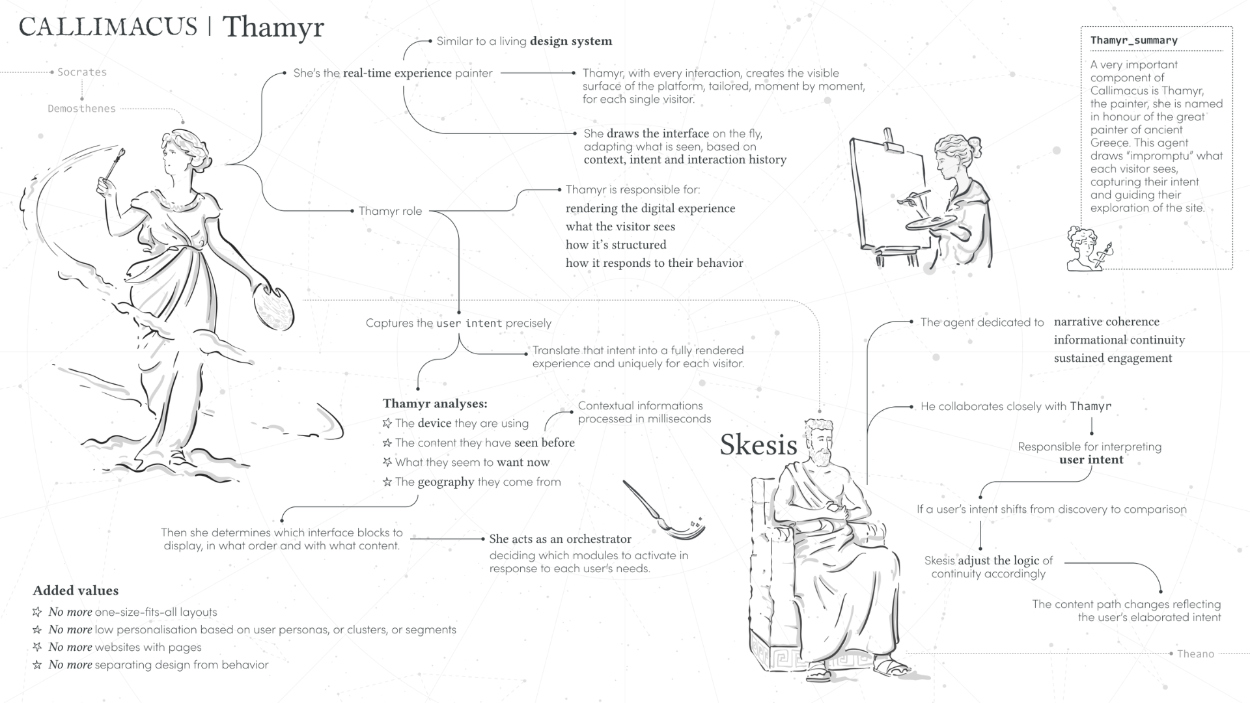
So Callimacus is made by an orchestra of agents. So we always try to have the best model for each of these agents. And best models, that means they’re the most, the biggest ones in terms of parameters. It means the most consistent with the purposes of that agent and also the most rapid and quick. That’s why we also work with Groq a lot. So we are currently combining some frontier models that we find on the market, open source, when appropriate, and they are all running on our infrastructure on Groq, which is based on Groq LPUs, our language processing unit.
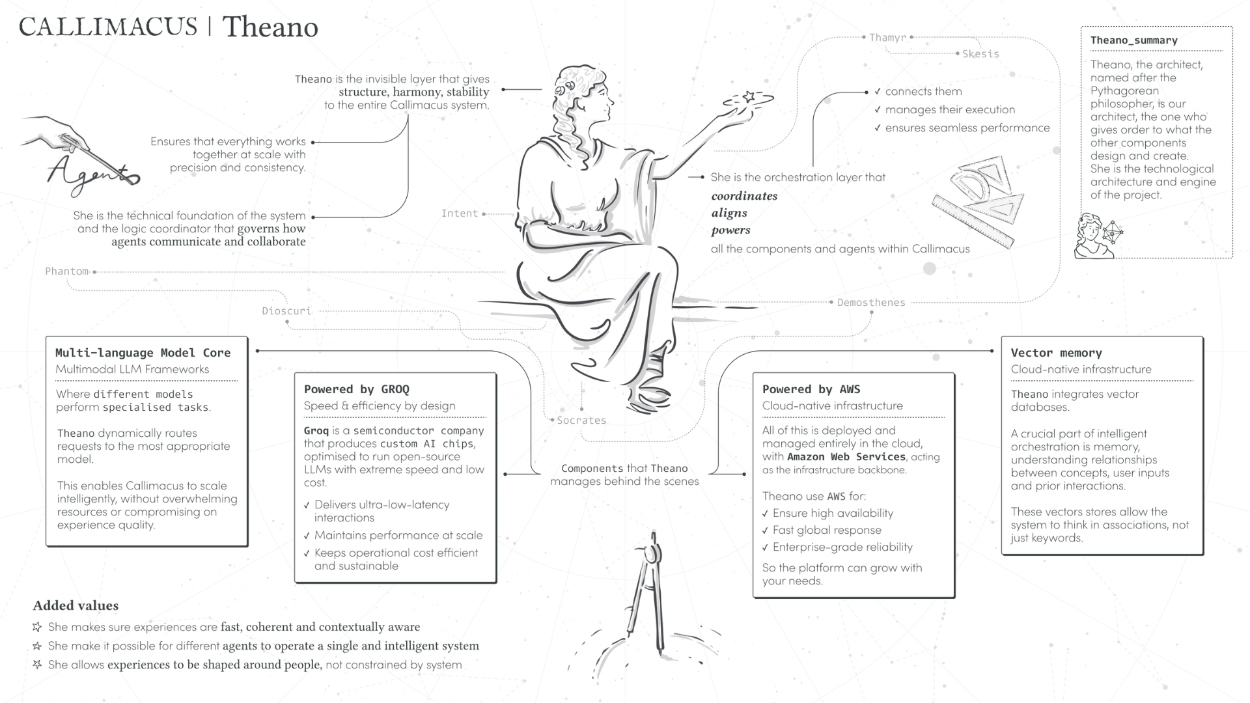
We started at the very beginning with the market available like OpenAI and so on, but of course that choice was good at the very beginning for, let’s say, to try to build the system. But then we realised that it was too expensive and too slow. Because for us, speed is critical. Because Callimacus is not only understanding the intent of the user, but it is crafting the user experience. So we need to get responses in milliseconds.
By the way, at the very beginning, Groq was not deploying any model from opening. It’s currently deploying the OSS version of ChatGPT. And so we were only using open source model.
I don’t know if I replied to your question, actually.
No, no, you did. That answers the question perfectly. I think the thing I wanted to add to it, though, was, we’ve talked about this philosophy. We talked about the infrastructure side of things. What you mentioned, the best model is not necessarily the one with the largest parameter count, not necessarily the biggest or the most expensive to run. And I think that’s something I just want to get into a little bit, which is, what does it mean then to have the right model for a task at hand? To be the right agent? Where do you shape that kind of behaviour in that sort of fit? Does that come from pre-training? Does it come from reinforcement learning? Or is it coming from the scaffolding and the system prompts and the environments and things that you’re giving AI to operate in?
Yeah. So I will start first with the first part of the question.
Our bet was that over time we will have seen latency curves and as well as the economics going down because we thought we will see models that will become cheaper to run and they will become faster. It is like at the very beginning, a part of the team was not really confident in this. I said to them, let me play my gray hair role. I will tell you that this will happen. It ended up happening. And one strategic choice that we took was to orchestrate rather than building models.
So as I said before, instead of investing in training or heavily fine tuning models ourselves, we try to focus on novel ways of using models. We also try to create, to design and develop an architecture that makes them more effective. And so to have systems that could let multiple models cooperate at the same time. And so we try to build a very strong orchestration, an environment which is orchestrating and delivering a framework to agents and to the existing ones, and to the ones that we could add in order to be very well working together.
But going directly to your question, as an example, in Callimacus there is one key component, which is called the shop assistant. (We have a Greek name for it, which is Skesis. Because you know that in Callimacus we have all this iconography, which is based on historical and Greek names.) And so the shop assistant is working great, based on something that we of course found open source on the market. I will not tell you what we found. It proved to be very interesting, very small, not a giant model. And we of course did some fine tuning of it. And we use it to generate the recommendations. As an example, the Brunello Cucinelli website on the current e-commerce. If you ask, may I see some blue blazers for a party for men, the shop assistant, this Skesis agent, currently provides more than 100 suggestions in less than one second. So it’s very fast. Very well done. It’s capable of reading the images, the content of videos, to understand, of course, what’s written in text. And then what we need to do, time by time, case by case, customer by customer, is to add some small, reinforced learning from humans in order to apply the specific needs of each customer or each industry.
Okay, perfect. That does answer my question. Sorry, it was a two part one and I think we got through everything there.
Now, you mentioned both of the kind of projects that Solomei AI has been behind, the ones that people can go experience. One is the corporate website, one is the e-commerce one you were just talking about. Behind both of those is the primary output of the work you’ve been doing, which is, as you said, Callimacus. So let’s get into what that is. If I understand it correctly, it’s a platform or a framework for building a new generation of websites. My knowledge of antiquity is not the best, but I’m pretty sure it’s named after a librarian of Alexandria. And that seems correct for what I think is a system for organising knowledge with editorial intent. It’s kind of the simplest way I can think about it.
Okay, of course we took inspiration from that person, one of the most important philologists in ancient Greece. We love this idea of philology because philology basically is helping you to understand what’s behind a language, what’s behind a word, what’s behind the ways that our language developed over time.
The three ideas which are behind Callimacus are the following three.
The first is to get rid of pages. And this goes back to the original idea that the team presented three years ago. Websites are currently done, currently conceived and developed using a metaphor, an approach that was adopted more than 30 years ago for the very first websites. So at CERN in Geneva, they were trying to figure out how to let someone else, some colleagues from another office or town have access to the knowledge base that was available on a server. Instead of simply letting that colleague download the paper, whatever it was, they created this idea of browsing. And so they adopted this idea of websites made on pages, which is coming from the media, which is coming from typography. So pages, menus, indexes, and so on. So it happened after 30 years that when you design a website, the very first thing that you do is focus on how it looks. So on the user interface. And then we also try to work on the user experience. But we are not really paying attention to the content itself. And as more proof that we have of it, each time that we saw proposals to renew a website we are putting some fake test content like lorem ipsum, as a text.
Yeah, yeah, we start with wire framing is the way to think.
Exactly, exactly.
And then, only once the website is live, we know if the content that we put into those wireframes is working. Because the content is what is engaging users, not the user interface. Of course, we like if the user interface is sleek, is very well done, is clear. But the reason why you go on TikTok is not because of the user interface, which is not existing.
So we said, why are the websites in some way losing disengagement capabilities? Why are people spending less time on websites? One reason, we thought, is that the content is in some way caged into pages. And it’s very hard to retrieve it. Well, each time that you go on a website, if you search for something, the burden is on yourself. It’s more that users have to dig into the content of a website to find what they really like or what they really want instead of having the website in some way prompting or having the content approach the users.
So the first idea, get rid of pages. The second idea: intent. So intent is something different from the historical data that we all have in our CRMs or CTP. Intent is something which is valid for a few seconds, few minutes, few hours, it’s a funeral. And it’s not valid tomorrow. If I buy on a website, as an example, batteries for my air tags, and I receive them thanks to the very efficient logistics the day after, and we all tend to receive in newsletters by the same merchant, which are saying to us, hey, why don’t you buy more? I have them. I’m not eating them like candies, I’m not eating them like M&Ms. This is happening because CRM is slow. And in the end, it’s clustering users, assuming that they will always replicate the same behaviours that they had during the very first interactions with them.
Another example, if I enter one of our beautiful boutiques, Poliano Cucini boutiques, and I bought a cashmere sweater for my wife. After that day, the people from the boutique, if I enter again, will not bother me with other cashmere sweaters for my wife because they already know that I bought one. Websites are doing the opposite. If I by chance buy something on a website, the website tends to cluster me as a person that will forever buy that kind of category of part of the collections. So the second is to follow the intent and we can get it without jeopardising the privacy of the users using those signals, which are exactly the same signals that our sister associates are able to understand when you enter a boutique.
The third idea, which is made possible by the first two, is that thanks to this idea of getting rid of pageless design and the intent, we can deliver a personalised experience to all the users at an individual level. So what you see then could be different from what I see, even if we are looking for the same thing, searching for the same item. But thanks to our attitude, mode, behaviour on the website, we would see different experiences.
On this, we built Callimacus.
Yes, it’s fundamentally a different thing. You could have said about you and I having different experiences on a typical e-commerce storefront if we happen to be part of different cohorts for A-B testing, for instance. That’s taking existing containers and putting different stuff in them that you think people will respond to. What you’re talking about is a multi-agent model to achieve composability of content in real time so that the website reacts to the user. There’s a very big difference between what we can achieve today with current, let’s say the technologies available in the market for personalisation and our ideas. Because in the end, the current technologies are providing you with solutions which are more or less inspired by a decision tree. You need to map all the different options. You need to think about the possible customer journeys. You need to decide when to personalise the experience.
If you don’t take into consideration all the possible options, quite inevitably, your experience will be personalised in very few cases and options. And this is what is happening currently during our daily experiences with digital applications. The case of Callimacus is different because there is no decision tree. We train the systems, so we train non-bonders to have that, let’s say, really small intuition (we call it the intent) in order to understand it.
I will make an example. If I enter the website, the new Brunello Cucinelli website, and I am using my iPad, I am sitting on the couch, so I’m relaxed, I’ve got a very stable and good bandwidth, and I ask to the website, or I click on the website, and I’m looking for some inspiration for a gift for my wife. The website will infer it, so it will understand it. And so the experience that will deliver to me will be like a more editorial base, so there will be more editorial content, there will be videos telling the craftsmanship of our collections, so it will be less product driven. Then after a while, if I immediately change the behaviour, so I start clicking on different options and the website understands that I’m closer to the purchase and I’m now less interested in editorial content, I would like to see more product options. It will change the behaviour and the experience that will provide it to me. And this is not happening because we create a decision tree, but we simply trained the models to understand this and to react. So basically, we try to add small intelligence to websites or to whatever is the digital application.
So I think that’s good framing and I think the reactivity portion of it and the constraints of it I think are important as well. It’s not fundamentally building an entirely new architecture in response to user signals and intent. It’s working within reasonably well-defined parameters about the content that exists. As you said, those videos are pre-made. The product photography is pre-shot. The marketing copy is to some extent pre-written I suppose.
As an example, the descriptions of the case of Brunello Cucinelli, the descriptions of these SKUs are pre-written. But we also have some texts which are generated because, as an example, when you are trying to discover the brand, in that case, there are some components which are crafting for you the content, crafting for you the copy. But you were right, all the imagery and the videos are pre-made because we can. You want to go for the generative AI, the generated ones but it’s experience which is crafted by AI. And it’s not a chatbot applied to an existing website because we don’t like that.
Yeah, so that’s an important distinction because there’s a lot of those out there. And that seemed to be the only idea that people had for a while was to go after that.
So I’ve spoken to a few executives, technology and brands over the last couple of months about the way that AI is changing – kind of buying behaviour and changing the way that people communicate and changing people’s expectations.
So what you’re talking about is very self-contained. It’s very much within the Brunello Cucinelli universe. Then there’s the wider transition that’s happening where product discovery, brand exploration, so much of our interactions with the web and with brands are kind of mediated by AI. There is that whole layer in there. And I’m interested to get your take on how you see the wider web changing as well.
Okay. Of course, we are all users of LLMs and they are becoming something like our personal assistants. But I don’t think, and we don’t think, that brands will ever be ready to give up with the building and protecting of their identities. Currently, very few luxury brands out there are available on Google Shopping, as an example. Amazon tried several times to build something for luxury. It didn’t work. Why? Because we don’t want to become commodities. When I say we, I’m putting on the hat of Brunello Cucinelli, whatever it is, the luxury brand. We are investing constantly to create our own identities. We don’t want anyone to intermediate our identities online. It can happen in the brick and mortar distribution, but when this happens, we send our visual merchandiser to take care of how the corners in the department store are appearing. And we don’t want our products, our collections, our heritage, our history, our craftsmanship to become only a few lines in a chatbot and in a dialogue on a chatbot. And so I’m pretty sure that we will ask our agents or our LLMs to give us some advice on which cashmere sweater we should buy. But I don’t think that this will only become, let’s say, text-based dialogue.
I think that sooner or later, we will see that these LLMs will allow brands to display things that will go beyond a very basic description of your item. And so as it happened in distribution, the brick and mortar distribution, the physical distribution. The world is not dominated by marketplaces. The world is not dominated by department stores. The last 25 years have seen the monobrow distribution dominating and acquiring increasingly market share. And none of us will ever get rid of our websites or whatever it is.
We don’t want anyone else to intermediate with the final consumer, letting them decide what to tell about our brand. I don’t know if I can reply to your question, but this is, think, something vital because we tend to believe that marketplaces will dominate the world. It’s not like this.
No, I think for certain segments of the market, if what you dealt in as a brand, and this is very much not the way it works for another question or luxury in general, if what you deal in is convenience and variety and volume, then all you are after is distribution and more distribution equals more success. If what you are after is conveying heritage and a story and an identity and making sure that that makes its way to the end consumer without somebody else’s spin on it, without somebody else interpreting it, then that’s not the case. That’s not what you want.
No, no, I agree with you. For that size, I exaggerated. Of course, it is depending on the industries. The industries which are leading the world in terms of innovation are the ones where you have very big identities. And those identities, they don’t want to be intermediated. Just think about Apple or whoever, they don’t want to be intermediated.
Yeah, absolutely. They don’t want to be part of a push towards sameness and homogenisation. They are well defined. And that’s a philosophy that I think I subscribe to with what we do at The Interline as well. Do you see Callimacus having a life beyond Brunello Cucinelli? Is it intended to be a framework that other companies adopt?
So when we first published the website, the corporate website in July 2024, we did it because we were trying to say to the market, we are there because we understood that we could have been asked, we could have received some market interest. After that, we started receiving inquiries from other brands, also from other industries. And so we said, okay, it seems like that can work. So we created a separate company and the team developed the first SDK for the market that was released in July 2025. We started receiving the first interest by system integrators and creative agencies. We certified some very big system integrators globally and also some important creative studios in Europe and now also in the US. And we understood that this could have become something for the market.
So currently it is like this. Callimacus is a platform that you can, as a brand, buy. It will be served like a software, so it’s a software as a service solution. Then the Solomei AI team is a product team. So they are focused on the roadmap. They have to work on the product. It’s very interesting what they are doing. The system integrators and the other partners are needed for approaching and addressing all the projects, all the interests that we might receive from other brands. Also at the very beginning, as I told you, our intent was to build it for ourselves. Then thanks to all these interests that we received from the market, we understood that the idea could have been valuable also for others.
Okay, that makes sense. Now, we’ve been talking about software pretty exclusively so far. We’ve been talking about what happens on my laptop, your iPad. But everyone listening to this is also in the business of making physical products. They might be the particularly fine luxury products that define Brunello Cucinelli, or they might be more mass market propositions.
If we step away from the web for a minute, what role do you see AI playing in supporting physical production as well? Actually bringing the physical stuff to market.
As I said to you before, the beginning of our dialogue, AI can play a fundamental role in understanding what we cannot understand and also projecting possible solutions. As a fashion brand – now I’m putting again on my head the hat of Brunello Cucinelli – we have plenty of things that we can do with AI in terms of optimising the allocation, optimising of course the supply chain, working closely in order to reduce the impact of our production on the environment. So there are many, many things that we can do that are, let’s say, less sexy perhaps than others, but they will have an important impact on the industry, on our processes.
I’m not saying that this should be valid for everyone, of course, but in our company, we don’t want to abstain from the ultimate decisions on the creativity to AI. Because we would lose our charm. Can you imagine if you were approached by a customer that is willing to buy a very precious cashmere sweater for his wife and we say to him, this has been done by robots or it has been conceived by an AI model, in some way we would lose some touch.
And so in our case, it’s more on the industrial processes – and not all of them, but the ones that can really become more effective, more sustainable.
The ones that optimise the conditions or the craft lives within, I guess is probably a good way to frame it.
Yeah, exactly.
Final question. Now, I think there’s some parallels between the kind of long-termism viewpoint that you have in the humanist philosophy and the sort of long horizon lens that people are taking on AI. Now, I wrote a piece a couple of weeks ago about the potential for AI to blur the lines between categories of software that have had pretty clear footprints in the past, right? So historically, you would buy a PLM solution, for instance. You would buy an ERP platform. You would buy a digital asset management system and there you might bolt on modules to those things. The footprint of those things might change over time, but generally software had a pretty fixed form once you’d acquired it.
You’ve talked about the composability of content. I feel like there’s there’s something happening with the composability of capabilities, you know actually like software that designs itself for the user as as it goes. Do you think that’s a realistic outcome?
I agree with you. I agree with this vision. I read your piece, your article, and agree with what you are saying because the software business is not coming from the medium age. It was born more or less 40 years ago, the corporate software business. And we went from one software doing a few things for everyone, to hyperspecialisation of the software.
Now, in our company, we have got everything. We have got the PLM, have got the DEM, e-commerce, everything. And these are all vertical softwares. And I agree with you that we will see this be impacted by AI. We will see different things happening because the boundaries are blurring. It’s more easy to jump from one place, one side of the boundary to the other one.
It’s very easy for us to ask for the development of new features and to be added into the software. It is more or less what we, in a small scale, what we did with Callimacus, because we are not using an external personalisation engine or we’re not using an external intent solution to understand the intent of the user and then to trigger some personalisation. It is done by agents. And for us, adding agents into the system, thanks to that orchestration I was telling you about before, has been relatively easy.
As an example, let’s talk about checkouts in e-commerce. We all know how it works and there are very important solutions out there for checkouts. There are giant companies, but they are all based on this idea of a structured checkout. So structured checkout means that you have to go from one phase to the other. First, you start with your name, address, billing information, and then you have got the payment system and so on. But in the real world, it is not working like this. It is unstructured. You enter a boutique, you forget to give your card, you try another one, then you give your address later on. So it’s not structured. You don’t have to follow those phases.
I think that the future of e-commerce will be able to do all these things together. Thanks to the fact that since you get rid of structures or infrastructure or say fixed phases, you can really jump from one thing to the other and it will be more easily feasible thanks to AI. So I could be in front of an e-commerce saying, but can I buy this? Of course. Do you have it in size 48? Of course I have it in 48. May I see it? Yes. Do you have a video of it? Yes, I have a video. Okay. But you have my credit card? Yes. Yes, of course, sir. I’ve got your credit card. Okay. Would you like to make the order now? I will do it later on. Please show me other things for my wife. Okay. Done. Would you like to place the order? Yes. Yes, sir.
This is not unstructured and it is not possible to do it with existing solutions, but users, visitors, we lost our websites and platforms to do this. So it means that the current boundaries that you described are going to become more blurred and we will see new shapes of this industry happening very soon.
That’s the perfect place to bring us through to a close. I do have one final cheeky question, Francesco. So The Interline will be doing our deep dive downloadable AI Report in the springtime for the third year. So we did one in 2024, 2025, and this will be 2026. Is there anything in AI in general, in our industry, in your sector or beyond it, that you think is either not talked about enough, not covered enough, or not talked about in the right way that we could pick up in that publication?
My idea is that we are talking about the agentic era not in a wrong way, in a way that I don’t personally …I would try to change perspective because we are talking about agents, that we will have our own agents, that we will be agents that will be doing tasks for us and so on, and agents will be talking to agents. But I think that we are missing one point. Because I think that we will always look for the real things, not for the fake things. We will always try to appreciate. Sorry, I will say it in a different way. I will reframe it. The more we create things which are not made by humans, the more we create things which are not approved by humans, the more we’ll be looking for things made by humans and approved by humans.
As I was talking with Nicholas Thompson, the CEO of The Atlantic, he’s a good friend of ours. He’s a great journalist. He has been the Editor-in-Chief of WIRED for many years. He said: the journalists are afraid that they will be substituted by AI. And I said to him, I think the opposite. Thanks to AI, we’ll have a market invaded by things written by AI and you will look for that specific thing written by a very strong and brilliant mind, a human mind. I sit also with my kids. I’ve got my daughter, she’s 18 and she’s using GenAI each day at school, even if it is forbidden, I’m sure she’s doing it. That’s great. She’s smart and she doesn’t want to study that much. And so that’s why she’s looking for this help.
But when we were looking at the TV screen, the television during the Olympics here in Milan, and we saw a TV ad, a commercial that was made by GenAI, she immediately got it and she said, I don’t like this, it’s fake.
Yeah, my kids are the same. The exact same trend. One is 8, one is 11, and one is three months. So the one that’s three months doesn’t have an opinion on it yet, but the older two do!
All the day.
Then I apologise for my broken English. It’s early morning.
Not at all. If you made me do this in Italian, we would have a much harder time.
Francesco, thank you so much for your time today. It’s been a pleasure having you on and I hope we get to chat again at some point in the future. All right. Thank you.
My pleasure. Thank you, Ben. Thank you so much.
And that’s the end of my chat with Francesco.
Brunello Cucinelli is a fascinating company and the eponymous man himself is a massively interesting guy, too. So if there’s anything we glanced off in this episode that you want to know more about, I’d encourage you to visit their corporate website and as an added bonus you’ll be able to see Callimacus in action.
In the meantime, I’m off to record another episode on a very different topic. So there’s a lot more to come as we carry on this weekly cadence of conversations that covers the whole spectrum, the entire product journey in fashion.
Thanks for listening to this one. I enjoyed it. I hope you did too. And I will speak to you again soon.
