Key Takeaways:
- The first of the annual big-tech briefings – Google I/O – featured a fresh look at wearable technology, new takes on world models and multi-modality, but the biggest push was to put AI between every brand and consumer interaction.
- Between Universal Cart, the latest manifestation of Google’s vision for agentic shopping, and the biggest overhaul to search in a quarter century, the future of storytelling and selling online is being painted as a non-participatory, extractive activity, leaving little incentive for the companies and people that populate the web.
- Coinciding with the ignominious end of another web-era DTC darling, statistics released separately this week show both the inevitability of agentic shopping and the lack of industry preparedness.
Summarise and debate with AI:
Take the content and context of this article into a new, private debate with your AI chatbot of choice, as a prompt for your own thinking. (Requires an active account for ChatGPT or Claude. The Interline has no visibility into your conversations. AI can make mistakes.)
The Interline has never been a source of blind tech evangelism. Our team is made up of people who love technology, who know fashion inside-out, from decades of direct experience, and who are committed to documenting how those two things evolve, whether they’re moving in the same direction or pulling against one another.
Sometimes, in the process of meeting that brief, we find ourselves coming down against technology – especially in cases of overreach, where tech either feels as though it’s extracting more from fashion than it’s putting back in, or where that’s demonstrably the case.
This week is an example of the latter. While we’re hard at work on the upcoming AI Report 2026 (which will be presenting a balanced, pragmatic perspective on the real, value-add applications of AI in apparel, footwear, accessories, and beauty workflows), the headlines wound up being dominated by the massive scope of Google’s latest I/O event, which set out the company’s stall for what it considers to be the future – not just of AI, or of Google’s own products, but of the internet itself.
As a raw indicator of AI adoption, I/O made a strong statement. By its own internal metrics, across the many AI surfaces it offers, Google is now processing 3.2 quadrillion tokens per month – up from 9.7 trillion two years ago. These numbers are big enough to be essentially meaningless, but we can read them in a distilled way: if you put AI in front of people, they’re going to use it at massive scale. Especially if you don’t really give them a whole lot of alternatives. More on that as we go.
To understand that scale, it’s useful to remind ourselves why Google exists in the first place. The company’s story is fascinating, and we encourage readers to listen to the Acquired episode “The Origin Of Search” as background for how one company came to be the front door of the internet.
The simplest and most useful exercise for putting this week’s news in context, though, is to think back to why the internet needed a gatekeeper to begin with. At the time – the late 90s – the web was a collection of pages that needed a machine philologist to understand, associate, rank, and then provide orienteering for.
As with any exercise of curation, whether it’s human-directed or algorithmic, the result was a narrowing of the horizon. While it’s unambiguously true that the early phase of the web needed an equivalent to the Yellow Pages (a reference that might leave some of our younger readers befuddled), it’s also true that, as part of this transition, the web went from being a very broad and messy horizon, to being essentially mediated through Google’s “ten blue links”. Your content either appeared on the first page, or it suddenly mattered a lot less than it had before.
Before you read on...
Our weekly news analysis will always be available to read here at The Interline, but you can get it (along with notifications for new podcast episodes, events, and more) in your inbox by signing up to our mailing list.
That narrowing did a lot for the SEO industry, obviously, but its net narrowing effect has largely been tolerated because, at the same time Google took over managing what surfaced (or didn’t) online, the web was also taking off as an application platform. And so much of what’s considered vibrant and essential about the internet today has its roots in web applications rather than traditional web sites.
Those web applications have, over time, become an incredibly diverse and important layer of computing. For an entire generation, the web browser is the operating system. And for several generations, the web browser is also the place they shop and socialise. Reading content is, even from our biased perspective, a much smaller part of the internet than those other essential life activities.

Unlike social content, where platforms like BlueSky, X, Reddit, and TikTok exist as their own islands, with varying degrees of indexing / crawling, online selling and advertising is still very much run through Google’s good graces. It was only in April of this year that Google ceded the crown of “world’s biggest digital advertiser” to Meta, and today a significant share of all retail ad spend runs through Google Shopping.
There is also a firm link between shopping and search, since both live in the same window. And while this has forged a strong behavioural link, arguably the biggest indicator of just how anchored to one another search and shopping have become lives in the data: the Shopping Graph, which is part of the backend of both traditional search and “AI mode” search now contains more than 50 billion product listings, with varying degrees of attribute accuracy.
In other words, Google has come to own both the interface layer that people discover products and brands through, and the planet’s biggest index of what those brands produce.
So when Google changes anything about the way search operates, it has an impact on the act of storytelling and selling online. And, needless to say, when they basically overhaul search to be something that barely resembles itself, then, well, shopping is about to undergo a radical overhaul as well.
That’s just what Google announced it was doing this week, giving search what it calls “the biggest upgrade in 25 years”.
There’s a lot of complexity to the new frontend, including tools to build mini-applications, data visualisations, and proactive agentic features that build on Google Alerts and give users the ability to send information agents out to search for them, or to watch for changes or stories, and to surface the results afterwards.
That last idea is the most pertinent one for our readers, and not just because it was demonstrated with a footwear example. As Google’s blog shows, if a user likes a particular celebrity or athlete, and wants to be notified if they release a new collaboration with a sportswear company, an AI agent can do that legwork for them.
But as mundane as that seems in the abstract, it’s emblematic of something much darker (at least in The Interline’s view) that runs throughout this year’s I/O: the idea that people don’t want to actually interact with the internet any more, and they’d prefer to let AI do it for them.
There’s little data to bear this out in practice, and Google is absolutely engaging in an exercise of self-selection. The more AI layers the company puts between users and real content – whether that content is an article, a video, or a PDP for a garment – by default, the more people will default to that behaviour. Just as “let me Google that” became shorthand for “I don’t know, but someone out there does, and I’d like to read what they have to say,” the suggestion is that the audience is done with the third part of that equation entirely, and they just want Google to give them the answer.
The Interline is aware that we have been beating the drum about the decline of the open web, and the impact this will have on fashion for some time, so rather than re-run our own polemic, we’ll point readers to a piece from Business Insider titled “Google Is About To Ruin The Internet,” which obviously has a feisty headline, but which contains a much more pertinent subheading: “A personalised internet isn’t the internet”.
There’s that narrowing again. If the first era of Google was paring the wilderness of the web down to something manageable, then this next era is that philosophy writ large: no matter what’s available online, Google will show you, by default, what it thinks you want to see, and it will obfuscate the underlying content to such an extent that you will essentially never see it, removing all incentive to create it.
And if this doesn’t scare our readers who value being found online and selling products online, then perhaps the other big announcement from I/O will: Universal Cart.
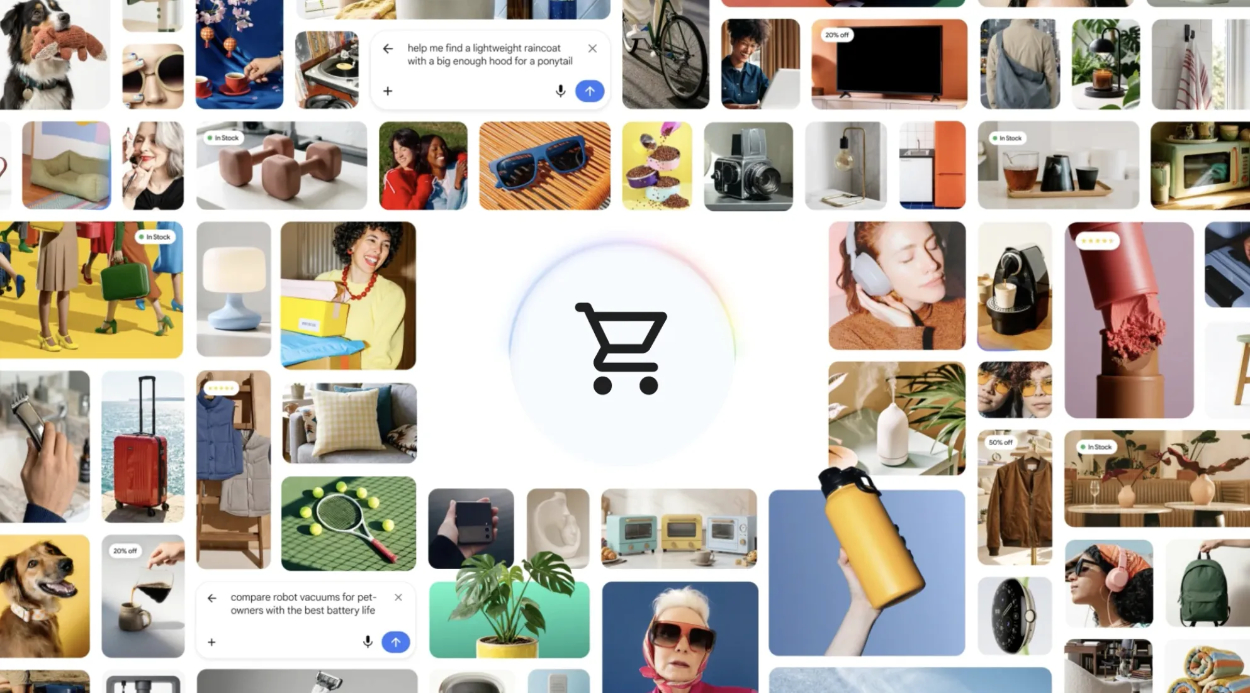
Billed as “bringing superpowers to your shopping,” Universal Cart feels more like – you guessed it – another way to remove choice from the user, to filter the information they see, and to disintermediate the seller.
To quote Google’s own blog:
“The moment you add a product to your cart, [AI] gets to work in the background – finding deals and price drops, giving you insights on price history, and alerting you when an item is back in stock.”
Which sounds, to us at least, like the historically-primary way of finding and buying products (clicking through to eCommerce storefronts) is expected to be replaced by having agents do the searching, the monitoring, and the purchasing for you. And while the initial roll-out is confined to Search and the Gemini app, Google is clear that Universal Cart will also be inserted into YouTube and Gmail.
For brands and retailers, this should feel like the marketplace devil’s bargain taken to the nth degree. Many brands have, over the years, decided to sell through major marketplaces like Amazon, only to pull back when they realised how much control they were ceding of the relationship with the consumer. Some then walked those retractions back again, when the impact on distribution became evident.
Imagine that, but with very limited avenues to walk away.
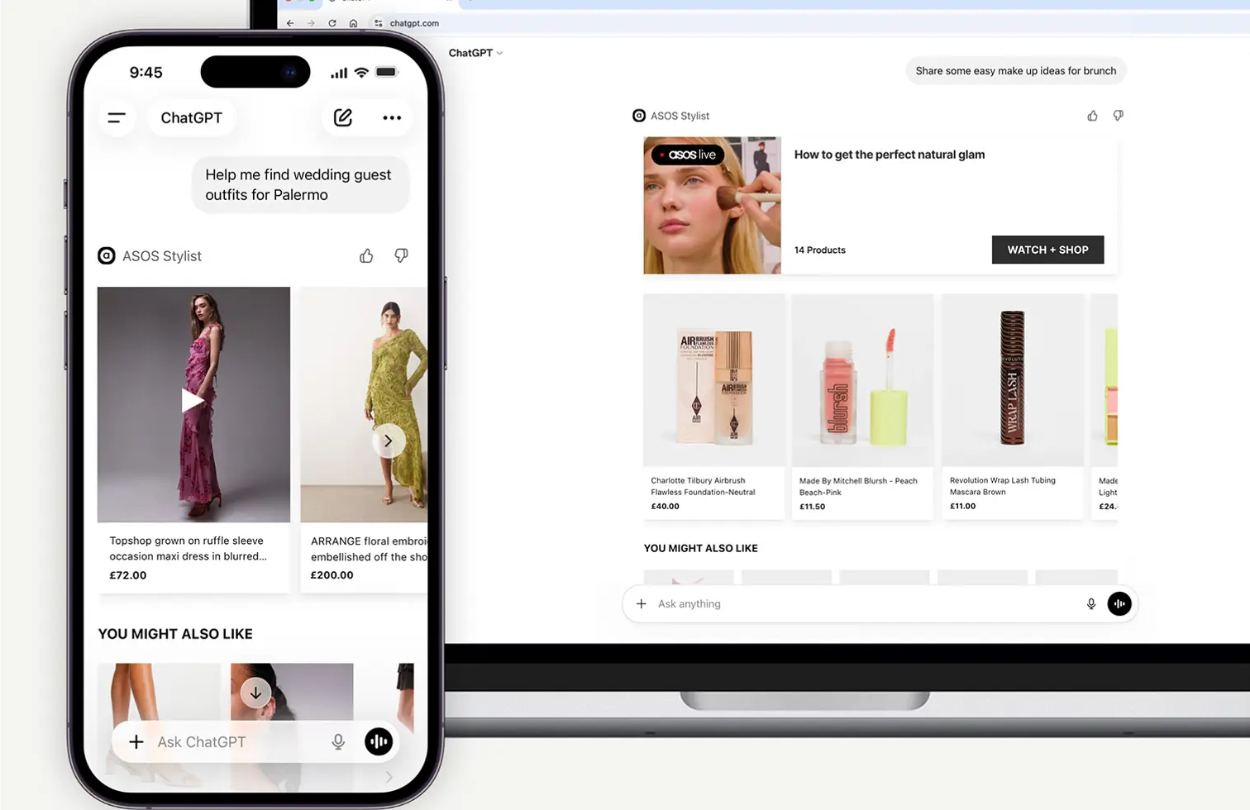
And if this all sounds like tinfoil hat territory, then consider the alternative approach that ASOS and OpenAI announced this week. This is, to quote “designed to be highly visual” and is intended to lead to a customer clicking through to the ASOS storefront afterwards – a new discovery channel, in other words.
It’s clear, from new data released this week, that agentic shopping isn’t going away, but it also seems as though a fork in the road is emerging when it comes to the form that it’s going to take – and how far the agent is going to muscle in on the process.
According to a new report from The Payments Association, nearly a third of UK shoppers would let an AI agent buy for them, and that figure rises to 45% among younger people. The same report suggests that close to 60% of UK retailers have already observed agent activity on their platforms – i.e. a majority of companies have had an AI click around on their website on a user’s behalf – and a similar percentage believe that “AI-initiated transactions” are already taking place, irrespective of whether the retailer themselves has done anything to prepare for that outcome.
The Interline understands, to be clear, that agentic interactions with web content are not going away. This publication is open-access, fully agent-parsable, and open-crawl. And our AI Report 2026 will generally land in an optimistic place where the impact of AI on fashion is concerned.
It’s also clear that this model of “use the computer for you” interaction is going to be the one that turns running LLMs into a potentially profitable exercise. There is, after all, a whole lot about using computers, in general, that people don’t like – regardless of how we, individually, feel about automating the process of reading product details and stories, looking at creative campaigns, and interacting with brand identities.
But there is also, we believe, a fundamental difference between the agentic age of the web, and the vision Google showcased this week: one where the internet becomes passive, non-participatory, and where Google owns so much of the channel between creator and consumer that all the incentive to tell stories disappears.
In a twist of fate, this week was also the one where SHEIN confirmed that it would be purchasing a majority stake in Everlane, the brand that pioneered the idea (or at least the fiction) of “radical transparency”. On the heels of Allbirds pivot to becoming a GPU-for-hire business, this represents the second death knell for the cohort of DTC brands that defined the early age of the internet.
The part The Interline keeps coming back to is this: brands will wax and wane, publications will do the same, but fashion should push back against (just as we intend to) the idea that the web is no longer something people want.
It seems, to us and to a lot of other analysts and observers, that this is a faulty idea. For fashion in particular, it feels bizarre to consider that the online userbase is happy to take this thing – the web – and turn it from a vibrant system full of content from brands and people, into an anodyne application environment where all the work of shopping, or socialising, or storytelling is done for you.
That idea also runs counter to the dramatic investment that’s being made in building new generative content pipelines and programmatic advertising stacks, if none of that content is ever going to be seen. And while, yes, it runs right alongside fashion’s preoccupation with personalisation, the cost of achieving that letting AI essentially take over the entire path to purchase, under one company’s purview, feels far too high.
It’s one thing to like the idea of optimising the funnel to a sale. It’s another to accept that, to get there, we should let all the texture and the context drain out of the internet. Which, if this model comes to fruition, is likely to happen far more quickly than people expect.