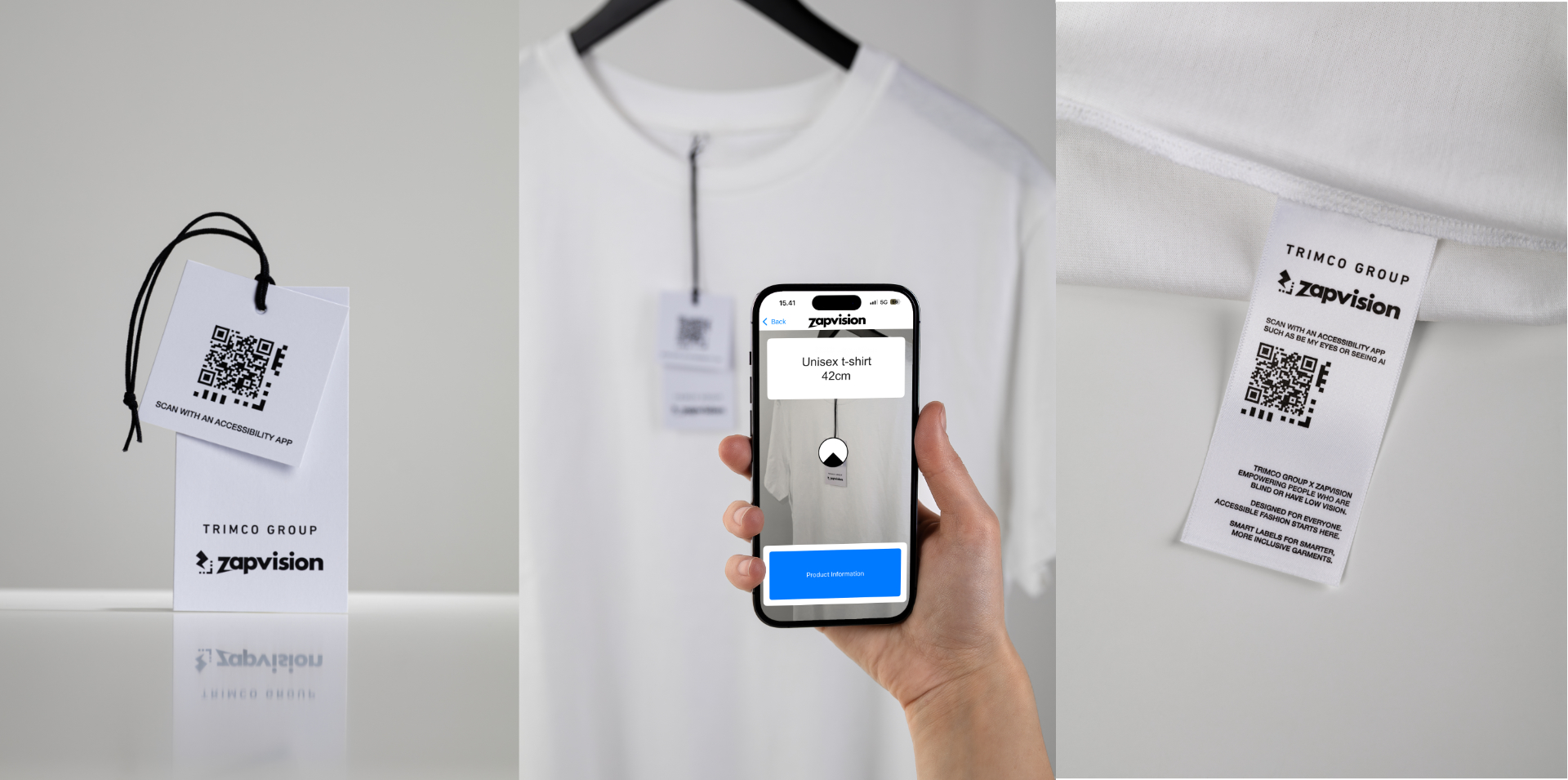
March 2026: Trimco Group announces a partnership with Zappar to bring Zapvision accessible QR codes to the apparel and footwear industry. The collaboration aims to improve access to product information for people who are blind or have low vision, aligning inclusion with the ongoing industry transformation driven by Digital Product Passports (DPP).
Traditional QR codes were designed for sighted users and offer very limited accessibility support. They require precise camera alignment and provide no built-in guidance, structured data or audio feedback for people who are blind or have low vision. Zapvision’s Accessible QR codes address these gaps by enabling detection from greater distances and delivering structured product information that works seamlessly with popular accessibility apps like Microsoft Seeing AI and Be My Eyes, providing clear spoken guidance throughout the scanning experience.
How Accessible QR Codes work
- Accessible QR (AQR) code combines a standard QR code with a dot-dash pattern positioned around one corner of the code.
- This enhanced design increases the detection and scanning distance, announcing all the information related to the product or signage using the device’s accessibility features (e.g. text-to-speech, larger fonts) for people who are blind or have low vision.
- AQR’s unique design allows brands to use a single QR code that works for everyone: standard smartphone cameras link to the brand’s digital interface, while accessibility apps can detect the code more easily and read product information aloud.
- This dual functionality ensures that brands can maintain a unified digital infrastructure while expanding access to a broader group of consumers.
“Accessible QR codes are designed to ensure that everyone can independently access information. As industries adopt QR-based Digital Product Passports at scale, these experiences must be inclusive by design. Partnering with Trimco Group allows us to bring Zapvision technology directly into apparel and footwear supply chains, making accessibility a practical and scalable reality for global brands.”
— Max Dawes, COO at Zappar
From food to fashion – expanding industry adoption
Accessible QR codes are already established in sectors such as food and beverage, with Unilever alone including Accessible QR codes on over 5 billion+ packs globally. In apparel and footwear, adoption remains limited. Through this partnership, Trimco Group aims to bridge that gap by integrating Accessible QR codes directly into labels and trims, making inclusion a natural extension of existing DPP strategies.
The collaboration operates through a structured technical setup. Zappar generates the Accessible QR code via API integration. Trimco Group then applies the code onto the physical label solution for the brand. The result is a seamless connection between digital accessibility software and physical product identification.
Demonstrating what is possible
Trimco Group has developed a series of sample labels featuring Accessible QR codes, with broader availability planned for upcoming collections. The objective is to demonstrate practical implementation and inspire brands to consider accessibility as an integrated component of their compliance and transparency initiatives.
“Digital Product Passports are changing the way brands communicate product information. As this infrastructure becomes standard, accessibility must be embedded from the beginning. Our partnership with Zappar enables brands to extend their digital strategy to include people who are blind or have low vision—without adding complexity to existing systems. Inclusion and compliance can, and should, move forward together,” comments Camilla Mjelde, Sustainability and Compliance Director at Trimco Group
By networking with specialised technology partners and leveraging proven solutions, Trimco Group reinforces its commitment to driving responsible innovation in the textile and footwear industry. Supporting people with low vision is part of ensuring that digital transformation serves all users.
Brands interested in exploring Accessible QR codes as part of their Digital Product Passport strategy are encouraged to contact Trimco Group to find out more.
For further information, please contact Jonita at Upshot PR: jonita@upshotpr.co.uk or Manuela Enache-Hyldahl at Trimco Group at manuela.enache-hyldahl@trimco-group.com
For high-res images please click here: Zappar X Trimco (Credit: Courtesy of Trimco Group)
About Zappar
Founded in 2011, Zappar is a pioneering UK technology company focused on enhancing and assisting the human experience through cutting-edge computer vision to deliver greater immersion, interaction and accessibility.
Zappar’s ecosystem includes: Zapworks, a complete XR platform for deploying rich 3D experiences to the web, including AR, VR and WebXR across handsets and headsets, Zapbox, the world’s most affordable mixed reality headset and Studio Z, an award-winning immersive production studio, delivering best-in-class campaigns across Web3D, AR, VR and WebXR, DOOH and mobile games.
More recently, Zappar launched Zapvision to make access to information on product packaging a basic human right by providing brands with a single Accessible QR code solution. This unique combination of solutions under one roof enables businesses to scale immersive experiences more affordably across different use cases, teams and devices. Partners include Nestle, Unilever, Pfizer, H&M, Disney, PwC, AstraZeneca, LEGOLAND, PepsiCo, Mondelez, Atlanta United and many more.
About Trimco Group
With over 40 years of combined experience and an international setup, Trimco Group is the textile and footwear industry’s go-to label and packaging supplier, as well as a global leader in supply chain traceability, data management, and RFID solutions.
Through its expertise in brand identity optimisation, including trims, care labels, packaging, and digital compliance tools, Trimco Group supports apparel and footwear brands worldwide in meeting evolving regulatory and sustainability requirements. Trimco Group employs more than 2,500 people across 27 countries, serving over 1,000 brands and 8,600 manufacturers globally.
