Hey, and welcome back to the Interline Podcast. You might not know it from my LinkedIn photo, but I wear glasses. Now, in my case, I need glasses for reading, using a computer, driving, and watching TV. So while I don’t tend to wear them when I’m walking around or at show floors or on stage, which is where you usually see me, I actually do spend most of my days with frames on my face. In spite of that, though, I actually don’t really know anywhere near as much about the eyewear industry as I do about apparel and footwear.
I’m familiar with a lot of the broad strokes that you probably are, which are that it’s monopolised by a giant group, that it’s a new frontier for wearables, and that it’s one of those categories where people tend to choose either super familiar shapes that are designed to be unremarkable or they see glasses as a chance to be bold, expressive, and colourful. I think I fall somewhere in those two camps depending on what different people tell me I can get away with at any given time.
There’s a lot more to eyewear than that though. From personalisation and 3D printing to platforms that are designed to lower the barrier of entry and maybe start disrupting some of that homogenisation I just mentioned. To get me up to speed, today I’m bringing on Mark Zouari and Sébastien Brusset, who both work at Visages.
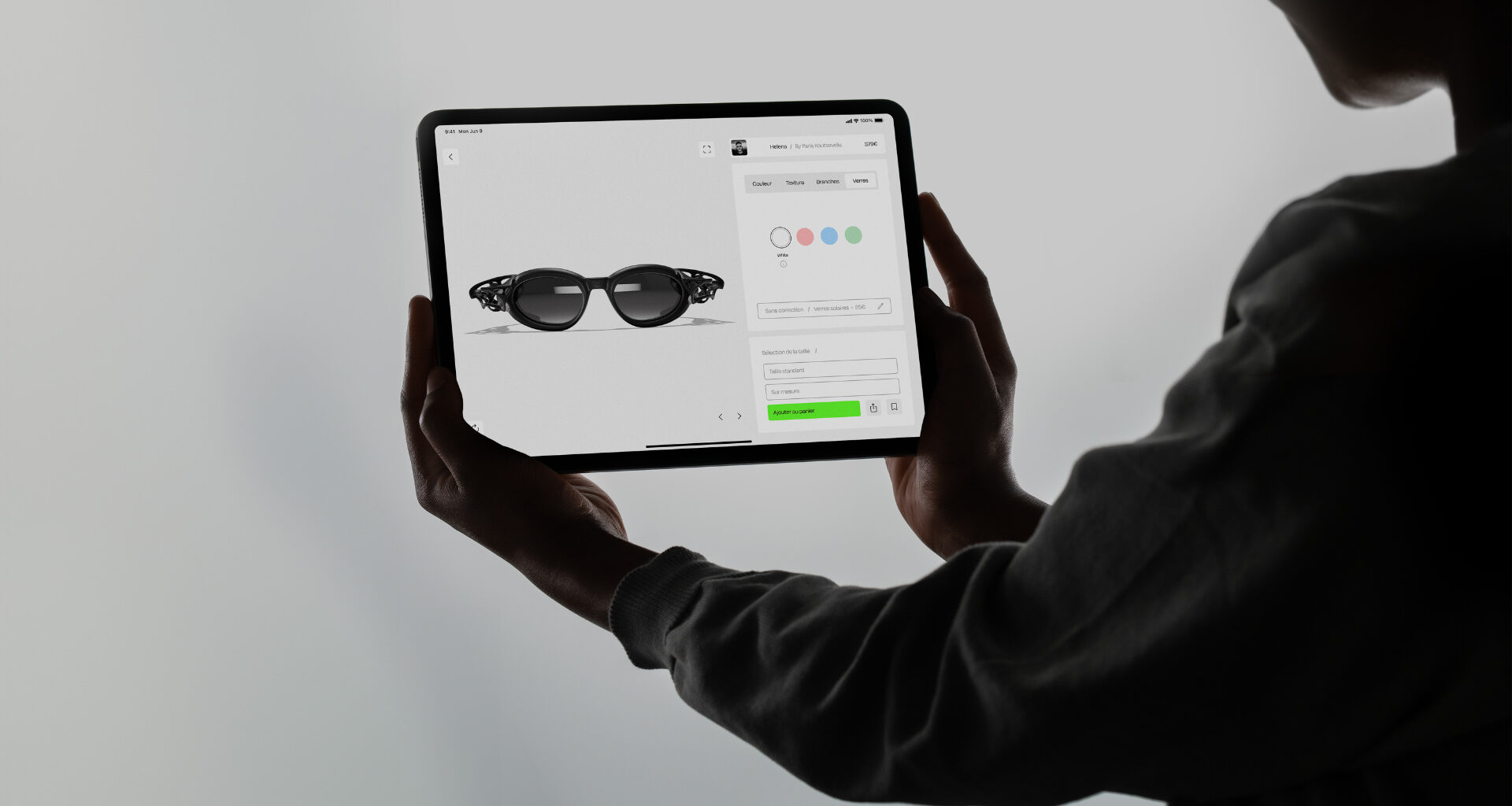
Visages is conceived as a way to get individual eyewear designs from independent creators onto people’s faces using AI-powered face scanning and tailored fit and producing those designs on demand through additive manufacturing. Mark is a Co-founder over there and Sebastian is Head of Optics & Design.
Together, the three of us get into what’s actually really going on in eyewear and we talk about the positive and negative impacts that technology could have on its future.
Never miss an episode
Get notifications for new podcast episodes, plus our weekly news analysis, events, and more, delivered straight to your inbox.
NB. The transcript below has been lightly edited.
Okay, Mark Zouari, Sébastien Brusset, welcome to The Interline Podcast.
Marc: Thank you very much.
Sébastien: Yeah, thank you, Ben. Pleased to be here.
It’s wonderful to have you here. This is the first one we’ve done with two people. So it’s going to be interesting to see how this develops. You both have very different areas of expertise. So I’m thinking as we go, the questions will make sense for one or both of you, but don’t hesitate to add to what the other has to say as we go, if you think that’s going to be valuable. Now, we always try and start these shows with a baseline, a definition, some foundational understanding.
And that’s especially useful when we’re talking about a sector that is maybe less familiar to our readers and our listeners than apparel and footwear would be. And when we think about eyewear, that’s an industry that’s pretty opaque when you look at it from the outside. It’s really big and it’s kind of impenetrable to look at to a lot of people.
So I want to start with just something definitional, which is, what does the eyewear industry really look like right now? Everybody’s familiar with the idea that there’s one mega conglomerate behind a lot of the consumer brands that we see. But I don’t think it’s as widely known how that affects the supply chain, the market opportunities and the mechanics behind the scenes. So, a big question to start with, but hopefully a shortish answer, which is, what is what is going on in eyewear?
Sébastien: So it’s a wide question as you said. Maybe at first just to intro, it’s a very complex industry because it’s a unique industry. I would say that, you know, it’s really at the confluence between the medical area because you have at first people coming to eyewear because they need some prescription or even sun protection, but it’s something that has a medical purpose.
And also on the other side you have something that is related to trends, to style, and really sign our silhouettes. So this is something that is really unique. Of course then all the industry is a bit complex in terms of production and in terms of distribution as well. You said that we all know that there is a big group that is at the centre, we are talking about EssilorLuxottica and they are managing both the lenses and the frame, and their weight in the industry is really massive. But aside from that, you have multiple actors that are doing some, let’s say, big turnover, middle turnover, a very small one. And you have all the industries that are organised around those players.
Of course, for a player like EssilorLuxottica, you have a supply chain with a very, very big factory that has a big capacity of developing and that has a lot of MOQ (minimum order quantity) to be able to produce. And you have also a lot of, let’s say, smaller industry, that factory that permits to produce less volume. But let’s say that mainly we need to produce in volume and the area where frames are produced is mainly in Asia. But you have a lot of different factories and a lot of different areas. For example, have in Shenzhen all the high-end production that is there, and then you have Wenzhou, you have Guangzhou, other areas in China that are dedicated to smaller brands or to reach a very low price with high quantity of course. And then you have some suppliers also that are based in Europe, based in other countries. But I have to say that, let’s say that the raw production is based in China and then you have a lot of different operations like finishing or specific parts developing in other areas.

Perfect, thanks Sébastian. I think, is it fair to say then that the dominant business model in eyewear is licensing? And if so, in what form? Because you mentioned EssilorLuxottica. Are the brands that consumers see online and in opticians, are those brands playing an active role in the design and the development of the products that people see? Or are they largely just licensing their names and reputations to big conglomerates that have hundreds of brands in their portfolio that then do the product work?
Marc: Yeah, absolutely. The industry is highly based on licensing. Sébastian said, EssilorLuxottica, which is the biggest player, controls roughly 30%. Just so you know, our industry is approximately $180 billion globally. So that’s a very, very big company. There’s also smaller ones that are still huge. Safilo, Marcolin. And they’re basically the ones that handle the whole process from design to tooling to production to distribution.
So when you go into an optician store today, first of all, you’ll recognise that most optician stores have very similar brands, if not all the same. And all of them are indeed controlled by licensing giants. This is how the system works. And let’s say the system works in that end for them. It doesn’t work as well for consumers. It doesn’t work as well for independent brands who wish to innovate. And the fact that we’re into this massive licensing standardised industry does play a role in the fact that innovation is very slow within the industry. So to answer your question, yes, it is a highly licensing industry.
Sébastien: But it’s also because, as I mentioned, it’s also medical devices. So for brands, even if they have strong assets and strong DNA, it’s sometimes really hard to have the knowledge of all this technical stuff. So it’s much more convenient for them to work with specialists in this way and I have to say that mainly they are not so involved in the design process. Of course they are brands so they are taking care of how it’s used but the license, I don’t know how to say but the company that had the license to use it, they develop by themselves and then they make validation through the brand. For the brands it’s not really a full continuation of their DNA, if that’s clear.
It makes sense. So it’s not a hands-on exercise necessarily when it comes to design and product development. And it’s also something that falls outside their domain expertise, because as you said, they’re not lens crafters. They’re not opticians. They don’t have that medical side of things.
So when we think about all those elements you’ve just said, there’s a question that I honestly don’t know the answer to, which is, what does it look like to try and stand up a new brand in that environment? Mark just mentioned innovation.
So let’s just park the unique parts of what Visages does for a minute, because we’ll come back to that. But I’m a glasses wearer. I try and seek out frames from unique brands. I’m wearing some glasses from Cubitts in London. I have no idea if they source their lenses and acetate from the same single pool of specialised suppliers that everyone else is using, or whether there are new suppliers for them to find the way they are in fashion.
And we’ve mentioned MOQs before. We’ve written a lot in the last couple of years about how apparel brands have been able to monopolise material supply and production capacity in a way that squeezes out new entrants who can’t meet minimum order quantities and that that drives down innovation and newness. How true is that in eyewear? If I wanted to create a new eyewear brand, how big is the barrier to entry?
Yeah, it’s not so easy, frankly speaking. If you are thinking in a traditional way, there is of course, a pool of suppliers, but there is quite a lot. So as mentioned earlier, there are some big ones that are really dedicated to the biggest players. But the biggest players also have their own production centre. Luxottica, for example, or Marconi, they have a big factory in Italy.
But then as soon as you are – even if you find a new supplier that will help you to launch your ascetic connection …but by the way you need to buy the raw material, you have big minimum order quantity even for small players because you buy the material in big quantities and you need to use it and this is a big barrier to start with. So you need to pay upfront, you have buying material, sometimes the tooling if you are making some molds, for example you have also to make some certification, you need to meet the optical constraints, so yeah it’s not a calm journey, it’s not so easy, it’s a capital eating I would say to start with, so this is a barrier.
Yeah. Marc, anything from your side on that one, because I know you’re in the business and the strategic end here at Visages as well.
Marc: Yeah, Seb is absolutely right. If I’m a new brand, I want to create my eyewear collection. First of all, it takes a lot of time, which means that new brands try to stay within the trends of fashion and try to innovate and create collections fast. So to create a new collection, I’d count at least six to 12 months to launch one single eyewear collection. In terms of financial investments, a few tens of thousands of euros at least to create the mold, to buy the raw material, and then to buy the stock. Buying stock means at least a few hundred pieces per SKU. Per SKU means per model, per colour. So if you want a full collection with multiple colours and a little bit of personalisation, it can go very fast.
I mean, that’s also one reason why brands are kind of locked out of the industry or obliged to go through these licensing giants because it’s too heavy. It’s very difficult to test a new product, very difficult to test a new shape without needing considerable financial investments.
I think we’ve kind of hinted at this, but to non-glasses wearers or to people who treat glasses as eyewear, as a purely kind of medical functional device who just need a pair of things to help them read, I think there’s a sentiment that aside from obviously the wildest designs, eyewear is quite a samey, a non-differentiated category and where a lot of the innovation and form and function has kind of been exhausted.
Independently of some of the sourcing and manufacturing challenges you’ve just mentioned, Marc, when it comes to new designers and brands entering the industry, how do you feel about the design challenge? Is it the case that this is actually a sector that’s short on ideas and that there isn’t much new to be done in eyewear? Or is it more accurate to say that it’s ended up being homogenised because so many brands have that single entity, that monolithic supply chain, those big barriers ahead of them?
Marc: So Sébastian is an amazing, by the way, eyewear designer. For the past 25 years, I think he’s the best qualified to answer this question.
Sébastien: You’re kidding me when you’re saying that it’s short on ideas, but I can understand that. In fact, when you are launching right now a new collection, you need to take into consideration all the investment. And so you have a lot of people that are really prudent. They don’t want to take a lot of risk, and so they capitalise on shapes that are working and so on. So, yeah, this is what could lead you to think that there is a lack of new ideas, but that’s not true. At first, there is a lot of innovation that is put into some components, hinges, and so on, that permits to be a very long-lasting product in terms of quality, reliability.
And you have also a lot of innovation that is put in terms of technology right now, for example, maybe we’ll talk about this later, but you have a lot of electronics embedded into a way that makes things also evolve. But I have to say that the new technology like additive manufacturing, for example, that we are working a lot at this age. So 3D printing, let’s say, permits to work with a lower quantity and also to really investigate new shapes, new volumes with a very limited risk. And so you can see that, let’s say, the traditional brands and even the new ones that are working traditionally, are really conservative because of the investments at first. But you have a part of that, an unlocking of new ideas with those new tech.
And we really believe that we will see really soon a lot of crazy stuff, totally crazy that will meet also your fitting issue. And everything’s a medical purpose, but with shades that you wouldn’t have been able to see before.
So, yeah, let’s say that it’s always a cycle. In the ‘80s, there were a lot of new shapes, new innovation, thanks to designers in fact, quite a lot that really investigate totally new things with regular acetate, etc. And then, it has been a bit calm in terms of style research. But now, if you look at the market, you can see that there is some very, very exciting stuff in terms of style and trends.
So there’s creative space to go after, basically, but the risk of doing so is high. Yeah, OK. And I think that teases up well for some of the things we’re going to carry on talking about now. Before we get into some of the exciting kind of form and function stuff, though, I think our audience is used to hearing about sustainability when it comes to soft materials, less so when it comes to more precision engineered and rigid products like eyewear.
Humour me for a second: just how much waste actually comes about in the typical eyewear development, sampling and production process?
Sébastien: Quite a lot. Quite a lot. Because at first, you know, the main material that is used is acetate, as you know, and acetate is what we call subtractive manufacturing. So that means that you are starting from a sheet of acetate that consumes a lot of water and material to be built, and then you remove 85% of the material it saves to go to the trash.
So, yes, it’s super wastey and it’s not so sustainable. There is a lot of research to make the raw material more sustainable itself. So we talk about bioacetate and so on, but same, as soon as you waste 85% of the material, you can’t claim any real sustainable practice.
The same for the metal, we used to work quite a lot on the iron side with titanium, for example, or even stainless steel that are really consuming a lot of resources. One material that is very interesting is aluminum, but it’s not very used in the eyewear industry, unfortunately. Things could change in this.
That’s why I think that working with additive manufacturing solves quite a lot of this because you use only the material that you need to build the product. According to me, this is the most important, but 3D printing technology is not dominant right now. It’s really acetate that takes the biggest part of the cake.
Okay, so the environmental cost of experimentation is also high. It would be a globe summary of that. Now this might be an ignorant follow-on question, but how much waste is kind of retail, unsold product and post-consumer? So I instinctively know the average return rate for apparel, which is super high, particularly depending if you’re dealing in mass market. And I’ve got a rough idea of what the typical markdown and sell-through rate, full price sell-through rate is for clothing.
I’m in the dark about both of those statistics when it comes to eyewear. Just walk me through that. We talked about the production waste. Let’s talk about the retail and consumer waste.
Sébastien: Yeah, you know, same. I would say that at first, to meet the MOQ, you have a lot of brands that are not able to sell all the amount of frames that they have about. So you have wastage before going into the retail and in the retail, it’s the same. An optician right now, I think the average amount of frames that they have is around 1,000 or something like that, and so there is a stock that is there, just to be displayed, but will never be sold in the end. So this is an issue.
Also, there is a lot of bad practice there because, for example, if you have a temple that is broken, the opticians, what they used to do is not to remove the temple and replace it, but they are sent back the frame and receive a new one. So you have big wastage in this. And then on the consumer side, you know, we used to change all the frames when we change our prescription. And so that means that you buy a frame every time you need a prescription, I’m not talking about some glasses, when you need prescription, every time you buy a new one, the other one is going to the trash directly. There is not really a second life, even if that starts.
In many countries, you have some retailers that are specialising themselves in the second-hand market. But let’s say that it’s the very, very beginning of this. I think that it will come also from the consumers. It’s never the retailer that will push in this direction, but that will come from the consumer side.
Marc: Just one simple statistic on this. One out of three eyewear models you see in a shop will never be sold, which is quite massive. If you combine the waste at production, which is around 80% with traditional production, plus one out of three or around 30% eyewear that never gets sold, end to end, that is quite a big number of waste in total. I think there are some incentives to finding some new ways of doing, because this is not ethical or sustainable in the long run.
Yeah, absolutely. That is some stark context there.
Let’s just talk a bit about the eyewear buying experience. So I mentioned I’m a glasses wearer. I’ve been through it myself, although I’m due to renew my prescription. So it’s due to go through it again soon. There’s definitely been some movement where virtual try-on is concerned, right? And I think that’s at least partly because that feels like an easier technical challenge to tackle with rigid materials and soft fabrics. Virtual try-on in apparel is still one of the most contested and hardest problems that there is out there, I think. But to me, it still doesn’t feel like I can buy online with full confidence about fit. And it still feels like the optics side of things is a bit divorced from the style and the design side of things when I’m buying, you know, the prescription and the fashion, the function and the fashion side of it feel a bit separate.
How do you guys see the shopping side of things and what do you think are the opportunities to improve it?
Marc: That’s a great question and we’re probably the right people to ask. As you may know, we declared war on standardised products. Overall, you want some eyewear or prescription eyewear that works, you need three things. You need a frame that fits your face or your facial features and you need a lens that is qualitative enough to answer to your prescription needs and well centered to your pupil. And finally, you need someone to be able to assemble the frame, the lens, according to your pupil.
So if we look at how it works in store up to now, we have the lens parameter because the prescription, I mean, the industry sells very individualised lenses that cost quite a lot of money. So on the lens side, we’re doing one lens for one customer, which totally makes sense. You have the optician in store that is there to adjust the lens to your face. However, the frame is still an issue because we may adjust it, but most of the frames are completely standardised. As Sébastian said earlier, it’s not just a pair of jeans you wear once in a while. This is really between a medical product and a fashion accessory. And you have it on your face all day long. If you’re wearing a prescription, then you know what I’m talking about. So do I. You better have something that works well, that’s comfortable for your face.
So online, to come back to the main question, there is a massive lack of tools when it comes to selling online. There is indeed virtual try-on which takes a few parameters into consideration and kind of drops a frame on your face with some kind of degree of precision that is not yet met in our opinion. But that’s far from enough to deliver precisely adjusted prescription eyewear.
There are two key measurements that are crucial for adjusting a prescription lens. The first one is the pupil distance, which is a horizontal measurement on where your pupil lies within your frame box. Your frame box being your frame shape, where your lens comes. This is super important. And there is also the pupillary height. So it’s the same measurement but vertically in order to know where your pupillary is. And today, online these measurements are not yet taken, which is a massive problem because brands still try to deliver prescription eyewear online. There’s a lot of returns because obviously their adjustment is not right. Some brands fail to do so or don’t even try to do so because of lack of tools and the result of all this is that eyewear is one of the only industries that hasn’t yet really had this digital transformation or transition because I think on one end you’ve got consumers that don’t really trust the process online and the brands on the other end know that they can’t deliver products that are adjusted to the face and to the prescription of the consumer.
So there is a real lack of innovation and lack of tools when it comes to selling online, and virtual try-on for sure right now is not yet precise enough to give an accurate representation.
Now walk me through your vision. You mentioned you declared war on, you know, common products. Walk me through your vision for how we exert a deeper change behind the shopping experience than behind the transaction. Because it’s one thing to plug a nicer front end into the existing way of doing things. It’s one thing to say, here’s a great consumer experience. It’s another to try and disrupt that by doing what you folks are doing, producing on demand or migrating towards additive manufacturing.
What’s led you to believe that it’s actually possible to disrupt the back end of eyewear to the extent that it needs to be done?
Marc: Yeah. So every issue I mentioned earlier is an issue that we’re trying to take into consideration. And the vision is, is really a 360º, let’s say, omnichannel experience. It’s very difficult to change the front end or the user experience for the consumer when the backend doesn’t follow. So at some point in order to innovate correctly there is a necessity to kind of control the whole value chain. Not necessarily control but innovate within the whole value chain.
For this, I think technology comes in the front end, whether it be virtual try-on, whether it be starting the consumer experience through a facial scan, which would make sense, right? Before buying shoes or asking you what your measurements, what your shoe size is, right? I mean, I think the base from this is to really understand your face. Once we understand your face, we can redirect you to which frames would suit you best, which frames are adapted to your prescription, which frame is adapted to your face shape, what colour would be adapted to your own eye colour, to your skin colour. That’s for the more style part. For the more medical part, we would really be able to give you a full adjustment to one tenth of a millimeter to really understand where your pupil lies, which frame and which lens is the most appropriate for your face. I’m not speaking just online. I’m really speaking of omnichannel.
So this could be an experience in store and it could also be online. This is once we have this information and we understand which frame fits the best or if we want to push it even further using 3D printing to manufacture on demand a unique frame that could suit your face individually. So 3D printing, we touched upon this subject earlier, but 3D printing or additive manufacturing is a new way of manufacturing that’s kind of entering a lot of industries right now, mostly for prototyping until now. But we are seeing a new direction that’s really around industrialisation. So this really allows for more customisation, more individualisation, production on demand, meaning your consumer, you order your eyewear, you choose your size or you choose the custom fit and your eyewear gets printed once you order. Which means that we’re only producing what needs to be produced and what will be really worn.
So end to end, if you put this whole chain together, we’ve got the front end where we start from the consumer’s face. We understand the features, we recommend what product the customer should buy and then on the back end we follow through with a new way to produce on demand sustainably with a lot of customisation in order to really adapt to the customer’s individual taste and medical requirements.
Okay, excellent. That is a lot of insight there. And I think being able to link that back to the challenges that we talked about before, gives us a good through line to understanding the mandate for it.
Now, so far we’ve been talking about eyewear as kind of pretty fixed medical and fashion objects. But we’ve been conveniently ignoring a pretty big elephant in the room, which is the fact that eyewear seems to have been chosen as the next platform shift in wearables as well as being maybe the easiest way to put AI on our bodies. I’m keen to get both of your perspectives on this because for me it feels like there’s a lot to be excited about from a technical point of view, like miniaturisation, fitting the things that you need, microphones, speakers, cameras and things into existing product categories is inherently cool. And then lens technology and kind of non-commercial Orion stuff that Meta was working on, the silicon carbide waveguides.
It also feels like a moment where this sort of consolidation and market dominance of big companies we’ve already talked about could repeat itself. We could be going beyond the billions that Meta has already invested in EssilorLuxottica, for example, and extending into even more of a monopoly and even more of a monoculture when we get into the integrated tech side of things as well.
What’s your outlook on this? How do you see glasses from a wearables point of view and from a platform point of view?
Sébastien: This is a super interesting question and that describes a very exciting moment. Yeah, you’re absolutely right. Eyewear is turning into something new that is a technological object. Maybe that will be the next big object, technological, that you will wear and that will replace. This is a view of Mark Zuckerberg, for example, that smart eyewear will replace our smartphone in quite a near future. And this could happen because at first, embedding AI into an eyewear is something that is super relevant, to ask a question to your agent about what you are seeing when the camera is looking at the same point as you. So you will have super precise question. You also have a microphone, you have earphones that are placed just in the proper way so you could really have a conversation with your AI. And as soon as you combine this with Web Guides, for example, and we saw the first experiment from Meta with the Rayban Meta display, that’s quite amazing. We could think about this new object and the new way that we’ll use all this tech. If we think about eyewear as your new smartphone, then you will use it to enter into the internet and so you will need to have something, a totally new experience, new interface, new way of interacting. So that will really drive the industry strongly.
I have to say that we are working quite a lot on designing some smart hardware. So we know exactly the interest that there is in the market right now to work on the subject. Maybe the challenge there is to let’s say for the traditional world to be part of this because integrating electronics into an airway is something that is very, very complex and a very small brand can’t do that so you need something on shelves to be integrated and a software platform that is common etc etc, so it’s not that simple.
Maybe the risk if this industry is not able to be part of it, is that we leave all the tech side to the GAFAM, so to the big ones. And then if we look at what happened on watches, which is quite close in terms of market, you can see that now smart watches are far bigger than the traditional market. Apple itself, with the Apple Watch, is bigger than the Swiss industry.
It’s also a risk in this area but this is a timing that is really exciting and I would say in terms of design also the risk that as soon as you have a lot of electronics are miniaturised but it’s a lot of smartphone into an eyewear is something that is quite complex. You can imagine the number of electronics that is inside and so in terms of form factor we have something that would be more standardised in a way, so less variety of shapes, and I don’t know on this side if the consumers are ready because, as we mentioned, eyewear is totally part of your personality and so seeing everybody with the same kind of glasses maybe that would be an issue, but in terms of functionality you know it’s just evidence that the eyewear is the best object to do that.
Yeah, I would agree with that. I think you’re right, there has to be some standardisation of form and packaging and things when it comes to inclusion of electronics. I think it’s a sadness long term if it ends up with everybody wearing the same glasses, the way that it’s ended up with everybody wearing the same watch and everybody carrying the same phone. I’m sure there’s expression to be wrung out there. It is a very interesting period though.
Let’s try and end on a forward-looking question. And I’ll do both of you. I’ll start with you, Marc, and then Sébastian, you can finish. And I want to ask you both to give me two perspectives, two reads on what eyewear could look like in the next decade. One can be your optimistic read, which is based on your expectations for technology and business model change and innovation, and one that’s more pessimistic, which is based on the way things stand today, what opportunities are going to be missed if we don’t try to do something different.
So Marc, I’ll start with you. What could the eyewear industry look like a decade from now?
Marc: That’s a very good question and it can go in many, many directions. I mean, I’m excited for one vision that I choose to believe in. I think that we’re going in this direction. Smart eyewear is, I think, the definition of augmented reality, right? I mean, when you’re looking somewhere or, I mean, we’re all pretty much using some AI of some sort on a daily basis or on a weekly basis. We’ve all opened these websites in order to help us or to write something and to receive some improvements. Imagine having this directly into your own lens, literally. I mean, you’re looking somewhere, you’re looking at a tree and you’re getting the definition of what that tree is, how old it is and why it’s here and you’re driving your car and it gives you direct GPS directions within your lenses and you’re receiving a call. I mean, again, everything you have on your smartphone, but in your lenses.
So the good part is maybe we’ll be less distracted by our cell phones as we are now. If you’re based in London. I used to live there as well. I mean, I think 80% of the people there are just, you know, head down watching their smartphone. Maybe the fact that we have it directly in our lens will allow us to actually be more into reality, although it’s augmented and more connected. At least I’m hoping for this direction.
I also see a lot of extremely positive impacts in a medical way. We’re working on some extremely exciting projects with some medical companies that are integrating technology with the DIY that are, you know, truly impactful for people that need it. I said, we’ll maybe add on to this later. So on that end, I see a very positive impact. On the other end, obviously, there is a downside that at what point will we actually be into real life? At what time will we come back to our own moment of pure consciousness, of non-connected, non-data collecting consciousness? And that is a question that is important, which is when will you take your eyewear off, you know, apart from for sleeping at night? And I really hope we manage to dissociate this. And I think that the big tech companies behind have a major responsibility and role to play to make sure that this is the case.
Also, today when you buy eyewear, whether you buy online or in store, I think from now on these tech giants will have to sell these smart eyewear directly to the consumer. So there will be a business impact for petitions, for bricks and mortar retail. Just like we saw with the Apple watch, it kind of shifted the dynamic for buying watches. No one really bought watches online, but I mean, now it’s the case. So I think this is also why we’re building tools to allow brands to sell directly online before it’s too late and before one player takes it all in a sense. So yeah, that’s my take. I can go on for a while, but I’ll give some room to Seb as well.
Yes, and Sébastian, from your point of view, maybe lean into the design and the production side of things, like the revolutions that are talking there.
Sébastien: Yeah. I will try not to say the same as Marc, but Marc, you said it all. In fact, maybe on positive note and talking just about style etc, I’d love that in a decade, additive manufacturing and all this possibility will allow to see a lot of creative stuff and even for very small creators that like just to launch their own collection with a really creative angle. Like in music, because we digitalise music that allows independent producers to do it by themselves, their creation. And I think that, you know, this is something that is totally feasible. And so in terms of style, that would bring something really positive.
In addition with the technology that is embedded into eyewear, I think that in a decade we’ll have probably the best agents that we could dream of powered by AI and so we could discuss directly and so we increase our knowledge. Also the technology will measure a lot of stuff that you can’t imagine yet, but we are able, for example, to detect with eye tracker some diseases like Parkinson’s or Alzheimer’s a lot, in advance. We could also stay healthier. So there are a lot of benefits with the rising of technology into eyewear and I’m really excited about that.
On the other hand, in a less positive way, the technology is evolving really, really fast and faster than the eyewear professionals, I would say, are able to follow and to integrate it. And so I’m afraid that if all this network of professionals are not evolving, then tomorrow we’ll buy our eyewear at Apple or Samsung. And what makes an eyewear very special is, you know, it’s the only object that permits you to see the world at its best, as precise as it is, thanks to your prescription. And tomorrow, maybe seeing well will be just an option. And you will see through filters and through a virtual world, an augmented world that will be decided by the GAFAM. So how it’s good for you to have your vision enhanced. And on this, I won’t be so positive.
Mm-hmm.
Sébastien: I think that the health area and the beauty to see the world that brings also connection between people is very important. And I’m afraid that with this technology inside the lens we’ll be more isolated than ever.
I think that’s a great place to bring us to a close. We’re generally technology-optimistic, but I also think it’s fair to say that nobody wants it to come at the expense of losing craft, and nobody wants it to be a forced control and mediation layer over reality. Neither of those things are desirable outcomes.
Well, guys, on that basis, I’m looking forward to seeing what Visages does over the coming years. I’ll be paying attention to the work you guys are putting in.
For the time being though, Marc, Sébastian, thank you so much for joining me. I’ve enjoyed this.
Marc: Thank you so much for inviting us. It was a real pleasure to speak all together.
Sébastien: Yeah, thanks a lot, Ben.
And that’s the end of my chat with Sébastian and Mark. As you could tell, I treated this one as an opportunity to build a better understanding of the eyewear sector. So I hope it’s been instructive for you on that basis as well. I definitely learned a lot. It’s particularly important, I think, to dwell on both the possibilities that technology offers to augment the core eyewear product and the potential that tech gives companies to escape the heavy consolidation and monopolisation we talked about. Definitely lessons in both of those things for apparel, footwear, and accessories.
We have some very different episodes coming up back in more typical space for The Interline, so stay tuned for those. Send your questions in via LinkedIn, via email, however you want to get a hold of me. And I’m going to look forward to speaking to you again soon.